
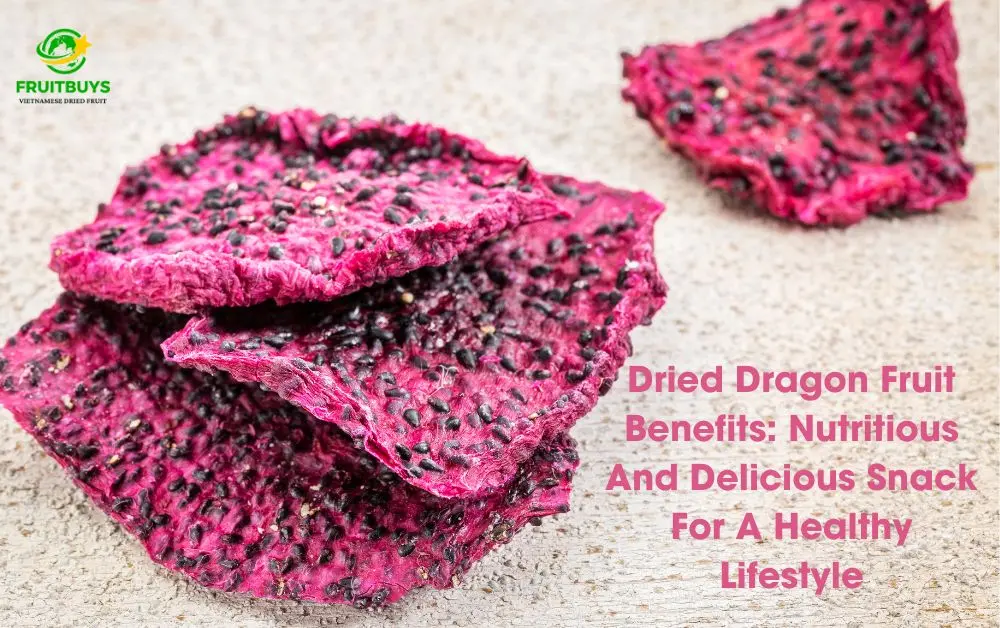
What are the benefits of dried dragon fruit, and does freeze-dried keep more?
Dried red dragon fruit is a concentrated source of fiber and potassium: 16 g of fiber and 1,800 mg of potassium per 100 g, with no added sugar. A 25 g snack portion gives about 4 g of fiber for 100 kcal. Freeze-drying keeps the magenta color, crisp bite and fruit shape that heat-drying tends to darken and toughen.
What do you actually get from a handful of dried dragon fruit?
Drying removes water, not the fruit. Fresh red dragon fruit is mostly water, so taking that water out packs the fiber, minerals and natural sugars of several fruits into a light, crisp piece. You get the color, crunch and nutrients of fresh fruit in a piece that keeps for 12 months at ≤25 °C and RH ≤60% without a fridge. Because it is concentrated, a small handful goes a long way.
For 100% freeze-dried red dragon fruit with nothing added, the typical values look like this:
| Per serving | 25 g snack pack | 100 g |
|---|---|---|
| Energy | 100 kcal | 400 kcal |
| Dietary fiber | 4 g | 16 g |
| Total sugars (all from the fruit) | 11 g | 44 g |
| Protein | 2 g | 8 g |
| Fat | 1.5 g | 6 g |
| Potassium | 450 mg | 1,800 mg |
| Sodium | 0 mg | 0 mg |
Typical values for 100% freeze-dried red dragon fruit; natural variation by origin, season and ripeness applies. Lot nutrition panel available for label artwork.
The full panel, with calcium, iron, magnesium and the 40 g US serving, sits in our freeze-dried dragon fruit nutrition facts.
Is dried dragon fruit good for digestion?
Yes, mainly through fiber. 16 g per 100 g makes dried dragon fruit one of the more fiber-dense fruit snacks: a 25 g portion supplies about 4 g, roughly a seventh of the 28 g daily value used on US labels and a sixth of the 25 g adequate intake EFSA sets for European adults.
What that means in practice: a small bag adds to the fiber most people fall short on. Eat a large bag quickly and you get a large dose of fiber at once, which some stomachs notice. Start with a 25 g portion and drink water with it.
Why does the potassium number matter?
Potassium is the mineral where dried dragon fruit stands out. 1,800 mg per 100 g means a 25 g pack gives 450 mg, close to a tenth of the 4,700 mg US daily value, with zero sodium alongside it. Most snacks run the other way: high sodium, little potassium.
That high-potassium, zero-sodium profile is why dried dragon fruit fits gym bags, hiking packs and post-workout snacks. Potassium contributes to normal muscle function and to the maintenance of normal blood pressure; both statements are on the EU list of authorised health claims, so a product with this profile can carry them when the pack meets the conditions of use. Anyone on a potassium-restricted diet should count it like any other concentrated fruit.
Where does the color come from, and is it good for you?
The magenta comes from betacyanins, the same family of natural pigments that colors beetroot. Dried red dragon fruit typically holds 225–360 mg of betacyanins per 100 g. No dye is needed for that color, which is why the powder is used to tint smoothies, yogurt and frosting a vivid pink.
No authorised health claim exists for betacyanins in the EU or US, so the honest benefit to put on a pack is “colored only by the fruit itself”. The pigment can also tint urine or stool red for a day, which is harmless; the full answer is in side effects of dragon fruit.
Is all dried dragon fruit the same? Freeze-dried vs heat-dried
No. The drying method decides how much of the fruit’s color, texture and simplicity survives.
| Freeze-dried | Hot-air dried | Soft-dried (infused) | |
|---|---|---|---|
| How it is made | Frozen, then the ice turns straight to vapor under vacuum | Warm air for many hours | Soaked in syrup, then dried |
| Color | Bright magenta, close to fresh | Darker, duller red to brown | Deep red, glossy |
| Texture | Light, crisp, melts on the tongue | Leathery, chewy | Soft, sticky |
| Moisture | 3.0–4.0% at release | Higher, so pieces stay chewy | Higher, so pieces stay soft |
| Ingredient list | Dragon fruit | Dragon fruit (sometimes sulfites) | Dragon fruit, sugar, often acid |
| Added sugar | None | None, unless declared | Usually yes |
Betacyanins are sensitive to heat and light, which is why long warm-air drying shifts the color toward brown. Freeze-drying never heats the fruit to that point, so the pigment, the shape and the open, crisp structure stay intact. The trade-off is weight-to-volume: freeze-dried pieces are bulky and must be kept away from moisture, so they ship in sealed foil bags with a desiccant.
If you are reading a label in a shop, two checks answer most of the question: is the ingredient list just “dragon fruit”, and is the color bright pink rather than brick red?
Is freeze-dried dragon fruit healthy as an everyday snack?
For most people, yes, in snack-sized portions. It brings fiber, potassium and fruit color with no added sugar, no fat added and zero sodium. The one number to keep in view is sugar: 11 g per 25 g, all from the fruit, about the same as a medium fresh fruit serving. Pairing it with yogurt or nuts slows how fast you eat it and adds protein.
Children love the color and crunch. For toddlers, crush pieces into yogurt or porridge rather than serving whole crisp pieces.
What can a brand put on the pack?
This is where the benefits become sales copy. A 100% freeze-dried red dragon fruit product, sold as a single ingredient, typically qualifies for:
| Claim | Basis per 100 g | Market |
|---|---|---|
| High fibre | 16 g, above the 6 g threshold | EU, UK |
| High in potassium | 1,800 mg, above the 600 mg threshold (30% NRV) | EU, UK |
| High fiber (40 g serving) | 6.4 g per serving | US |
| Good source of potassium (40 g serving) | 720 mg per serving | US |
| No added sugar | Single ingredient, nothing added | EU, UK, US (with conditions) |
| One ingredient: dragon fruit | Clean label, no colors or flavors | All |
Each claim depends on the final recipe and the lot nutrition panel, so the numbers on your artwork should come from the lot you buy. How FruitBuys supplies that panel, and how it changes when you blend with other fruits, is covered in freeze-dried dragon fruit nutrition facts.
Buying dried dragon fruit for your own product?
If the benefits above are what you want to sell, the sourcing decisions are short:
- Choose red flesh. White-flesh dragon fruit dries to a pale, mild piece with no magenta. See red or white freeze-dried dragon fruit.
- Pick the format for the job. Slices and dice for snack packs and cereal, crumbles for chocolate and toppings, powder for color in drinks and yogurt. See freeze-dried dragon fruit formats.
- Write moisture into the contract. Crisp texture and color hold best at ≤4.0% moisture and aw ≤0.25 at release.
- Ask for a pre-shipment sample and taste it next to whatever you sell today.
FruitBuys sources red-flesh fruit from the Lam Dong coastal belt (former Binh Thuan) and the Mekong Delta (Long An, Tien Giang) and freeze-dries it at qualified partner facilities, with the main season running April to October. Specifications, packing and documents are on the freeze-dried dragon fruit product page, and the full buying checklist is in what to check before buying freeze-dried dragon fruit in bulk.
If your product needs the softer, chewier texture of a soft-dried piece rather than a crisp one, tell us the application: a powder inclusion or a crumble often gives the color without the crunch, and we can send both to compare.
Taste the difference before you decide
Send us your application and target market, and we will ship a pre-shipment sample of freeze-dried red dragon fruit in sealed foil bags within 24–48 hours of approval.
[email protected] · WhatsApp Export +84 919 739 589
FAQ
Is dried dragon fruit good for you?
In snack portions, yes. A 25 g serving gives about 4 g of fiber and 450 mg of potassium for 100 kcal, with no added sugar or sodium. Choose products whose only ingredient is dragon fruit.
Does freeze-dried dragon fruit make you poop?
It supports regularity, because it is high in fiber: about 4 g per 25 g. Most people notice nothing beyond normal digestion at a snack portion. A red tint afterwards comes from the natural pigment and is harmless.
Does freeze-dried dragon fruit have added sugar?
Not when the ingredient list says only “dragon fruit”. Its 44 g of sugars per 100 g come from the fruit itself. Soft-dried or infused dragon fruit usually has sugar added, so check the label.
How much dried dragon fruit should I eat a day?
A 25 g portion, about a small handful, is a sensible everyday amount. It holds the fiber and sugar of roughly 200 g of fresh fruit flesh, so treat it like a fruit serving rather than an unlimited snack.
Is freeze-dried better than fresh dragon fruit?
It is more concentrated, not more nutritious per fruit. Freeze-drying keeps most of the color and texture and makes the fruit shelf-stable for 12 months at ≤25 °C and RH ≤60%, so you can eat it out of season or use it in recipes where fresh fruit would add water.



