Where are Vietnam’s cashews grown, and how do you secure a traceable Vietnam-grown supply for the year?
Vietnam’s cashews grow mainly in the Southeast, around Dong Nai and the former Binh Phuoc province, and in the Central Highlands, in Dak Lak, Gia Lai and Lam Dong. The harvest runs from February to May. Most kernels Vietnam exports start as imported raw nuts, so a supply that is Vietnam-grown and traceable by lot is a deliberate choice. FruitBuys makes its freeze-dried cashews from Vietnam-grown raw nuts as standard and supplies them year-round under one annual contract.
For a buyer, that answers three questions at once: where the nut comes from, what goes on the certificate of origin, and how to keep a production line supplied in September as well as in April. It also starts a product story that is true from the orchard to the pouch: an ivory, light, crisp kernel with the clean, mildly sweet taste of fresh cashew, grown in Vietnam’s red-soil cashew country. This page sets out the regions, the trade reality, the paperwork and the annual plan behind FruitBuys freeze-dried cashew nuts.
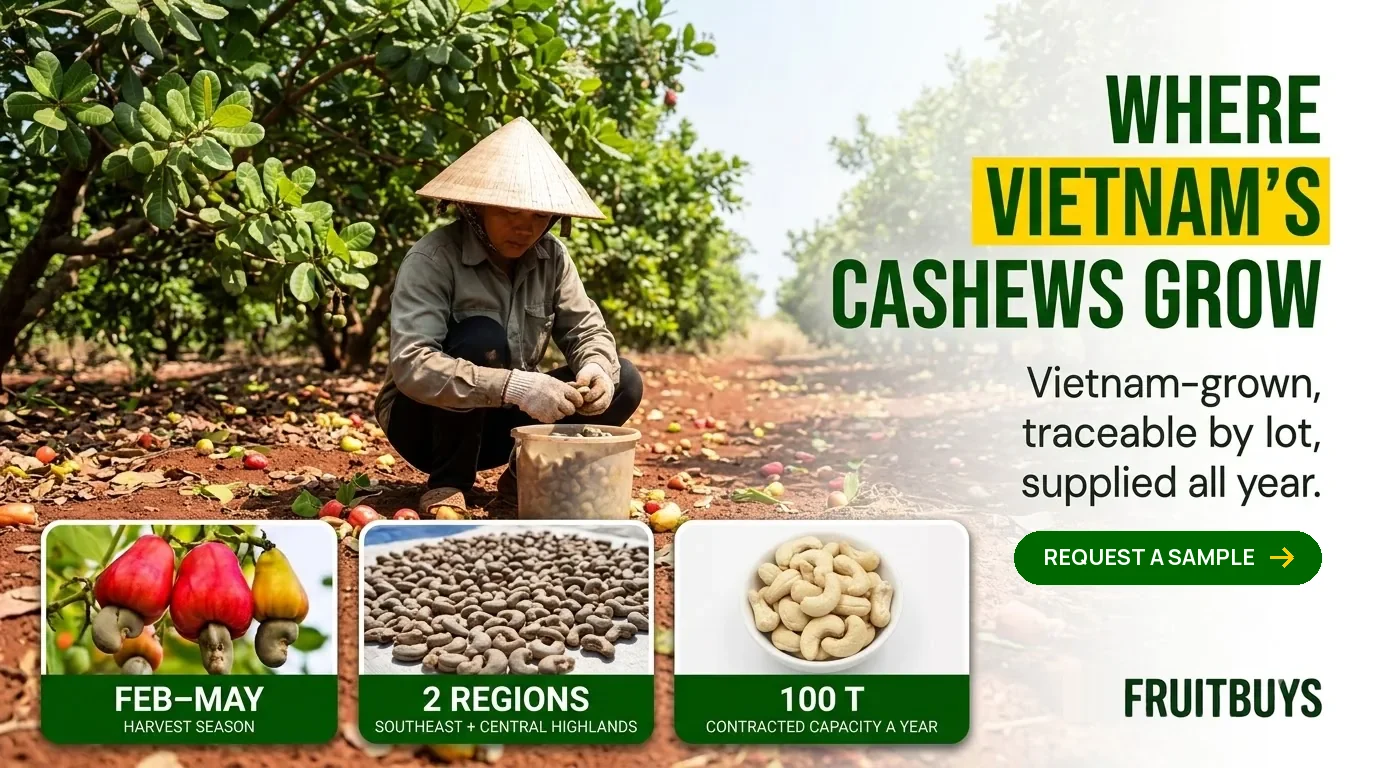
Where are cashews grown in Vietnam?
| Region | Provinces | What buyers should know |
|---|---|---|
| Southeast | Dong Nai, including former Binh Phuoc | The country’s largest cashew-growing area; long-established orchards on red basalt soils |
| Central Highlands | Dak Lak, Gia Lai, Lam Dong (including former Dak Nong) | Upland orchards on basalt plateaus; a second growing base that spreads supply across regions |
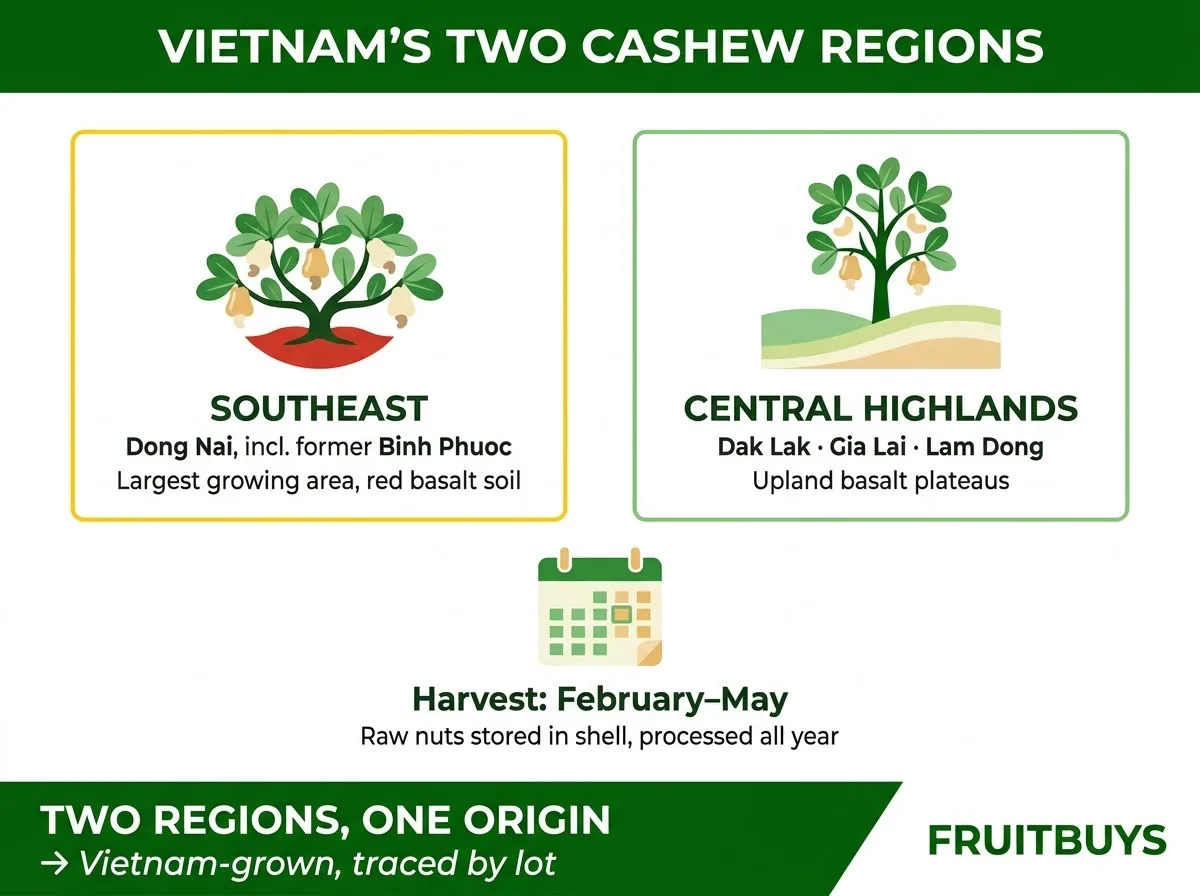
Since Vietnam’s 2025 provincial merger, former Binh Phuoc is part of Dong Nai province and former Dak Nong is part of Lam Dong; the trade still uses the old names, and so do we.
The cashew tree flowers in the dry season, and the nuts fall from February to May, when the dry weather helps them dry on the ground before collection. Binh Phuoc cashew is protected as a geographical indication in Vietnam: only authorised users may put “Binh Phuoc cashew” on a product name or label. That is why we describe where our nuts are grown, and do not use the name as a brand.
Why do most Vietnamese cashew kernels start as imported raw nuts?
Because Vietnam’s processing industry has grown far beyond its own orchards. Vietnam exported about 767,000 t of cashew kernels in 2025, worth about US$5.23 billion (Vietnam Customs, preliminary). To do that, processors imported about 3 million tonnes of raw cashew nuts that year, mainly from Cambodia and West Africa, and domestic raw nuts covered only about 10% of processing demand (VINACAS, via VietNamNet, January 2026). Vietnam’s own crop, roughly 340,000 t of raw nuts in 2024/25, is around 6% of world output (CBI, 2026).
There is nothing wrong with imported raw nuts; they built Vietnam’s position as the world’s leading cashew processor, and Vietnam supplies about two thirds of the cashew kernels the EU imports (CBI, 2024 data). But it means “Vietnamese cashew” on a label usually describes where the nut was processed, not where it grew. For a buyer who needs to state origin, answer a retailer’s due-diligence questionnaire or tell a farm-to-pack story, that difference matters.
What does “Vietnam-grown and traceable” mean on paper?
Our freeze-dried cashew programme starts from Vietnam-grown raw nuts as standard, from the Southeast and the Central Highlands. On paper, that becomes three things:
| Record | What it shows | Who sees it |
|---|---|---|
| Lot traceability file | Each lot traced to its growing region and raw-material intake batch | Your QA team and auditors, on request and during audits |
| Certificate of Origin | Vietnam as the country of origin: Form EUR.1 for the EU and UK, Form CEPA for the UAE | Customs at destination |
| Facility lock and audit access | One qualified partner facility per contract, written notice and pre-shipment sample re-approval before any change, and your right to audit, including social-compliance audits you commission | Your QA and compliance teams |
The certificate of origin shows the country, not the region or the batch; the traceability file carries that detail. Together they give a US importer, an EU retailer or a Gulf distributor a straight answer to “where was this grown and who processed it?”
There is also a customs point. Under the EU–Vietnam agreement, nuts of Chapter 8 must be wholly obtained in Vietnam to count as Vietnamese origin, so kernels shelled in Vietnam from imported raw nuts do not qualify. Plain cashew kernels enter the EU at 0% duty either way, so this is about clean origin documentation rather than duty. Codes, duty and checks by market are in which HS code freeze-dried cashews ship under.
If the harvest is February to May, how do you buy in October?
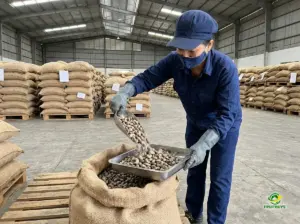
Raw cashew nuts keep well in their shells. After harvest they are dried and stored in shell, then shelled, peeled and graded through the year. That is what lets kernels be freeze-dried year-round, in batches matched to each customer’s call-offs, rather than in one seasonal rush.
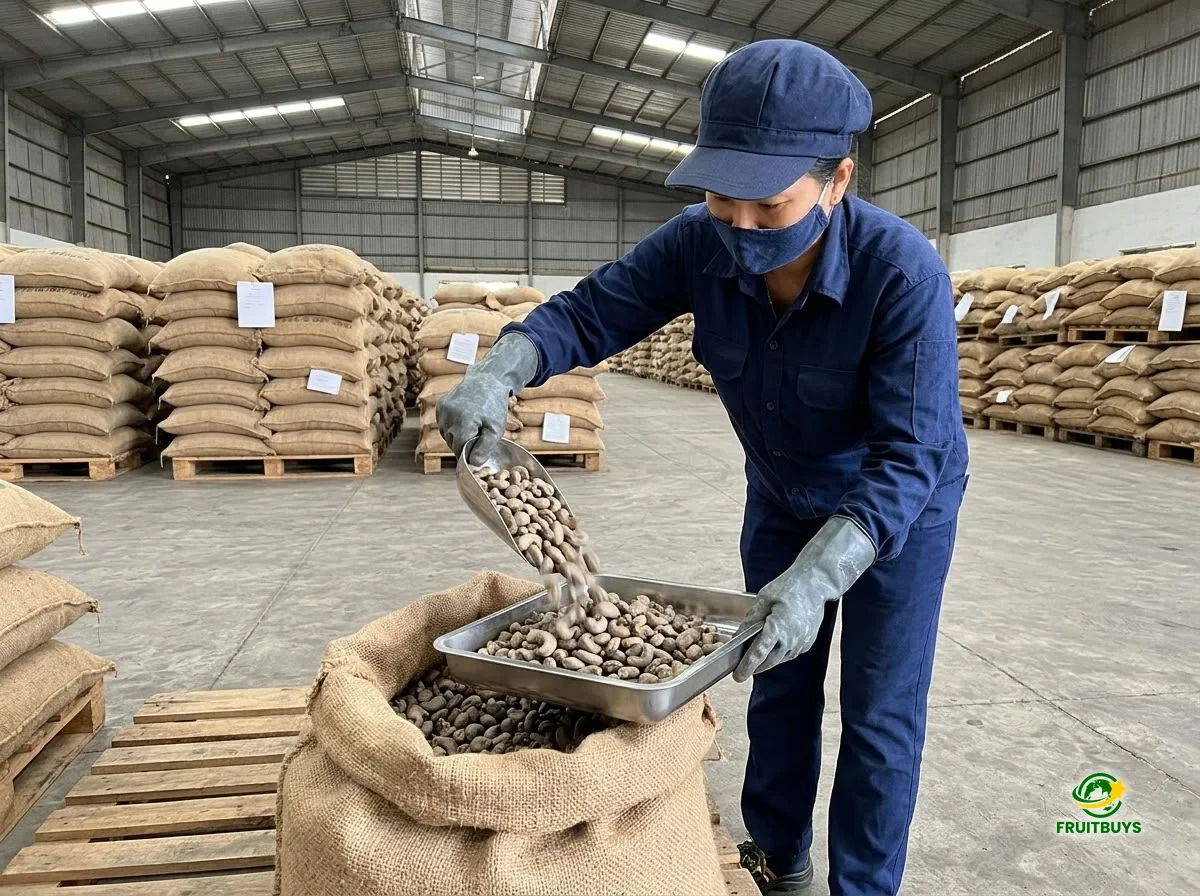
For your planning, the season still matters in one way: it sets when the year’s raw-nut volume is secured. Booking your annual volume early in the year means the raw nuts for your programme are bought from that season’s harvest, and your call-offs draw on them month by month.
How do you book a year of supply?
The conversation that matters most with a new buyer is the call-off calendar, and I would rather have it at the start than in a rush in month nine. A workable annual plan looks like this:
- Agree the annual volume and grades early in the year: whole W240, W320 or W450 equivalents, splits, pieces or dice, and any seasoned SKUs.
- Set the call-off rhythm, monthly or quarterly, matched to your production plan and warehouse space.
- Lock the specification and the facility once: release limits, grade tolerances, packing, documents, and one qualified partner facility for the contract.
- Approve a pre-shipment sample for each lot, drawn from the packed product before loading.
- Ship each call-off in about 20–30 days per 20 ft container from deposit, floor-loaded or palletised, alone or shared with other FruitBuys freeze-dried products.
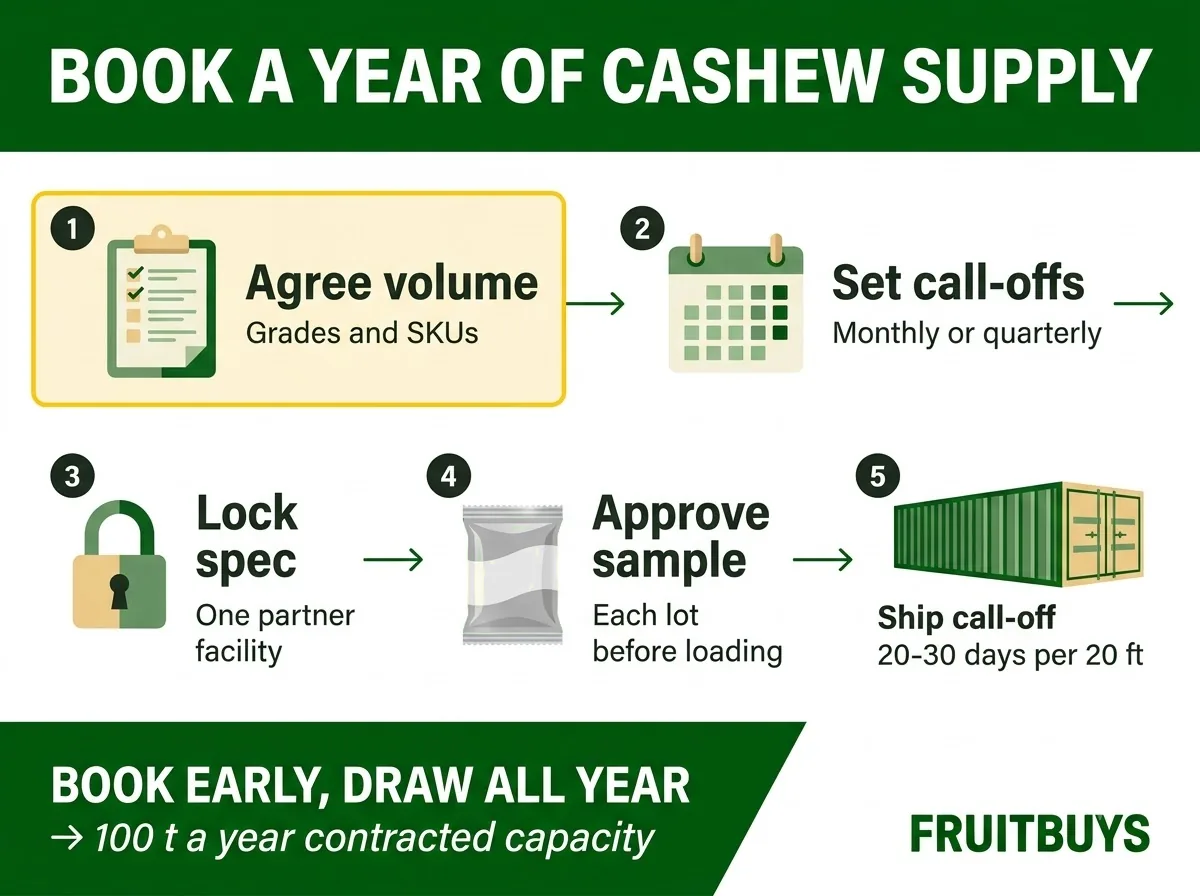
Contracted capacity for freeze-dried cashew is 100 t a year, so the earlier a volume is booked, the more of the year’s plan it can secure. OEM, ODM and private-label programmes start at 500 kg per SKU. The full approval path is in how to take a freeze-dried cashew supplier from sample to first container.
If your plan is to roast or process raw kernels yourself, we are not the right source: we do not sell unprocessed kernels. Where FruitBuys fits is a finished ingredient: freeze-dried kernels in every cut, roasted and coated cashew lines, and fruit-and-cashew blends packed ready for your line.
Are cashews from Vietnam safe to eat?
Yes. Vietnam supplies about two thirds of the cashew kernels the EU imports, and the EU sets aflatoxin limits for ready-to-eat nuts five times tighter than the US action level. Cashew kernels from Vietnam are not on the EU list of products under increased border checks (Regulation (EU) 2019/1793).
For our freeze-dried kernels, every container lot carries a third-party COA from an independent ISO/IEC 17025 accredited laboratory for moisture, water activity, free fatty acids, peroxide value, total plate count, yeasts and moulds, E. coli and Salmonella. EU-bound lots also carry aflatoxin B1 and total aflatoxins, against EU limits of 2.0 µg/kg and 4.0 µg/kg for ready-to-eat tree nuts. Every lot passes a metal detector before packing. The full release specification is in the freeze-dried cashew specification, and the yield from kernel to freeze-dried product is explained in how much cashew kernel goes into 1 kg freeze-dried.
Plan your annual cashew programme
Tell us your annual volume, grades, call-off rhythm and destination, and we return a draft supply plan with samples from current production. Samples are ready in 3–5 working days. Email support@fruitbuys.com or message WhatsApp Export +84 919 739 589.
FAQ
Where are cashews grown in Vietnam?
Mainly in the Southeast, around Dong Nai and the former Binh Phuoc province, and in the Central Highlands, in Dak Lak, Gia Lai and Lam Dong.
When is the cashew harvest in Vietnam?
From February to May. Raw nuts keep in shell, so kernels are shelled, graded and freeze-dried through the year.
Are Vietnamese cashews grown in Vietnam?
Many are not: Vietnam imported about 3 million tonnes of raw nuts in 2025, and domestic nuts covered about 10% of processing demand. FruitBuys makes its freeze-dried cashews from Vietnam-grown raw nuts as standard, traceable by lot.
What does the certificate of origin show?
Vietnam as the country of origin, on Form EUR.1 for the EU and UK or Form CEPA for the UAE. The growing region and intake batch are in the lot traceability file.
Can I buy freeze-dried cashews year-round?
Yes. Book an annual volume, set a monthly or quarterly call-off, and each 20 ft container is produced in about 20–30 days after deposit.
Are cashews from Vietnam safe to eat?
Yes. Vietnam is the EU’s main cashew supplier, and our freeze-dried lots carry a third-party COA, with aflatoxin results on every EU-bound lot.
Can I use “Binh Phuoc cashew” on my label?
Binh Phuoc cashew is a protected geographical indication in Vietnam, so only authorised users may use the name on products. We describe the growing region instead.