Which specs keep freeze-dried cashews crisp, clean and shelf-ready, and what should the lot COA show?
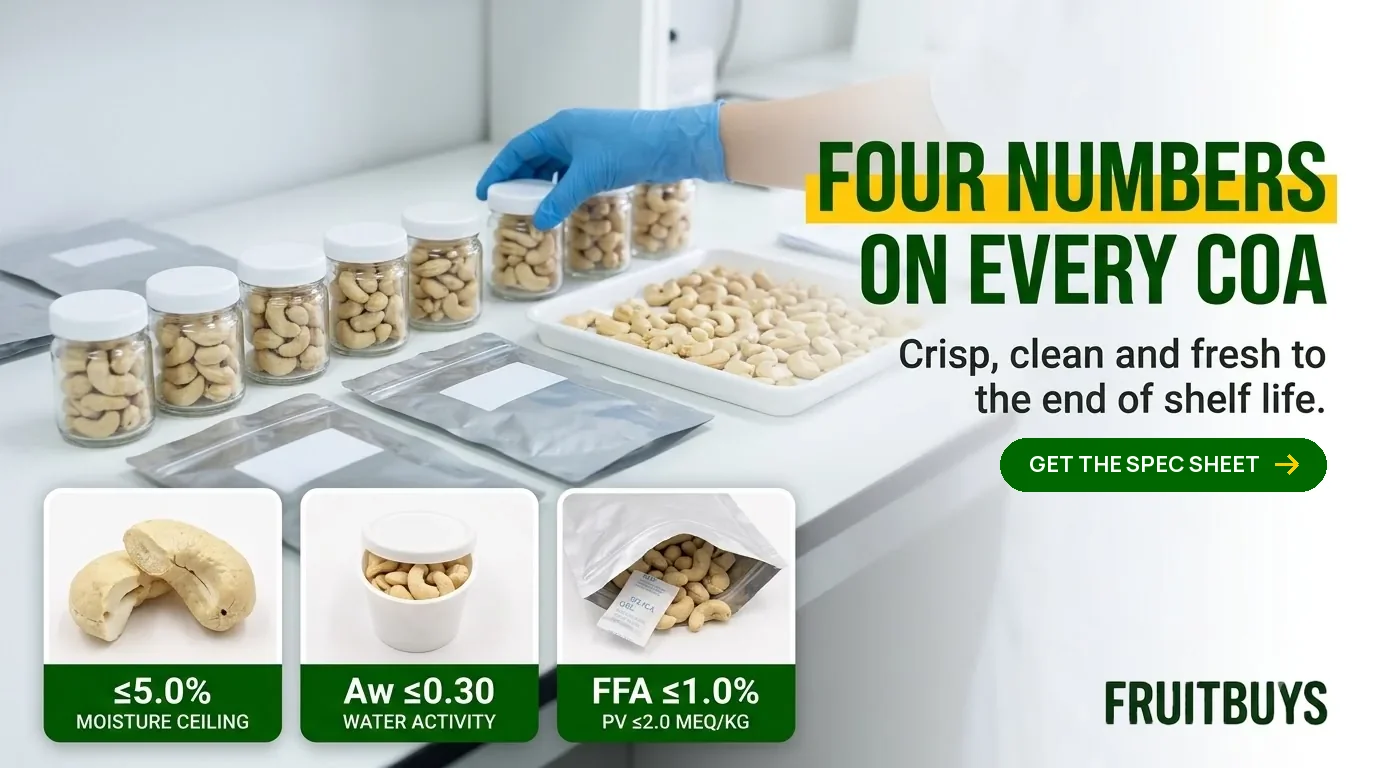
Four numbers carry most of the weight: moisture ≤5.0%, water activity ≤0.30, free fatty acids ≤1.0% and peroxide value ≤2.0 meq/kg. The first two keep the kernel crisp and microbially stable; the last two keep it tasting of fresh cashew to the end of its shelf life. Every container lot of FruitBuys freeze-dried cashew nuts is released against all four on a third-party COA, together with the core microbiology. EU-bound lots add aflatoxin.
Why it matters on the shelf: a freeze-dried cashew sells on its bite. It should break with a soft, clean crack, look ivory white and taste clean and mildly sweet, with no oily or stale note when the consumer opens the pouch months later. The specification below is what protects that experience, and it gives your QA team limits it can write straight into the purchase contract.
What does every lot COA cover?
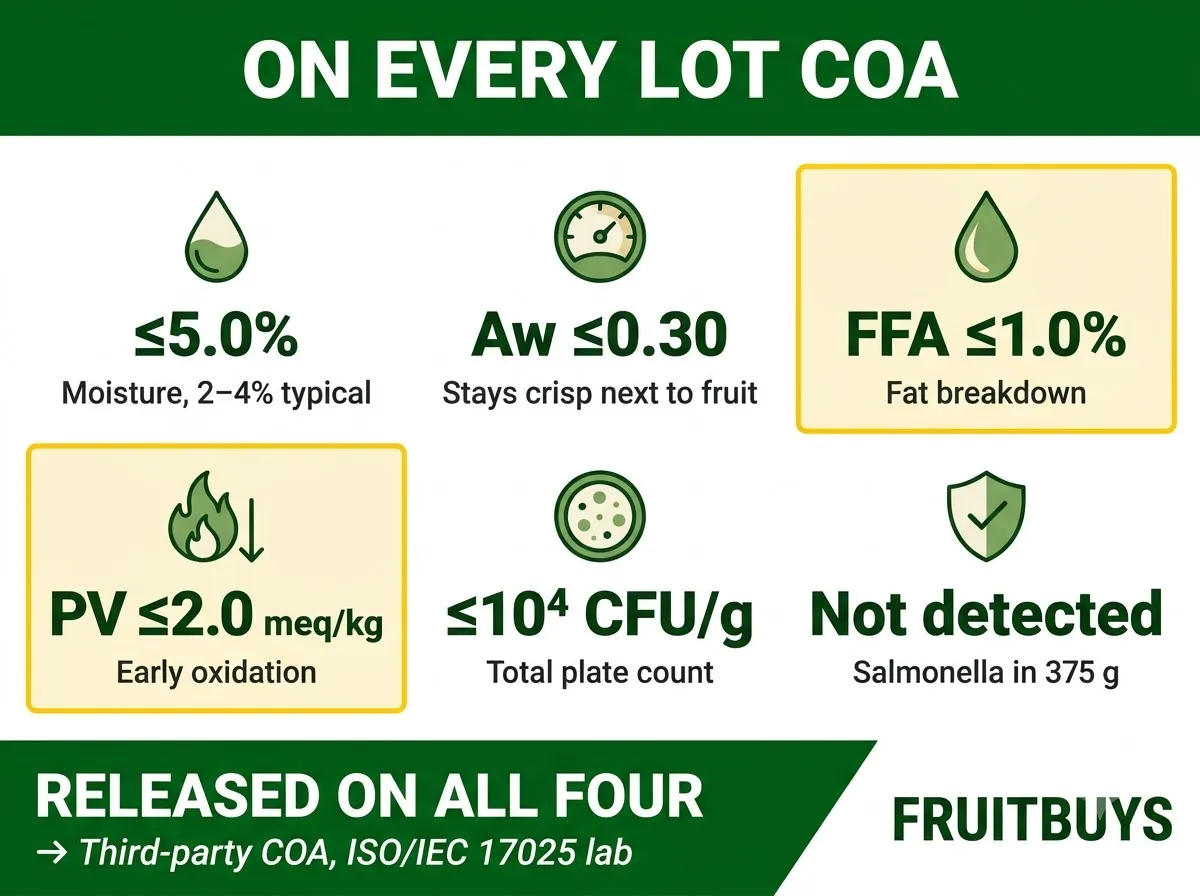
Each container lot is tested before stuffing by an independent ISO/IEC 17025 accredited third-party laboratory. The standard lot COA carries eight results:
| Test | Release limit | What it tells you |
|---|---|---|
| Moisture | 2–4% typical at release; ≤5.0% contract ceiling | How much cashew you pay for per kilogram, and how long the kernel stays crisp |
| Water activity (Aw) | ≤0.30 | Whether the kernel stays crisp next to freeze-dried fruit and stays microbially stable |
| Free fatty acids (FFA) | ≤1.0% as oleic acid | How far fat breakdown has started; rising FFA ends in a soapy, rancid note |
| Peroxide value (PV) | ≤2.0 meq O₂/kg | Early oxidation, long before anyone can smell it |
| Total plate count | ≤10⁴ CFU/g | General hygiene of handling and packing |
| Yeasts and moulds | ≤10² CFU/g | Early warning of moisture exposure |
| E. coli | Not detected | Hygiene of hands, water and contact surfaces |
| Salmonella | Not detected in 375 g | The pathogen retailers and authorities check first in nuts |
EU-bound lots also carry aflatoxin B1 and total aflatoxins on the lot COA. I release a container only when every result on its COA sits inside these limits. Each lot passes a metal detector before packing, and foreign matter is nil.
How do FruitBuys limits compare with AFI and EU/US rules?
The Association of Food Industries (AFI) Specifications for Cashew Kernels (updated September 2023) is the specification most cashew sale contracts cite, in the US and well beyond it. Our release limits match or tighten it:
| Parameter | FruitBuys release | AFI cashew kernel spec | EU / US rule |
|---|---|---|---|
| Moisture | 2–4% typical, ≤5.0% ceiling | 3–5% | |
| Water activity | ≤0.30 | Not set | |
| Free fatty acids | ≤1.0% | ≤1.5% | |
| Peroxide value | ≤2.0 meq/kg | ≤5 meq/kg | |
| E. coli | Not detected | Not detectable | |
| Salmonella | Not detected / 375 g | Negative / 375 g | |
| Listeria monocytogenes | Not detected / 125 g (on request or by market) | Negative / 125 g | |
| S. aureus | <10 CFU/g (on request or by market) | <10 CFU/g | |
| Total plate count / yeasts and moulds | ≤10⁴ / ≤10² CFU/g | Not set | |
| Aflatoxin | On the lot COA for EU lots | Limits of the country of sale | EU ready-to-eat tree nuts: B1 ≤2.0 µg/kg, total ≤4.0 µg/kg. US FDA action level: 20 µg/kg total |
| Lower size grade in whole grades | ≤10% | ≤10% | |
| Broken kernels and pieces in whole grades | ≤10% | ≤10% |
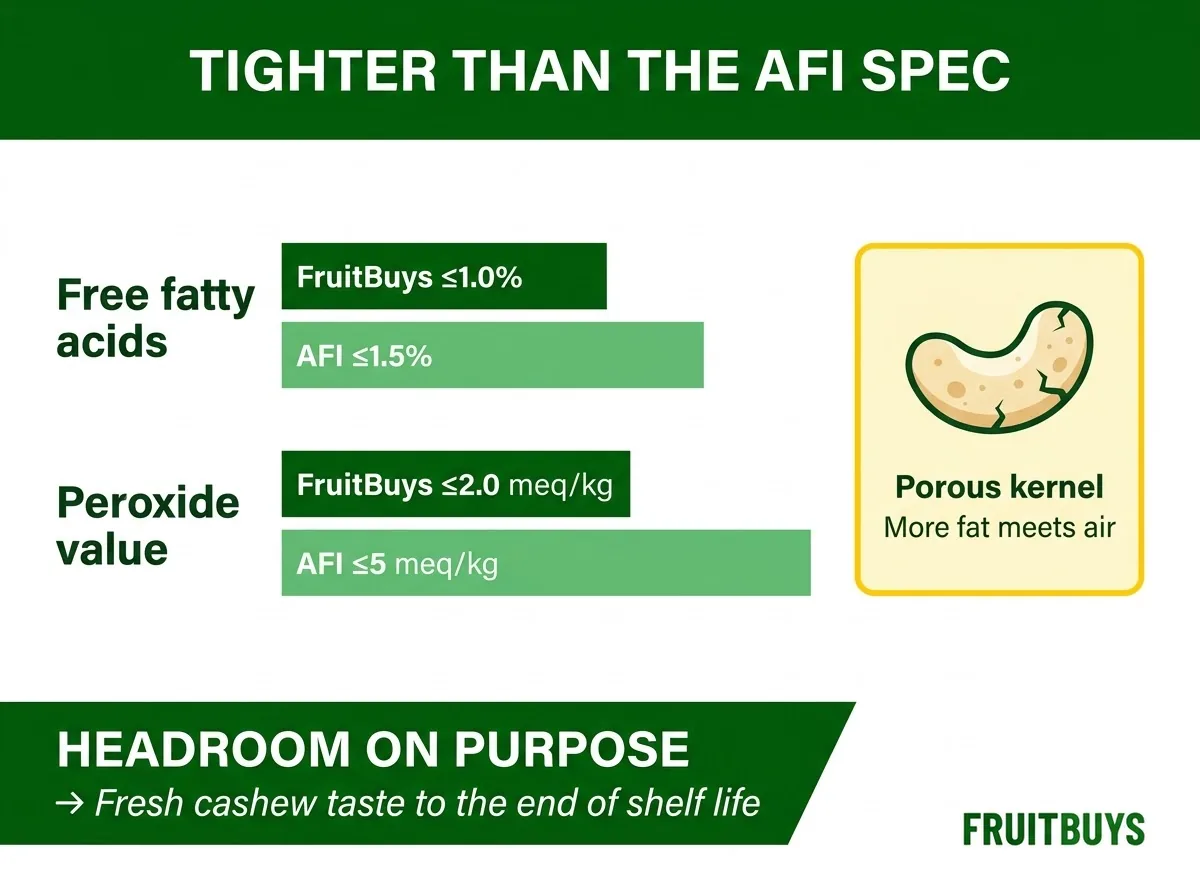
Two lines stand out. We add water activity, because a freeze-dried kernel is often packed beside freeze-dried fruit and Aw decides whether the mix stays crisp. And the oxidation limits are set well inside AFI, for a reason that comes from the process.
Why do moisture and water activity decide the bite?
Moisture tells you how much water is in the kernel by weight, which is how much cashew you are buying. Water activity tells you how much of that water is free to move, which decides whether the kernel keeps its snap and whether microbes stay dormant.
A freeze-dried cashew is made by moisture-conditioning the kernel to about 35–45%, deep-freezing it and then drying it under vacuum, so the ice leaves a fine porous structure behind. At 2–4% moisture and Aw ≤0.30, that structure stays dry and the kernel breaks with a light, clean crack. Let the Aw climb and the porous kernel softens faster than a dense roasted nut, because more surface is open to humid air. The process and its yield are explained in how much cashew kernel goes into 1 kg freeze-dried.
Why does a porous kernel need tighter oxidation limits?
Cashew is 45% fat, mostly oleic acid. Oxygen, heat and light slowly break that fat down: first into peroxides, which PV measures, then into free fatty acids and the flavour compounds that make a nut taste stale. A porous freeze-dried kernel exposes more fat surface to oxygen than a whole roasted kernel of the same size.
We answer that at release: FFA ≤1.0% against AFI’s 1.5%, and PV ≤2.0 meq/kg against AFI’s 5. The lot starts its shelf life with headroom, and with cool storage that headroom carries it to 18–24 months at ≤18 °C and RH ≤50%, or 12 months at ≤25 °C and RH ≤60%. For buyers who want more, nitrogen flushing or an oxygen absorber is available on request. Packing and warehouse practice are covered in how long freeze-dried cashews stay fresh.
What do EU and US buyers need on aflatoxin?
Aflatoxins are produced by moulds that can grow on nuts in warm, humid conditions, and the limits differ by market. In the EU, ready-to-eat tree nuts must stay at or below 2.0 µg/kg aflatoxin B1 and 4.0 µg/kg total aflatoxins. The US FDA action level for total aflatoxins in human food is 20 µg/kg, five times higher.
That is why aflatoxin B1 and total aflatoxins sit on the lot COA for every EU-bound container. For US lots, aflatoxin testing is added on request. Low water activity after drying keeps moulds from growing during storage and transit, so the risk sits with the raw nut and the drying step, and the lot COA confirms the result. Border checks, documents and codes by market are in which HS code freeze-dried cashews ship under.
What else can you add for your market?
Some retailers and markets ask for more than the standard lot COA. These tests are ordered for your shipment:
| Test | Typical reason | Who arranges |
|---|---|---|
| Listeria monocytogenes, S. aureus | Ready-to-eat lines, retailer audits | FruitBuys, at a lab of your choice |
| Lead and cadmium | Retailer specification, baby and toddler lines | FruitBuys, at a lab of your choice |
| Pesticide multi-residue screen to EU or US limits | EU retail, private-label programmes | FruitBuys, at a lab of your choice |
| Aflatoxin on US lots | Retailer specification | FruitBuys, at a lab of your choice |
| Nutrition panel, FDA or EU format | Label artwork | FruitBuys, at a lab of your choice |
We arrange independent testing at an accredited laboratory of your choice, such as Eurofins or SGS in Vietnam; each test is available for each lot on request, before the container is sealed. Book them when you confirm the order and results arrive before loading.
What should you check when the container arrives?
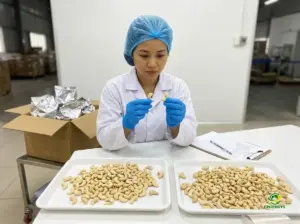
Open cartons from the door, the middle and the back of the container, and spread a sample from each on a white tray. These are the defects worth looking for, what usually causes them and what to do:
| What you see | Likely cause | What to do |
|---|---|---|
| Soft or chewy kernels | Moisture pick-up after drying, weak bag seal | Read Aw on site; compare with the COA and the retained sample |
| Dense, glassy core when snapped | Kernel dried without moisture conditioning | Weigh a levelled 1-litre cup: whole freeze-dried kernels typically weigh 250–400 g; well above 430 g calls for a check of the batch record |
| Stale, soapy or oily smell | Oxidation from heat or oxygen exposure | Ask the lab for FFA and PV on the affected cartons |
| Scorched tips or brown patches | Heat damage before drying | Photograph against the approved sample under the same light |
| Testa (skin) residue | Gap in peeling or sorting | Count against the limit in your pre-shipment sample agreement |
| Broken kernels above the grade | Carton compression or rough handling | Weigh broken pieces; whole grades allow ≤10% by weight |
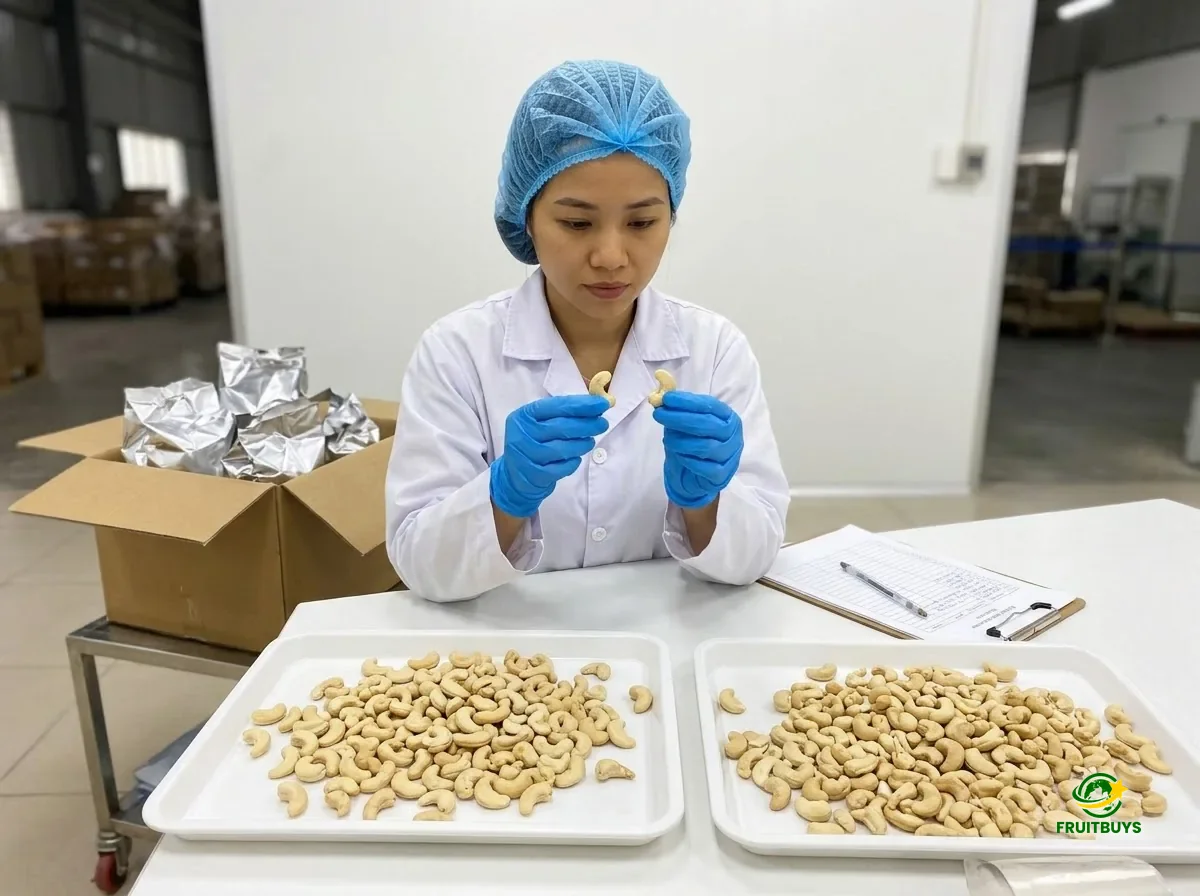
Whole kernels are packed at 10–15 kg per carton so they arrive whole and evenly curved; pieces and dice go up to 20 kg. Why carton weight follows the format is explained in how many kilograms fit in a 20 ft container.
How are claims and disagreements settled?
You have fixed windows and a physical reference:
- 14 days from unloading to raise a claim on packaging, appearance, breakage or water activity.
- 30 days to raise a claim based on laboratory results.
- A retained sample from every container lot, kept for the shelf life of the product, up to 24 months, so both sides test the same reference.
Write the limits in this article, the claim windows and the retained-sample rule into your purchase contract. A dispute then becomes a comparison of numbers. The full approval path, from sample to first container, is in how to approve a freeze-dried cashew supplier.
Testing a trial lot first
On a trial or LCL order, we send our in-house QC log for moisture, water activity and sensory with the lot, and a third-party COA on the trial lot is available on request in 3–5 working days. Before that, the pre-shipment sample arrives as 100–200 g in two sealed foil pouches drawn from the packed lot: one for your sensory check, one kept sealed for your own laboratory.
Partner facilities hold HACCP, ISO 22000, US FDA Facility Registration and BRC (qualified processing facility); we lock one qualified partner facility to each contract, and you keep audit access.
Need the full specification sheet?
Ask for the specification with release limits, COA scope and the optional test menu for your destination market. Email support@fruitbuys.com or message WhatsApp Export +84 919 739 589.
FAQ
What moisture should freeze-dried cashews have?
We release lots at 2–4% moisture against a contract ceiling of ≤5.0%. Higher moisture means less cashew per kilogram and a shorter crisp life.
What is the water activity limit?
Aw ≤0.30 on every container lot COA. At that level the kernel stays crisp, sits beside freeze-dried fruit without softening, and microbes cannot grow.
What FFA and peroxide value are acceptable for cashew kernels?
The AFI specification allows FFA up to 1.5% and peroxide value up to 5 meq/kg. We release freeze-dried kernels at FFA ≤1.0% and PV ≤2.0 meq/kg, to give the porous kernel headroom over its shelf life.
What is the EU aflatoxin limit for cashews?
For ready-to-eat tree nuts, 2.0 µg/kg aflatoxin B1 and 4.0 µg/kg total aflatoxins. We put both on the lot COA for every EU-bound container.
Are heavy metals and pesticide residues on every COA?
No. They are tested on request or for the destination market, at an accredited laboratory of your choice, before the container is sealed.
Does low water activity mean the product is sterile?
No. Low Aw stops microbes from growing but does not remove those already present. That is why the COA also carries plate count, yeasts and moulds, E. coli and Salmonella.