
Is mangosteen banned in the US, and why is it so hard to find and so expensive?
No, mangosteen is not banned in the US today, but for years it effectively was, and fresh fruit still comes in only from a few approved origins under strict plant-health conditions. Until 2007, US plant-health rules kept fresh mangosteen from the main Southeast Asian producers out of the country because of quarantine pests. Since then, fresh fruit has entered from Thailand, irradiated and inspected, plus small volumes from Puerto Rico and Hawaii. Freeze-dried mangosteen is different: it is a processed food, it needs no quarantine irradiation, and it ships legally by sea from origins such as Vietnam, whose fresh mangosteen is not cleared for the US.
Was mangosteen ever illegal in the US?
In practice, yes. Fresh fruit can carry fruit flies and other pests that would threaten American orchards, so USDA’s plant-health service allows a fresh fruit in only from origins it has assessed and under the treatments it sets. For decades, fresh mangosteen from the countries that grow most of it had no approved route, which is where the “banned” reputation comes from.
That changed in 2007. A USDA rule effective 23 July 2007 allowed fresh mangosteen, along with lychee, longan, mango, pineapple and rambutan, from Thailand, on condition that the fruit is irradiated at 400 gray and inspected (Federal Register, 21 June 2007). Small shipments from Puerto Rico began the same year, and from 2008 Hawaiian mangosteen could be shipped to the mainland after irradiation at 150 gray. Irradiation at these doses is a quarantine treatment against insects; the fruit is then sold like any other.
Can you buy fresh mangosteen in the US today?
Yes, in season and at a price. Fresh mangosteen appears mainly in Asian grocery stores and specialty retailers in early to mid-summer, flown in from approved origins. Every step adds cost: air freight, treatment, inspection and a fruit that lasts only about a week after picking.
Fresh Vietnamese mangosteen is not on that list. As of 2025 reports, the fresh fruits cleared for import from Vietnam into the US were dragon fruit, rambutan, longan, lychee, star apple, mango, pomelo and coconut. Mangosteen from Lai Thieu and the Mekong Delta, a celebrated Vietnamese specialty, reaches American shoppers as freeze-dried fruit.
Why is mangosteen so expensive?
Because of what it takes to get the fruit out of the rind and across an ocean.
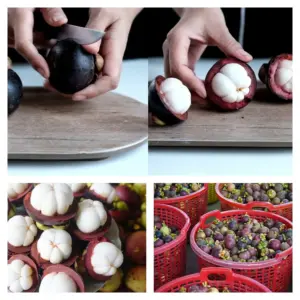
- Most of the fruit is rind. It takes about 17–24 kg of whole mangosteen to make 1 kg of freeze-dried fruit. The edible white aril is only about a quarter of the fruit’s weight.
- Every aril is peeled by hand. The thick purple rind is opened by trained peelers, often under water so its yellow latex does not stain the flesh.
- The clock is short. Fresh mangosteen holds for only 7–10 days at 13 °C after harvest, so peeling, freezing and drying all happen within days.
- The season is short. Vietnam’s main crop runs from May to August, with the best fruit from May to mid-July.
- Fresh imports pay for speed. Air freight, quarantine treatment and inspection all land on the price of fresh fruit in the US.
That is also why freeze-drying suits this fruit. Once the water is gone, a kilo of freeze-dried mangosteen carries the fruit of 17–24 kilos of whole mangosteen in a bag that keeps 12 months at ≤25 °C and travels without a cold chain.
Is freeze-dried mangosteen legal to import into the US?
Yes. Freeze-dried mangosteen is a processed food regulated by FDA, not a fresh fruit subject to USDA’s fresh-fruit entry conditions. It needs no quarantine irradiation and no fresh-fruit permit. An importer files FDA Prior Notice before arrival, runs a Foreign Supplier Verification Program, and the facility that makes it holds US FDA Facility Registration. Whole arils and diced ship under HS 0804.50, powder under 1106.30; the full document set and duty are in which HS code freeze-dried mangosteen ships under.
| Fresh mangosteen | Freeze-dried mangosteen | |
|---|---|---|
| US entry route | Approved origins only, under USDA plant-health conditions | Processed food under FDA rules |
| Quarantine treatment | Irradiation and inspection (Thailand) | None needed |
| Transport | Air freight, chilled | Sea freight, standard dry container |
| Shelf life | About a week | 12 months sealed at ≤25 °C, RH ≤60% |
| Available | A few weeks in summer | All year |
| Vietnamese origin | Not cleared as fresh fruit | Ships today |
What should you look for in freeze-dried mangosteen?
Five things on the bag and in the hand:
- One ingredient. “100% mangosteen”, with no sugar or syrup on the label and 0 g added sugars on the panel.
- Whole arils. Complete, flower-shaped clusters of white segments, not a bag of crumbs.
- Ivory to light cream colour. A natural pink blush at the crown is normal ripe fruit; brown or grey is not.
- A crisp bite. It should snap and then melt; a chewy or sticky texture means moisture got in.
- The seed. Larger segments carry a natural seed that is crisp after drying and eaten with the fruit; good packs say “Contains natural seeds”.
When is fresh the better choice?
When you want to eat the fruit fresh and can buy it in season, fresh mangosteen from an approved origin is a treat worth the price. Freeze-dried does a different job: the same flavour all year, at a fraction of the weight, for snacking, baking, chocolate and drinks, and for any brand that wants mangosteen on a shelf for twelve months rather than a few weeks. For the nutrition side, see is freeze-dried mangosteen healthy.
Bring Vietnamese mangosteen to your shelf
FruitBuys supplies freeze-dried mangosteen from Lai Thieu and the Mekong Delta in bulk and in private-label pouches, with the export dossier for the US already in the file. The specification, formats and terms are on the freeze-dried mangosteen product page.
FAQ
Is mangosteen illegal in the US?
No. Fresh mangosteen has been allowed from Thailand since 2007, irradiated and inspected, and from Puerto Rico and Hawaii. Before 2007, fresh fruit from the main producing countries had no approved route, which is why it was called banned.
Why was mangosteen banned in the US?
Because fresh fruit can carry fruit flies and other quarantine pests. USDA allows a fresh fruit only from assessed origins under set treatments, and until 2007 mangosteen from Southeast Asia had none.
Can I get Vietnamese mangosteen in the US?
Not as fresh fruit: it is not among the fresh fruits cleared from Vietnam. As freeze-dried mangosteen, yes, all year.
Does freeze-dried mangosteen need irradiation to enter the US?
No. Quarantine irradiation is a condition for fresh mangosteen. Freeze-dried mangosteen is a processed food and enters under FDA rules with Prior Notice.
Why is mangosteen so expensive?
Most of the fruit is rind, every aril is peeled by hand within about a week of picking, and it takes about 17–24 kg of whole fruit to make 1 kg of freeze-dried mangosteen.
When is mangosteen in season?
In Vietnam the main crop runs from May to August. Freeze-dried mangosteen is available all year.



