
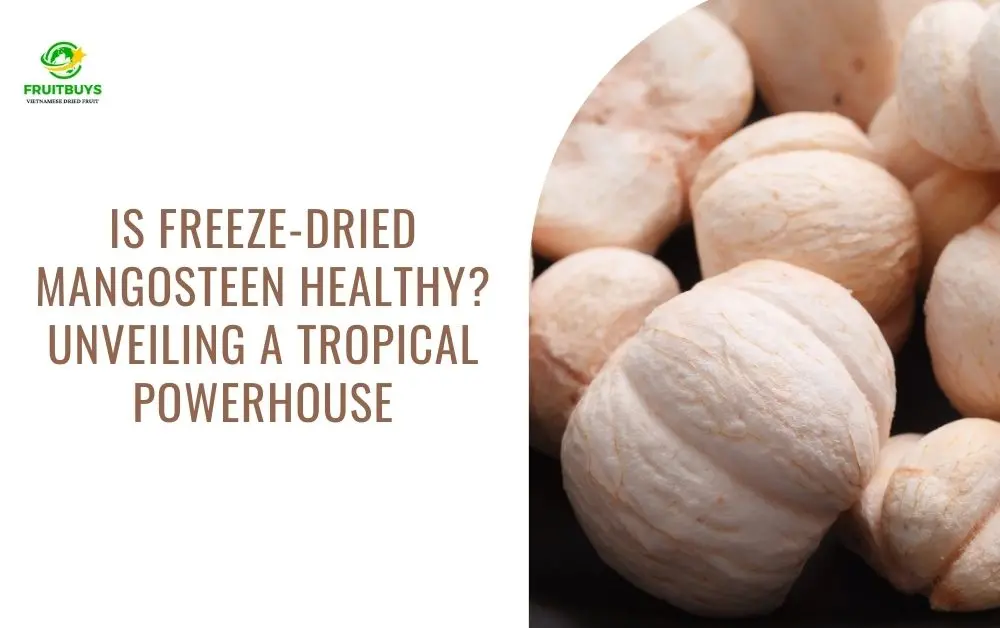
Is freeze-dried mangosteen healthy, and what do you actually get in each bite?
Freeze-dried mangosteen is 100% fruit: no added sugar, no oil, no preservatives, with 13.3 g of fibre per 100 g and the full sweet-tart flavour of the fresh fruit. It is also concentrated. Taking the water out leaves about 70 g of natural sugar in every 100 g, so it eats like a fruit snack, not a diet food. A handful of about 40 g gives 160 kcal, 5.3 g of fibre and the taste of a fruit many people have never had fresh.
Freeze-dried mangosteen is the white aril of Garcinia mangostana, hand-peeled from the purple rind and freeze-dried until it is crisp, sold as whole arils, diced pieces or powder. It is not mango, and it is not the mangosteen rind powder sold as a supplement. Buying it for a food brand or a retail range? The bulk specification, formats and terms are on the freeze-dried mangosteen product page.
Why is mangosteen called the “Queen of Fruits”?
Because of how it tastes and how hard it is to get. Across Southeast Asia, mangosteen has long been called the queen of fruits, paired with durian as the king. Inside a thick, deep-purple rind sits a cluster of snow-white segments, shaped like a small flower, that taste sweet first, then bright and tart, with a floral finish often compared to lychee and peach. The fruit lasts only about a week after picking and has to be opened by hand, which is why it stays rare outside the countries that grow it.
In Vietnam the best-known mangosteen comes from Lai Thieu in the Southeast, where some orchards are more than a century old, and from Cho Lach (Ben Tre) and the river-island orchards of the Mekong Delta. The main harvest runs from May to August.
What do 100 g and a 40 g handful contain?
| Nutrient | Per 100 g | Per 40 g handful |
|---|---|---|
| Calories | 400 kcal | 160 kcal |
| Total fat | 1.7 g | 0.7 g |
| Saturated fat | 0 g | 0 g |
| Sodium | 0 mg | 0 mg |
| Total carbohydrate | 90 g | 36 g |
| Dietary fibre | 13.3 g | 5.3 g |
| Total sugars | 70 g (0 g added) | 28 g |
| Protein | 3.3 g | 1.3 g |
Typical values for 100% freeze-dried mangosteen; natural variation by origin, season and ripeness applies. Lot nutrition panel available for label artwork.
Read it the way you would read any dried fruit. The fibre is real and the fat and sodium are close to zero; the sugar is the fruit’s own, concentrated by drying. In the EU these numbers support a “high fibre” claim, and in the US a “good source of fiber” claim at a 40 g serving. The full label view, including the EU energy figure, is in freeze-dried mangosteen nutrition per 100 g.
Freeze-Dried vs. Fresh Mangosteen: What Changes and What Stays
What changes is the water; what stays is the fruit. Fresh mangosteen aril is about 80% water. Freeze-drying freezes the aril and then removes that ice under vacuum at low temperature, so the water leaves without the fruit being cooked. What remains is the sugar, fibre, acids and aroma of about five to six times its weight in fresh aril.
| Fresh mangosteen | Freeze-dried mangosteen | |
|---|---|---|
| Texture | Soft, juicy, melting | Crisp and airy, then melts on the tongue |
| Flavour | Sweet-tart, floral | The same flavour, more concentrated |
| Water | About 80% | 5% or less |
| Shelf life | About a week after picking | 12 months sealed at ≤25 °C, RH ≤60%; 18–24 months in cool storage |
| Availability | One short season, mostly in Asia | All year, anywhere |
| Preparation | Cut and open the rind | Ready to eat from the bag |
Because the fruit is never heated the way hot-air drying heats it, freeze-drying keeps more of its colour, aroma and heat-sensitive nutrients than conventional drying does. The trade-off is density: 100 g of freeze-dried mangosteen is a lot more fruit than 100 g of fresh, so a sensible portion is a handful, not a bag.
Is the sugar natural?
Yes. Plain freeze-dried mangosteen has one ingredient, “100% mangosteen”, and no added sugar. Fresh aril is a sweet fruit, and once the water is gone that sweetness sits in a smaller weight. Check the label of any freeze-dried mangosteen you buy: if the ingredient list shows sugar or syrup, or the nutrition panel shows added sugars, it is a sweetened product, not plain freeze-dried fruit.
What about xanthones and antioxidants?
Mangosteen is known for xanthones, a family of plant compounds studied for their antioxidant activity. Most of them sit in the purple rind, which is why rind extracts are sold as supplements. The white flesh, the part you eat and the part that is freeze-dried, carries only small amounts. Enjoy freeze-dried mangosteen as a fruit, for its taste and its fibre, rather than as a supplement.
Can you eat the seeds in freeze-dried mangosteen?
Yes. The larger segments carry a natural seed, and after freeze-drying it turns crisp with a nutty crunch, eaten together with the fruit. Keeping the seed in is also what keeps each cluster of segments whole. Retail packs carry the line “Contains natural seeds” so nobody is surprised.
How do people eat freeze-dried mangosteen?
Straight from the bag, mostly. The whole flower-shaped clusters are the snack: crisp on the first bite, then melting into fresh mangosteen flavour. Beyond that:
- Breakfast: on yogurt, smoothie bowls, oatmeal and granola, added just before eating so it stays crisp.
- Chocolate: half-dipped in white or dark chocolate, or diced into bars.
- Drinks: crushed or as powder in smoothies, milk tea and cocktails.
- Baking and desserts: diced into muffins and scones, or as powder in cream fillings and ice cream.
More ideas are in freeze-dried mangosteen recipes and mangosteen powder recipes.
Why does freeze-dried mangosteen cost more than other dried fruit?
Because of the work inside each kilo. It takes about 17–24 kg of whole mangosteen to make 1 kg of freeze-dried fruit: most of the weight is rind, every aril is lifted out by hand, and the fruit has to be peeled within about a week of picking. In the US there is a further reason it is rare: fresh mangosteen can only come from a few approved origins, so freeze-dried is how most people there get to taste it. The full story is in is mangosteen banned in the US.
Who should choose something else?
Anyone counting sugar closely. Freeze-dried mangosteen is a fruit snack with natural sugar, not a low-sugar or keto food. If that is your goal, a few pieces on plain yogurt give the flavour without much of the sugar, and a bigger bowl of fresh fruit gives more volume for the same calories.
Sourcing freeze-dried mangosteen for your brand
FruitBuys supplies freeze-dried mangosteen in bulk and in private-label pouches, from Lai Thieu and Mekong Delta fruit, with a nutrition panel on your commercial lot for your label. Tell us your market and format, and we send the specification and a sample.
FAQ
Is freeze-dried mangosteen good for you?
It is 100% fruit with 13.3 g of fibre per 100 g, almost no fat or sodium and no added sugar. Like all dried fruit it is concentrated, so a 40 g handful (160 kcal) is a sensible portion.
How does freeze-dried mangosteen compare to fresh mangosteen in nutrients?
It is the same fruit with the water removed, so 100 g of freeze-dried carries the nutrients of about five to six times that weight of fresh aril. Freeze-drying keeps colour, aroma and heat-sensitive nutrients better than hot-air drying.
How much sugar is in freeze-dried mangosteen?
About 70 g per 100 g, all from the fruit itself. Plain freeze-dried mangosteen has no added sugar.
Is freeze-dried mangosteen high in vitamin C?
No. Mangosteen is not a high-vitamin C fruit; its strengths are flavour, fibre and a single-ingredient label.
Does freeze-dried mangosteen contain xanthones?
Only small amounts. Most of mangosteen’s xanthones are in the purple rind, not in the white flesh that is freeze-dried.
Can you eat the seeds?
Yes. After freeze-drying the seed is crisp with a nutty crunch and is eaten with the fruit.
Is freeze-dried mangosteen safe to eat?
Yes, it is plain fruit, ready to eat from the bag. As with the fresh fruit, anyone with a known mangosteen allergy should avoid it.
How long does freeze-dried mangosteen last?
12 months in the sealed bag at ≤25 °C and RH ≤60%, and 18–24 months in cool storage at ≤18 °C and RH ≤50%. Once opened, reseal the bag and keep it dry; the pieces stay crisp as long as humid air stays out.



