Freeze-Dried Passion Fruit for Bulk and Private-Label Buyers
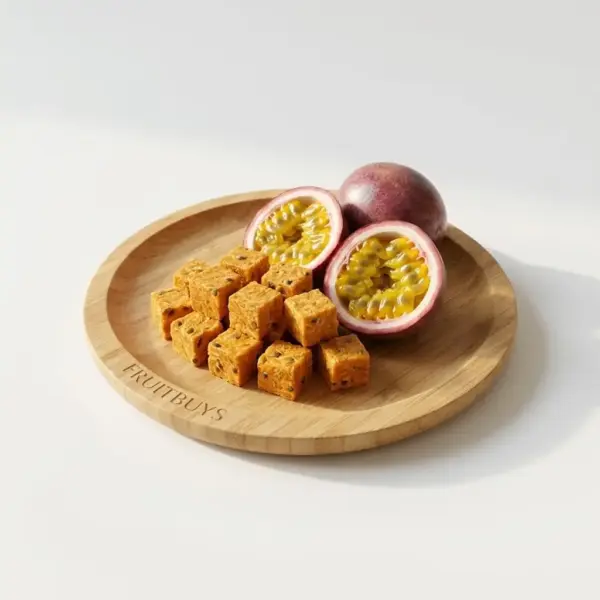
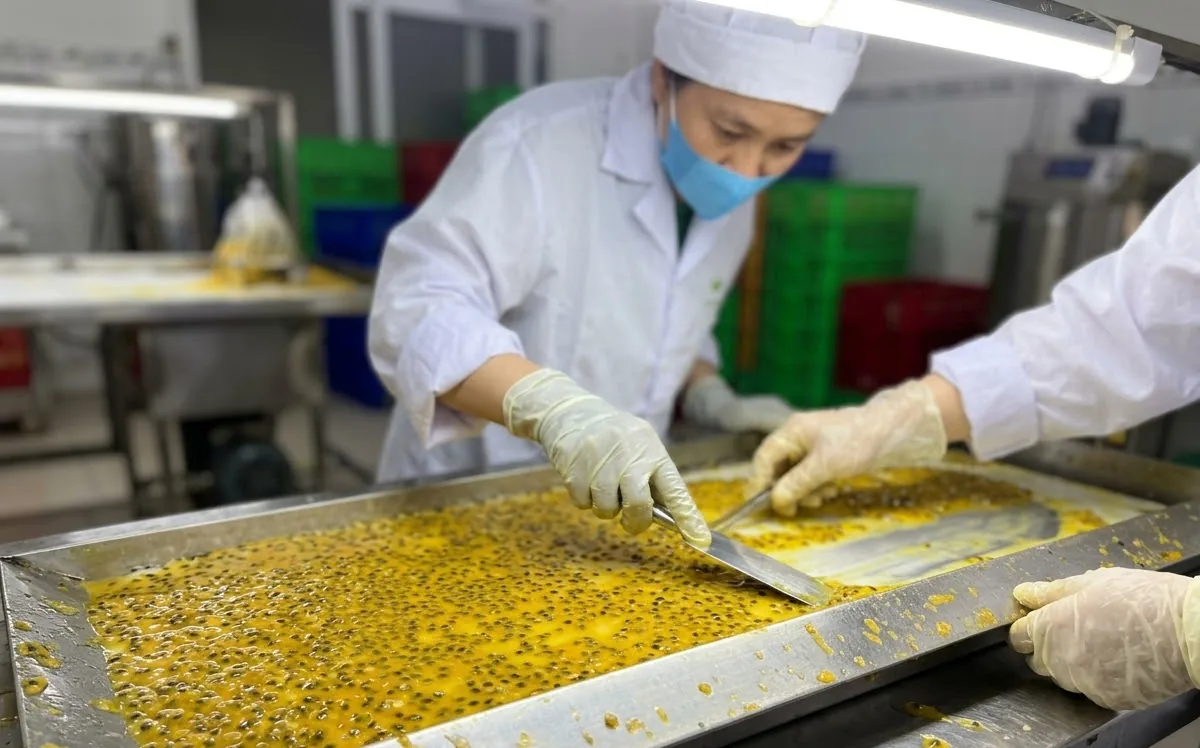
Freeze-dried passion fruit is the seed-in pulp of Passiflora edulis, frozen as a slab, dried under vacuum to ≤5.0% moisture and water activity ≤0.30, then diced into crisp golden cubes. Nothing is added: no sugar, no carrier, no acidulant.
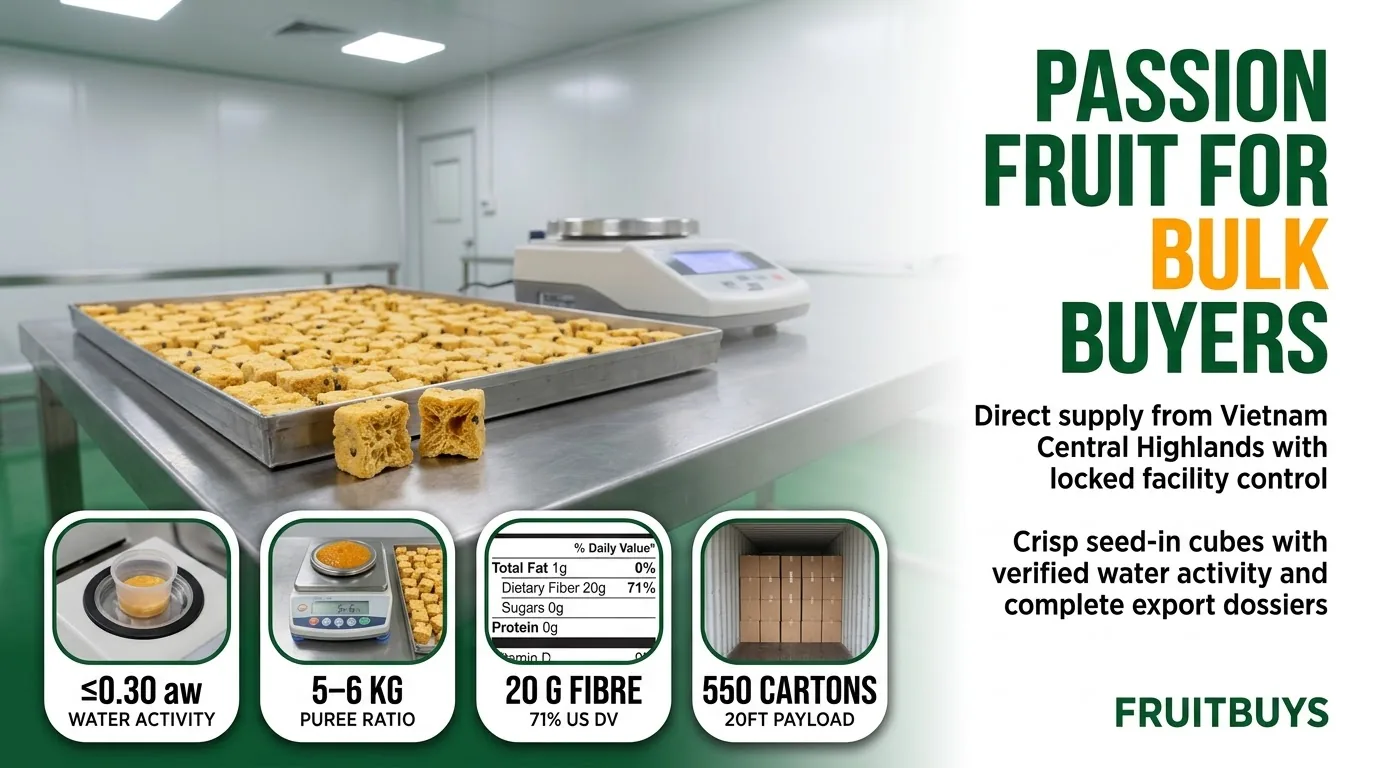
The black seeds stay in, and they carry most of the product’s 20 g of fibre per 100 g. FruitBuys sources fruit from Vietnam’s Central Highlands, runs each contract in one locked partner facility, and ships every container lot with a third-party COA.
Passion fruit is the sharpest flavour in the freeze-dried range. A few cubes lift a bowl of cereal or a chocolate bar in a way milder fruits cannot. The same acidity and fibre make it pull moisture fast, so the bag, the carton and your formula all need to be right. The figures below are the operating targets our partner facilities run to.
Product specification
| Parameter | Specification |
|---|---|
| Ingredient | 100% passion fruit pulp with seeds (Passiflora edulis); no added sugar, preservatives or carrier |
| Raw fruit | Purple-yellow hybrid and purple types, Central Highlands (Gia Lai, Dak Lak, Dak Nong, Lam Dong) |
| Raw pulp | 13–17 °Brix, pH 2.8–3.2, moving with the dry and rainy season |
| Format | Diced cubes 10×10, 15×15 or 20×20 mm, seeds visible |
| Fines (bottom of bag) | ≤3% on 20 mm cubes, ≤5% on 10 mm cubes |
| Seedless version | Made to order at a higher price; about 6.5–8.5 kg puree per kg (vs 5–6 kg seed-in) |
| Moisture | ≤5.0% (release limit) |
| Water activity | ≤0.30 (release limit) |
| Colour / taste | Golden yellow to orange; intensely tart-sweet, characteristic aroma |
| Texture | Crisp, porous, melts quickly; seeds stay crunchy |
| Total plate count | ≤10⁴ CFU/g |
| Yeasts & moulds | ≤10² CFU/g |
| E. coli | <10 CFU/g |
| Salmonella | Not detected / 25 g |
| Foreign matter | Visual sorting plus metal detection |
| Shelf life | 12 months at ≤25 °C, RH ≤60%; 18–24 months in cool storage at ≤18 °C, RH ≤50% |
| HS code | 0813.40, other dried fruit (powder: 1106.30), per the WCO HS Nomenclature; your broker confirms the national line |
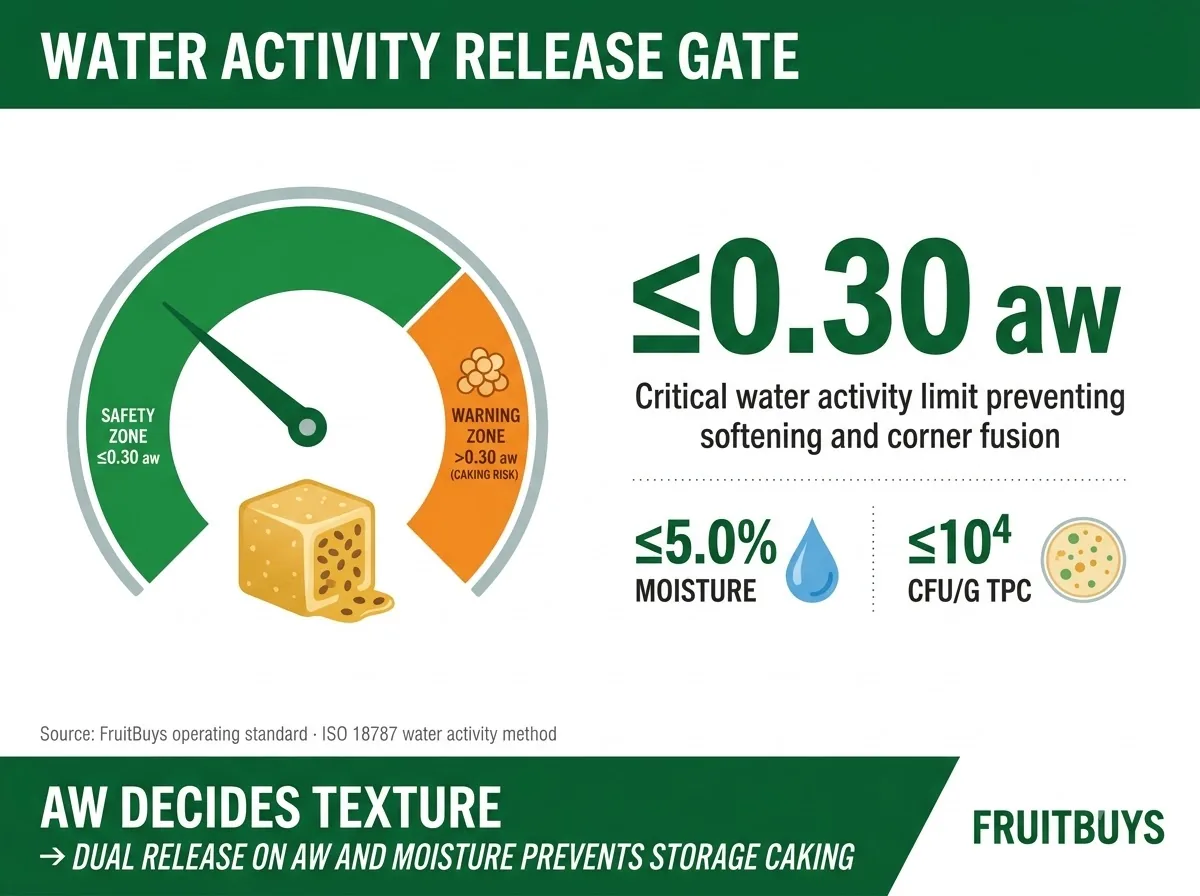
Water activity is the line between a crisp cube and a sticky block. Passion fruit pulp is acidic and rich in soluble fibre, and both pull humidity out of the air. Once aw climbs past 0.30 the surface softens and cubes start to fuse at the corners. We release on aw as well as moisture. Write both into your contract, and your QA team signs off the first container with a number instead of a debate. The full limit-setting logic is in what moisture and water activity freeze-dried passion fruit should meet.
Seed-in or seedless
Seed-in is the standard, and for most products it is the better ingredient. Freeze-drying does not leave the seeds hard like fresh ones; they turn into a light, hollow crunch that survives in cereal and chocolate. The black-on-gold contrast is the first thing a shopper sees through a window pouch or on the face of a chocolate bar, and the seed oil carries a good part of the aroma. The seeds also supply most of the 20 g of fibre on the panel.
Taking them out costs twice: a separation step and lost yield raise the cost per kilo, and the finished cube loses its crunch and much of its fibre. The seedless version is made to order at a higher price. Pay for it when the application truly needs it: smooth drinks, fine powders, products for small children. The trade-off by application is set out in seed-in or seedless freeze-dried passion fruit.
Yield: what a kilo of freeze-dried passion fruit is made of
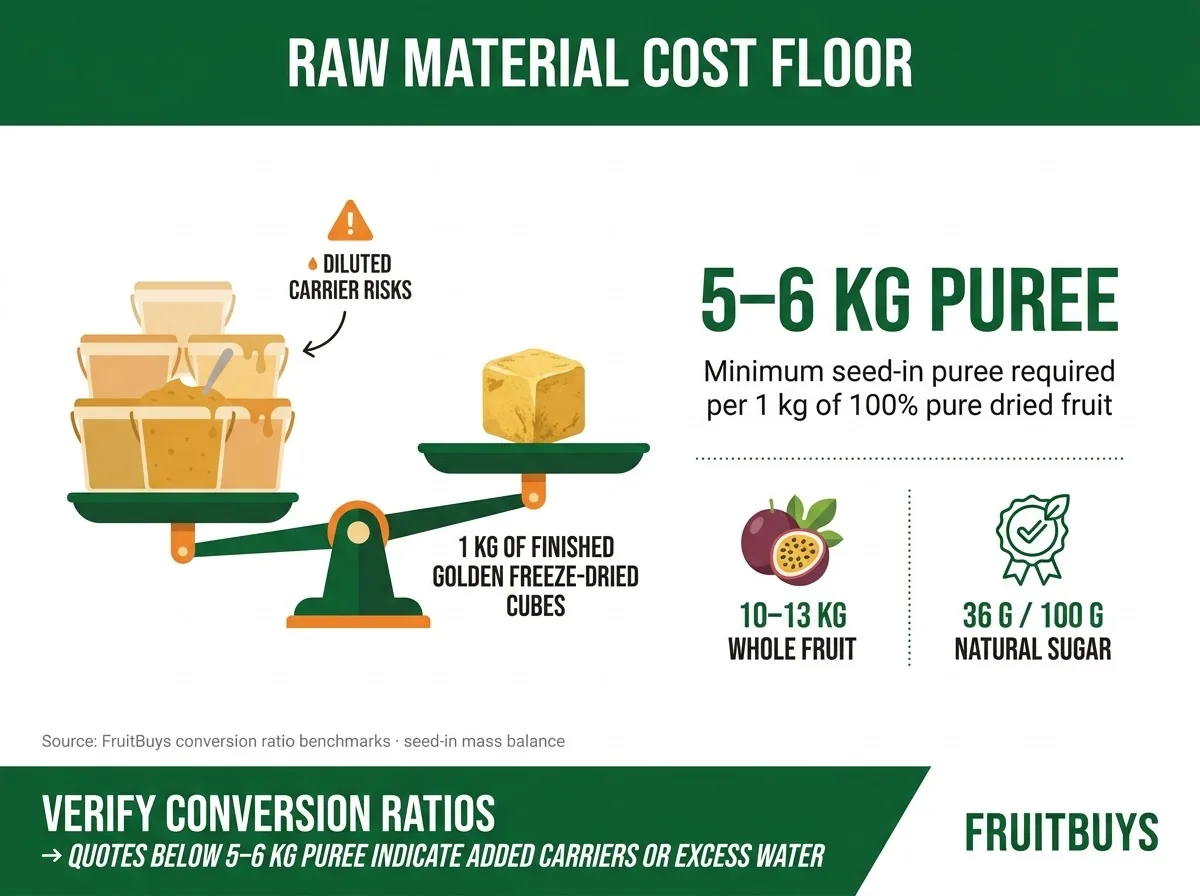
It takes 5–6 kg of seed-in puree to make 1 kg of freeze-dried passion fruit. The pulp is only 45–50% of the whole fruit, so at farm level that is roughly 10–13 kg of whole passion fruit per finished kilo, before rainy-season culls.
Use the puree figure to test a quote. Multiply the local puree price by 5–6, then add drying and packing. An offer that lands well below that floor is usually carrying added sugar, a carrier, or extra water. Check the ingredient line and compare total sugars with the 36 g per 100 g below. The arithmetic is worked through in how many kilos of passion fruit make 1 kg of freeze-dried.
Nutrition (per 100 g)
| Nutrient | Amount | % DV* |
|---|---|---|
| Calories | 440 kcal | |
| Total fat | 8 g | 10% |
| Saturated fat | 0 g | 0% |
| Sodium | 0 mg | 0% |
| Potassium | 1,000 mg | 21% |
| Total carbohydrate | 80 g | 29% |
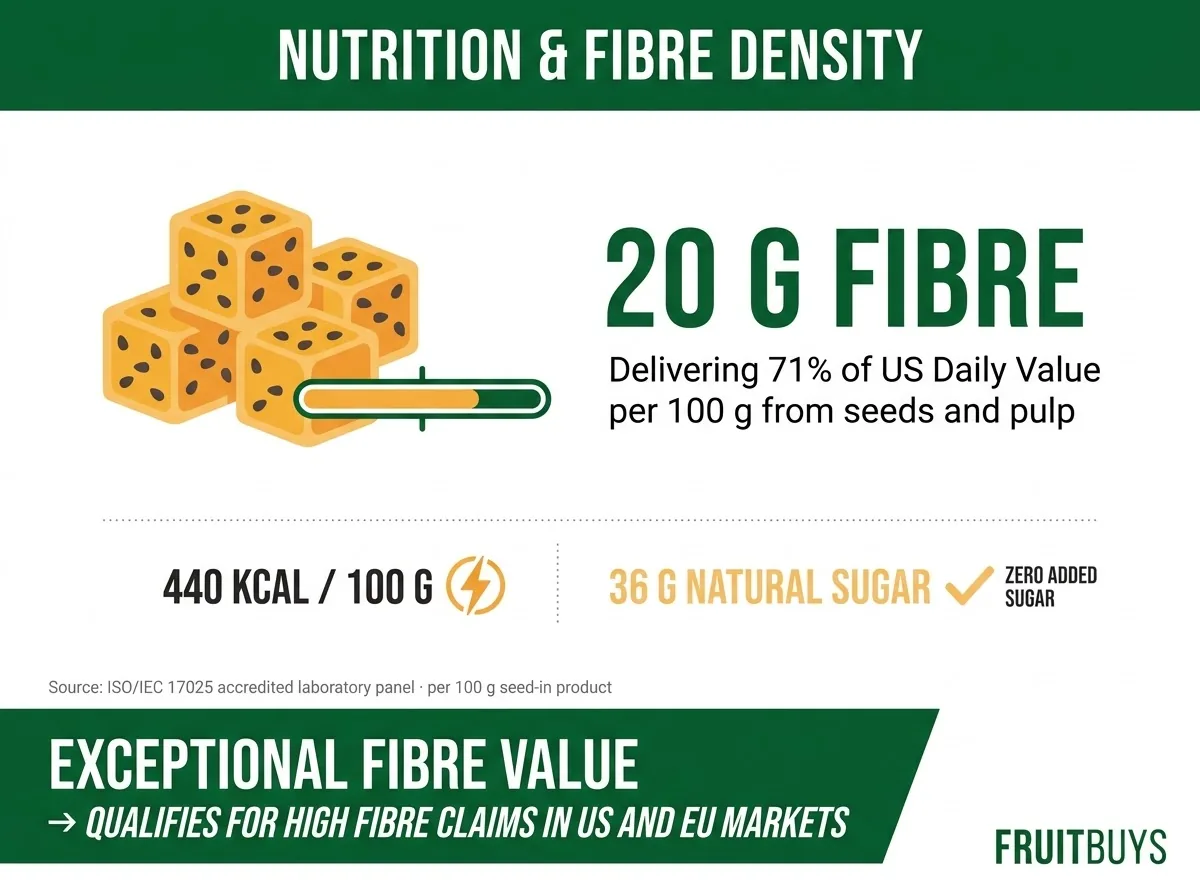
| Dietary fibre | 20 g | 71% |
| Total sugars | 36 g (0 g added) | |
| Protein | 8 g | 16% |
*Third-party laboratory nutrition panel on FruitBuys seed-in freeze-dried passion fruit, scaled to 100 g; typical values; 2,000 kcal diet.
The fat is seed oil, not frying oil, and the fibre comes mostly from the seeds. At 20 g of fibre per 100 g (71% DV), this is one of the strongest fibre stories in the freeze-dried fruit range, and it gives your brand team a ready “high fibre” angle for the front of pack. The final claim is set on your serving size in the destination market. Details are in freeze-dried passion fruit nutrition per 100 g. For your printed label, FruitBuys samples your commercial lot and arranges the panel at an ISO/IEC 17025 accredited laboratory.
Formats and applications
| Format | Best for | Working note |
|---|---|---|
| 20×20 mm cubes | Retail snack packs, chocolate bark, high-visibility toppings | Shape and seeds sell the product on shelf |
| 15×15 mm cubes | Cereal, granola, trail mix, ice cream inclusions | Doses cleanly on most cereal lines |
| 10×10 mm cubes | Yogurt and smoothie-bowl toppings, bakery decoration | Even spread per spoon |
| Rehydrated | Sauces, dessert fillings, cocktails, tea infusions | Returns juice-like flavour in cold water |
| Powder | Beverage premixes, smoothie bases, coatings | Separate product; see below |
Passion fruit works hard per gram. The acidity and aroma of Central Highlands fruit are concentrated by drying, so an inclusion rate of 2–5% is enough to give a whole batch of cereal or chocolate a clear tropical note. That keeps ingredient cost per finished unit lower than with milder fruits that need a heavier dose to register.
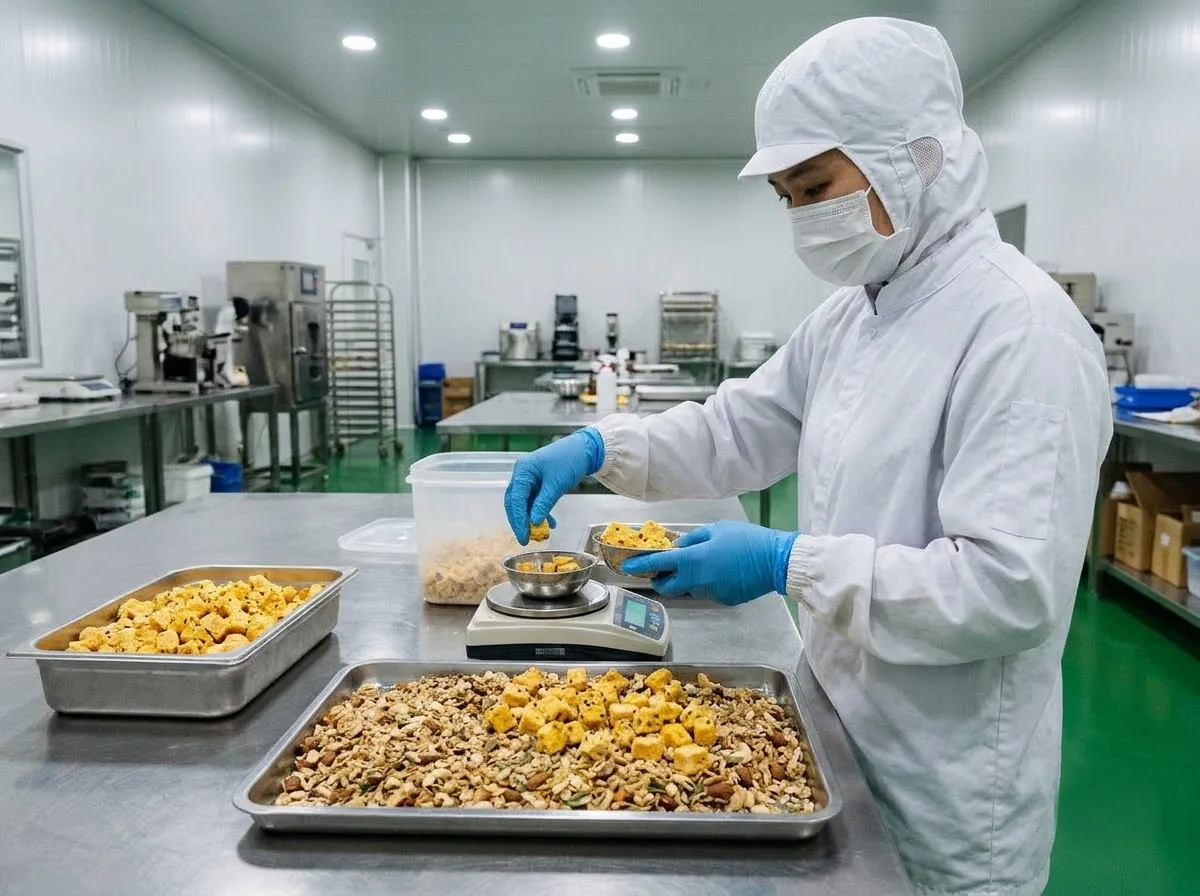
Any base wetter than the fruit softens it on the shelf, and passion fruit softens faster than most. In yogurt or a moist filling, coat the cubes or add them at the point of serving. Run a 4-week test in your real base before you lock the formula. The format choice by application is covered in cubes or powder: which format fits your product.
Passion fruit powder is a separate specification, milled from freeze-dried pulp. See the passion fruit powder page and what to specify for freeze-dried passion fruit powder.
Packaging
| Item | Detail |
|---|---|
| Bulk | 1–5 kg aluminium-foil PE bags, soft-vacuumed with a food-grade desiccant sachet, in 5-ply cartons |
| Carton | 58 × 28 × 34 cm, 7–10 kg net depending on cut size and packing |
| Retail (OEM) | 30 g / 50 g / 100 g / 500 g foil zip pouches or custom |
| Shelf life | 12 months from production in the unopened bag at ≤25 °C, RH ≤60%; 18–24 months in cool storage at ≤18 °C, RH ≤50% |
We soft-vacuum instead of nitrogen-flushing. An inflated bag wastes carton space, so you pay to ship air, and under stacking the foil creases and cracks. On passion fruit a cracked bag is a soft lot within days. The same organic acids and natural sugars start pulling moisture the moment a bag is cut open. That is why we pack bulk in 1–5 kg foil bags and size them to the batch your line runs in one shift: open a bag, use the whole bag, and nothing sits half-open long enough to cake. Cool storage at ≤18 °C stretches usable stock to 18–24 months, which lowers the risk of writing off slow-moving inventory. Bag, carton and loading choices are compared in how freeze-dried passion fruit should be packed and loaded.
Commercial terms and container planning
| Term | Detail |
|---|---|
| Production capacity | 100 tons/year |
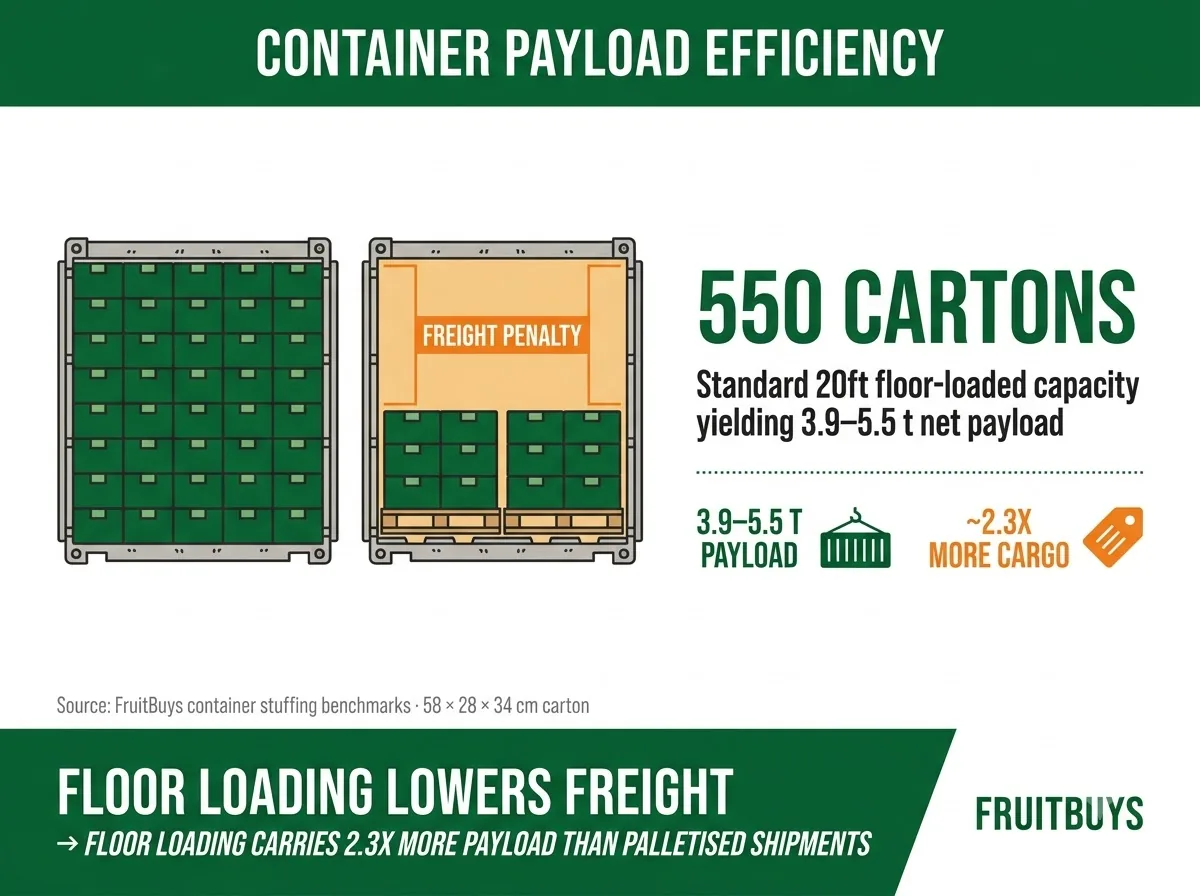
| 20ft, floor-loaded | 550 cartons; 3.9–5.5 tonnes |
| 40ft HC, floor-loaded | about 1,100 cartons; 7.7–11 tonnes |
| Palletised option | About 240 cartons per 20ft (24 cartons per 1,200 × 1,000 mm pallet) |
| Container type | Standard dry container; no reefer needed |
| Supply | Year-round; main harvest May–December |
| Production lead time | 20–30 days per 20ft after deposit |
| Samples | Prepared in 3–5 working days; delivery time depends on the airline |
| OEM / ODM | MOQ 500 kg (about 10,000 × 50 g pouches); pouch printing 7–10 working days digital, 15–20 rotogravure; high-barrier window pouches available |
| Payment | T/T 40% deposit, 60% before shipment or against copy B/L; L/C at sight |
| Incoterms | FOB, CIF, DDP |
| Port of loading | Cat Lai Port or Tan Son Nhat Airport |
Floor-loading carries about 2.3 times the cargo of pallets. Palletise only if your warehouse cannot unload by hand; otherwise you pay more than double the freight per kilo. Carton weight works the same way: the same 550 cartons carry 3.9 tonnes at 7 kg or 5.5 tonnes at 10 kg.
Quality and documents
- Every full-container lot: third-party COA for moisture, water activity, total plate count, yeasts & moulds, E. coli and Salmonella.
- Periodic surveillance: lead, arsenic and aflatoxin (total and B1) tested at an ISO/IEC 17025 accredited laboratory. Reports available on request.
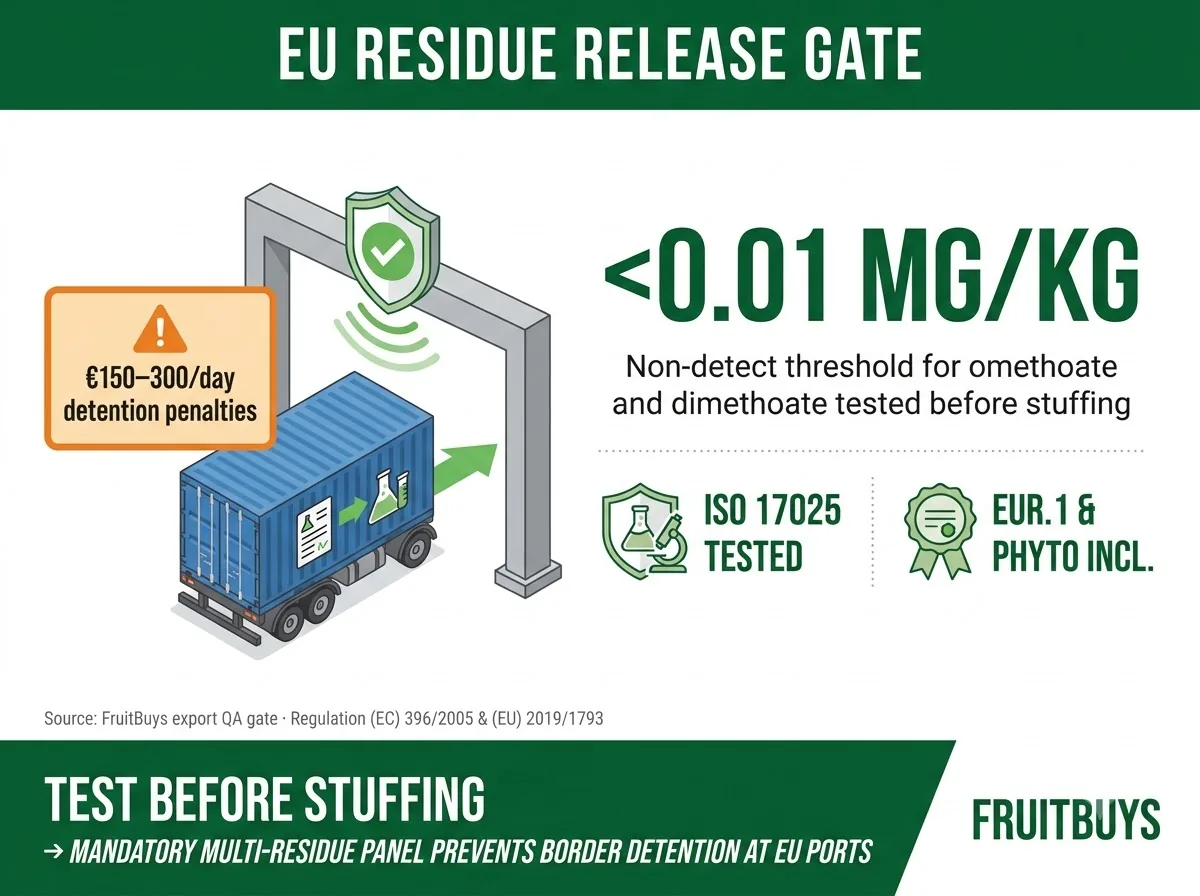
- EU release gate: every EU-bound full container is released only on a non-detect multi-residue result for omethoate and dimethoate, run at an ISO/IEC 17025 accredited laboratory before stuffing. Other market-specific panels are coordinated the same way.
- Claims: 14 days from devanning for packaging, appearance, fines and water activity; 30 days for laboratory results. If results diverge beyond method tolerance, the retained sample goes to an independent accredited laboratory agreed by both sides.
- Trial and LCL orders: in-house release QC log (moisture, water activity, sensory) plus the surveillance report. Independent third-party testing is arranged at net lab cost and credited in full against your first container order.
- Pre-shipment sample: 100–200 g from the packed commercial lot in two sealed foil pouches with desiccant, one for your sensory check and one lot-code sealed for your lab.
- Retained sample: kept from every container lot for its full shelf life.
- Facility control: one qualified processing facility is locked per contract. Any change needs prior written notice and re-approval of the pre-shipment sample. You have audit access.
- Facility compliance & certifications: HACCP, ISO 22000, BRC (qualified processing facility) and US FDA Facility Registration, with Halal certification available on request.
- Shipment documents: commercial invoice, packing list, bill of lading, COA, Certificate of Origin Form EUR.1 for EU and UK preferential duty, and a phytosanitary certificate with every shipment as part of our standard export dossier.
Import and labelling
- Ingredient line for private label: “100% passion fruit (Passiflora edulis)”. Add “with seeds” if your market or your customer expects the format to be stated.
- EU and UK: Form EUR.1 secures preferential duty under the EU–Vietnam Free Trade Agreement and UKVFTA. For pesticide checks, Regulation (EC) No 396/2005 applies fresh-fruit MRLs to dried products through a processing factor: divide the result on the dry product by about 5.6 before comparing.
- US: the panel above follows 21 CFR 101.9 Nutrition labeling of food; your label is built on your final pack and serving size.
- UAE: Arabic labelling and product registration are handled with your importer before the first shipment.
Verify the sample in three steps
- Open and weigh. Check bag integrity, desiccant and net weight against the packing list.
- Weigh the fines and measure the aw. Fines should sit within the limit for your cube size; at or below 0.30 the lot was dried and sealed right. Keep the second sealed pouch for your own lab.
- Test in your product. Run a storage test in your real base and check crispness at week 1 and week 4. Approve the pre-shipment sample in writing; it becomes the reference for your container.
Comparing several suppliers? Line up their answers with what to check before buying freeze-dried passion fruit in bulk.
FAQ
How much do I need in a recipe?
An inclusion rate of 2–5% is enough to make passion fruit the lead flavour in cereal, granola or chocolate.
Is sugar added to freeze-dried passion fruit?
No. It is 100% passion fruit with its seeds; the 36 g of sugar per 100 g is the fruit’s own, concentrated by drying.
Can I get it without seeds?
Yes, made to order at a higher price. Separating the seeds adds a step and lowers yield, and the cube loses its crunch and much of its fibre, so we recommend seed-in unless your application rules out seeds.
How much fits in a container?
550 cartons in a 20ft and about 1,100 in a 40ft HC, floor-loaded. At 7–10 kg per carton that is 3.9–5.5 tonnes or 7.7–11 tonnes.
When is passion fruit available?
Year-round, with the main harvest from May to December.
What is the minimum order for private label?
500 kg for OEM, ODM and private-label packing.
Do you provide a COA and phytosanitary certificate?
Yes. Every full-container lot ships with a third-party COA, and every shipment carries a phytosanitary certificate as part of our standard export dossier.
How long does it keep?
12 months from production in the unopened bag at ≤25 °C, RH ≤60%, and 18–24 months in cool storage at ≤18 °C and RH ≤50%.
Request a sample and quote
Send these 12 details and we return a specification, sample and terms in one reply:
- Destination country and port
- Application: ready-to-eat retail or ingredient for re-processing
- Format: cube size (10, 15 or 20 mm), seed-in or seedless, or powder
- Fines limit, if you have one
- Moisture / aw target, if tighter than standard
- First-order volume: trial, LCL, 20ft or 40ft HC
- Annual volume and preferred delivery months
- Packaging: bulk bag size or retail pouch size
- Private label: artwork status and labelling market
- Extra tests required by your market or customer
- Preferred Incoterm and payment term
- Target delivery date