
Freeze-Dried Strawberries for Drinks: A Guide for Beverage and Coffee Chains
Beverage and coffee chains use freeze-dried strawberries in two ways: 100-mesh powder at 8–12 g per 350–500 ml cup for natural pink colour and real strawberry taste, and slices or dice that float on the drink and soften in under two minutes. FruitBuys Vietnam supplies both from Da Lat strawberries, packed for stores, with no cold storage needed.
One strawberry SKU can run a refresher, a strawberry latte, a matcha drink and a smoothie, sit in the back room for 12 months at ambient temperature, and put Strawberries on the ingredient line instead of a red dye. This guide covers how each format behaves in a cup, starter builds per drink, cost per cup, store packaging, food safety for no-cook use and how to plan supply for a chain. The buying guide is freeze-dried strawberries in bulk.
Why do beverage chains use freeze-dried strawberries?
Because they solve the three problems fresh fruit and syrup create behind a counter:
- No spoilage, no cold room. Fresh strawberries last days and need refrigeration; frozen fruit needs freezer space in every store. Freeze-dried fruit keeps 12 months at ≤25 °C, RH ≤60%, in a sealed bag on a shelf.
- Real fruit on the menu board. A pink drink made with strawberry powder can say made with real strawberries. In the US, FDA has asked the food industry to phase out petroleum-based dyes, Red No. 40 among them, by the end of 2026; in the EU and UK, Allura Red (E129) carries a warning about children’s activity and attention. Strawberry powder colours the drink with fruit.
- A visible garnish that sells the drink. Red slices floating on a refresher or a cold foam read as real fruit in a photo, which is where most of these drinks are sold first.
Every 10 g of powder carries the fruit of about 100–120 g of fresh strawberries, so the flavour is fruit, not flavouring.
Which format does what in a cup?
| Format | Best drink | What it does in the cup |
|---|---|---|
| Powder, 100 mesh | Lattes, milk teas, smoothies, lemonades, cold foam | Disperses for colour and flavour; settles if the drink stands, so serve shaken or blended |
| Seed-reduced powder | Clear lemonades, teas, sodas | Same colour without dark specks |
| Slices 4–6 mm | Refreshers, iced teas, sparkling drinks | Float on top; soften and release colour in about 30–90 seconds in a cold drink |
| Dice 5–10 mm | Smoothie bowls, layered drinks, toppings | Sink or sit in foam; keep a soft bite |
| Crumble 1–3 mm | Rim sugar, cold-foam topping, whipped cream | Stays crisp on a dry or fat-based topping |
Slices are the garnish customers see; powder is the colour and taste they drink. Most strawberry menus use both: 8–10 g of powder in the drink and 2–3 g of slices on top.
How do you get powder to mix evenly?
Treat it as fruit, not syrup. Freeze-dried strawberry powder is the whole berry, fibre and seeds included, so it disperses rather than dissolving clear. That is what gives the drink body and a natural look; it also means a few habits matter:
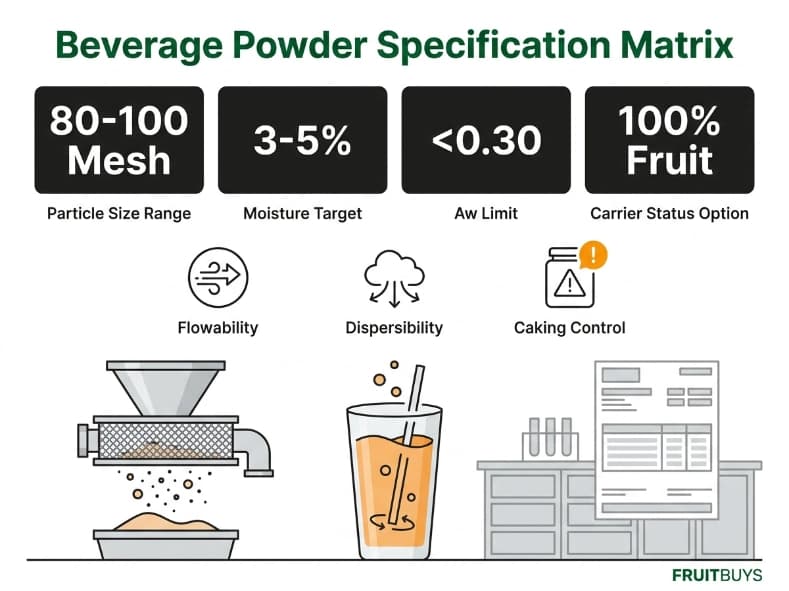
- Choose 100 mesh. Finer powder wets out faster in a shaker and leaves no grain on the tongue.
- Dry-blend first. Mix the powder with the sugar, the base powder or a little syrup before the liquid goes in. Powder dropped onto cold milk on its own forms lumps.
- Shake or blend. A cocktail shaker, a frother or the blender cycle disperses it in seconds.
- For bottled drinks, add a small amount of pectin, gellan or xanthan to keep the fruit in suspension through the shelf life.
The full dosage chart across applications is in strawberry powder uses and dosage for food brands; the powder specification is on the freeze-dried strawberry powder page.
Building a strawberry menu for spring? Send your drink list and cup sizes to [email protected] or WhatsApp +84 919 739 589 and get powder and slice samples sized for a store trial. REQUEST SPEC SHEET / SAMPLE →
What colour do you get in milk, matcha and lemonade?
The pink comes from anthocyanin, and it follows acidity:
| Drink base | Typical acidity | Colour you get |
|---|---|---|
| Lemonade, iced tea with lemon, refreshers | pH about 3–4 | Bright red-pink |
| Yogurt drinks, smoothies with fruit | pH about 4–4.5 | Clear strawberry pink |
| Milk, oat milk, lattes | pH about 6.5–6.8 | Soft, slightly mauve pink |
| Matcha latte | Near neutral | Pink layer under green, softer than in lemonade |
For a strawberry matcha, build the pink layer separately: shake 10–12 g of powder with the milk and a little sweetener, pour it over ice, then float the matcha on top. The colour contrast stays clean because the two layers are mixed at different pH. For a brighter pink in milk drinks, raise the dose toward 12 g or add a small amount of strawberry purée or lemon to the strawberry layer where the recipe allows.
Starter builds per cup
These are bench starting points for a 16 oz (about 470 ml) cup; adjust to your sweetness and ice ratio.
| Drink | Strawberry | Base | Method |
|---|---|---|---|
| Strawberry refresher | 8–10 g powder + 2 g slices | Green tea or lemonade, syrup to taste, ice | Shake powder with syrup and base; pour over ice; top with slices |
| Strawberry latte | 10–12 g powder | Milk, sweetener, espresso optional | Dry-blend powder with sweetener, froth with cold milk, pour over ice |
| Strawberry matcha | 10–12 g powder | Milk layer + matcha shot | Pink milk layer over ice, matcha floated on top |
| Strawberry smoothie | 12–20 g powder (3–5%) | Banana, yogurt or milk, ice | Blend 30–45 seconds |
| Cold-foam topping | 3–4 g powder + crumble | Sweet cream foam | Whip powder into foam; finish with crumble |
What does it cost per cup?
Cost of strawberry per cup = price per kg ÷ 1,000 × grams per cup.
As a hypothetical example for the arithmetic only, at USD 20 per kg of powder, a 10 g dose costs USD 0.20 a cup, and a 2 g slice garnish about USD 0.04. For that, the drink carries the fruit of 100–120 g of fresh strawberries, a real-fruit claim on the menu and a colour customers photograph, which lets a chain price a real-fruit drink above a syrup-flavoured one. One 1 kg bag of powder covers about 100 cups at 10 g.
How should it be packed for stores?
By what one store uses in a few days, so nothing sits open on a humid back counter:
- Powder: 500 g or 1 kg foil bags with a silica gel sachet, about 50 or 100 cups each; or single-dose stick packs for each cup, packed in Vietnam, with digital print from 3,000–5,000 units per SKU.
- Slices and crumble: 500 g or 1 kg foil zip bags, light enough to stand at the bar station.
- Distribution centre: bulk 5 kg powder bags or 1–5 kg slice bags in 5-ply cartons of 58 × 28 × 34 cm, if your central kitchen repacks.
At the bar, keep the open bag zipped between drinks and away from the ice well and the steam wand. A part-used bag, resealed with its desiccant, stays usable for about two weeks; sizing the bag to a store’s weekly use keeps every cup tasting the same. Bulk packaging and loading are in freeze-dried strawberry packaging, shelf life and loading.
Is it safe to add without cooking?
Yes, which is why beverage programmes specify it carefully. Freeze-dried strawberries go into the cup as they are, so the release limits are written for ready-to-eat use: every full-container lot ships with a COA from an independent ISO/IEC 17025 accredited third-party laboratory for moisture, water activity, total plate count (≤10⁴ CFU/g), yeasts and moulds (≤10² CFU/g), E. coli (<10 CFU/g) and Salmonella (not detected in 25 g). Lead, arsenic and aflatoxin are covered by periodic surveillance testing.
Berry programmes in ready-to-eat use often add a hepatitis A and norovirus panel; FruitBuys books it before the container is sealed, so the answer is in your file before your QA team asks. For other market or customer panels, such as pesticide multi-residue or Listeria and Enterobacteriaceae, FruitBuys arranges independent testing at an accredited laboratory of your choice, such as Eurofins or SGS in Vietnam, before loading. At water activity ≤0.30, the fruit itself gives microbes nothing to grow on in the bag. The full specification and how to read the COA are in freeze-dried strawberry specs, moisture and COA.
How do you plan supply for a chain?
Like any core menu ingredient: forecast, buffer, and book the season.
- Forecast by store count. Grams per cup × cups per store per day × stores × days. For example, 30 strawberry drinks a day at 10 g in 200 stores is 60 kg of powder a day, about 1.8 t a month.
- Hold safety stock of 6–8 weeks at your distribution centre. Production runs 20–30 days per 20ft after deposit, plus transit, and a dry ingredient with a 12-month shelf life costs little to hold.
- Book the season. Share an annual plan by quarter before December; FruitBuys reserves Da Lat fruit and drying slots against it. A launch in spring needs the order placed in winter.
- Ship powder by the container. Powder loads about 11 t per 20ft, with slices for garnish in a mixed 40ft HC if you need both.
- Start with a trial. A 50–100 kg powder trial by air or LCL runs a store pilot before the container.
When is a different format the better choice?
When the drink needs crystal-clear colour or a long heat treatment. Powder makes a cloudy, natural-looking drink; for a clear sparkling soda, the seed-reduced powder at a lower dose, or slices steeped in the drink, gives colour without sediment. For bottled drinks that are pasteurised or retorted, the pink shifts with heat, so run a heat trial and plan for a stabiliser. High-speed stick-pack lines run better on the free-flowing powder with up to 1% silicon dioxide. FruitBuys supplies all three versions from the same fruit, so the choice is about the cup, not the supplier.
Request samples for your menu trial
Send your drink list, cup sizes, store count and launch month. FruitBuys returns a specification, powder and slice samples sized for a store pilot, and a supply plan with safety stock and lead times.
REQUEST SPEC SHEET / SAMPLE →
Email [email protected] · WhatsApp Export +84 919 739 589
FAQ
What freeze-dried strawberries do coffee chains use in refreshers?
Typically sliced freeze-dried strawberries, about 4–6 mm, floated on the drink as a garnish, with strawberry powder or a fruit base in the drink for colour and flavour. Slices soften in about 30–90 seconds in a cold drink and release their colour.
Do freeze-dried strawberries dissolve in drinks?
Not completely. The powder disperses because it is whole fruit with fibre and seeds; 100 mesh, dry-blending with sugar and a shaker or blender give an even drink. Slices soften and stay as pieces.
Can you put freeze-dried strawberry powder in milk or matcha?
Yes. Use 10–12 g per 16 oz cup, dry-blended with sweetener and shaken with cold milk. In milk the colour is a soft pink; for strawberry matcha, build the pink milk layer first and float the matcha on top.
How long do freeze-dried strawberries stay crunchy in a drink?
Only briefly. In a cold drink, slices soften in about 30–90 seconds. On a dry topping, such as rim sugar or cold foam, crumble stays crisp much longer, which is why it is used there.
Are freeze-dried strawberries safe to add without cooking?
Yes. They are released to ready-to-eat limits, with Salmonella not detected in 25 g and E. coli below 10 CFU/g on every container lot’s COA. Hepatitis A and norovirus panels are booked before loading for programmes that need them.



