
Freeze-Dried Soursop RFQ Checklist for Importers and Food Manufacturers
A weak freeze-dried soursop RFQ creates weak supply control. When a buyer asks only for “freeze-dried soursop,” the reply may include a sample, but the buyer still has no locked format, conversion basis, moisture target, Aw target, seed-removal rule, defect limit, pack route, COA scope, Nutrition Facts basis, HS review or destination-market file.
That gap becomes visible later, when the bulk lot does not match the sample or the document file does not match the market route. A freeze-dried soursop RFQ should define the product that must be supplied, controlled, documented and released. FruitBuys Vietnam uses the RFQ stage to align Raw Material Sourcing Governance, Quality Control, Documentation, MOQ Flexibility/Market Trial Support, OEM/private label delivery and export logistics coordination before sample-to-bulk approval.
A Strong RFQ Defines the Product Before the Sample
A freeze-dried soursop RFQ should define product form, application, release criteria, packaging, document scope and destination market before sampling.
The sample should test a specification, not replace it.
Buyers should not approve bulk supply from a generic product name.
The first RFQ error is treating freeze-dried soursop as one fixed item. It is not. The same fruit can become half-moon slices, cubes, chunks, crumble or powder. Each format needs different QC, packaging, COA and application proof.
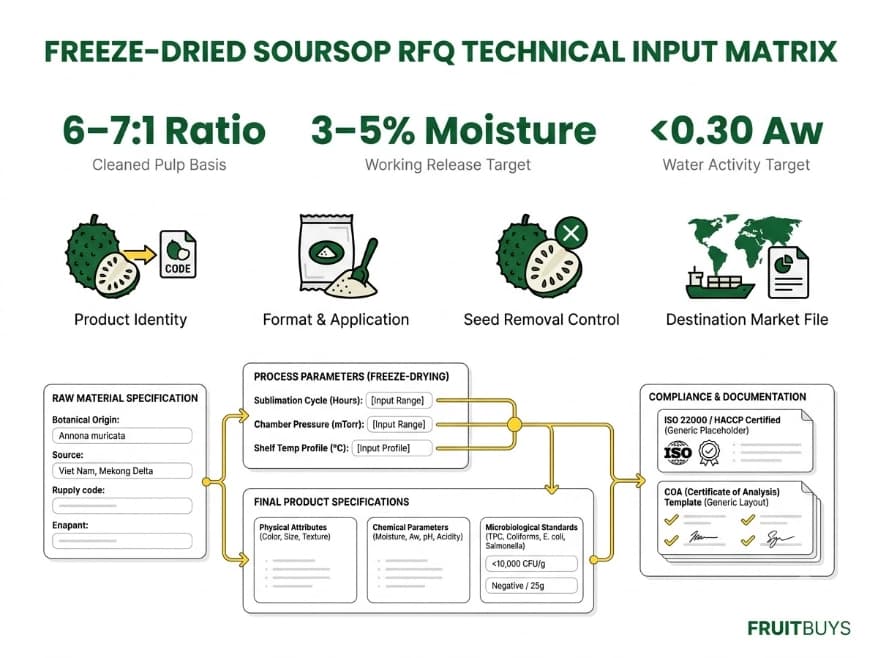
A strong RFQ should tell FruitBuys what product must be supplied and what evidence must release it. It should include technical inputs, not only product name and desired use.
Start with these minimum fields:
| RFQ Field | Buyer Input Needed |
|---|---|
| Product name | Freeze-dried soursop |
| Botanical identity | Annona muricata L. where required |
| Ingredient | Soursop pulp after peel, core and seed removal |
| Format | Half-moon slice, cube, chunk, crumble or powder |
| Application | Snack, cereal, chocolate, beverage, dairy, bakery, foodservice or private label |
| Moisture target | 3–5% |
| Aw target | <0.30 |
| Packaging route | Retail, foodservice, bulk or buyer-defined |
| Document scope | COA, lab report, label file, HS basis and market checklist |
| Destination | US, EU, UAE or buyer-defined market |
FruitBuys connects this checklist to the full freeze-dried soursop B2B specification guide. The pillar article gives the full product pathway. This RFQ article turns that pathway into buyer inputs.
RFQ Section 1 — Product Identity
Product identity prevents confusion between fruit pieces, powder, formulated powders and mixed products. The RFQ should not use “soursop product” as the only description.
| Product Identity Field | Required RFQ Detail |
|---|---|
| Commercial name | Freeze-dried soursop |
| Common names | Soursop, guanabana, graviola where useful |
| Botanical name | Annona muricata L. where required |
| Ingredient basis | Edible pulp after peel, core and seed removal |
| Additives | None unless buyer-approved and declared |
| Formula status | Pure fruit, carrier-containing powder, blend or premix |
| Product form | Pieces, crumble, powder or private-label SKU |

This section protects later label, Nutrition Facts and claims review. A pure fruit piece, pure freeze-dried powder and powder with carrier should not share one file. Powder buyers should review freeze-dried vs spray-dried soursop powder before submitting the RFQ. Powder route controls ingredient declaration, nutrition, claims, caking behavior and HS review.
RFQ Section 2 — Origin, Maturity and Raw-Material Control
Raw-material control shapes yield, flavor, color, aroma, seed-removal labor and drying behavior. The RFQ should ask how the raw material is governed, not only where it comes from.
| Raw-Material Input | Why It Matters |
|---|---|
| Origin route | Supports raw-material traceability |
| Harvest or intake period | Supports supply planning and maturity review |
| Maturity criteria | Supports flavor, texture and yield |
| Fruit condition | Controls over-soft, damaged or under-mature fruit |
| Pulp preparation | Confirms peel, core and seed removal |
| Cleaned pulp recovery | Supports conversion review |
| Intake record | Supports sample-to-bulk traceability |
The conversion basis for FruitBuys freeze-dried soursop is:
6–7 kg cleaned soursop pulp → 1 kg freeze-dried soursop
That ratio applies to cleaned pulp after peel, core and seed removal, not whole fruit. Buyers should connect this field to freeze-dried soursop fresh-to-dry conversion ratio and Vietnam soursop origin and maturity control.
RFQ Section 3 — Format and Application
Format must follow application.
A retail snack slice, cereal cube, chocolate crumble and beverage powder do not need the same specification.
The buyer should define application before requesting the sample.
The RFQ should map the buyer’s intended use to the required product form.
| Application | Recommended Starting Format | RFQ Control Point |
|---|---|---|
| Retail snack | Half-moon slice or chunk | Breakage, visual standard, packaging |
| Cereal/granola | Cube or crumble | Size tolerance, fines, distribution |
| Chocolate | Crumble, micro-cube or powder | Particle range, Aw, mouthfeel |
| Beverage/smoothie | Powder | Mesh, carrier status, dispersibility |
| Dairy topping | Cube, chunk or crumble | Rehydration and texture |
| Bakery/bar | Crumble or powder | Mixing, heat and moisture interaction |
| Foodservice | Slice, chunk, crumble or powder | Pack handling and after-opening control |
| Private label | Buyer-defined SKU | Artwork, pack, label and market file |
The format decision should link to freeze-dried soursop formats and size selection and freeze-dried soursop applications for food manufacturers. Do not request one sample to approve all applications. Each application needs a test condition and pass/fail rule.
RFQ Section 4 — Moisture and Aw
Moisture and Aw must appear as separate RFQ fields. FDA explains that water activity equals equilibrium relative humidity divided by 100, and FDA also states that Aw affects food stability and should be brought to a suitable level after drying and maintained during storage. (U.S. Food and Drug Administration)
For FruitBuys freeze-dried soursop, the working targets are:
| Parameter | RFQ Target |
|---|---|
| Moisture | 3–5% |
| Water activity | Aw <0.30 |
The RFQ should also ask for:
- Test method or lab basis where required
- Sample point
- Release value
- Retained sample
- Packaging condition
- Corrective action for out-of-limit result
Moisture affects texture, weight basis and Nutrition Facts concentration. Aw affects available-water behavior and stability. The buyer should review freeze-dried soursop moisture and water activity control before approving a lot-release file.
RFQ Section 5 — Seed Removal and Physical Defects
Soursop contains many seeds, so seed control cannot be left to verbal assurance. The RFQ should define seed-removal expectations and physical-defect limits.
| Defect Field | RFQ Requirement |
|---|---|
| Whole seeds | Rule and inspection basis |
| Seed fragments | Limit and inspection method |
| Peel residue | Acceptance rule |
| Core fiber | Acceptance rule |
| Foreign matter | Hold and investigation rule |
| Color | Accepted natural range |
| Texture | Crisp, light and porous target |
| Fines | Limit by format |
| Breakage | Limit by format |
| Clumping/caking | Limit for pieces or powder |
| Off odor | Rejection rule |
This section should connect to soursop seed-removal and foreign-material control and common freeze-dried soursop defects and release controls. A buyer should not approve bulk if the RFQ does not define what counts as a defect.
RFQ Section 6 — COA and Laboratory Testing
The COA request must match the exact product, format, lot and destination.
A sample COA or historical report cannot release a commercial lot.
Buyers should define the laboratory panel before sample-to-bulk approval.
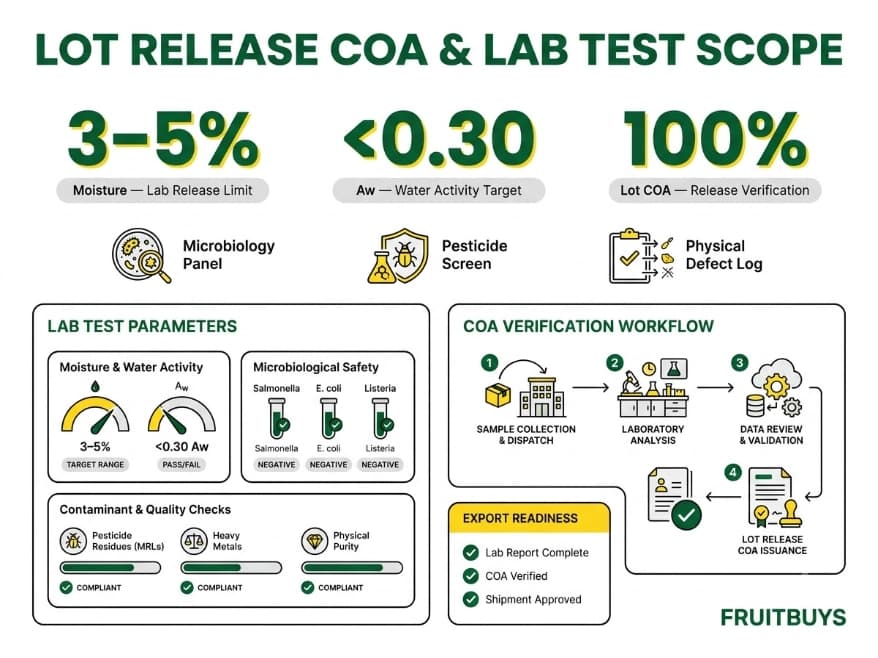
A freeze-dried soursop RFQ should define which tests are required for the buyer’s route.
| Test/Document | RFQ Decision |
|---|---|
| Moisture | Required release test |
| Aw | Required release test |
| Microbiology | Buyer-defined panel |
| Pesticide residues | Destination-specific panel |
| Heavy metals | Destination-specific contaminant scope |
| SO₂/preservatives | Required when claim or risk applies |
| Added sugar verification | Required when no-added-sugar claim is used |
| Nutrition testing | Required for label-ready panel |
| Foreign-material inspection | Required for seed and physical-defect control |
| COA | Lot-specific release summary |
| Laboratory report | Required when buyer needs method detail |
Codex CXC 75-2015 includes dried fruits and vegetables within the scope of low-moisture foods and explains that Salmonella cannot multiply under low-Aw conditions but may remain viable for extended periods.
That is why low Aw supports stability review but does not replace hygiene controls, microbiology review or lot-specific evidence. The detailed document logic belongs in freeze-dried soursop COA and laboratory testing.
RFQ Section 7 — Packaging and Shelf-Life
Packaging protects the product condition achieved after drying. The RFQ should not ask for shelf life without naming the pack route.
| Packaging Field | Buyer Input |
|---|---|
| Pack route | Retail, bulk, foodservice or OEM |
| Pack size | Buyer-defined |
| Inner bag or pouch | High-barrier requirement if needed |
| Seal method | Buyer approval required |
| Carton configuration | 60 × 39 × 39 cm/10 kg net planning basis where used |
| Storage instruction | Cool, dry, sealed, away from humidity and direct light |
| Shelf-life target | Valid only after final pack validation |
| Breakage limit | Format-specific |
| Caking or clumping limit | Required for powder and small particles |
| Retained sample pack | Required for comparison |
Shelf life belongs to the product-package system. A freeze-dried soursop sample in a temporary pouch does not prove the final retail pouch, bulk liner or foodservice pack. The buyer should review freeze-dried soursop packaging and shelf-life control before requesting final pack approval.
RFQ Section 8 — Nutrition Facts, Claims and Label Route
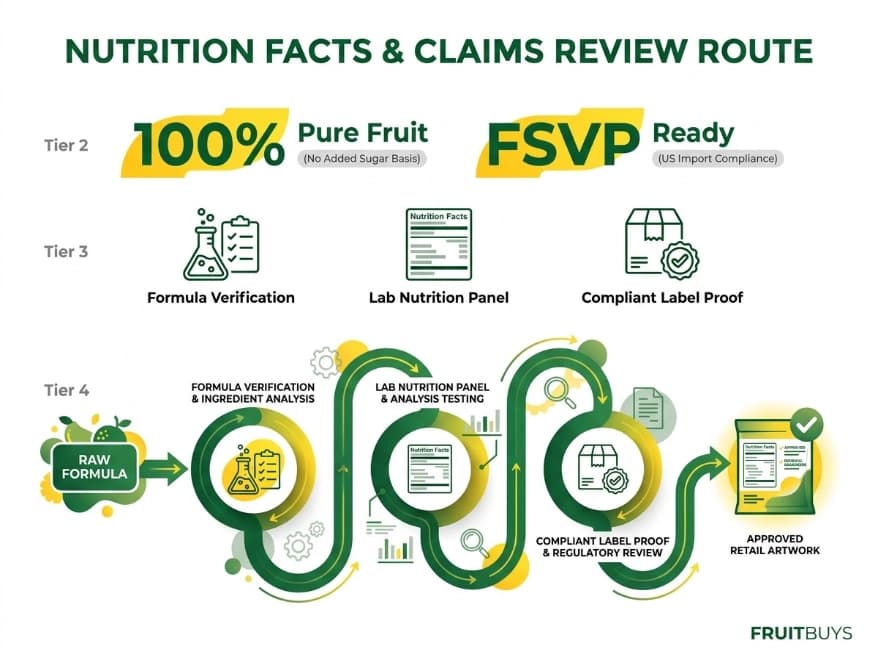
Retail, private-label and powder SKUs need early label review. The RFQ should state whether Nutrition Facts, ingredient declaration, claims and market-language review are required.
| Label/Claim Field | RFQ Input |
|---|---|
| Product name | Must match format and formula |
| Ingredient statement | Pure fruit or formulated product |
| Serving size basis | Market and pack route |
| Nutrition Facts | R&D estimate or lab-ready panel |
| Added sugars | Formula-based review |
| Fiber, potassium, vitamin C claims | Lab-supported only |
| No preservatives | Formula and process review |
| 100% fruit | Formula and carrier-status review |
| Claims list | Exact wording for approval |
| Forbidden claims | Disease, cure, detox and unsupported wellness language |
| Artwork stage | Only after product and document locks |
Nutrition and claims should be reviewed through freeze-dried soursop Nutrition Facts for label development and soursop marketing claims food brands must avoid.
RFQ Section 9 — HS Code and Market Readiness
The RFQ should not ask for export documents after production is finished. Classification and market file review should happen early.
The World Customs Organization describes the Harmonized System as a multipurpose international product nomenclature arranged in a legal and logical structure, with commodity groups identified by six-digit codes. (Wcoomd) UNSD lists HS 081340 for other dried edible fruit under heading 0813 and HS 110630 for flour, meal and powder of products of Chapter 8. (UNSD)
For freeze-dried soursop, the RFQ should define:
| Document Field | RFQ Input |
|---|---|
| Product form | Pieces, powder, blend or premix |
| HS planning route | Pieces and powder reviewed separately |
| Ingredient statement | Pure fruit or formulated |
| Destination market | US, EU, UAE or other |
| Importer role | Buyer or importer file owner |
| Product registration | Required where destination demands it |
| Label route | Retail, foodservice or bulk |
| COA scope | Destination-specific |
| Origin file | Buyer-required scope |
| Shipment document wording | Must match final product |
For U.S. routes, FDA FSVP guidance states that importers of human or animal food must establish and follow a foreign supplier verification program to ensure imported food meets applicable U.S. requirements unless an exemption applies (U.S. Food and Drug Administration).
FDA also requires prior notice for food imported or offered for import into the United States (U.S. Food and Drug Administration). Buyers should connect these fields to freeze-dried soursop HS code for pieces and powder and freeze-dried soursop market readiness for the US, EU and UAE.
RFQ Section 10 — Sample-to-Bulk Approval
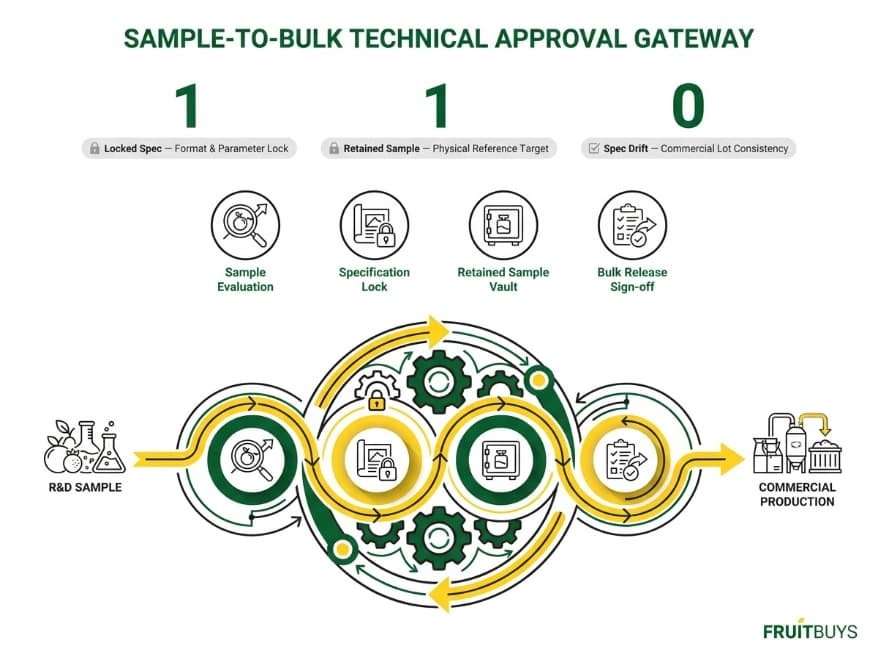
The RFQ should state how a sample becomes bulk approval. Without this bridge, the buyer approves an isolated sample and loses control of the commercial release.
| Approval Field | RFQ Requirement |
|---|---|
| Sample purpose | R&D, sensory, packaging, label or pre-production |
| Approved sample record | Buyer approval captured |
| Retained sample | Required physical reference |
| Specification lock | Format, moisture, Aw, defects and pack |
| COA plan | Test scope and lot-release basis |
| Packaging approval | Final pack or approved route |
| Change-control triggers | Format, source, moisture, Aw, formula, packaging or market |
| Bulk review | Lot-specific comparison to approved sample |
| Release decision | Accept, hold, rework review or reject |
The full approval bridge is defined in freeze-dried soursop sample-to-bulk approval.
RFQ Section 11 — Carton and Logistics Planning
Logistics planning must protect the product approved by QA.
Carton count alone cannot release a shipment because freeze-dried soursop is light, fragile and moisture-sensitive.
The RFQ should define carton configuration, loading route, lot coding and document handover.
The current carton planning basis is 60 × 39 × 39 cm / 10 kg net.
The current practical planning basis is 20ft: 2.5 MT and 40ft / 40HC: 6.0 MT, pending loading validation.

The RFQ should define:
| Logistics Field | RFQ Input |
|---|---|
| Carton dimension | External size |
| Net weight per carton | Product weight |
| Inner pack count | Bag or pouch count |
| Lot code | Carton and document match |
| Loading route | Floor-loaded, palletized or buyer-defined |
| Storage instruction | Dry, clean, protected |
| Handling sensitivity | Breakage, caking or moisture risk |
| Container type | Buyer-defined |
| Shipment document file | COA, packing list, product description and lot match |
Connect this section to freeze-dried soursop carton and container planning.
RFQ Master Checklist

| RFQ Area | Buyer Must Provide | FruitBuys Review Output |
|---|---|---|
| Product identity | Product name, botanical name, ingredient basis | Product specification draft |
| Format | Slice, cube, chunk, crumble or powder | Format suitability review |
| Application | Snack, cereal, beverage, dairy, bakery or other | Application-fit route |
| Origin/maturity | Origin route and maturity expectation | Raw Material Sourcing Governance input |
| Conversion | Cleaned pulp basis | Yield-planning clarification |
| Moisture/Aw | 3–5% moisture and Aw <0.30 | Release target alignment |
| Seed control | Seed and fragment rule | QC inspection requirement |
| Defects | Color, texture, fines, breakage, caking | Defect-limit file |
| COA/testing | Test panel and report need | Lot documentation plan |
| Packaging | Pack size, pouch, inner bag, carton | Packaging specification path |
| Nutrition | Label route and lab need | Nutrition Facts plan |
| Claims | Exact claim list | Claims-control review |
| HS/market | Destination and product form | Documentation route |
| Sample approval | Sample purpose and pass/fail rule | Sample-to-bulk approval file |
| Logistics | Carton and loading route | Export logistics plan |
Application Mapping
| Buyer Type | Application | Required Format | Proof Needed | FruitBuys Delivery |
|---|---|---|---|---|
| Importer | Bulk ingredient distribution | Cubes, chunks, crumble or powder | Product spec, COA scope, HS basis, carton plan | Documentation and Export Logistics Coordination |
| QA manager | Supplier approval | Buyer-defined format | Moisture, Aw, defects, testing, retained sample | Quality Control |
| Private-label brand | Retail freeze-dried pouch | Slices, chunks or powder | Pack, Nutrition Facts, claims, market checklist | OEM/Private Label Delivery |
| Beverage developer | Powder drink or premix | Powder | Carrier status, mesh, dispersibility, caking, label route | MOQ Flexibility/Market Trial Support |
| Cereal manufacturer | Fruit inclusion | Cubes or crumble | Size tolerance, fines, Aw, application trial | Quality Control |
| Regulatory reviewer | Destination-market file | Final commercial SKU | Label, COA, HS, claims and importer route | Documentation |
| Logistics coordinator | Shipment planning | Final packed format | Carton count, lot code, storage instruction and document match | Export Logistics Coordination |
Highest-Risk Decision: Sending a Generic RFQ
The highest-risk shortcut is sending a generic RFQ that asks only for freeze-dried soursop.
A generic RFQ may produce a sample, but it cannot control bulk consistency, documentation, packaging, label or destination readiness.
Buyers should submit a technical checklist before requesting commercial samples.
A generic RFQ creates predictable failure points. The buyer receives a sample but does not know the conversion basis. The sample looks crisp but has no Aw result. The powder tastes good but carrier status is unclear. The retail pouch design begins before Nutrition Facts and claims are reviewed. The shipment plan assumes carton count without packaging validation.
The correct sequence is:
Application → format → specification → sample → retained sample → COA plan → packaging → label / claims → market file → logistics → bulk release
FruitBuys uses the RFQ stage to prevent disconnected decisions. The buyer should not ask FruitBuys to correct missing technical inputs after sample approval. The RFQ should define those inputs before the sample is prepared.
Why FruitBuys Delivers This
FruitBuys Vietnam supplies export-ready freeze-dried soursop through an Integrated Product Supply Model. The buyer receives one configured product, one approved specification and one accountable supplier relationship.
Documentation turns the RFQ into a reviewable product file. FruitBuys aligns product identity, ingredient statement, COA scope, lab plan, HS basis, label route, claims review, packaging file and shipment records.
Quality Control defines the release conditions: format, moisture, Aw, seed control, defect limits, retained sample and lot disposition. The RFQ creates the control points that QA later uses.
Raw Material Sourcing Governance connects origin, maturity, cleaned pulp recovery and seed-removal preparation to the finished product.
MOQ Flexibility/Market Trial Support helps buyers test application and format where operationally supported before final packaging or bulk release.
OEM/Private Label Delivery aligns product, pack, Nutrition Facts, claims and market file for retail or branded SKUs.
Export Logistics Coordination connects carton configuration, lot coding, storage instruction, loading route and document handover to the approved product route.
Buyer Checklist
Before sending a freeze-dried soursop RFQ, complete:
- Product name
- Botanical identity
- Ingredient basis
- Pure fruit or formulated status
- Target application
- Required format
- Size range or mesh
- Conversion basis
- Moisture target
- Aw target
- Seed-removal requirement
- Seed-fragment rule
- Defect limits
- Fines limit
- Breakage limit
- Powder caking limit where applicable
- COA scope
- Laboratory test panel
- Pesticide panel where required
- Heavy-metal scope where required
- Nutrition Facts route
- serving-size basis where retail applies
- Proposed claim list
- Destination market
- HS review route
- Retail or bulk pack size
- Pouch or inner-bag requirement
- Carton configuration
- Storage instruction
- Sample purpose
- Retained-sample rule
- Sample-to-bulk approval path
- Change-control triggers
- Logistics handover requirement
Do not request a commercial sample until the RFQ can define what the sample must prove.
Summary
A freeze-dried soursop RFQ should define product identity, ingredient basis, format, application, conversion ratio, moisture, Aw, seed control, defect limits, COA scope, lab testing, packaging, Nutrition Facts, claims, HS review, market readiness, sample-to-bulk approval and export logistics.
FruitBuys Vietnam uses 6–7 kg cleaned soursop pulp for 1 kg freeze-dried soursop, with working targets of 3–5% moisture and Aw <0.30. The RFQ should turn buyer intent into a controlled product file before sampling.
FAQ
What should a freeze-dried soursop RFQ include?
It should include product identity, format, application, moisture, Aw, seed control, defect limits, COA scope, lab testing, packaging, label route, destination market and sample-to-bulk approval.
Should the RFQ define format before sample request?
Yes. Slices, cubes, chunks, crumble and powder have different applications, defects, packaging risks and document requirements.
What conversion ratio should buyers use?
Use 6–7 kg cleaned soursop pulp for 1 kg freeze-dried soursop. This applies after peel, core and seed removal.
What moisture and Aw should be requested?
Use 3–5% moisture and Aw <0.30 as the working release targets for FruitBuys freeze-dried soursop.
Does one COA work for every market?
No. The COA scope must match product, lot, test method, destination market and buyer requirement.
Should claims be included in the RFQ?
Yes. Include the exact proposed claim list so unsupported disease, detox, nutrient or powder claims can be removed before artwork.
What should buyers request first?
Submit the completed freeze-dried soursop RFQ checklist after locking product format, destination market and approval criteria.
Conclusion
Submit the completed freeze-dried soursop RFQ checklist after locking product format, destination market and approval criteria.
References
- U.S. Food and Drug Administration. “Water Activity (aw) in Foods.” FDA Inspection Technical Guide. (U.S. Food and Drug Administration)
- Codex Alimentarius Commission. “Code of Hygienic Practice for Low-Moisture Foods, CXC 75-2015.”
- U.S. Food and Drug Administration. “Guidance for Industry: Foreign Supplier Verification Programs for Importers of Food for Humans and Animals.” January 2023. (U.S. Food and Drug Administration)
- U.S. Food and Drug Administration. “Prior Notice of Imported Foods.” Current FDA import-process page. (U.S. Food and Drug Administration)
- World Customs Organization. “What is the Harmonized System?” Current WCO nomenclature overview. (Wcoomd)
- United Nations Statistics Division. “HS 081340 — Other dried fruit.” Current classification detail. (UNSD)
- United Nations Statistics Division. “HS 110630 — Flour, meal and powder of products of Chapter 8.” Current classification detail. (UNSD)