
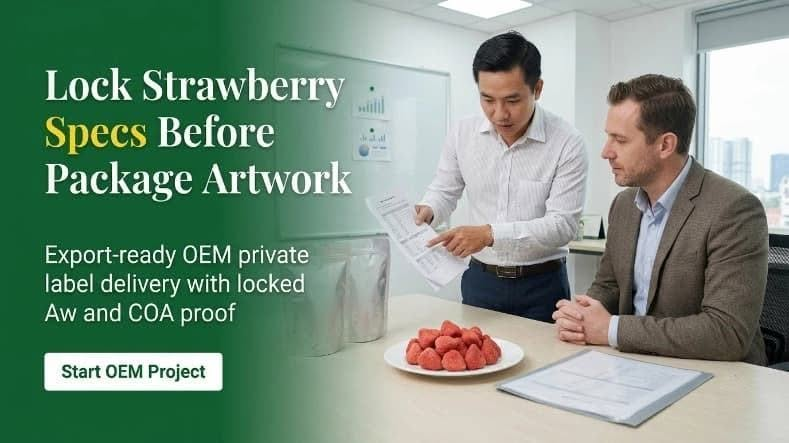
Private Label Freeze-Dried Strawberries from Vietnam: From Brief to Pallet
Yes, FruitBuys packs freeze-dried strawberries under your brand: from 3,000–5,000 pouches per SKU on digital print, or from 500 kg per SKU (about 20,000 pouches of 25 g) on rotogravure, in 15–50 g snack packs or larger pouches, as straight strawberry or a custom mix with banana, mango or dragon fruit. With the spec signed and the artwork approved, a container of finished pouches is typically ready in 5–8 weeks.
The pouch carries the strongest message in the snack aisle: one ingredient, Strawberries, no added sugar and a red the shopper can see. FruitBuys Vietnam handles the fruit, the pouch, the filling, the label data and the export file at qualified partner facilities; your team owns the brand, approves the golden sample and signs off the artwork. This guide walks through the five steps, the mixes, the timeline and the first order that fits your launch.
| Key numbers | |
|---|---|
| MOQ | 3,000–5,000 pouches per SKU on digital print · 500 kg per SKU (about 20,000 × 25 g) on rotogravure |
| Snack and retail packs | 15–50 g stand-up zip pouches; 30, 50, 100, 500 g foil zip pouches or your own size |
| Mixes | 2–4 fruits per pouch, ratio set by weight, held within ±2–3% |
| Pouch printing | Digital 7–10 working days · rotogravure 15–20 working days |
| Production | 20–30 days per 20ft after deposit |
| Spec and artwork to container | Typically 5–8 weeks |
| Shelf life | 12 months at ≤25 °C, RH ≤60%; 18–24 months in cool storage at ≤18 °C, RH ≤50% |
How does private label work with FruitBuys?
You bring the brand and the market; FruitBuys runs the supply chain behind the pouch. FruitBuys coordinates strawberry growing areas in the Lam Dong highlands, locks one qualified partner facility for your programme, sets the process standard, releases each lot against your specification and prepares the export documents. Your programme stays at that facility: any change needs written notice and a new sample approval, and the facility is open to your audit.
| Step | What happens | Who decides | Typical time |
|---|---|---|---|
| 1. Brief and spec | Market, cut, pouch, mix, label, target date | You and FruitBuys | A few working days |
| 2. Samples and golden sample | Samples cut and packed to the spec, approved in writing | Your R&D and QA | 3–5 working days + courier |
| 3. Artwork and label | Nutrition panel, claims, market text, barcode | Your agency, data from FruitBuys | Set by your team |
| 4. Pouch print and packing | Pouches printed, filled and sealed at the source | FruitBuys | 2–3 weeks print, 20–30 days production |
| 5. Pre-shipment approval and loading | Sample from your packed lot, COA, documents | You approve, FruitBuys ships | Before the container is stuffed |
Step 1: Brief and specification
A one-page brief decides most of the cost and every later step. Send:
- Market and channel: US, EU, UK, UAE; supermarket, Amazon, gift, kids’ snack, café.
- Cut: whole berries for a gift pouch; slices for the classic snack; dice or crumble for mixes, toppers and kids’ packs.
- Pack: pouch size, pouch style, outer case or shelf-ready tray count.
- Mix (if any): fruits and target ratio.
- Artwork count: one design or several flavours and languages.
- Launch date and your first-year volume estimate.
FruitBuys returns a written specification (cut size, moisture ≤5.0%, water activity ≤0.30, micro limits, pouch film and fill weight), a pouch and print plan with both print routes, and a sample schedule. Moisture and water activity matter more in a retail pouch than in bulk: the pouch is opened by a shopper, not a QA team, so every bag has to be crisp on the first bite.
Step 2: Samples and the golden sample
The golden sample is the reference every container is checked against. FruitBuys prepares samples in 3–5 working days in the cut, mix and fill you briefed, packed in sealed foil with a desiccant. Your R&D team tastes, photographs and tests them; once you approve one in writing, it becomes the golden sample. A matching retained sample is held by FruitBuys, so colour, cut size, breakage and taste have a fixed reference for the life of the programme.
Two checks worth doing on the samples, with any supplier:
- Fill the pouch you plan to print. Freeze-dried strawberry slices pour at about 60–80 g/L, so a 25 g fill takes roughly 0.3–0.4 litres. A pouch sized for dried mango or nuts looks half empty, or will not close, over sliced strawberries.
- Shake a mixed pouch. Small, dense pieces settle to the bottom on the way to the shelf. If the first handful should look like the photograph, choose cuts of similar size for every fruit in the mix.
Planning a private-label strawberry snack or mix? Email [email protected] or WhatsApp +84 919 739 589 with your market, pouch size and launch date. START OEM →
Step 3: Artwork and label compliance
FruitBuys supplies the data; your agency designs the pack. Because FruitBuys freeze-dries strawberries with no added sugar, colour, preservative or carrier, the ingredient line reads Strawberries and the front panel can carry 100% strawberries and no added sugar. A mix reads as the fruits in descending order of weight, for example Strawberries, bananas.
Your agency receives:
- Nutrition panel in US Nutrition Facts or EU/UK format (kJ and kcal), from a sample of your trial or first commercial lot analysed at an independent ISO/IEC 17025 accredited laboratory, so you print numbers measured on your fruit and your mix.
- Claims check: which fibre and vitamin C claims fit your serving size and market. Values per 100 g and per serving are in freeze-dried strawberry nutrition facts.
- Shelf life: 12 months at ≤25 °C, RH ≤60%. For a longer printed date, FruitBuys runs an accelerated shelf-life study on your final pack.
- Origin and facility file: “Product of Vietnam”, lot coding, and the partner facility’s HACCP, ISO 22000, BRC (qualified processing facility) and US FDA Facility Registration documents for your retailer’s supplier approval, with Halal certification available on request.
- Market text: Arabic label text and registration data for the UAE, with your importer’s name and address; barcode or FNSKU placement for Amazon.
Retailers buying ready-to-eat berries often ask about hepatitis A and norovirus in their supplier questionnaire. FruitBuys can arrange that panel on your first lot at an accredited laboratory of your choice, so the report is in your file before the question arrives.
EU packaging rules. The EU packaging regulation has applied since August 2026: it limits PFAS in food-contact packaging and requires packaging on the EU market to be recyclable by 2030. For an EU launch, give your packaging requirements at brief stage; the film structure and the film supplier’s declarations, PFAS included, go into the pouch specification before anything is printed. Many new brands launch on a high-barrier foil pouch and plan a recyclable structure for the second artwork run.
Step 4: Packing: pouches, snack packs and cases
| Choice | Options |
|---|---|
| Snack packs | 15–50 g stand-up zip pouches, single-serve to sharing size |
| Retail pouches | 30, 50, 100, 500 g foil zip pouches, or your own size |
| Film | Full foil PET/AL/LLDPE, about 80–120 µm in total; or a window pouch in high-barrier laminate (PVDC-coated K-PET/LLDPE or AlOx/SiOx-coated PET/LLDPE) |
| Inside every pouch | Food-grade silica gel desiccant; optional light nitrogen flush as a cushion against breakage on the shelf |
| Outer case | Your count; typical for 25–30 g pouches: 40–50 per 5-ply master case, or 4 shelf-ready trays of 10–12 |
| Marketplace labels | Carton and pallet labels to your instructions; UPC or FNSKU printed on the pouch for Amazon FBA |
Pouches are filled and sealed in a dehumidified packing room at the source, so the fruit goes into your pouch as crisp as it left the dryer. A window sells strawberries better than any photograph, so FruitBuys supplies window pouches only in high-barrier film and writes the structure into the pouch spec; for long distribution chains, a full-foil pouch with a strong photograph keeps every berry red to the last day. Film, desiccant and storage detail is in freeze-dried strawberry packaging and shelf life.
Which print route pays for your first run? Digital, until the reorder is confirmed. Rotogravure needs an engraved cylinder for each colour of each design, typically USD 60–90 per colour from Vietnamese print partners; digital needs none but runs about 30–40% more per pouch. The breakeven:
Breakeven pouches = total cylinder cost ÷ (digital price per pouch − rotogravure price per pouch)
For a six-colour design, that usually lands around 15,000–20,000 pouches. Launch SKUs, seasonal editions and multi-flavour tests run digital; a SKU already listed with a retail chain moves to rotogravure. Order pouches 3–5% over the fill count for pre-made pouches and 7–10% for rollstock, which covers line set-up, so your 20,000-pouch order delivers 20,000 filled pouches.
Custom mixes: strawberry with banana, mango or dragon fruit
Strawberry and banana is the mix shoppers search for, and it works for a reason: the tart red berry against the sweet, creamy banana gives a snack that tastes complete with nothing added. FruitBuys freeze-dries banana, mango and red dragon fruit in Vietnam on the same carton and quality standard as strawberries, so a mixed pouch is packed at one partner facility, under one specification, on one set of export documents.
| Mix | What it gives the pack |
|---|---|
| Strawberry + banana | The classic: tart and creamy, kid-friendly, easy flavour story |
| Strawberry + mango | Bright red and gold, tropical, sweeter profile |
| Strawberry + red dragon fruit | Deep red and magenta, striking through a window pouch |
| 3–4 fruit “berry tropical” | Range-defining SKU for a brand with several single-fruit pouches |
How a mix is held to spec:
- Ratio by weight, written into the specification; your R&D sets it, and an equal-parts blend is an easy starting point for a tasting panel.
- Each fruit dosed by weight into every pouch, held within ±2–3% of the target ratio, and the total fill checkweighed.
- Matched cut sizes so the mix stays even from the first handful to the last.
- Each fruit released against its own spec before blending, so moisture and water activity are right for every component.
A mix also lets one container carry a whole range: single-fruit pouches and mixed pouches can ship together on the same carton standard, which typically saves 15–20% in logistics cost per kilo against separate LCL shipments.
Step 5: Pre-shipment approval and loading
Before the container is stuffed, the pre-shipment sample is drawn from your packed retail lot, in your pouch, with your lot code, and sent to you for written approval. Each lot ships with a COA from an independent ISO/IEC 17025 accredited laboratory for moisture, water activity and microbiology, plus the standard export file: commercial invoice, packing list, bill of lading, certificate of origin (EUR.1 for the EU and UK) and a phytosanitary certificate with every shipment. A retained sample from every container lot is kept for the full shelf life, so the tenth container is checked against the same golden sample as the first. The full RFQ and sample-approval checklist is in freeze-dried strawberry RFQ and sample checklist.
Timeline and MOQ: which first order fits your brand?
| Your situation | Start with |
|---|---|
| New brand testing the category | One or two SKUs from 3,000–5,000 pouches each, digital print, 15–30 g sliced |
| Snack range adding strawberry | A straight strawberry pouch plus a strawberry-banana mix, digital first |
| Amazon or DTC seller | Digital print with FNSKU on the pouch, cases labelled for FBA |
| Retail chain own label | Full container, rotogravure, accelerated shelf-life study on the final pack |
| Below 3,000 pouches per SKU | The same fruit in 1–5 kg bulk foil bags, packed in your own country, moving to Vietnam-packed pouches once volume proves out |
Pack straight-strawberry SKUs from dry-season fruit (December to April), which is firmer, deeper red and sweeter, and hold the cartons in cool storage, where sealed pouches keep 18–24 months. Rainy-season fruit suits dice and crumble in mixes and toppers. The harvest calendar is in benefits of Vietnamese strawberries.
Start your private-label programme
Send your market, cut, pouch size, mix, number of artworks, case count and launch date. FruitBuys returns a specification, a pouch and print plan with both print routes, a season plan for your SKUs and a sample schedule, so your first pouches can be on the water while your team finalises the launch. Product details are on the freeze-dried strawberries page; the full buying guide is freeze-dried strawberries in bulk; other fruits and services are on FruitBuys OEM and private label.
START OEM →
Email [email protected] · WhatsApp Export +84 919 739 589
FAQ
Can I private label freeze-dried strawberries?
Yes. FruitBuys packs freeze-dried strawberries in your printed pouches, with the ingredient line Strawberries, from 3,000–5,000 pouches per SKU on digital print. Nutrition data, origin and facility documents are supplied for your label and retailer approval.
What is the MOQ for private-label pouches?
3,000–5,000 pouches per SKU on digital print, or 500 kg per SKU (about 20,000 pouches of 25 g) on rotogravure, which gives the lowest cost per pouch once a SKU sells.
Can you mix freeze-dried strawberries and bananas?
Yes. Strawberry with banana, mango or red dragon fruit, 2–4 fruits per pouch, each dosed by weight within ±2–3% of the ratio in your specification, packed at one partner facility.
Do you help with US and EU labels?
Yes. FruitBuys supplies a nutrition panel measured on your lot in US or EU/UK format, the ingredient line, a claims check for your serving size, shelf life, origin and facility documents. Your agency places them in the artwork.
How long from artwork to shipment?
Typically 5–8 weeks from signed specification and approved artwork: about 2–3 weeks for pouch printing and 20–30 days of production per 20ft, partly in parallel, then pre-shipment approval and loading.



