Freeze-Dried Longan Processing and Critical Control Points

Freeze-dried longan process control matters because a finished sample can hide weak operations upstream. Whole Pitted longan may look clean in a small sample while bulk production fails through torn arils, seed fragments, uneven drying, high breakage, moisture pickup or a COA that does not match the released lot.
Importers, QA managers, procurement teams, R&D developers and private label buyers need to understand the process route before they approve a product specification. The question is not whether longan can be freeze-dried. The question is whether each processing step protects the approved format and release file. If the buyer reviews only the finished appearance, the real risk stays inside intake, pitting, tray loading, drying endpoint, grading and packing. FruitBuys treats processing as a Quality Control and Documentation issue under one accountable supply relationship.
The Process Starts Before the Freeze Dryer
Freeze-dried longan processing starts with raw-material acceptance, not with the freeze dryer.
Variety, maturity, intake condition and pitting suitability decide how much finished product can meet the approved format.
Buyers should verify the raw-material route before judging the dried sample.
The freeze dryer cannot repair weak fruit. It only removes water from the product that enters the chamber. Longan with poor maturity, soft arils, cracked skin, fermentation odor, mixed variety or delayed handling creates loss before drying begins.
FruitBuys starts the process route with Raw Material Sourcing Governance. That means the growing area, harvest timing, variety direction, maturity and raw-material intake must align with the buyer’s intended format. A Whole Pitted snack needs stronger shape retention than powder. A tea garnish needs visual appearance and aroma. A cereal inclusion needs size and fines control.
Buyers qualifying the full product route should first review the freeze-dried longan buyer guide. For raw-material selection, the correct technical path starts with Vietnam longan origin and harvest season, then moves into conversion and process control.
USDA FSIS explains that freeze-drying preserves foods by removing water through sublimation, where water escapes from frozen food without passing through the liquid phase. That process principle supports the need to control the fruit before freezing because the final structure reflects the condition of the material loaded into the dryer. (Ask USDA)
Raw-Material Intake and Sorting
Raw-material intake decides whether the process begins with usable fruit or hidden loss. FruitBuys should treat intake as a release gate for processing, not as a warehouse receiving step.

At intake, the file should record:
| Intake Item | What FruitBuys Checks | Buyer Risk If Missing |
|---|---|---|
| Supplier or growing-area record | Source route and traceability | Weak origin control |
| Harvest or intake date | Timing and freshness | Delayed processing risk |
| Variety direction | Aril thickness and pitting suitability | Unstable yield and shape |
| Visual condition | Cracked, damaged or fermented fruit | Off-odor and reject loss |
| Maturity | Texture, sweetness and process behavior | Tearing, collapse or weak aroma |
| Foreign matter | Leaves, stems, soil, insects or debris | Inspection and food-safety risk |
| Raw-material lot code | Link from fruit to production | COA cannot support traceability |
Sorting should remove fruit that shows fermentation, pest damage, excessive softness, rupture, decay or foreign matter. This step affects both yield and QA. If the intake standard allows weak fruit into peeling, later operations carry the damage forward.
The fresh-to-dry conversion ratio explains how raw-material basis affects yield. This process article uses that conversion logic to show where loss enters the production route.
Washing, Peeling and Pitting Control
Longan processing becomes sensitive when peeling and pitting start. The product shifts from protected fruit to exposed flesh. From this point forward, hygiene, tool control, surface condition and foreign-material inspection matter more.

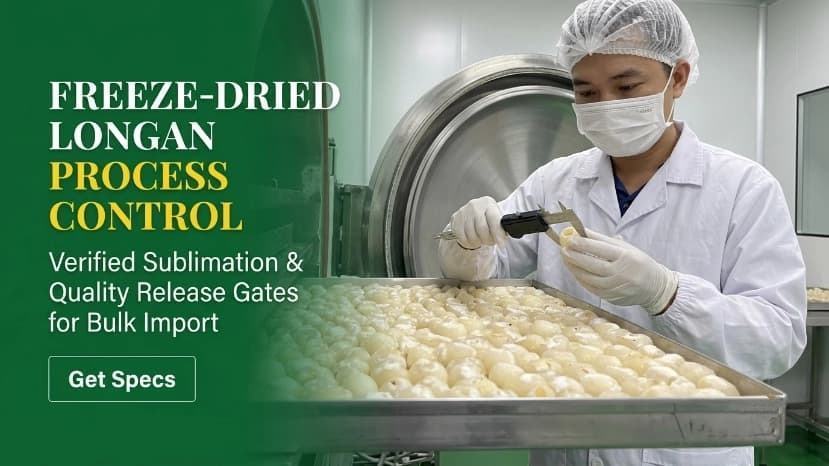
The pitting step creates the biggest visual risk for Whole Pitted longan. The operator must remove the seed without tearing the aril ring beyond the approved grade. Weak pitting control can create:
- Torn flesh
- Seed fragments
- Peel fragments
- Juice loss
- Inconsistent opening size
- Higher broken-piece rate
- Lower Whole Pitted recovery
- Downgraded chunks or powder input
Codex CXS 360-2020 identifies dried longan flesh as a style of dried longan and includes defect concepts such as broken flesh and extraneous vegetable material. That supports the buyer’s need to define broken flesh, seed fragments, peel fragments and foreign matter as processing and grading issues, not only appearance issues. (FAOHome)
FruitBuys should control peeling and pitting through written work instructions, tool accountability, operator training, inspection points and lot records. If the process uses knives or pitting tools, the record should show tool issue, tool return and defect checks. A missing tool-control record exposes the buyer to a foreign-material gap that a finished photo cannot resolve.
This is where Quality Control must connect to Documentation. The buyer should not accept “hand-peeled” or “manual pitting” as a quality claim. The buyer should ask how FruitBuys verifies pitting defects, seed fragments, peel fragments and broken flesh before freezing.
Draining, Holding and Pre-Freezing
After pitting, longan flesh carries surface moisture and exposed sugars. If the product waits too long before freezing, texture, color, aroma and microbiological risk can drift. The buyer should ask how FruitBuys controls the time between pitting, draining, tray loading and freezing.

Draining protects the process in two ways. First, it reduces unnecessary surface water that increases drying load. Second, it helps avoid localized ice buildup that can affect product shape and tray uniformity.
The holding stage needs clear limits. FruitBuys should define:
- Maximum holding time after pitting
- Holding temperature where applicable
- Covered or protected container requirements
- Clean-zone handling
- Lot separation
- Reinspection before tray loading
Pre-freezing must prepare the product for sublimation. If longan pieces freeze unevenly, the drying profile can vary across the tray and between trays. If the arils stick together before freezing, the final product can show fused surfaces, broken edges or uneven drying. This is not a cosmetic issue. It determines whether the dryer receives a uniform load.
Tray Loading Controls
Tray loading looks simple, but it controls drying uniformity, shape retention and final breakage. Longan arils should not be loaded as a wet heap. Excessive overlap creates uneven heat and mass transfer. Overloaded trays can produce wet spots, longer drying time and unstable Aw.

FruitBuys should define tray loading by:
| Tray Loading Factor | Control Question |
|---|---|
| Product weight per tray | How much flesh enters one tray? |
| Layer depth | Is the product single-layer or overlapping? |
| Piece spacing | Are arils separated enough for drying? |
| Drip control | Is surface water controlled before loading? |
| Tray identity | Can each tray connect to the batch? |
| Visual arrangement | Does the loading method protect Whole Pitted shape? |
The buyer should request the tray-load standard for production, not just for sample runs. Small samples often receive careful spacing. Bulk production can drift when workers increase tray load to speed throughput. That shortcut can create uneven drying and more breakage.
When the target format is Whole Pitted, tray loading must protect the aril ring. When the format is Diced/Chunks, tray loading must protect size and reduce fused pieces. When the format is Powder, tray loading still matters because uneven drying can later create milling and caking risk.
Primary Drying and Secondary Drying
Freeze-drying removes ice by sublimation during primary drying, then reduces remaining bound moisture during later drying control.
The dryer cycle must be verified by product condition, moisture and Aw, not by time alone.
Buyers should request release criteria rather than accepting a verbal drying cycle.
Freeze-drying works by freezing food and applying vacuum so ice converts directly to vapor. USDA FSIS and technical food-extension sources describe freeze-drying as a process that removes water from frozen food by sublimation under reduced pressure. (Ask USDA)
In practical buyer language, the process has two critical phases:
| Phase | Main Function | Buyer Concern |
|---|---|---|
| Primary drying | Removes frozen water through sublimation | Uneven loading can leave wet spots |
| Secondary drying | Reduces remaining bound moisture | Endpoint must match moisture and Aw release limits |
The buyer does not need the supplier to publish proprietary machine settings. The buyer needs evidence that the cycle releases product within the approved specification. Time, shelf temperature and vacuum logs can support internal process control, but the finished lot still needs moisture and Aw verification.
A longan lot can appear dry on the surface while selected pieces still carry higher internal moisture. Whole Pitted arils create cavities and structural variation after seed removal. That makes representative sampling important.
The moisture and water activity control article should own the technical discussion of moisture and Aw. In this process article, the control rule is simple: drying endpoint must move into lot release, not remain inside the machine record.
Moisture and Aw Release Controls
Moisture and Aw are not the same control. Moisture measures how much water remains in the product. Aw measures available water behavior. FDA’s technical guide explains water activity through equilibrium relative humidity and identifies Aw as a key factor in preservation because it reflects water available for microbial and chemical behavior. (U.S. Food and Drug Administration)

FruitBuys uses a working target of 3–5% moisture and Aw ≤0.30 for freeze-dried longan, subject to lot-specific testing. These targets support a crisp low-moisture format, but they do not prove sterility and they do not replace microbiology testing.
The buyer should require the release file to show:
- Sample identity
- Finished lot code
- Test date
- Method
- Moisture result
- Aw result
- Specification limit
- Pass/fail status
- Link to retained sample
Low Aw can prevent microbial growth under defined conditions, but it does not erase contamination introduced before or after drying. FDA’s draft guidance on low-moisture ready-to-eat foods focuses on sanitation programs and corrective actions for pathogen contamination events, which reinforces that low-moisture products still require sanitation control and environmental discipline. (U.S. Food and Drug Administration)
Grading and Format Separation
After drying, FruitBuys must separate the dried output into approved formats. This is where gross dried output becomes saleable released product.

A batch can produce:
- Whole Pitted
- Partially broken whole pieces
- Half Cut
- Diced/Chunks
- Crumbles
- Powder input
- Rejects
The buyer should not treat all dried output as the approved SKU. Whole Pitted output must meet shape and defect criteria. Chunks must meet size and fines criteria. Powder must meet ingredient, mesh, caking and carrier requirements.
The freeze-dried longan format selection article should define format choices in detail. In process control, the important point is that grading must happen before packing and before commercial release.
Grading records should track:
| Grading Item | Buyer Purpose |
|---|---|
| Whole-piece percentage | Confirms Whole Pitted recovery |
| Broken-piece rate | Separates defect from intentional format |
| Fines | Protects cereal, snack and pouch quality |
| Seed fragments | Confirms pitting control |
| Peel fragments | Confirms peeling and inspection control |
| Color variation | Protects visual grade |
| Foreign matter | Supports QA release |
This step directly affects the sample-to-bulk consistency controls. A sample with selected whole pieces does not prove bulk grade unless the same grading criteria apply to production.
Packing Without Losing the Drying Result
Packing can destroy a good drying result when it admits moisture, creates breakage or breaks lot identity.
Freeze-dried longan needs controlled handling, high-barrier packaging, seal control and clean lot coding after release.
Buyers should review packaging before treating moisture and Aw results as commercially protected.
Freeze-dried longan absorbs moisture quickly when exposed to humid air. Packing must protect the product immediately after grading. Open exposure time, room humidity, bag structure, seal quality and handling pressure all affect final stability.

FruitBuys should control packing through:
- Low-humidity handling where operationally required
- Clean and dry packing area
- Short open exposure time
- Approved bag or pouch structure
- Seal-integrity checks
- Correct desiccant or oxygen absorber use when validated
- Product-compatible fill method
- Carton configuration
- Lot coding
- Retained sample
Packaging must match the product format. Whole Pitted pieces need protection from compression. Chunks need fines control. Powder needs caking control and stronger protection against moisture exposure. Retail pouches need artwork, coding and package integrity. Bulk bags need strong seal discipline after filling.
The packaging and shelf-life validation article should own the packaging science. This process article keeps the rule clear: drying is not complete until the product is packed in a way that preserves the release condition.
Lot Testing and Controlled Release
Controlled release ties the process record to the product the buyer receives. FDA states that 21 CFR Part 117 establishes CGMP requirements, hazard analysis and risk-based preventive controls for human food. For buyers, the operating lesson is direct: a food process needs documented controls and records, not verbal assurance. (U.S. Food and Drug Administration)
FruitBuys should align the release file with:
| Release File Item | Function |
|---|---|
| Product specification | Defines what was approved |
| Raw-material lot | Links origin to production |
| Processing batch | Connects process record to output |
| Format grade | Confirms saleable product type |
| Moisture and Aw | Confirms drying endpoint |
| Microbiology where required | Supports food-safety release |
| Residue and sulfite tests where required | Supports destination and label review |
| Packaging file | Confirms product protection |
| COA | Summarizes lot-specific test status |
| Retained sample | Supports dispute review |
| Change-control record | Protects repeat supply |
The COA and laboratory testing requirements article should define the full test file. This process article only establishes where the proof must connect. Not every process control point becomes a formal HACCP CCP.
Formal CCP designation depends on the facility’s hazard analysis, process validation and food-safety plan. Buyers should request the relevant summary or certificate scope when needed, but they should not treat a certificate logo as proof that one finished longan lot meets the approved specification.
Application Mapping
| Buyer Type | Application | Required Format | Proof Needed | FruitBuys Delivery |
|---|---|---|---|---|
| Importer | Bulk freeze-dried longan distribution | Whole Pitted, Half Cut or Chunks | Process flow, moisture, Aw, COA, grade split | Quality Control and Documentation |
| Private label brand | Retail snack pouch | Whole Pitted or controlled Chunks | Pitting control, whole-piece rate, packing record, retained sample | OEM/Private Label Delivery |
| Tea brand | Infusion or garnish | Whole Pitted or Half Cut | Shape retention, aroma, clean pitting, visual grade | Raw Material Sourcing Governance and QC |
| Cereal producer | Dry inclusion | Diced or Chunks | Size, fines, moisture control, breakage record | Format control and sample-to-bulk alignment |
| Beverage developer | Powder blend | Powder | Powder input control, moisture, Aw, mesh, carrier status | Documentation and product-format control |
| QA manager | Vendor approval | Any approved format | Process map, hazard-control summary, COA, traceability | Documentation and controlled release |
Processing decisions should follow the buyer’s application. Whole Pitted longan needs stronger pitting and breakage control. Powder needs stronger milling, moisture and packaging discipline. The same raw material and dryer cycle cannot automatically support every format without grading and release criteria.
Why FruitBuys Delivers This
FruitBuys supplies freeze-dried longan through an Integrated Product Supply Model. Growers, qualified production partners, QC, packaging, documentation and logistics operate behind one export-ready product. The buyer reviews one locked specification and one release route instead of managing disconnected explanations after a problem appears.
Under Raw Material Sourcing Governance, FruitBuys aligns variety, harvest timing, maturity and raw-material intake with the intended format. Under Quality Control, FruitBuys checks pitting, tray loading, moisture, Aw, grading, breakage and product release against the approved specification. Under Documentation, FruitBuys connects origin, process records, COA, packaging file and retained sample to the finished lot. Under Export Logistics Coordination, FruitBuys aligns carton configuration and shipment handling with product protection.
A buyer may assume the process is finished once the dryer cycle ends. It is not. The product still needs grading, packing, lot coding, COA alignment and retained-sample control. FruitBuys keeps those steps inside one supplier relationship so the buyer can approve a documented product, not just a good-looking tray sample.
Buyer Checklist
Before approving the freeze-dried longan process route, request:
- Raw-material origin and variety direction
- Maturity and intake criteria
- Peeling and pitting control method
- Seed-fragment and peel-fragment criteria
- Draining and holding controls
- Tray-load standard
- Freezing and drying endpoint criteria
- Moisture and Aw release limits
- Grading definitions for Whole, Half, Chunks and Powder
- Broken-piece and fines limits
- Foreign-material inspection method
- Packaging structure and seal-control route
- COA scope
- Retained-sample rule
- Change-control triggers
- Process-to-lot traceability
Use the freeze-dried longan RFQ checklist after locking the process controls that apply to your target format.
Summary
Freeze-dried longan processing must control raw-material intake, peeling, pitting, draining, tray loading, freezing, primary drying, secondary drying, grading, packing and lot release. FruitBuys uses a working specification of 3–5% moisture and Aw ≤0.30, subject to lot testing.
Buyers should verify seed fragments, peel fragments, breakage, COA, packaging and sample-to-bulk controls before approving bulk production under FruitBuys’ integrated product supply model.
FAQ
Where does freeze-dried longan processing start?
It starts at raw-material intake. Variety, maturity, fruit condition and lot identity affect pitting yield, drying uniformity, breakage and finished-grade recovery before the freeze dryer runs.
What is the most sensitive processing step for Whole Pitted longan?
Pitting is the most sensitive visual step. Poor control can tear the aril, leave seed fragments, increase juice loss and reduce Whole Pitted recovery.
Why does tray loading matter?
Tray loading affects drying uniformity. Overlap or excessive load can create wet spots, longer drying time, uneven Aw and more breakage after drying.
Can low Aw replace microbiology testing?
No. Low Aw helps control growth under defined conditions, but it does not prove pathogen absence. Buyers still need risk-based microbiology and sanitation controls.
Should buyers ask for machine settings?
Buyers do not need proprietary settings. They need release criteria, moisture and Aw results, grade records, COA, retained samples and evidence that the process matches the approved specification.
How does process control connect to sample approval?
The approved sample should become measurable criteria for bulk production. Format, moisture, Aw, breakage, seed fragments, packaging and COA must remain consistent from sample to release.
Conclusion
Submit the target format, defect limits, moisture/Aw targets, packaging route and COA scope so FruitBuys can review the freeze-dried longan processing controls before sample approval.
References
- USDA Food Safety and Inspection Service. “Does freeze-drying make food shelf stable?” (Ask USDA)
- Virginia Cooperative Extension. “Factors that Impact Small-Scale Freeze Dryer Effectiveness.” (Tài Nguyên Xuất Bản)
- U.S. Food and Drug Administration. “Water Activity (aw) in Foods.” (U.S. Food and Drug Administration)
- U.S. Food and Drug Administration. “Draft Guidance for Industry: Establishing Sanitation Programs for Low-Moisture Ready-to-Eat Human Foods and Taking Corrective Actions Following a Pathogen Contamination Event.” (U.S. Food and Drug Administration)
- U.S. Food and Drug Administration. “FSMA Final Rule for Preventive Controls for Human Food.” (U.S. Food and Drug Administration)
- U.S. Food and Drug Administration. “Current Good Manufacturing Practices (CGMPs) for Food and Dietary Supplements.” (U.S. Food and Drug Administration)
- Codex Alimentarius Commission. “CXS 360-2020: General Standard for Dried Fruits.” (FAOHome)