How many kilos of fresh longan make 1 kg of freeze-dried longan?
8 to 9.5 kg of whole fresh longan go into every kilogram of freeze-dried longan: about 8–8.5 kg in the dry main crop, 9–9.5 kg when rain-season fruit carries more water. That ratio is the single biggest line in the cost of the product, because every extra kilogram of fresh fruit per finished kilogram adds roughly 11–12% to the raw material bill. Know the ratio, know which season your lot comes from, and you can read any freeze-dried longan quote in a few minutes.
Why does it take 8–9.5 kg of fresh longan?
Because two things leave the fruit before it becomes a crisp ball: the parts you cannot eat, then the water.
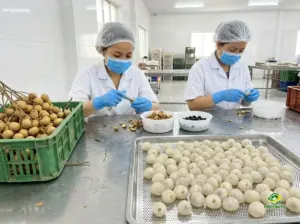
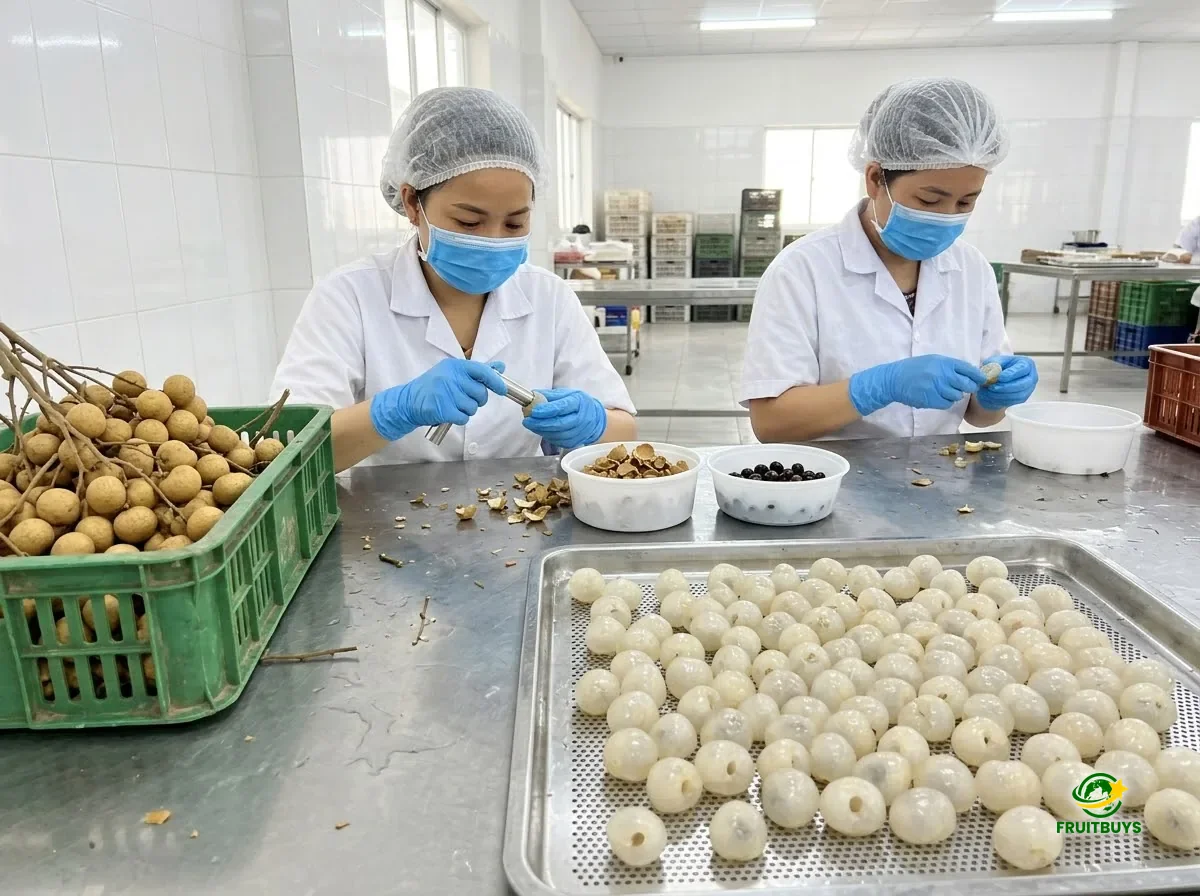
Longan aril is about 83% water. Of every kilogram of peeled, deseeded aril, only around 170 g is fruit solids, and those solids are what you buy. Before that, the shell and the large glossy seed come off by hand, split or soft fruit is sorted out, and some juice runs off at the peeling table. In real operation, 30–40% of the fruit weight that arrives at the facility gate never reaches the drying tray.
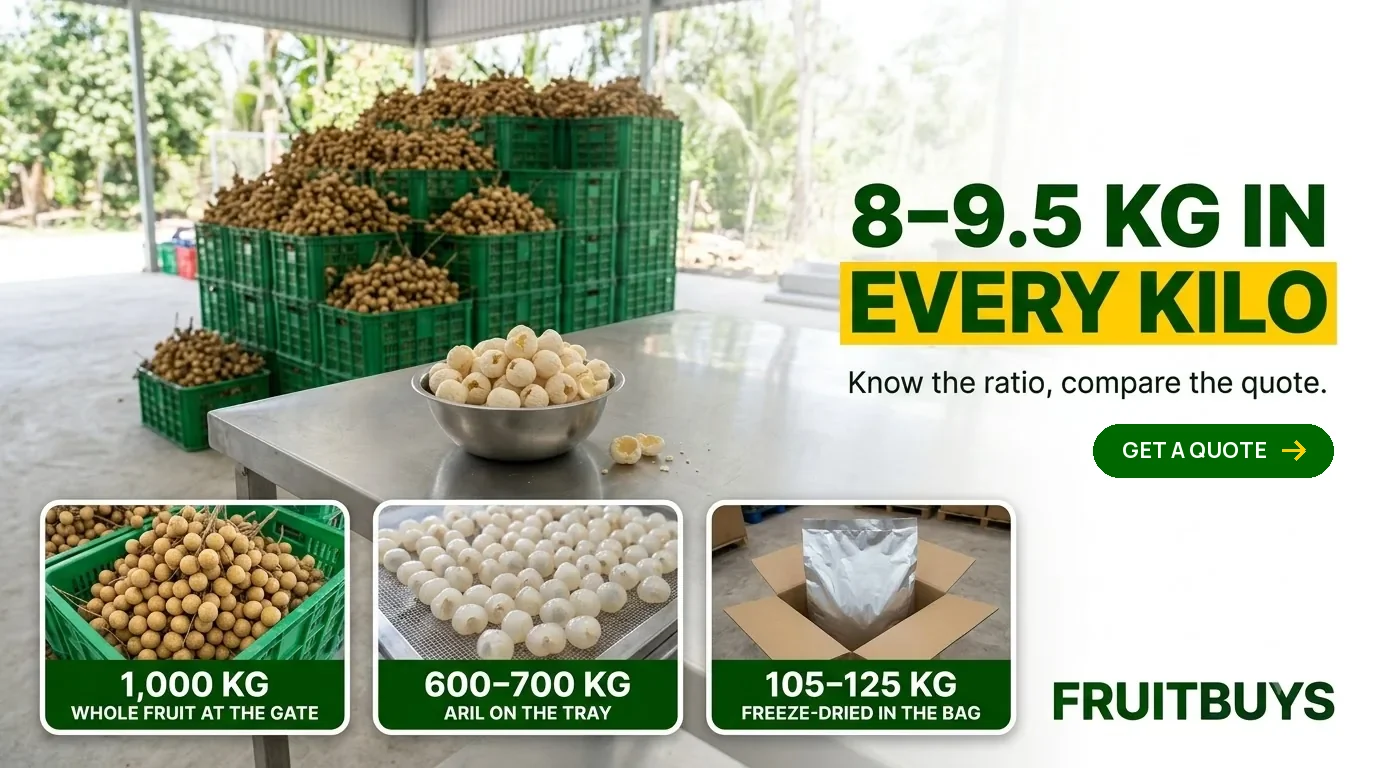
Follow one tonne of whole longan through the facility:
| Step | Weight | What happens |
|---|---|---|
| Whole fresh longan at the gate | 1,000 kg | Bunches stripped, fruit graded at 18–22 °Brix |
| Peeled, deseeded aril on the tray | 600–700 kg | Shell, seed, sorting and peeling drip removed |
| Freeze-dried longan in the bag | 105–125 kg | Water removed to ≤4% moisture |
| Fresh fruit per kg finished | 8–9.5 kg |
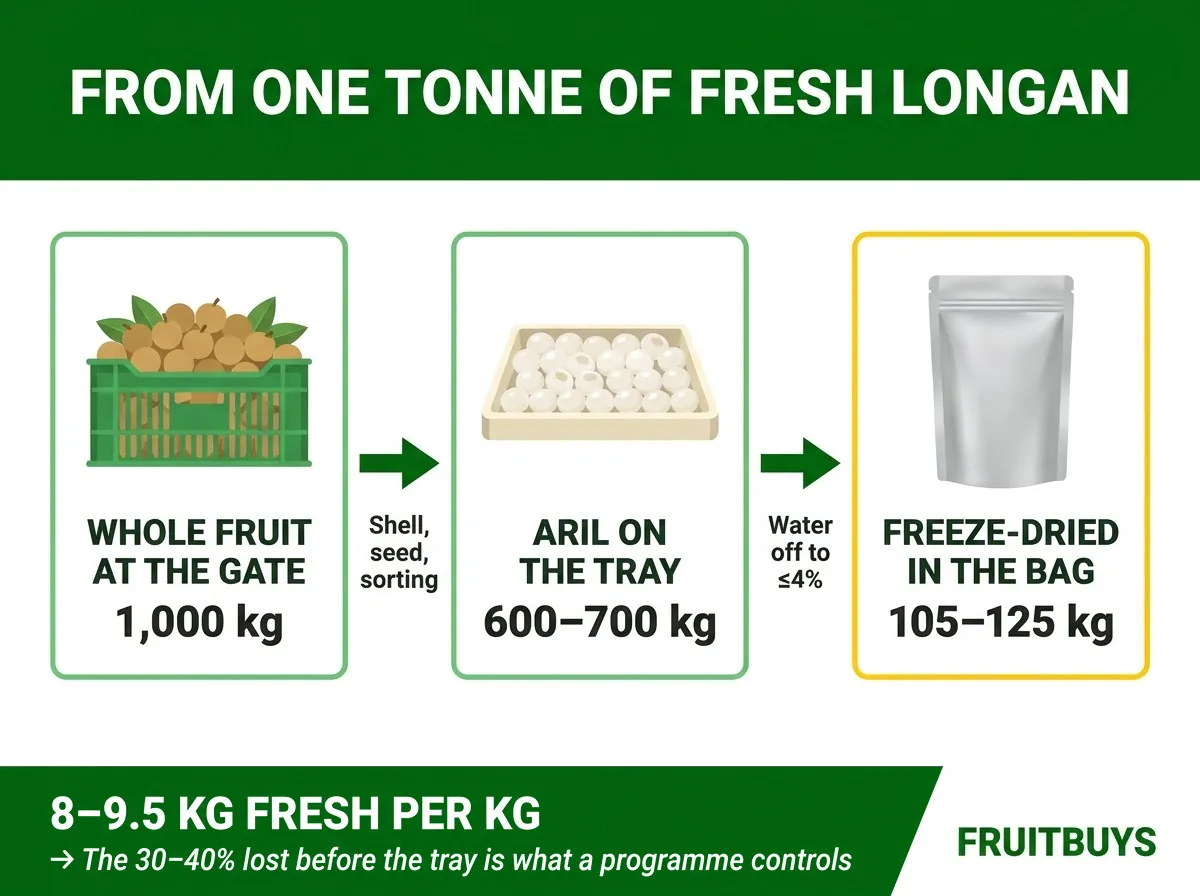
The water is not a loss you can engineer away; it is the definition of the product. What a good programme controls is the 30–40% before the tray: ripe fruit with a thick aril, peeled fast and cleanly, so more of what you paid for at the gate ends up in your carton.
What does one kilogram buy you in the pack?
Taking out the seed and 83% of the water does not remove the fruit; it concentrates it. The honey-floral aroma and natural sweetness of a full basket of fresh longan end up in one kilogram of light, ivory balls, and that kilogram goes a long way:
| Measure | Freeze-dried longan |
|---|---|
| Whole balls per kg | about 600–800 |
| Balls in a 35 g retail pouch | about 20–28 |
| Shelf look of a 35–50 g pouch | as full as a 100–120 g pouch of chewy dried fruit |
Read the 8–9.5 kg ratio on the kilogram and the product looks expensive. Read it on the pack, the cup of tea or the dessert topping, where a few balls carry the flavour of a handful of fresh fruit, and the fruit cost per unit you sell is what decides your margin.
Whole fruit or aril: which basis is a quote using?
Ask this first, because the same product can be described with two very different numbers.
| Basis | Ratio per kg finished | Who uses it |
|---|---|---|
| Whole fresh longan (shell and seed on, as bought from the orchard) | 8–9.5 kg | Procurement cost, what the farmer is paid on |
| Peeled, deseeded aril (what goes onto the dryer tray) | about 5.5 kg | Process engineering, dryer loading |
A supplier quoting “5.5 to 1” is not more efficient than one quoting “9 to 1”; they are describing the same fruit at different points. When you compare two offers, put both on the whole-fruit basis, because that is where the money is spent.
How does the season change the ratio?
Longan sold to FruitBuys’ partner facilities comes mostly from Mekong Delta orchards, where growers stagger flowering so fruit ripens every month, with a peak in June and July. The ratio moves with the weather the fruit grew in:
| Fruit | Typical ratio | Why |
|---|---|---|
| Main crop, dry weather, 20–22 °Brix | 8–8.5 kg | Thick, firm aril, more solids per kilogram |
| Rain season or off-season fruit, 18–19 °Brix | 9–9.5 kg | The fruit takes up water; more is dried off for the same solids |
The finished product meets the same specification either way: ≤4.0% moisture, aw ≤0.25 at release. What changes is how much fresh fruit it took to get there. A programme that runs on scheduled call-offs through the year averages the seasons; a buyer who books only in the rains should expect the upper end of the ratio in the raw material cost.
What should a complete freeze-dried longan quote include?
Every freeze-dried longan price is built from the same six lines. Lay quotes side by side on this table and the comparison becomes fair:
| Cost line | What drives it | What to check on the offer |
|---|---|---|
| 1. Fresh longan | Orchard price × 8–9.5 kg per kg finished | Ratio stated on whole-fruit basis |
| 2. Peeling and deseeding | Hand labour per kg of aril | Whole deseeded balls, not halves sold as whole |
| 3. Freeze-drying | 18–24 hours of vacuum dryer time per batch | Release moisture ≤4.0%, aw ≤0.25 |
| 4. Packing | Foil barrier bag, silica gel, 5-ply carton | Soft vacuum, no nitrogen; bag size matched to your batch |
| 5. Testing | Lot COA, sulfite result | ISO/IEC 17025 laboratory named on the COA |
| 6. Export dossier and inland freight | C/O, phytosanitary certificate, trucking to Cat Lai | Documents listed in the offer |
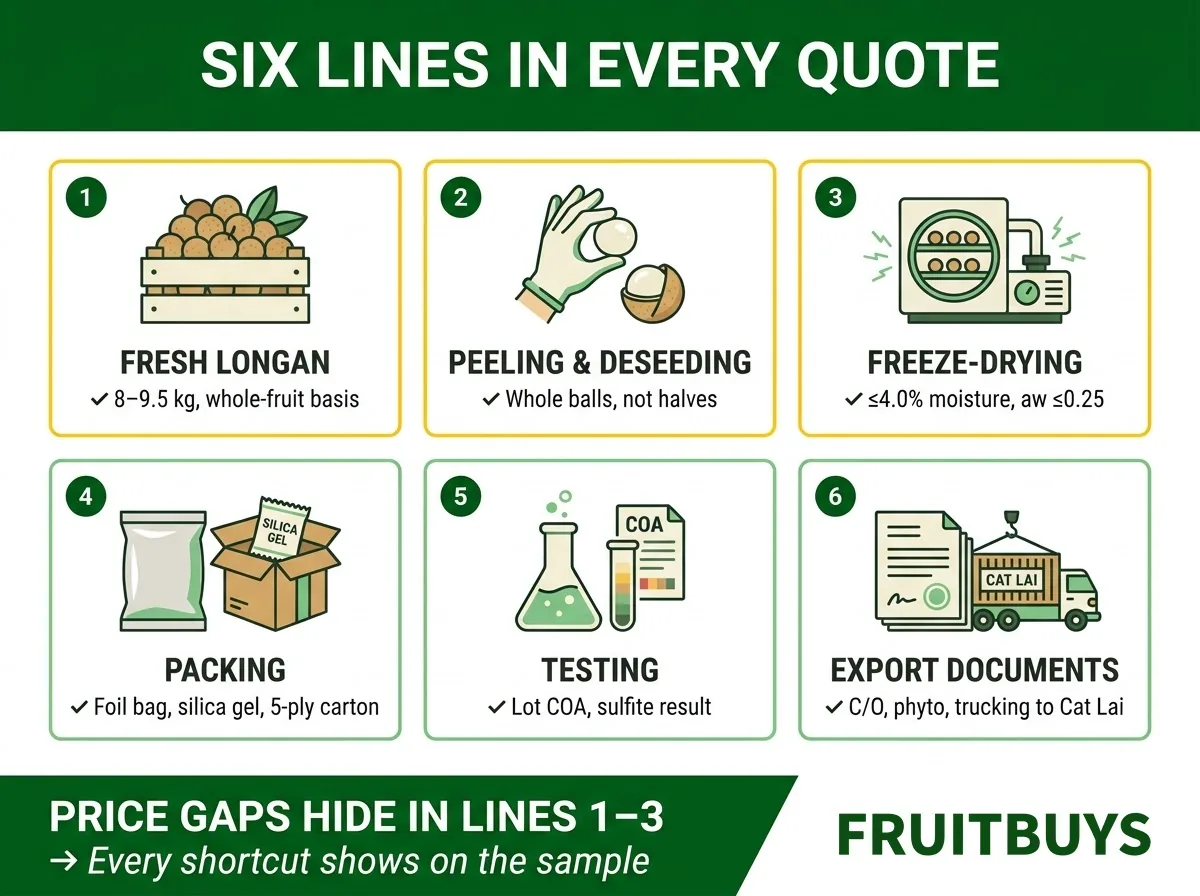
When one offer sits well below the others, the gap is almost always in lines 1 to 3, and it usually comes from one of four shortcuts. Each one shows on the sample:
- Syrup infusion. Arils soaked in sugar syrup before drying pick up sugar solids, so a kilogram of finished product can come from 5–6 kg of fresh fruit instead of 8–9.5 kg. The ratio looks efficient because part of what you are buying is sugar at fruit prices. Check: the ingredient line reads “longan” only, and the balls do not feel sticky or taste candied.
- Thin-fleshed fruit. Cheap fruit with a thin aril tears when the seed comes out, and dries flat and broken instead of round. Check: count whole balls in 200 g against the ≤10% broken limit.
- High moisture. Above 5% on the COA, part of each kilogram is water you are paying fruit prices for. Check: measured moisture and aw on the COA.
- Heat-dried longan sold as freeze-dried. Dark brown and chewy is the traditional product, with a different cost structure. Check: colour, crack and the sulfite result.
These are the checks every buyer should run, on every supplier, including FruitBuys. A quote built on the same basis as yours is worth comparing; anything else is a different product.
How does a dry container replace a reefer?
Removing 83% of the water changes how the fruit travels. A 40 ft HC floor-loaded with freeze-dried longan carries 7,840–11,200 kg of finished product, the equivalent of about 60–100 tonnes of fresh longan, in a standard dry container. No refrigeration, no ripening clock and no fruit softening in transit: the product left Vietnam shelf-stable and arrives that way.
The grade decides how much of that fresh-fruit value fits in one box:
| Grade | Carton fill | 40 ft HC load | Fresh-fruit equivalent |
|---|---|---|---|
| Whole balls | 7 kg | 7,840 kg | about 65–75 t |
| Pieces | 9–10 kg | 10,080–11,200 kg | about 80–100 t |
For inclusions, where shape does not matter, pieces put about 30–40% more fruit into the same container and lower the freight cost of every kilogram. For residue checks, results on the dried product convert back to the fresh-fruit basis with a processing factor; that calculation sits in the freeze-dried longan market compliance guide.
Compare offers with one sheet
| Question to ask every supplier | Answer that makes the quote comparable |
|---|---|
| What fresh-fruit ratio is the price built on? | 8–9.5 kg whole fruit per kg, with the season named |
| What is the release moisture and aw? | ≤4.0%, aw ≤0.25, measured on the COA |
| What is the ingredient line? | 100% longan, no sugar, unsulfured |
| Which grade, and what breakage limit? | Whole balls ≤10% broken, or pieces |
| How is it packed? | Foil barrier bag, silica gel, soft vacuum |
| Which documents ship with the container? | Lot COA, sulfite result, C/O, phytosanitary certificate |
Send FruitBuys your grade, volume and destination, and the reply comes back on this same basis, with the season your lot will be packed in. The specification behind the numbers is in what moisture, water activity and COA freeze-dried longan should ship with, the full product sheet is on the freeze-dried longan product page, and the freeze-dried longan RFQ checklist lists what a firm quote needs.
FAQ
How many kg of fresh longan make 1 kg of freeze-dried longan?
8–9.5 kg of whole fresh fruit: 8–8.5 kg in the dry main crop, 9–9.5 kg for rain-season fruit.
Why is freeze-dried longan priced so far above fresh longan per kilogram?
Each kilogram holds the solids of 8–9.5 kg of fresh fruit, plus hand peeling, deseeding and 18–24 hours of vacuum drying. Per kilogram of fruit solids, it is the same fruit with the water and the waste removed.
What does the ratio look like on a peeled basis?
About 5.5 kg of peeled, deseeded aril per kilogram finished. Compare quotes on the whole-fruit basis, where the purchase cost sits.
Does the season change the quality?
No. Every lot is released at ≤4.0% moisture and aw ≤0.25. The season changes how much fresh fruit it takes, not the finished specification.
Is the same ratio true for traditional dried longan?
No. Heat-dried longan is sold at much higher moisture, so it takes less fresh fruit per kilogram and is a different product: dark, chewy and often sulfured.
Does freeze-dried longan need a refrigerated container?
No. It ships in a standard dry container. A 40 ft HC carries the equivalent of about 60–100 tonnes of fresh longan.