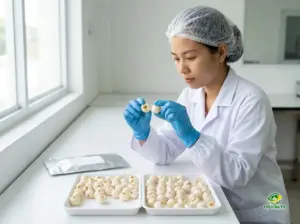
What moisture, water activity and COA should freeze-dried longan ship with?
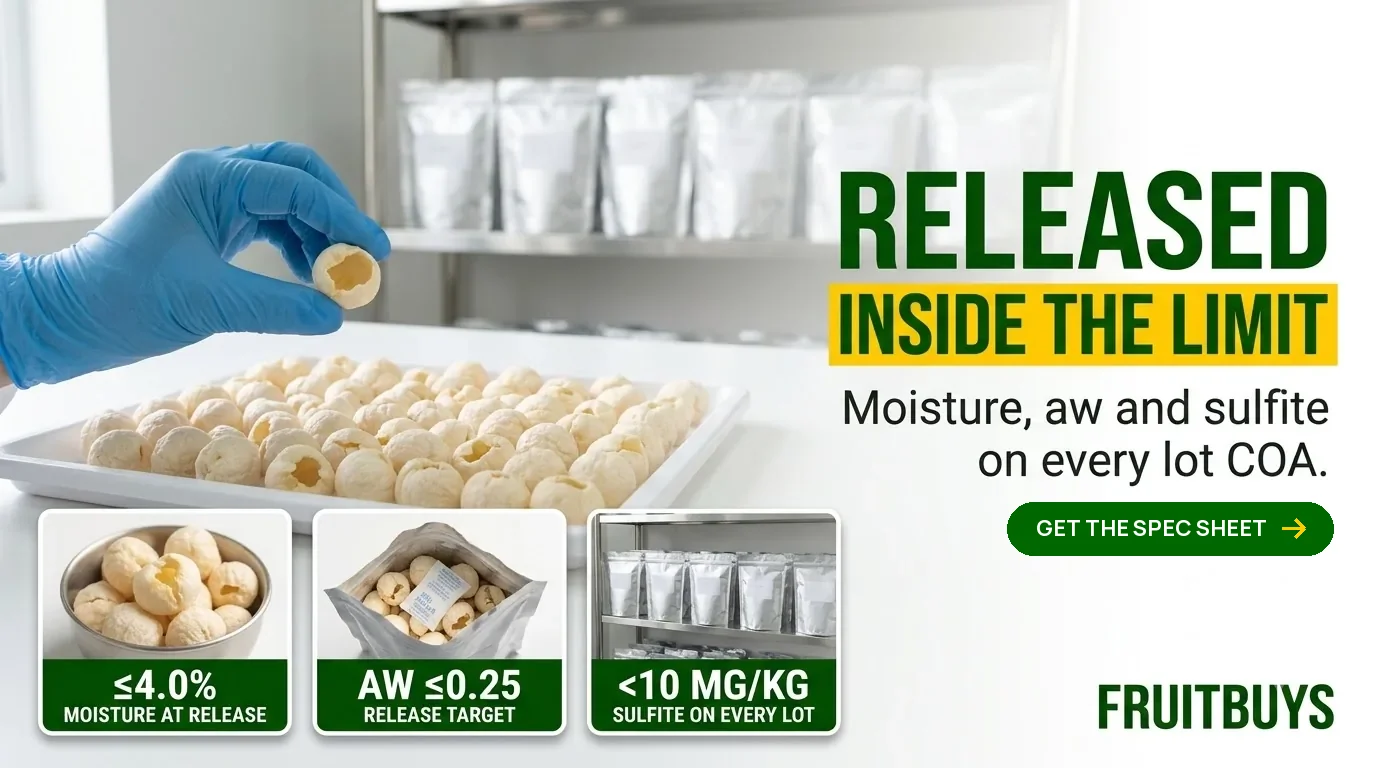
Write moisture ≤5.0% and water activity (aw) ≤0.30 into the contract, and hold your supplier to a release target inside it. FruitBuys releases freeze-dried longan at ≤4.0% moisture and aw ≤0.25, with a lot COA from an independent ISO/IEC 17025 accredited laboratory and a sulfite result below 10 mg/kg on every container, whatever the destination. Longan is one of the sweetest fruits that goes into a freeze dryer, and that sweetness is both why shoppers love it and why the buffer matters: a ball released with headroom still cracks like meringue when your team opens the carton in Rotterdam, New Jersey or Jebel Ali.
Which limits go in the contract, and which are release targets?
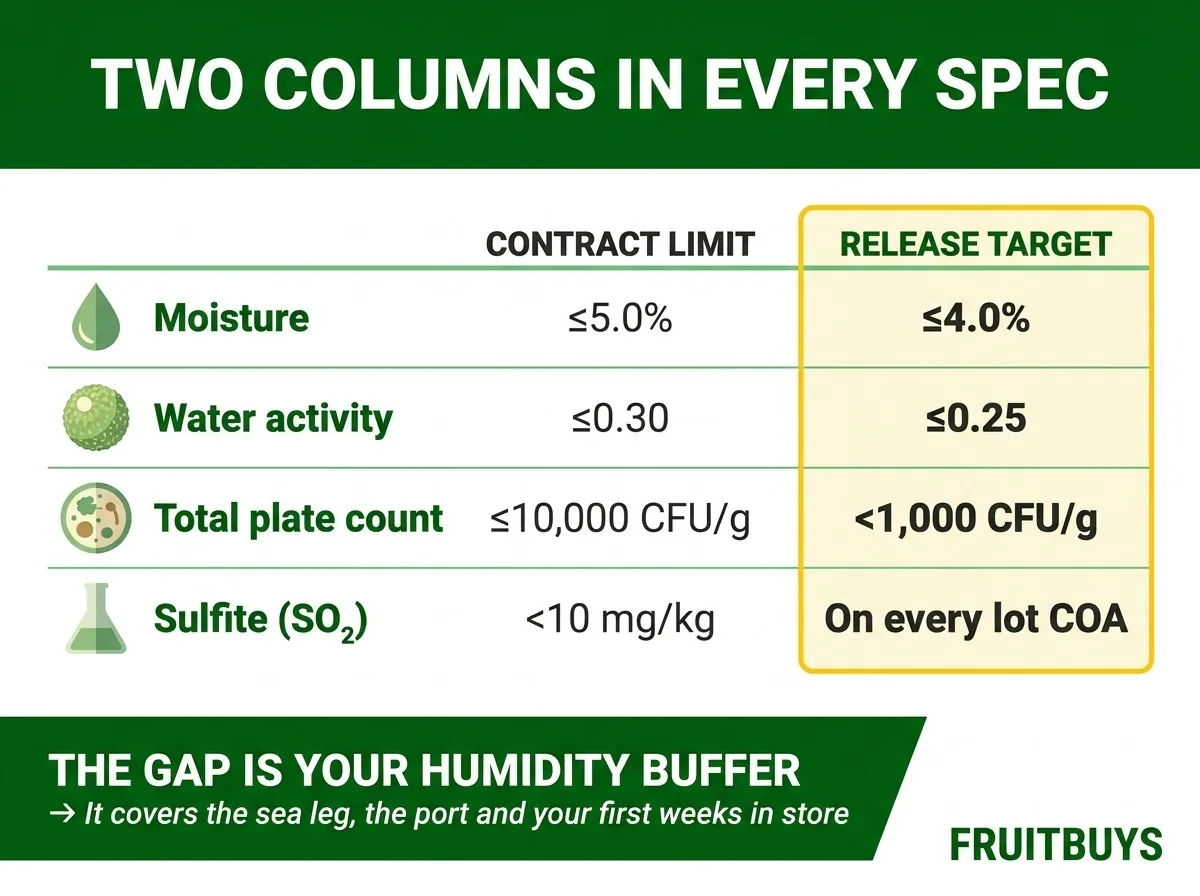
Put two columns in your specification: the ceiling your QA team accepts against, and the target FruitBuys releases at. The gap between them is the humidity buffer that covers the sea leg, the port and your first weeks of storage.
| Parameter | Contract limit | FruitBuys release target | What it protects |
|---|---|---|---|
| Moisture | ≤5.0% | ≤4.0% | You pay for longan solids, not water |
| Water activity | ≤0.30 (ISO 18787:2017) | ≤0.25 | Balls stay crisp and loose in the bag |
| Total plate count | ≤10⁴ CFU/g | <10³ CFU/g | Ready-to-eat use as snack, topping or inclusion |
| Yeasts and moulds · E. coli · Salmonella | ≤10² CFU/g · <10 CFU/g (ISO 16649-2) · not detected / 25 g (ISO 6579-1) | Zero tolerance: no lot leaves without a passing COA | Ready-to-eat safety from peeling table to shelf |
| Sulfite (as SO₂) | <10 mg/kg | On every lot COA | An unsulfured claim with nothing to declare |
Moisture tells you how much water is left in the ball. Water activity tells you how free that water is to move, and that is what decides crunch and whether anything can grow. Below aw 0.30 nothing grows, which is why freeze-dried longan needs no preservative and the ingredient line reads “longan” and nothing else.
How do batch-sized foil bags keep sugar-rich longan crisp?
Longan goes into the dryer at 18–22 °Brix, and once the water is gone that sugar lines the inside of a light, open sponge. Natural sugar draws moisture from humid air, so the whole job is to dry the ball with a buffer and keep air away from it until your line needs it. FruitBuys runs it as one chain:
- Freeze: peeled, deseeded arils are blast-frozen at −35 to −40 °C until the core is below −30 °C, so the sweet flesh is locked solid and the round cup shape is set before any water leaves.
- Dry: sublimation runs under deep vacuum, below 0.5 mbar, for 18–24 hours with shelf heat held at or below 50–55 °C. Kept below that line, the sugar never softens or caramelises: the ball stays ivory, open and crisp, and it smells of fresh longan rather than toasted syrup.
- Pack: the packing room is held at 20–24 °C and RH ≤35–40%, and every batch is bagged within 20 minutes of leaving the dryer.
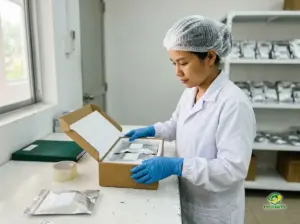
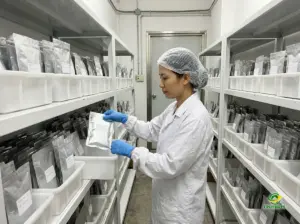
- Seal: each bulk bag is a PET/AL/LLDPE foil laminate of 100–120 µm, gently vacuumed so it sits flat without crushing the balls, and sealed with 50–100 g of food-grade silica gel. No nitrogen flush: a puffed bag wastes carton space and puts pressure on hollow balls.
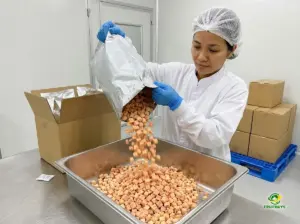
Bags hold 1–5 kg, sized to one mixing batch on your line. Your team opens a bag, empties it into the mix, and every other bag stays sealed and crisp until its turn. In the original unopened bulk bag, the product holds 18–24 months in cool storage at ≤18 °C and RH ≤50%, and 12 months once repacked into retail pouches at ≤25 °C and RH ≤60%.
What travels with each container: lot COA or baseline surveillance?
Both, and they answer different questions.
The lot COA answers “is this container right?”. Every container ships with results from an independent ISO/IEC 17025 accredited third-party laboratory for moisture, water activity, total plate count, yeasts and moulds, E. coli and Salmonella, plus sulfite. These are the numbers that can change from lot to lot, so they are measured on yours.
Baseline surveillance answers “is this supplier in control?”. Heavy metals and mycotoxins reflect the growing area and the process rather than a single lot, so FruitBuys screens them on a periodic schedule with an independent laboratory. The reports, with methods and detection limits, sit in the technical file your QA team receives for supplier approval.
When your market sets its own screen, such as EU or US pesticide multi-residue limits or a nutrition panel for label artwork, FruitBuys books it with the laboratory before the container is stuffed, so the results are in your QA file before the vessel sails. Plan 3–5 working days of lab time into the booking date.
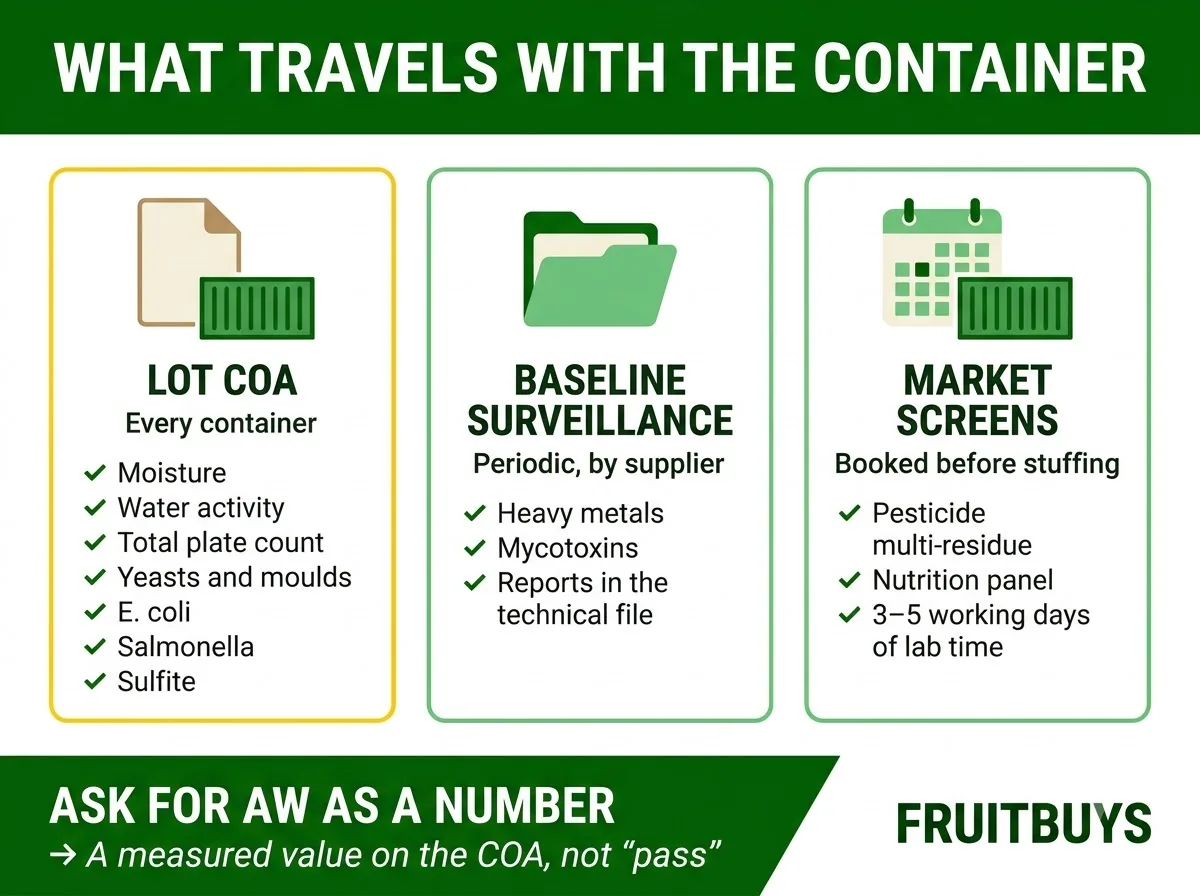
One request worth making of every supplier, including FruitBuys: ask for water activity as a measured number on the COA, not “pass”. That single figure tells your team more about how the lot will behave in your warehouse than anything else on the sheet.
Ivory with a beige rim: what does natural unsulfured longan look like?
A good lot is ivory to light cream, with a pale beige rim around the opening where the seed was. That rim is the natural colour of the aril at its thickest point, and it is the clearest visual signature of longan that has not been bleached or fumigated. Traditional dried longan is dark brown and chewy, and much of the trade has used sulfur to hold colour; freeze-drying keeps the fruit pale without it.
Use colour in your specification as a match to the approved sample, not as a single shade. Three readings tell your QA team what they are looking at:
| What you see | What it means |
|---|---|
| Ivory to light cream, pale beige rim, fresh floral aroma | Natural unsulfured longan, dried below caramelisation |
| Bright, uniform paper-white | Possible bleaching; check the sulfite result |
| Tan to brown patches, toasted smell | Heat damage or an aged lot |
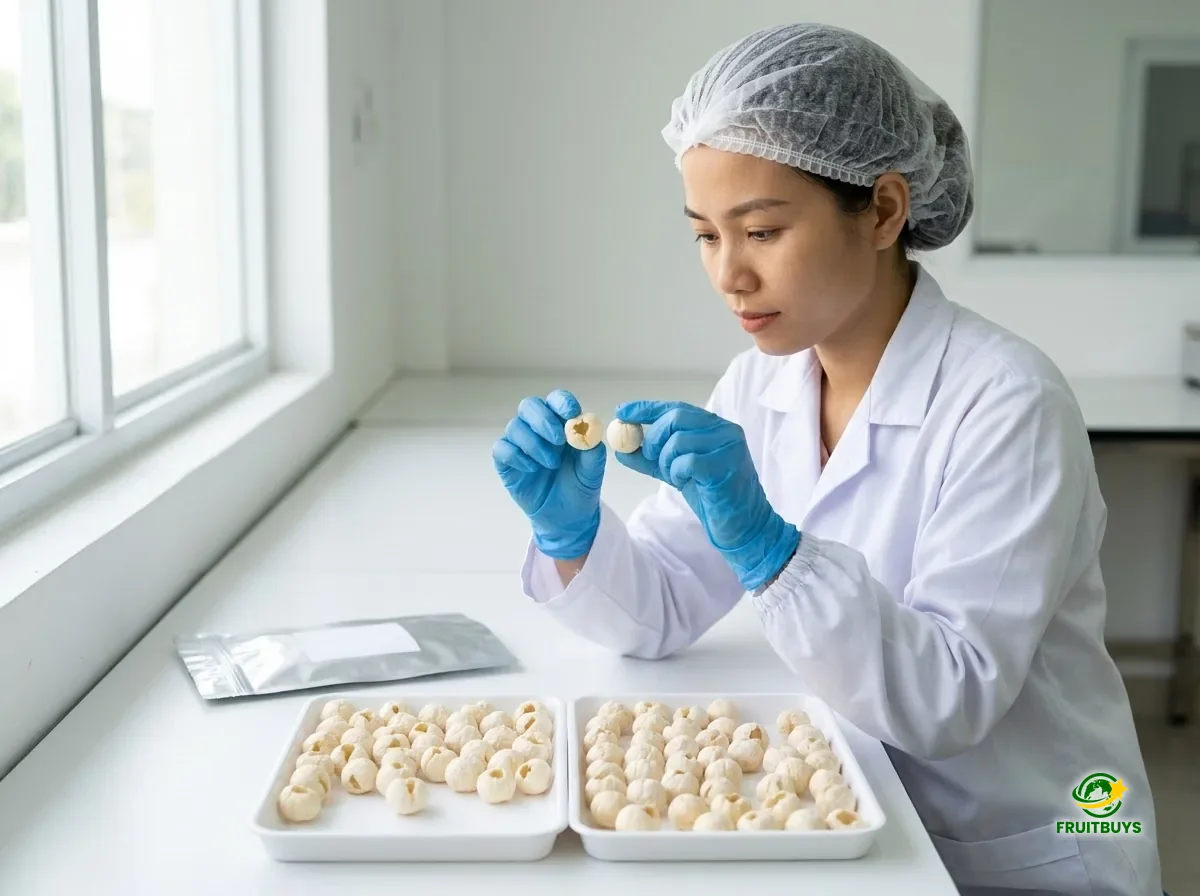
Pair the visual check with the sulfite result on the COA, and your pack can carry “unsulfured” with evidence behind it.
How much breakage and fines should a whole-ball grade allow?
A hollow ball is light, and that is its commercial strength: a 35–50 g retail pouch looks as full as a 100–120 g pouch of chewy dried fruit. The same lightness means grade limits belong in the contract.
| Grade | Size | Breakage limit | Fines (3 mm screen) | Carton fill |
|---|---|---|---|---|
| Whole balls | 18–25 mm, ≥85% on size | Broken or split balls ≤10% | ≤3–5% | 7 kg |
| Halves | Natural halves | Fragments ≤10% | ≤3–5% | 7–8 kg |
| Pieces | Broken balls and halves | No whole-ball requirement | ≤3–5% | 9–10 kg |
These limits are money on your line. With fines at ≤3–5%, 95%+ of what you pay for is whole fruit that tips straight from bag to hopper, with no one standing at a sieve. Low fines also keep sugar dust off the face of a chocolate bar and out of a cup of tea, where it turns the liquid cloudy. That is why bags are gently vacuumed rather than nitrogen-puffed: a puffed bag is squeezed when cartons are stacked, hollow balls are the first to crack, and a badly packed lot can reach port with 15–20% fines.
Every carton passes a metal detector before it is closed. Choose the grade by where the fruit ends up: whole balls for retail pouches and visual toppings, pieces for granola, chocolate and bakery inclusions, where they cost less per kilogram to buy and ship about 30–40% more kilograms in the same container.
What should you check at devanning?
A lot released at aw 0.25 in sealed foil should open at your dock as it left Vietnam. A short receiving routine within 48–72 hours of devanning lets your QA team confirm that and sign it into stock:
- Photograph the container interior and the cartons as found, before unloading further.
- Open two or three sealed bags from different rows; check crack, colour and aroma against the approved sample.
- Read water activity on a freshly opened bag within minutes: a lot released at 0.25 sits well inside the 0.30 contract limit.
- Count broken or split balls in a 200 g portion against the ≤10% whole-grade limit, and shake the same portion over a 3 mm screen for fines.
- File the lot COA and sulfite result against the lot code on the carton.
If anything differs from the approved sample, tell FruitBuys within 14 days of devanning, or within 30 days for laboratory results. FruitBuys keeps a retained sample from every container lot for its full shelf life and tests it alongside yours, so the answer rests on the same lot and the same seal.
Set your specification with this table
| Your use | What to write into the spec |
|---|---|
| Retail snack pouch or gift pack | Whole-ball grade, ≤10% broken; all six COA parameters plus sulfite; colour as approved sample |
| Herbal tea or dessert blend | Whole balls or halves; same ready-to-eat limits; sulfite result for the unsulfured claim |
| Granola, cereal or trail mix | Pieces at ≤3–5% fines for clean dosing; same ready-to-eat limits |
| Chocolate or white-chocolate bark | Pieces or halves; add the fruit to the fat phase, where it stays crisp |
| Frozen yogurt or bubble-tea topping | Whole balls; pack as a separate topper so the crunch lasts to serving |
| Hot, humid destination (Gulf, Southeast Asia) | Accept on aw; store at ≤25 °C, RH ≤60% from devanning; cool storage for stock held past 12 months |
| EU destination | Add pesticide multi-residue to the pre-stuffing panel |
| Private label with a long printed date | Accelerated shelf-life study on your final pack, run by FruitBuys as a service |
Your QA team can approve FruitBuys before the sample lands with one document set: the specification, a container-lot COA template and the baseline surveillance reports. How the process holds bulk lots to the approved sample is covered in how freeze-dried longan bulk matches the approved sample; bag, carton and container options are in freeze-dried longan packaging and container loading. The freeze-dried longan product page has the full specification, and the freeze-dried longan RFQ checklist lists what a firm quote needs.
FAQ
What water activity should freeze-dried longan have?
At or below 0.30 in the contract. FruitBuys releases at 0.25 or lower, so the balls keep a buffer against humid air on the way to you.
Why does longan need tighter humidity control than many freeze-dried fruits?
It is dried from fruit at 18–22 °Brix, so the dry ball is rich in natural sugar, and sugar draws moisture from air. Release at aw ≤0.25 and a sealed foil bag with silica gel keep it crisp.
Which tests come with each container?
A lot COA from an independent ISO/IEC 17025 accredited laboratory for moisture, water activity, total plate count, yeasts and moulds, E. coli and Salmonella, plus a sulfite result below 10 mg/kg. Heavy metals and mycotoxins are covered by periodic baseline surveillance.
Is freeze-dried longan sulfured or preserved?
No. The ingredient is 100% longan. At aw ≤0.30 it is shelf-stable without preservatives, and the sulfite result on the COA confirms the unsulfured claim.
Why is there a beige rim around the opening?
It is the natural colour of the aril where it was thickest around the seed. An ivory ball with a pale beige rim is what unsulfured, low-temperature-dried longan looks like.
How long does it keep?
18–24 months in the unopened bulk bag with desiccant in cool storage at ≤18 °C and RH ≤50%; 12 months once repacked into retail pouches at ≤25 °C and RH ≤60%.
How is a question about a lot resolved?
Tell FruitBuys within 14 days of devanning for appearance, breakage or water activity, or within 30 days for laboratory results. FruitBuys tests the retained sample from your lot alongside yours.