How to Start a Dried Mango Private Label Brand

Every time you sell dried mango under someone else’s brand, you are building their equity, not yours. You are training your customers to search for a name you do not own, at a price point you do not control, on a product you could replace with your own label and keep the margin you are currently handing to a middleman.
Dried mango private label is not a complex operation. It is a sourcing decision, a packaging decision, and a compliance decision and if you have the right supplier, all three can move from first conversation to retail-ready product in under 60 days.
This guide walks you through every step. What private label dried mango actually means at the operational level. The specifications you must lock down before designing your packaging. The compliance requirements that determine whether your product can legally be sold in the US, EU, or UAE. The real margin math. And the realistic timeline from first contact to first sale.
What “Private Label Dried Mango” Actually Means
Three terms circulate in the B2B dried fruit trade. They are not interchangeable.
White label means you purchase a pre-made product in standard bulk format and apply your own brand packaging. The product specification is fixed you choose from what the supplier already produces. Lead time is short. Flexibility is low. Differentiation is minimal because every buyer has access to the same base product.
OEM (Original Equipment Manufacturer) means you specify the product parameters variety, cut format, moisture target, packaging format, weight per unit and the supplier produces to your specification. You own the recipe in the sense that your spec sheet defines the product. FRUITBUYS VIETNAM operates on this model. OEM dried mango from 1,000kg.
ODM (Original Design Manufacturer) adds design services to OEM the supplier assists in developing the product specification, packaging design, and label compliance documentation, not just manufacturing to a spec you arrive with. For first-time brand builders who do not have an in-house food technologist or packaging designer, ODM support eliminates the gap between “I want a product” and “I have a launch-ready product.”
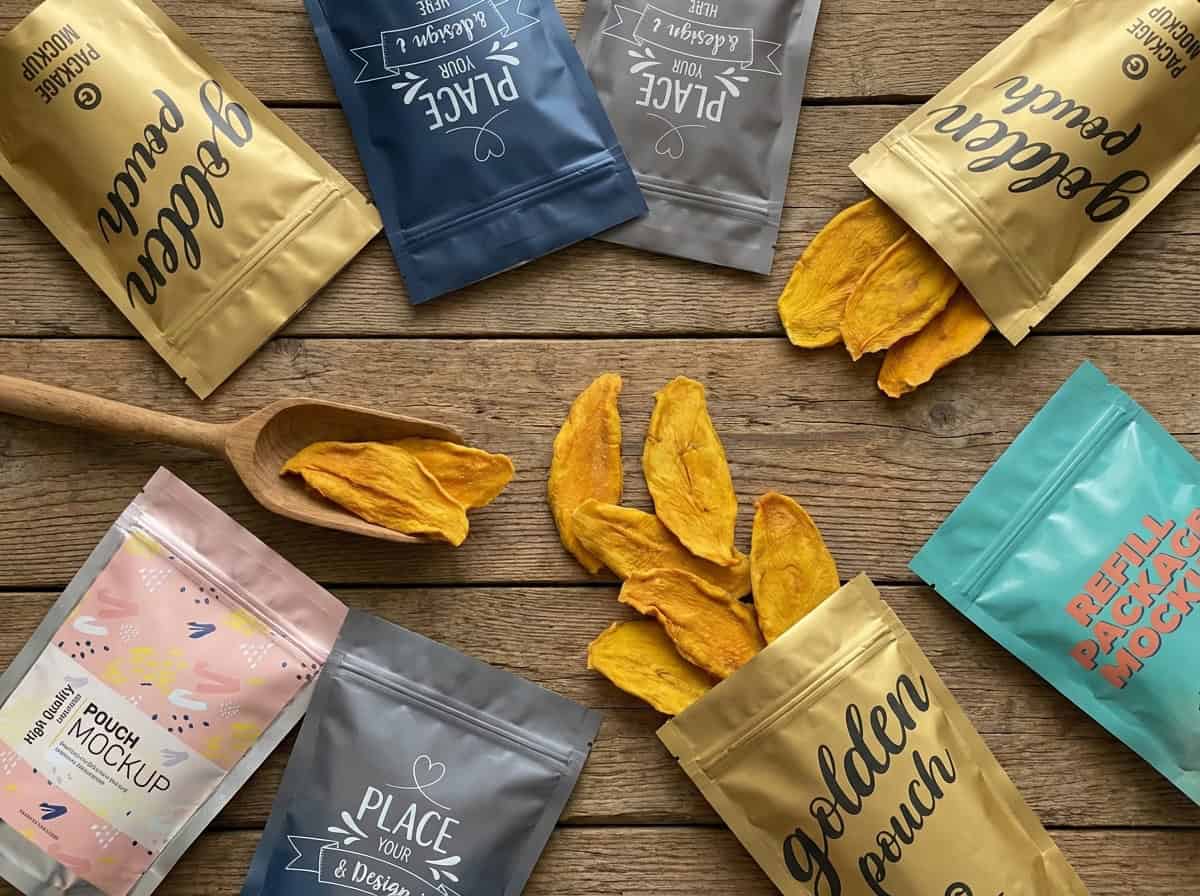
For most Amazon sellers, DTC brands, and retail private label buyers entering dried mango for the first time, OEM with ODM support is the right model. You define the commercial parameters (no added sugar, Keo or Cát Chu variety, 100g retail bags, your brand name), the supplier builds the product and supports the label. You own the brand. You control the margin.
Why Dried Mango Is the Right Private Label Product Right Now
The category is growing. The clean label signal is strong. And the margin structure works. The global dried mango market is growing at 6.2–7.6% CAGR. The no/low sugar snack segment accounts for 39% of all healthy snack claims globally. 58% of US consumers are actively reducing sugar intake and 43% inspect ingredient labels in-store before purchasing. A dried mango brand with an ingredient list reading “100% Mango (Mangifera indica)” and valid FDA claims including “No Added Sugars” and “Excellent source of Vitamin C” arrives in the health food channel with a label that closes the sale before a word of marketing copy is read.
The retail turn is fast. Dried mango is a consumable product with broad consumer familiarity, clear use occasions (snacking, baking, gifting, travel), and natural repeat purchase behavior. Once a customer finds a brand they trust in the clean label snack category, they return. The economics of private label work when product quality drives that return.
The production barrier is lower than most buyers assume. OEM dried mango starts at 1,000kg. A 1,000kg order in 100g retail bags produces 10,000 consumer units. If your retail price is $6.99 and your landed cost per unit is $2.80–$3.20, your gross margin on the first order is above 50%. That is not a hypothetical. That is the math on the product category this guide is about.
The Six-Step Private Label Launch Process
Step 1: Define Your Product Specification
Before any packaging is designed or any quote is requested, the product specification must be locked. This is not a bureaucratic step. It determines your cold chain requirement, your shelf life claim, your label compliance, and your retail channel eligibility.
The core decisions:
- Variety: Keo (year-round supply, competitive pricing, balanced sweet-sour profile), Cát Chu (18–20°Bx, premium flavor, MOQ 1,000kg), or Hoà Lộc (20–22°Bx, ultra-premium, seasonal advance booking 60 days required)
- Processing method: Hot air drying (AD) mandatory for “No Added Sugar” claim. Confirm in writing with your supplier that no osmotic pre-treatment is used.
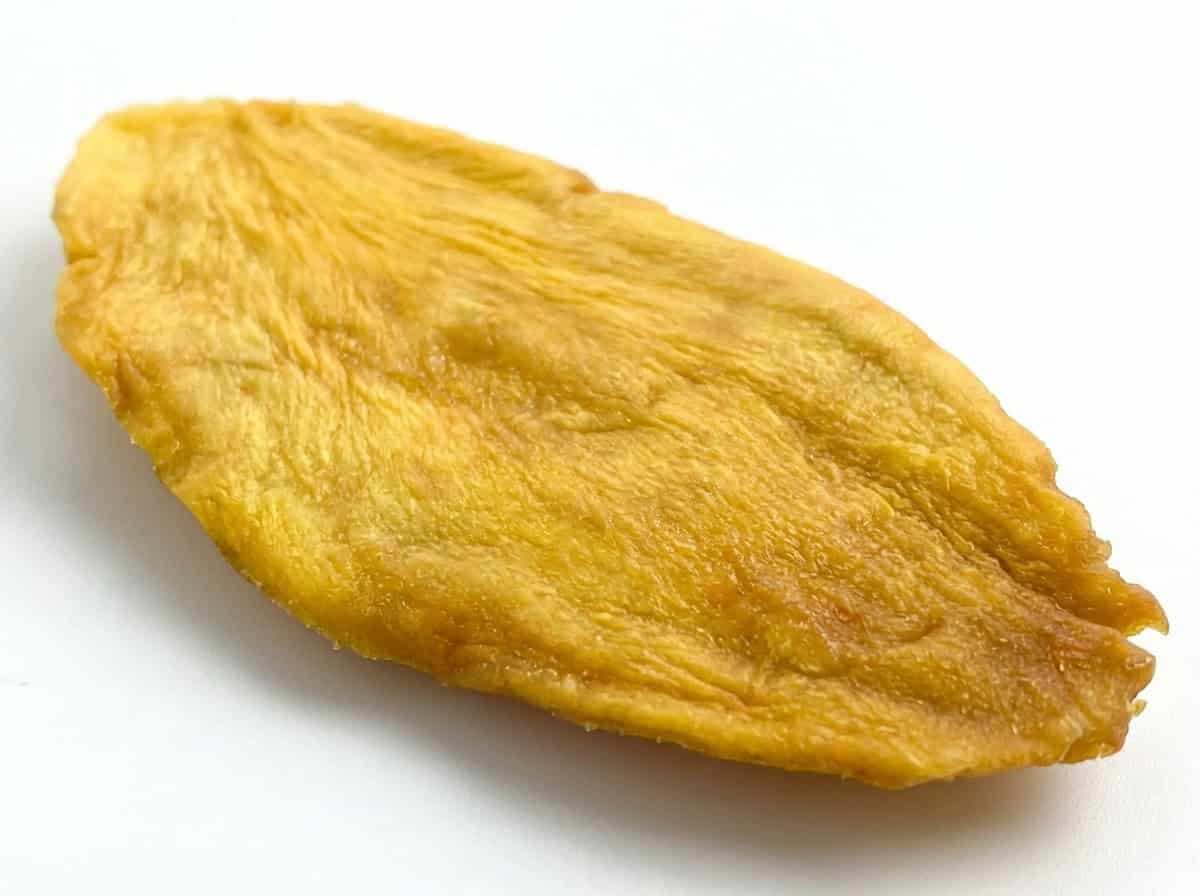
- Cut format: Slices (3–5mm) for direct retail snacking. Chunks or dice (5–8mm) for trail mix, granola, or multi-ingredient products.
- Sugar claim: No Added Sugar (0g added sugars on COA, verified by ISO 17025 lab per batch)
- Allergen statement: Produced in a facility that also processes tree nuts (cashews) required on label
- Target moisture: 15–18%, aw ≤0.60
Once the spec is confirmed, your supplier can run the COA, confirm production parameters, and give you the technical data your label requires.
Step 2: Order and Test Samples Before Any Packaging Spend
This step is non-negotiable and costs almost nothing relative to the risk of skipping it. Request samples from your shortlisted supplier. A qualified supplier ships within 3–5 business days with a full COA from an accredited lab. When the sample arrives, do three things:
First, taste it against your own retail standard. Is the texture consistent? Is the color uniform natural amber not artificially bright yellow (possible indicator of sulfites or sugar coating) and not excessively dark (possible indicator of uncontrolled Maillard browning from poor drying temperature)?
Second, send it to an ISO 17025-accredited lab in your market. Request a full sugar profile (HPLC method) and a moisture/aw measurement. Confirm added sugars are 0g and moisture is within 15–18%. This costs $80–$150 and confirms the supplier’s COA against independent testing.
Third, match the lab results to the COA batch number. The COA the supplier provides must correspond to the batch your sample came from not a separate “quality batch” kept for presentation purposes.
If all three checks pass, proceed to packaging. If any fails, move to the next supplier before spending a dollar on design.
Step 3: Design Your Packaging to Compliance Standards
Packaging for dried mango private label has two layers of requirements: brand design and regulatory compliance. Both must be on the artwork before the packaging film is printed.
For US market (FDA):
- Nutrition Facts panel in FDA 2020–2025 format (includes separate “Added Sugars” line must show 0g)
- Ingredient statement: “100% Mango (Mangifera indica)”
- Allergen statement: “Produced in a facility that also processes tree nuts (cashews)”
- Net weight in both imperial (oz) and metric (g)
- Name and place of business of the US importer of record
- “Best By” date or lot code
For EU market (Regulation 1169/2011):
- Nutrition declaration per 100g (Energy in kJ and kcal, Fat, Saturates, Carbohydrate, Sugars, Protein, Salt)
- Ingredients list in descending order of weight
- Allergen declaration
- Net quantity in metric
- Country of origin: Vietnam
- Best before date
- Name and address of EU importer or distributor
For UAE market:
- Arabic-language label mandatory
- Halal certification mark (must be from an approved UAE body)
- ESMA registration number
- Arabic ingredient list and nutrition declaration
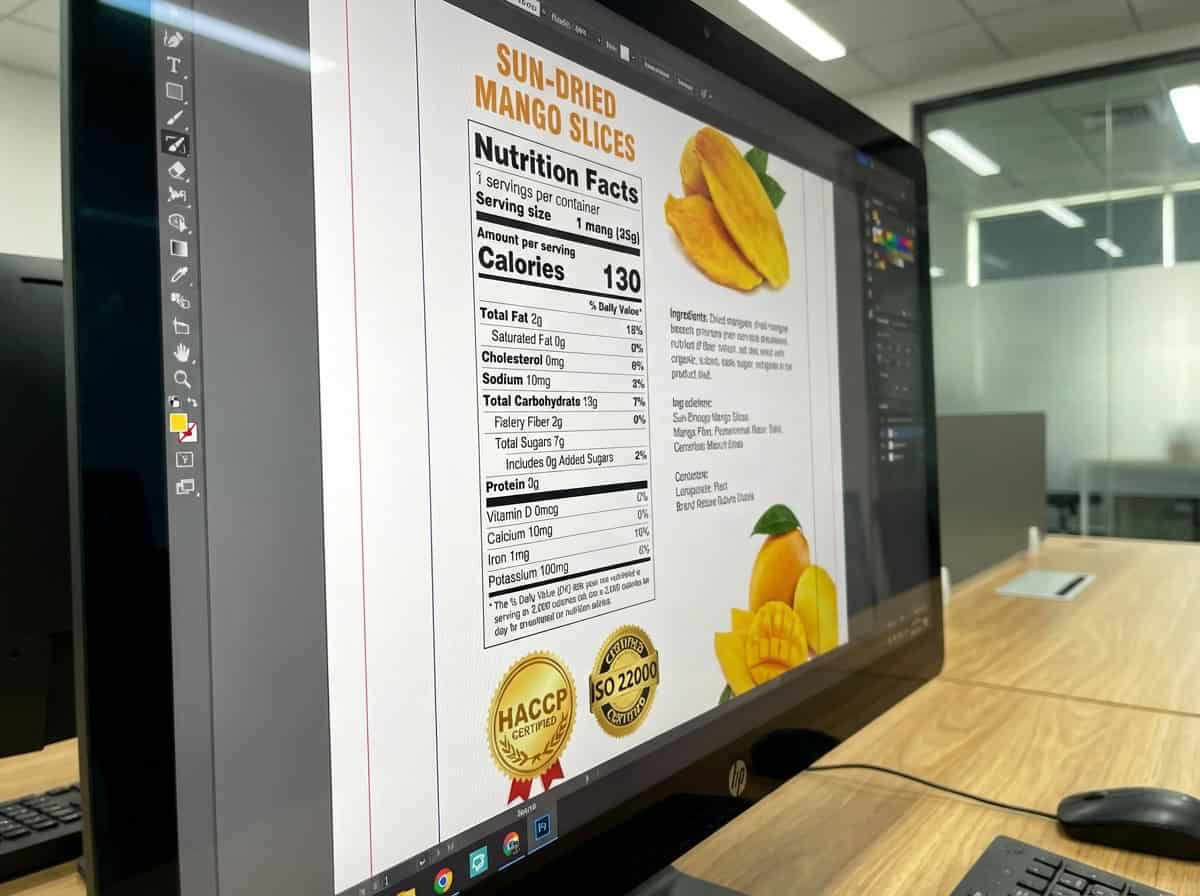
FRUITBUYS VIETNAM provides FDA-format and EU-format Nutrition Facts templates as standard with every OEM order, along with the COA data needed to populate your label accurately. Your designer applies the brand layer. The compliance layer comes from us.
Packaging material: Aluminum foil laminate (barrier film) is the correct material for dried mango no added sugar. It provides the oxygen and moisture barrier needed to maintain aw stability throughout the product’s shelf life. Standard formats: 50g, 100g, 500g, and 1kg zip-lock retail bags.
Step 4: Confirm Your Order Parameters and Place the Deposit
Once samples are approved and packaging artwork is finalized, the order confirmation contains five elements:
- Product specification (variety, format, moisture target, aw limit, SO₂ statement)
- Packaging specification (bag format, weight per unit, print file sign-off)
- Order quantity (minimum 1,000kg for OEM)
- Incoterms (FOB Cát Lái, CIF, or DDP to your destination)
- Payment (T/T: 40% deposit, 60% before shipment or against B/L copy)
Production begins after deposit confirmation. Lead time: 20–30 days for a container or large batch order.
Step 5: Manage Import Compliance at Your Destination
Your supplier’s export documentation handles the Vietnam side. Your import compliance is your responsibility but a qualified supplier pre-prepares the documents your customs broker needs.
The standard export documentation package from FRUITBUYS VIETNAM includes:
- Certificate of Origin (C/O Form EUR.1 for EU, standard C/O for US/UAE)
- Phytosanitary Certificate
- HACCP Certificate
- ISO 22000 Certificate
- COA from accredited third-party lab (SGS / Bureau Veritas / Eurofins) batch matched
- Commercial Invoice, Packing List, Bill of Lading
US-specific: Confirm your FSVP (Foreign Supplier Verification Program) compliance as the US importer of record. Your customs broker handles the entry. The COA and Phytosanitary Certificate are the two documents most commonly queried at US customs for dried fruit.
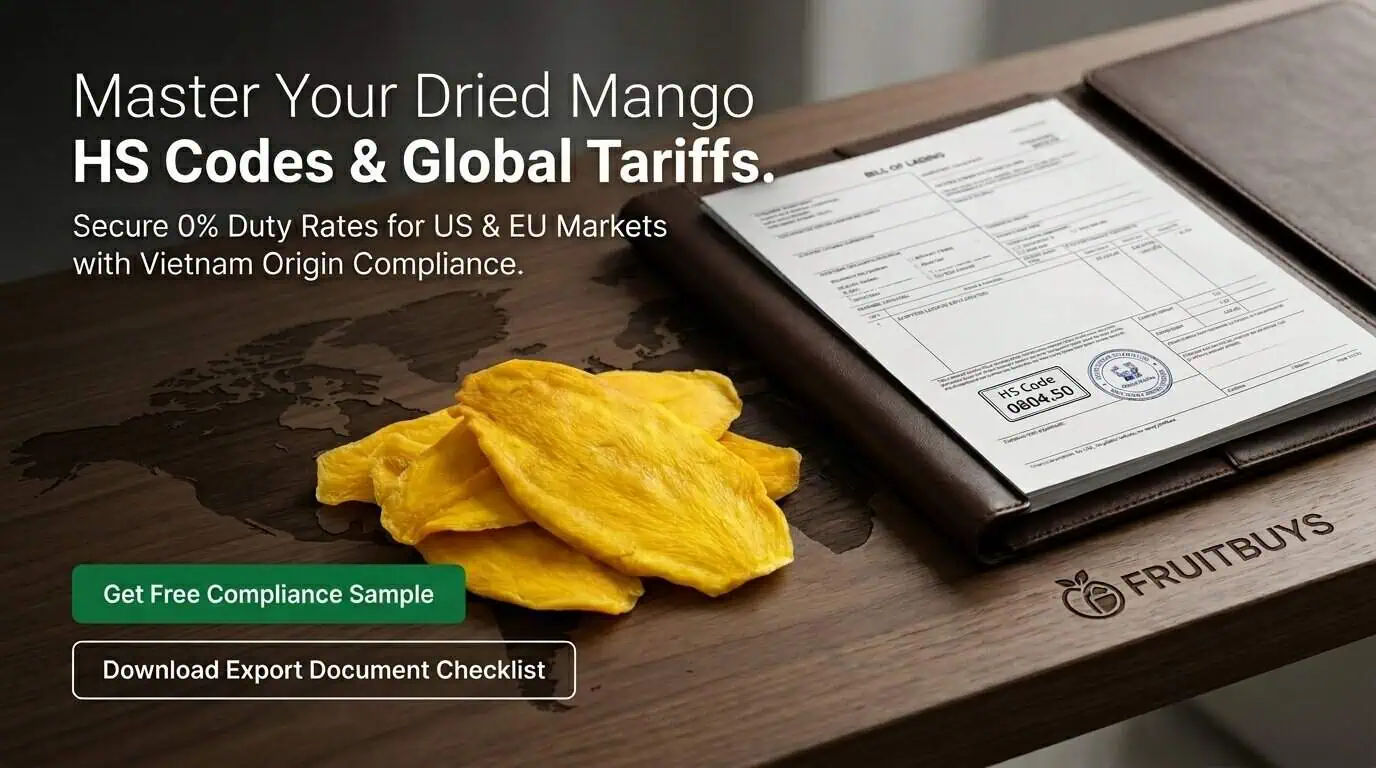
EU-specific: EUR.1 Certificate of Origin is required to claim the 0% EVFTA tariff rate. Without it, your product enters at the MFN rate also 0% for HS 0804.50.00, but the EUR.1 belongs on file.
Cold chain at the destination port: Reefer container arrives at the port. Your cold storage warehouse must accept and store the product at 10–20°C from the moment it clears customs. Do not let it sit at ambient temperature in a receiving dock. A sealed bag maintains its aw in cold storage. Temperature exposure above 25°C after the reefer is disconnected begins the clock on quality degradation.
Step 6: Launch, Measure, and Scale
Your first 1,000kg order in 100g retail bags produces approximately 10,000 consumer units. This is your market test. You are not betting a container on an unproven SKU you are testing at a scale that generates real sales data without over-committing capital.
Measure two things in the first 90 days: sell-through rate and repeat purchase rate. If sell-through on the first 10,000 units exceeds 70% within 60 days, your product has velocity. If repeat purchase within 60 days of first purchase exceeds 25%, your product has retention. Both together indicate a SKU worth scaling.
At that point, the conversation with FRUITBUYS VIETNAM shifts from trial to contract. Contract pricing applies at quarterly container volume. Lead time and documentation remain the same. The product does not change only the volume and the price per kilogram improve in your favor.
The Margin Math
These figures are based on industry benchmarks and the product cost structure for OEM dried mango no added sugar from Vietnam. They are directional estimates, not guarantees. Your actual margins depend on your retail channel, packaging costs, freight, and distribution fees.
| Cost Element | Estimate (Per 100g Unit) |
|---|---|
| Product cost (FOB, OEM, Keo variety) | ~$0.80–1.10 |
| Packaging (custom printed aluminum foil bag) | ~$0.15–0.25 |
| Freight + cold chain (amortized per unit) | ~$0.20–0.40 |
| Import duty (US: Free via GSP; EU: 0% EVFTA) | $0.00 |
| Import broker + local delivery | ~$0.05–0.10 |
| Estimated landed cost per 100g unit | ~$1.20–1.85 |
| Typical retail price (US health food channel) | $5.99–$8.99 |
| Gross margin range | ~65–79% |
| Amazon FBA channel (after fees ~30–35%) | ~40–55% net |
The landed cost advantage from Vietnam versus Philippines or Thailand sourcing is $0.40–0.80 per kilogram of raw product. At 10,000 units per order, that differential is not noise it is the difference between a sustainable margin and a margin that forces you to compete on retail price rather than product quality.
Timeline: From First Contact to Product on Shelf
| Stage | Duration | What Happens |
|---|---|---|
| Initial contact + sample request | Day 1 | You contact FRUITBUYS VIETNAM, specify product parameters |
| Sample dispatch | Day 3–5 | Samples + COA + tech spec sheet shipped |
| Sample receipt + internal testing | Day 8–12 | You receive and evaluate samples |
| Third-party lab test (optional but recommended) | Day 12–20 | Independent lab confirms sugar profile and moisture spec |
| Packaging design + compliance review | Day 15–25 | Brand design + FDA/EU label compliance layer finalized |
| Order confirmation + deposit | Day 25–30 | Spec sheet, packaging file, order quantity, Incoterms confirmed |
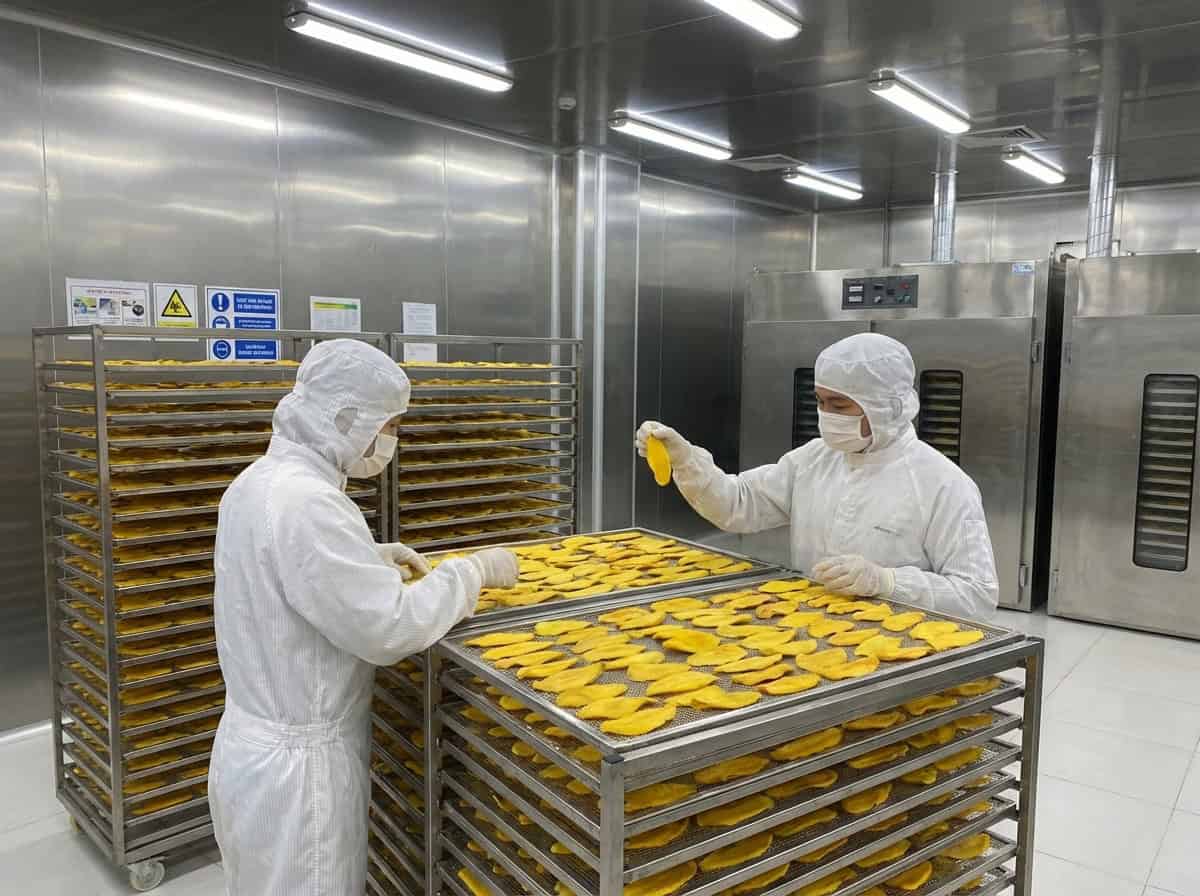
| Production | Day 30–55 | 20–30 day lead time after deposit |
| Export documentation + loading | Day 55–60 | C/O, Phyto, COA, HACCP, packing list, B/L prepared |
| Ocean freight (US West Coast) | +18–22 days | Reefer container in transit |
| Customs clearance + delivery to warehouse | +5–10 days | Customs broker processes entry, cold storage receives |
| Product available for sale | ~Day 90–100 | First units available for retail or Amazon FBA fulfillment |
Ninety to one hundred days from first contact to first sale. That timeline assumes no artwork revision delays and no customs hold. Work backward from your target launch date and your peak selling season. If peak season is Q4 (holiday gifting channel), first contact must happen by end of June at the latest.
The Freeze-Dried Expansion: Your Second SKU Without a New Supplier
Once your soft-dried mango private label has proven itself at retail, there is a natural next step that expands your product line without adding a new supplier relationship, new origin story, or new compliance infrastructure.
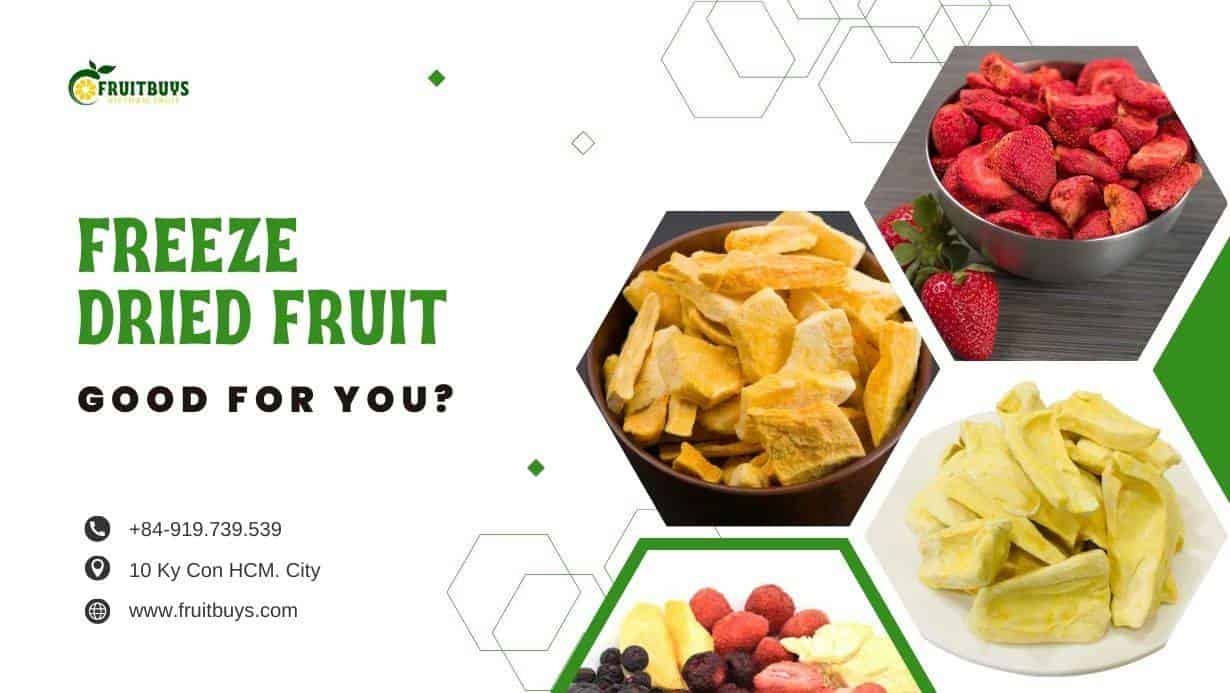
Freeze-dried mango uses the same Vietnamese mango, the same no-added-sugar qualification, and the same FRUITBUYS supply chain. The freeze-drying process removes moisture to below 3%, creating a crispy, airy product with 12–18 months shelf life at ambient temperature no cold chain required for shipping or retail storage.
The practical brand-building implication: your soft-dried mango SKU serves buyers who want a chewy, fresh-fruit-adjacent snacking experience and who are comfortable with refrigerated shelf products. Your freeze-dried mango SKU serves convenience channel buyers, online subscription box curators, travel retail, and gift packaging accounts who need ambient shelf life and are willing to pay the premium for it. Retail price per gram for freeze-dried runs 2–3x higher than soft-dried.
Two SKUs. One supplier. One origin story. Two retail price points. The brand architecture builds itself.
Freeze-dried mango powder the same ingredient reduced to functional powder form adds a third tier for buyers selling into the smoothie, beverage, bakery, or sports nutrition channel. Margin on ingredient powder formats is the highest in the mango processing value chain.
Frequently Asked Questions
What is the minimum order for private label dried mango?
OEM private label production at FRUITBUYS VIETNAM starts at 1,000kg. There is no minimum for trial and sample orders you can start with samples at no product cost (buyer pays shipping) and scale from there. A 1,000kg OEM order in 100g retail bags produces approximately 10,000 consumer units.
How long does private label dried mango production take?
Production lead time is 20–30 days after deposit confirmation for a container or bulk order. Add 5–10 days for export documentation and port logistics, then ocean freight transit time to your destination (18–22 days to US West Coast, 28–35 days to Rotterdam or US East Coast). Total timeline from order confirmation to product in your warehouse is approximately 55–65 days.
Can I use my own packaging design for OEM dried mango?
Yes. You provide the finalized artwork file (print-ready PDF or AI). FRUITBUYS VIETNAM confirms the compliance elements are present (Nutrition Facts, ingredient statement, allergen declaration, net weight, best-by date format) before the film is printed. We provide FDA-format and EU-format Nutrition Facts data to populate your design. Your designer applies the brand layer.
What certifications come with the product?
Every OEM order ships with HACCP Certificate, ISO 22000, Certificate of Origin (EUR.1 for EU, standard C/O for other markets), Phytosanitary Certificate, and COA from an ISO 17025-accredited third-party lab (SGS, Bureau Veritas, or Eurofins). Halal certification is available on request. Organic certification is available on request.
Do I need to register with FDA to import dried mango to the US?
As the US importer of record, you must comply with FDA’s Foreign Supplier Verification Program (FSVP) requirements under FSMA. Your Vietnamese supplier must be a registered FDA food facility. FRUITBUYS VIETNAM holds the required FDA facility registration. Your customs broker handles the import entry. The COA and Phytosanitary Certificate are the two most commonly queried documents at US customs for this product category.
What is the shelf life of private label dried mango no added sugar?
Sealed and stored at 10–20°C: 6–9 months from production date. Without added sugar and without preservatives, this product requires cold chain storage reefer container for ocean freight, cold storage warehouse at destination. Shelf life claims on your retail label should reflect the storage conditions your distribution chain can guarantee. A 6-month claim at 10–20°C is defensible. A longer claim requires independent shelf life study data.
The Brand Starts With One Decision
Every week you spend selling someone else’s dried mango is a week your brand is not being built. The market for no-added-sugar, clean label dried fruit is growing at 9% per year. The OEM barrier is 1,000kg and 20–30 days of production lead time. The compliance documentation comes pre-prepared. The cold chain guidance is included from day one.
Contact FRUITBUYS VIETNAM today. Tell us your target market, your retail channel, your weight format, and your preferred variety. We send samples within 3–5 business days with a full COA and spec sheet. You approve the product. We produce. Your brand ships in under 60 days from confirmation. Stop building equity for someone else’s label.
Contact FRUITBUYS VIETNAM:
- WhatsApp: +84-909.499.619
- Email: hotro@fruitbuys.vn
- Website: https://fruitbuys.com
- Office: 10/2 Ky Con, Cau Kieu Ward, Ho Chi Minh City
- Warehouse: 182 An Phu Dong 09, An Phu Dong Ward, District 12, Ho Chi Minh City