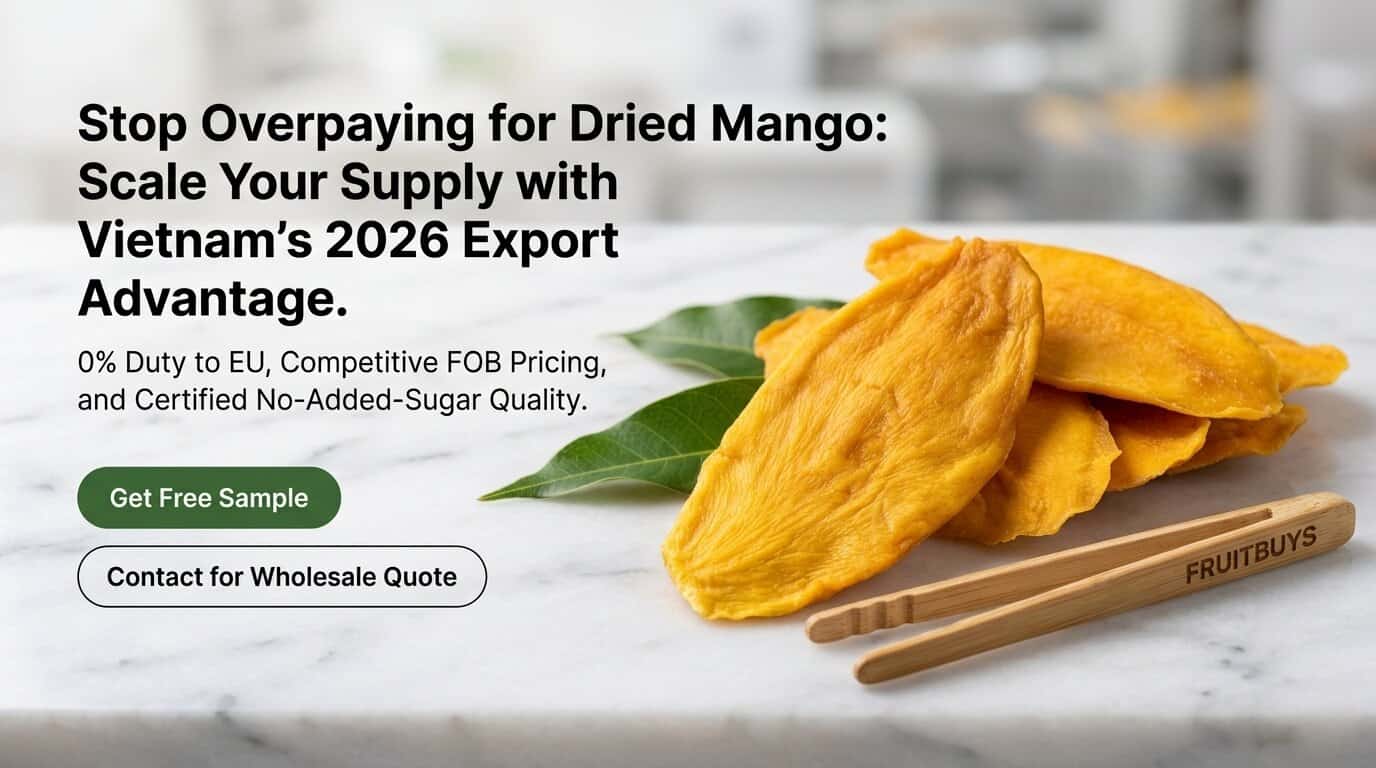
Dried Mango Market Trends 2026: Clean Label, No Sugar, Plant-Based

While a category manager at a US natural food distributor spent Q3 2025 “monitoring the no-sugar dried fruit trend,” one of their direct competitors listed an unsweetened dried mango SKU in four regional natural food chains, negotiated a 12-month supply agreement with a Vietnamese exporter, and captured the shelf space. By the time the first distributor’s internal approval process concluded in Q4, the shelf position was gone. The consumer demand signal had been measurable for 24 months. The supply infrastructure in Vietnam had been in place longer. What was missing was the decision.
That scenario is not hypothetical. It is the standard outcome when trend analysis replaces procurement action. The dried mango market in 2026 is not at a stage where watching and waiting carries low risk. The clean label, no-sugar, and plant-based demand signals that are now reshaping the dried fruit category are not emerging. They have already emerged. The buyers who move now capture supply agreements, preferred pricing, and retail shelf positions from the sourcing decision that the watching-and-waiting competitor still has not made.
This article presents the market data, the structural demand drivers, and Vietnam’s supply position so your procurement team has what it needs to stop analyzing and start sourcing.
The Market: Size, Growth, and Where the Demand Is Coming From
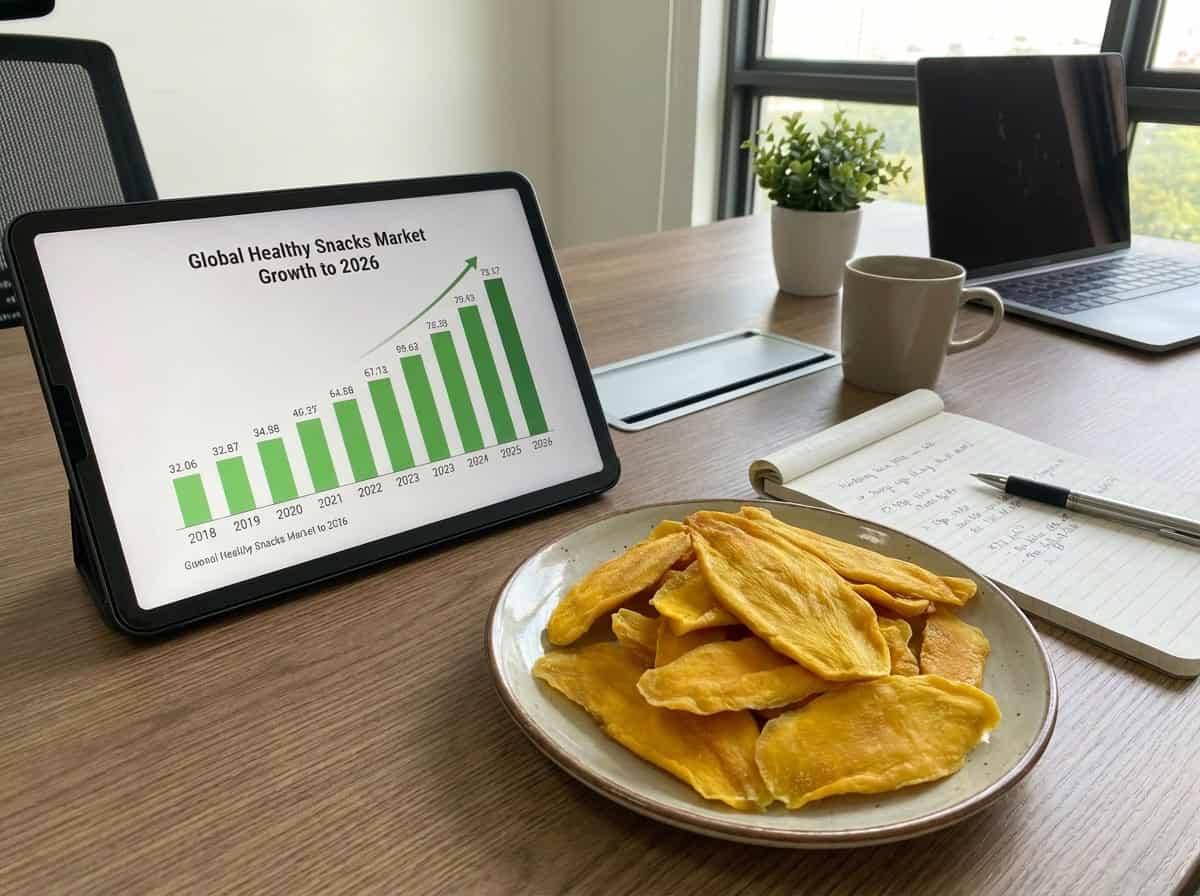
The global healthy snacks market reached an estimated $101–108 billion in 2025. Within that category, the dried fruit segment represents a mature but actively restructuring market the overall category is not growing through new consumers discovering dried fruit. It is growing through existing consumers trading up from sweetened, preserved, and artificially colored products to clean label, no-sugar, and single-ingredient formats. That trade-up is structural, not cyclical, and it is accelerating.
The global dried mango market specifically is estimated at $1.0–1.2 billion in 2025, growing at approximately 7% CAGR through 2033, according to multiple industry research sources. The no-added-sugar and sugar-free snack sub-segment grows faster sugar-free snack launches have tracked a 9.3% CAGR according to Glanbia Nutritionals’ industry data, outpacing the broader dried fruit category growth rate by a meaningful margin. The sugar-free snacks market as a whole was valued at approximately $2.5 billion in 2024 and is projected to reach $5.8 billion by 2034.
What that growth rate means for a B2B buyer in 2026: the window to build a supply relationship, establish retail distribution, and become the established player in your market’s clean label dried mango category is still open but not indefinitely. The brands who enter the no-sugar dried mango category in 2026 and 2027 will have measurable first-mover advantage over those entering in 2028 and beyond, when the shelf category will already have defined leaders in the natural and specialty channel.
Trend 1 – Clean Label: The Irreversible Consumer Mandate
The clean label trend is the most important structural driver in the global packaged food market, and it directly governs the dried mango category in every target market.
30% of global food and beverage launches now carry clean label claims no artificial additives, no preservatives, minimal processing, and fully transparent ingredient declarations, according to Innova Market Insights. 74% of US consumers prefer products with recognizable ingredients. 43% inspect ingredient lists before purchase. These are not fringe consumer behaviors. They are mainstream purchasing criteria that now apply to the grocery snack aisle as rigorously as they do to fresh produce.
For dried mango, the clean label mandate translates into a two-tier market structure that is now visible in US natural food retail, EU specialty channels, and UAE premium import segments:
Tier 1 – Conventional sweetened dried mango: Ingredient list reads “mango, sugar, sulfur dioxide (preservative).” Positioned on price. Margins eroding under retail competition and private label displacement. Declining shelf presence in health and natural channels.
Tier 2 – Clean label no-added-sugar dried mango: Ingredient list reads “mango (Mangifera indica).” Positioned by ingredient transparency and verified documentation. 0g added sugars confirmed by ISO 17025 lab COA. SO₂ not detected. No preservatives. This tier is growing, and its retail price premium over Tier 1 is sustained because the ingredient documentation barrier prevents low-cost suppliers from entering without process investment.
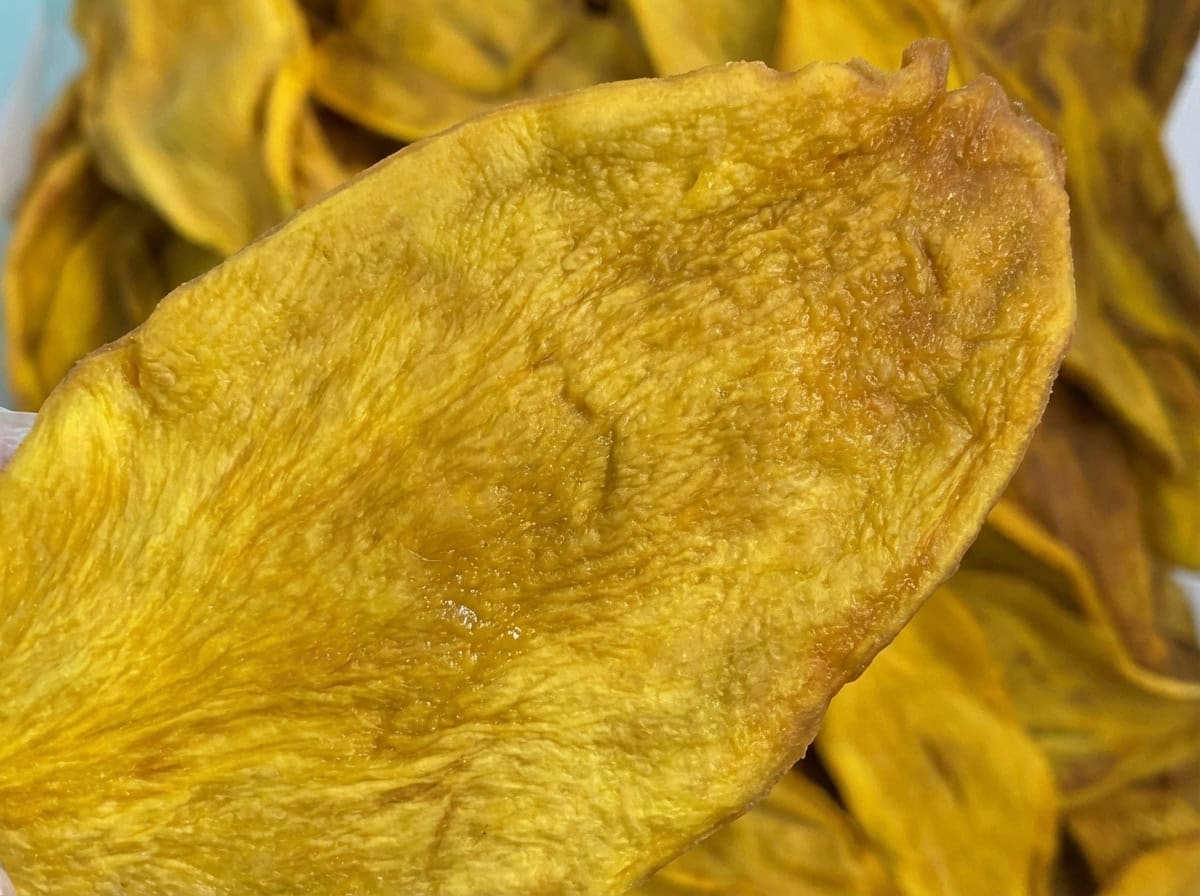
The clean label tier is where brand equity accumulates. A distributor who builds their retail positioning around a verified no-added-sugar, sulfite-free dried mango from a documented Vietnamese origin does not compete on price with Tier 1 suppliers. They compete on trust and in the clean label channel, trust is a harder-to-replicate competitive advantage than any cost position.
Trend 2 – No Added Sugar: 58% of Consumers Are Driving This
Sugar reduction is not a niche wellness trend confined to diabetic-conscious consumers. It is a mass-market behavioral shift that affects purchasing decisions across demographics, income levels, and retail channels.
58% of US consumers are actively trying to reduce their sugar intake. 39% of global snack launches now carry no/low sugar or no additives/preservatives claims. Gen Z and Millennials who account for 94% of daily snacking occasions globally show the highest stated preference for no-added-sugar products versus any other labeling claim in the natural snack category.
The commercial translation: “No Added Sugars” is no longer a specialty product claim. It is an entry-level requirement for shelf space in natural food retail in the US and EU, and it is becoming the expected baseline in premium grocery across all channels. The brands that had a no-added-sugar product on shelf three years ago built the customer relationship. The brands entering the category now are playing catch-up on a claim that was optional in 2022 and is close to mandatory in 2026 in the channels that matter most.
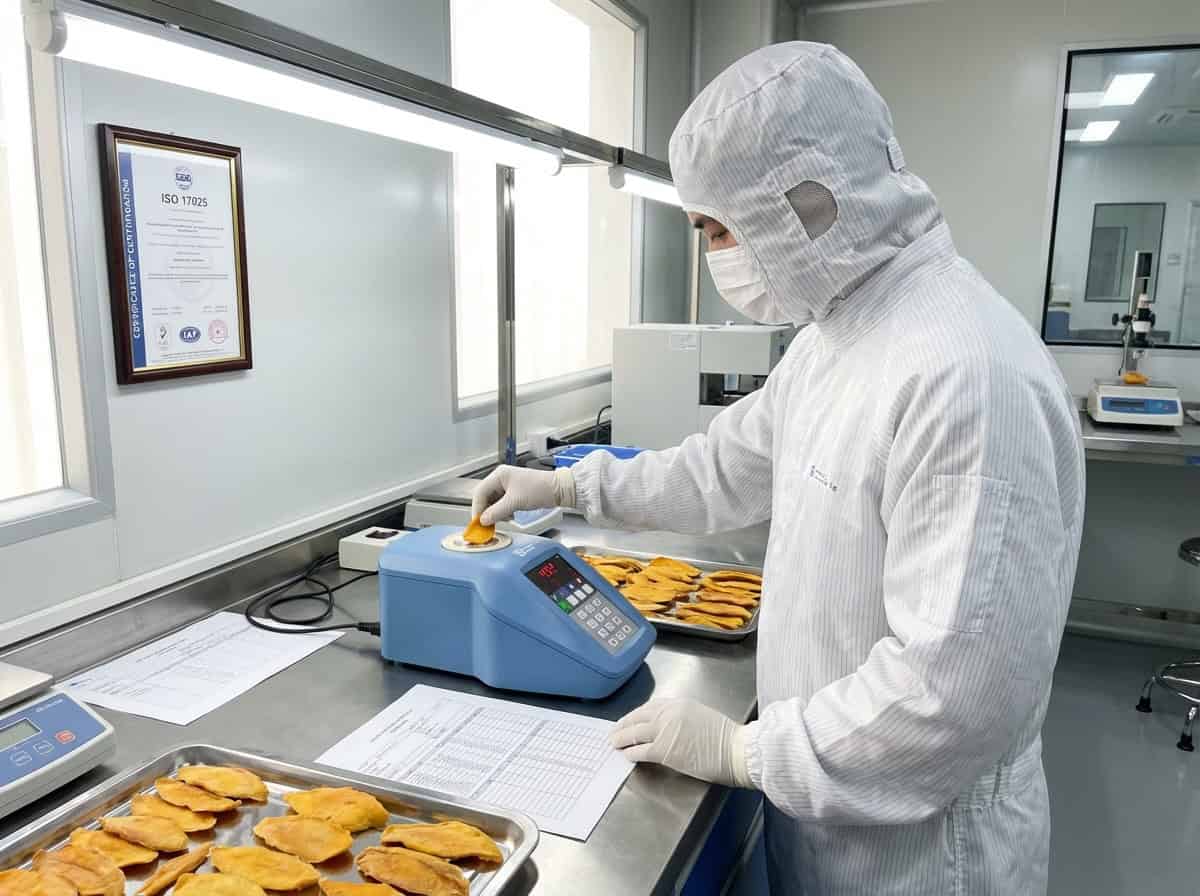
For dried mango specifically, the no-added-sugar claim carries a documentation requirement that screens out underprepared suppliers. Under FDA 21 CFR 101.60, a “No Added Sugars” claim requires that no sugar or sugar-containing ingredient has been added, and the label must accurately declare 0g added sugars on the Nutrition Facts panel. A COA from an ISO 17025-accredited laboratory confirming Added Sugars: 0g per production batch is the verification document that retail buyers, QC auditors, and FSVP-compliant importers require to maintain this claim.
The suppliers who can deliver that COA per batch not per product launch, not per annual certification, but per batch are the suppliers whose buyers stay. The ones who cannot are the ones whose buyers discover the compliance gap after their first retail audit.
Trend 3 – Plant-Based: The Positioning Bridge Between Snacking and Wellness
Plant-based is the fastest-growing segment descriptor in Asia-Pacific snack markets, and it is consolidating its position in US and EU natural food retail as the category extension point that connects general snacking to the wellness and functional nutrition segments.
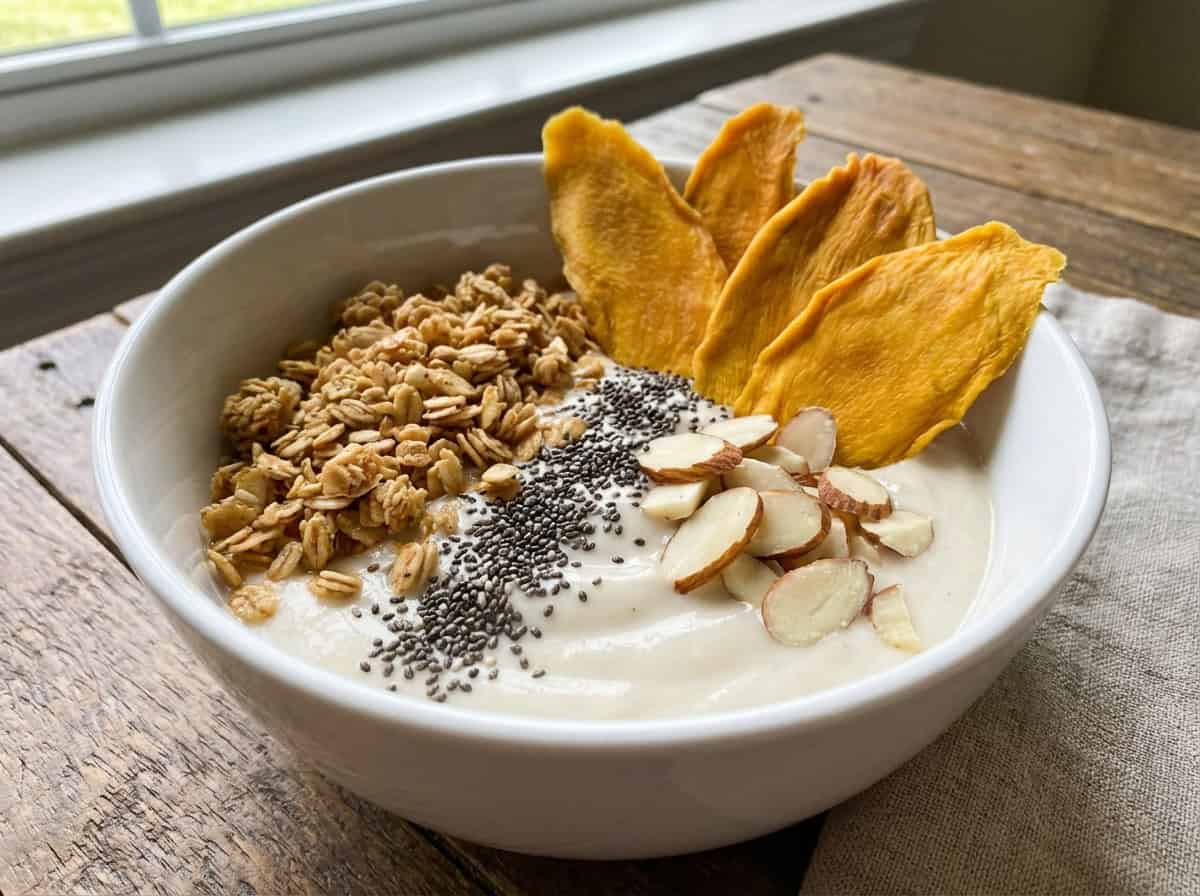
Dried mango no added sugar is a 100% plant-based, whole-food product one ingredient, zero processing aids, zero animal-derived components. It qualifies without reformulation for vegan, plant-based, and “whole food plant-based” (WFPB) diet positioning. In the US natural food channel, that positions it in the same purchasing context as products that command $6–$12 retail price points for 100g snack formats. In EU specialty retail, the WFPB positioning overlaps significantly with the organic and clean label premium tier.
The strategic commercial insight: plant-based positioning works as a brand amplifier for dried mango no added sugar because it requires no product change. The ingredient is already 100% plant-derived, already single-ingredient, already free of all animal-derived processing aids. What changes is the brand language and the shelf adjacency. A brand that positions dried mango no added sugar as a plant-based snack ingredient in trail mix, granola, or protein bars accesses the plant-based category premium without reformulating its supply chain.
This is the “smart positioning on existing foundations” principle applied at the brand level: same ingredient, new category language, new retail shelf position, new consumer audience, new margin tier.
Trend 4 – Vietnam Origin: The Supply Story the Market Wants to Tell
Origin storytelling is a documented commercial driver in specialty food retail.
Vietnam’s position in the global dried mango supply landscape in 2026 carries three structural advantages that are commercially communicable at the retail brand level:
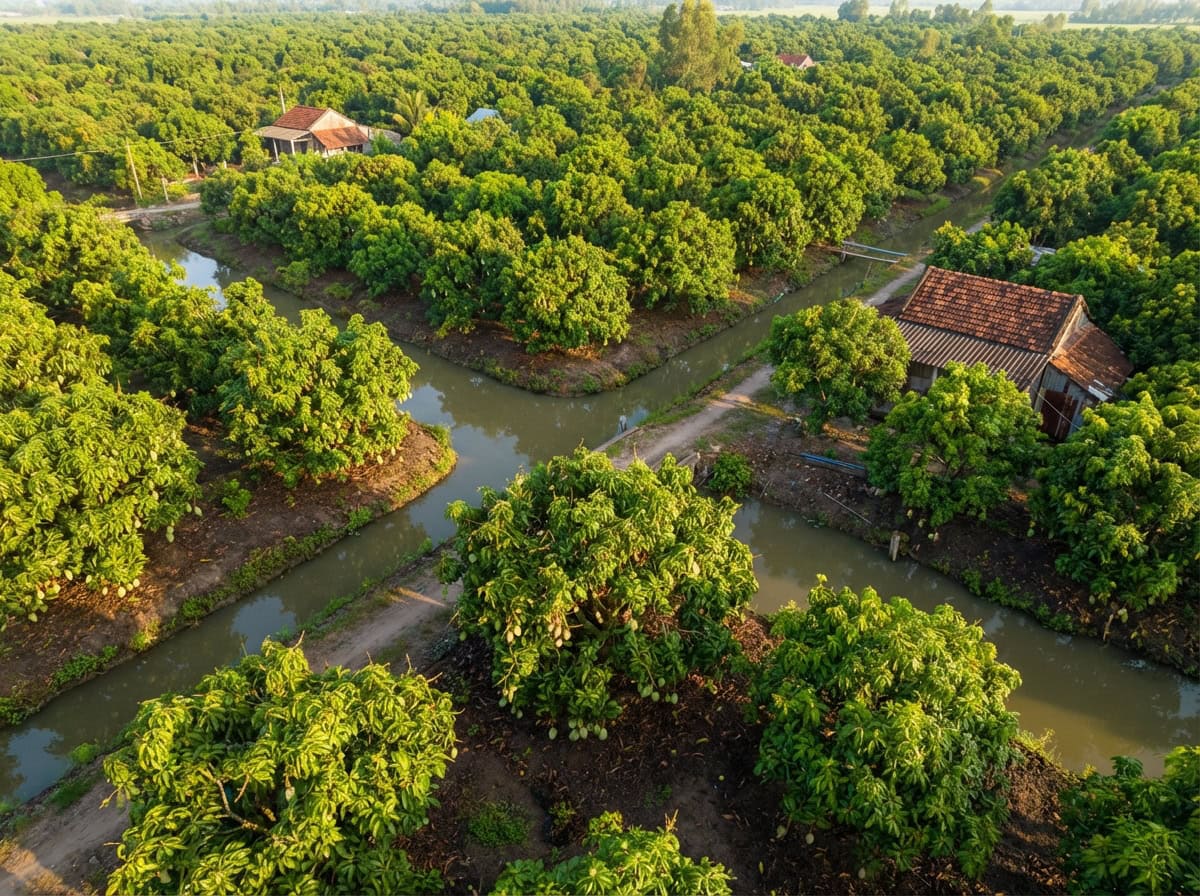
Agricultural credentials: Vietnam produces over 1 million MT of mango annually across 114,000 hectares, with 46 cultivated varieties across 63 provinces. The Mekong Delta Đồng Tháp, Tiền Giang, An Giang, Vĩnh Long is the world-class tropical fruit growing region that produces the Cát Chu and Hoà Lộc varieties that premium buyers in Japan, the US, and the EU specifically request. The US Ambassador to Vietnam reportedly called Hoà Lộc mango “the best mango in the world.” That is a retail story with provenance, geography, and authority behind it.
Export momentum: Vietnam’s mango exports reached $308 million in 2024 a 43.5% increase year-over-year. That growth rate reflects both expanding production capacity and maturing export infrastructure: colder-chain logistics, wider certification access, and a growing number of export-grade processors capable of meeting FDA, EU, and UAE compliance requirements.
Competitive cost position: Vietnamese dried mango exports typically clear below comparable Thai and Philippine grades. That cost differential funds the COA documentation, cold chain logistics, and certification overhead that clean label channel entry requires without eliminating margin for the buyer or the brand.
For brands building an origin story around Vietnamese tropical fruit ingredients, FRUITBUYS VIETNAM provides origin documentation, variety-specific sourcing, and the full certification package that supports provenance claims from retail shelf copy to supply chain audit documentation. See: Vietnam Dried Mango: Export Market Data, Suppliers & Pricing 2026.
The Convergence Point: Where All Three Trends Intersect
The structural insight that guides sourcing decisions in 2026 is not about tracking three separate trends it is about recognizing where they converge into a single product specification.
| Trend | Consumer Driver | Retail Channel Signal | Product Requirement |
|---|---|---|---|
| Clean Label | 74% prefer recognizable ingredients; 43% read labels | Natural food, specialty, free-from | Single ingredient; no additives; verified COA |
| No Added Sugar | 58% reducing sugar; 9.3% CAGR in sugar-free launches | Health food, diabetic-conscious, sports nutrition | Added Sugars 0g; ISO 17025 lab confirmation per batch |
| Plant-Based | Fastest growing Asia-Pacific segment | WFPB, vegan, functional nutrition | 100% plant-derived; no animal processing aids |
| Vietnam Origin | Provenance storytelling; competitive cost structure | Specialty import, natural food, gift retail | Variety documentation; Mekong Delta origin; certified exporter |
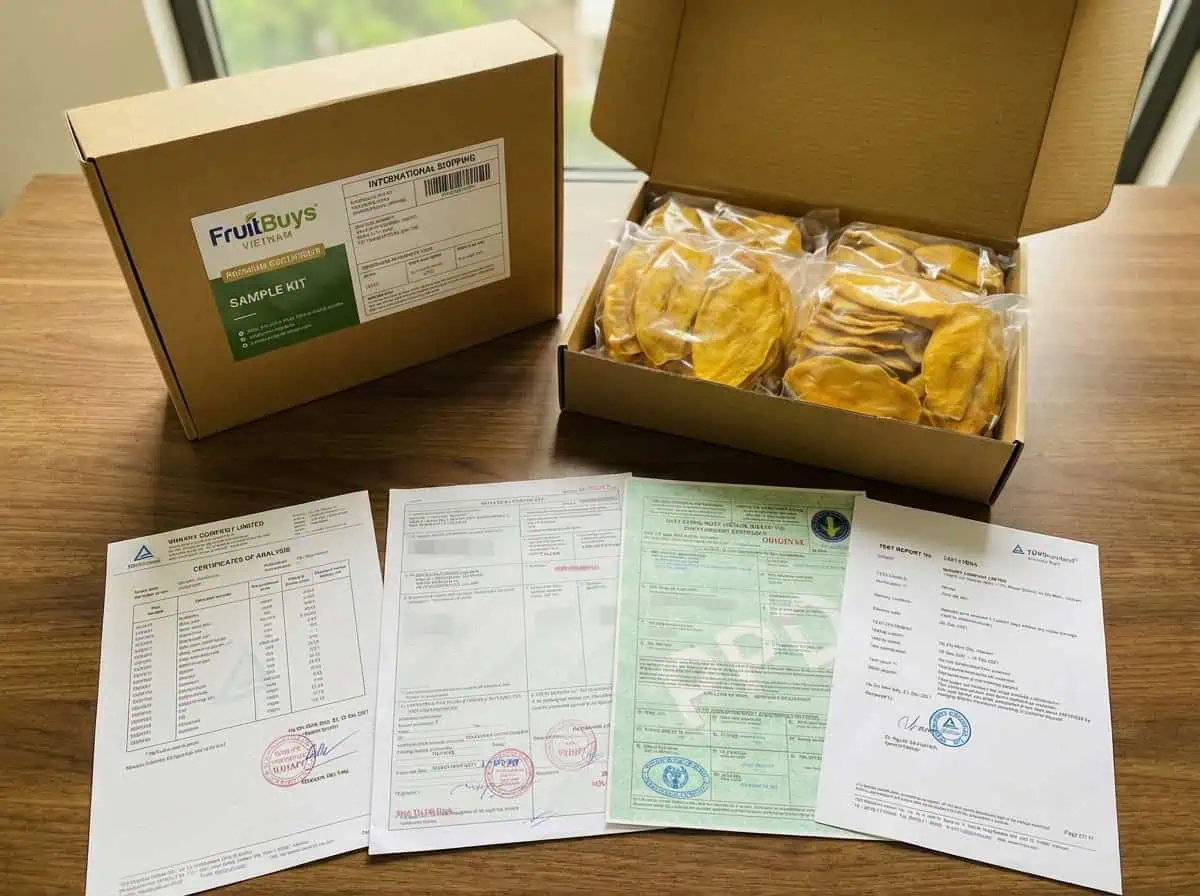
Dried mango no added sugar from FRUITBUYS VIETNAM satisfies all four columns simultaneously not as a marketing position, but as a documented product specification. The COA confirms Added Sugars 0g and SO₂ not detected. The ingredient declaration confirms 100% Mango (Mangifera indica). The Certificate of Origin confirms Vietnamese provenance. HACCP and ISO 22000 certifications confirm process standards.
The brands that build their retail positioning around all four claims hold a more defensible market position than those that lead with one. A competitor can match your clean label claim by switching suppliers. Matching your clean label + no added sugar + plant-based + documented Vietnamese Mekong Delta origin simultaneously requires finding a supplier who delivers all four and that field is narrow.
2026–2028: The Market Signals That Determine Your Timing
Three forward-looking signals are shaping the dried fruit category through 2028 that buyers should factor into sourcing decisions made today.
Signal 1 – Retail shelf reset cycles are underway now. Major natural food retail chains in the US and EU review their dried fruit category annually, with range resets typically executed in Q2–Q3. Buyers who qualify a supplier and build their product story in Q1–Q2 2026 position for those range reviews. Buyers who wait for Q3 to make sourcing decisions are presenting to buyers who have already allocated shelf space.
Signal 2 – Sugar labeling scrutiny is increasing. The FDA’s nutrition label enforcement focus on added sugars declarations has intensified since the 2020 Nutrition Facts panel update. Retailers in the natural channel are conducting independent supplier audits specifically around added sugar and preservative claims. The wave of “no added sugar” claims that cannot be substantiated by batch-matched COA documentation will generate enforcement actions and product recalls creating shelf space vacancies that documented suppliers will fill.
Signal 3 – Vietnam’s export growth is not slowing. Vietnam’s government has set a target of 140,000 hectares of mango cultivation, 1.5 million MT production, and $650 million in mango exports by 2030. Infrastructure investment in cold chain logistics and export-grade processing is expanding. The window for buyers to establish preferred supplier agreements at current pricing before demand from additional market entrants tightens supply availability is open in 2026 it will narrow as more international buyers complete the sourcing discovery process that this article accelerates.
The Objection: “Trends Are Cyclical. Clean Label Could Fade.”
It is worth addressing this directly because it is the rationale some procurement teams use to delay category entry decisions.
Clean label is not a product trend. It is a consumer trust movement driven by decades of ingredient disclosure failures, food fraud incidents, and growing consumer access to nutritional education. The 43% of consumers who now read ingredient lists before purchase are not going to stop reading ingredient lists because a contrary trend emerges. The 30% of global food and beverage launches that now carry clean label claims reflect industry adaptation to a permanent shift in consumer expectation, not a fashion cycle.
The no-sugar movement is similarly structural. It is driven by public health policy, mounting clinical evidence about excess sugar consumption, and generational consumer education that has already changed what the next 20 years of food purchasing behavior looks like. Sugar-free snack launches growing at 9.3% CAGR is a measurement of existing demand, not a forecast of speculative demand.
Plant-based as a category descriptor is not losing ground in any major consumer market tracked as of 2026. Its growth rate in Asia-Pacific is the fastest of any snack category segment. In the US and EU, it has moved from specialty positioning to mainstream grocery placement. The brands that positioned in plant-based three years ago are defending market position. The brands positioning now are still building it. Both are better than the brands who decided to wait.
The more accurate risk is not “what if clean label fades.” It is: what if your competitor commits to a Vietnamese dried mango no-sugar supply agreement this quarter and you do not? That is not a hypothetical risk. It is a concrete competitive scenario with a 90-day import timeline. And that is the risk worth managing.
Frequently Asked Questions
How big is the dried mango market in 2026?
The global dried mango market is estimated at $1.0–1.2 billion in 2025, growing at approximately 7% CAGR through 2033, based on multiple industry research reports. The no-added-sugar and sugar-free sub-segment is growing faster sugar-free snack launches have tracked a 9.3% CAGR outpacing the overall dried fruit category.
Why is clean label important for dried mango brands in 2026?
30% of global food and beverage launches now carry clean label claims. 74% of US consumers prefer recognizable ingredients. For dried mango brands, clean label positioning requires a documented single-ingredient product with no added sugar and no sulfites verified by ISO 17025 lab COA per batch. Retail chains in the natural and specialty channel increasingly require this documentation as part of supplier onboarding, not as an optional credential.
Is Vietnam a reliable source for dried mango in 2026?
Vietnam exported $308 million in mango products in 2024, a 43.5% increase year-over-year. National mango production exceeds 1 million MT annually across 114,000 hectares and 46 varieties. Export-grade certified processors with HACCP, ISO 22000, and FDA registration serve US, EU, UAE, Japan, and Korea markets. Vietnam’s cost position is 20–40% below Thailand and the Philippines for comparable premium grades.
What does “no added sugar” mean for dried mango market positioning?
A “No Added Sugars” claim on dried mango means the product was produced without osmotic pre-treatment, sugar syrup, or any added sweetener at any stage of processing. Under FDA 21 CFR 101.60, the Nutrition Facts panel must show Added Sugars: 0g. The claim requires verification by a batch-specific COA from an ISO 17025-accredited laboratory not a general product certification. Brands who hold this documentation are positioned to enter health food, clean label, and free-from retail channels that reject sweetened alternatives.
What is driving growth in plant-based snacks in 2026?
Plant-based snack growth is fastest in Asia-Pacific and consolidating in US and EU natural food retail. The driver is not ideological veganism it is the overlap between plant-based positioning, clean label credentials, and whole-food ingredient preference among health-conscious mainstream consumers. Dried mango no added sugar is inherently 100% plant-derived with no reformulation required, making it a direct beneficiary of this positioning trend without supply chain complexity.
The Market Is Not Waiting for Your Decision
The brands building clean label, no-sugar, plant-based dried mango products in 2026 are sourcing now. The supply agreements being signed today lock in pricing, volume commitments, and supplier exclusivity arrangements that will shape who owns the category shelf position in 2027 and 2028.
You have the market data. You have Vietnam’s export track record. You have the convergence point between clean label, no sugar, and plant-based mapped to a single product specification that FRUITBUYS VIETNAM delivers with documentation per batch. The only missing variable is the sourcing decision.
Contact FRUITBUYS VIETNAM today. Request free samples with full COA and technical spec sheet. They ship in 3–5 business days. Your first container can be in your warehouse within 60–75 days of placing the order. The competitor who moves this week will be on shelf in Q3. The competitor who moves next month will be on shelf in Q4. You decide which one you are.
Contact FRUITBUYS VIETNAM:
- WhatsApp: +84-909.499.619
- Email: hotro@fruitbuys.vn
- Website: https://fruitbuys.com
- Office: 10/2 Ky Con, Cau Kieu Ward, Ho Chi Minh City
- Warehouse: 182 An Phu Dong 09, An Phu Dong Ward, District 12, Ho Chi Minh City