How to Import Dried Mango from Vietnam: Complete Guide

A US natural food distributor contacted a Vietnamese dried mango supplier in January. The price was competitive. The website looked credible. They placed a 20ft container order in February without requesting a COA, without specifying no-sugar processing, and without asking about cold chain requirements. The container shipped dry. It arrived at Long Beach in March with visible mold on 40% of units and advanced Maillard browning throughout. FDA hold was issued. Customs broker fees ran $3,200. Total write-off: $31,000. The supplier had delivered exactly what they were paid to deliver bulk dried mango, standard specification. Nobody had asked for anything else.
That outcome is not bad luck. It is a sourcing process with gaps in it. Every gap in this guide is a version of that story a question not asked, a document not verified, a cold chain requirement discovered after the container had already sailed.
This guide closes every gap. It covers how to import dried mango from Vietnam in seven sequential steps: supplier qualification, product specification, sample evaluation, order placement, export documentation, import compliance at your destination, and cold chain management from port to warehouse. By the end, you have a process, a checklist, and the documentation standard your supplier must meet before a single kilogram ships.

Step 1 – Qualify the Supplier Before the First Conversation Goes Further
The Vietnamese dried mango supplier landscape ranges from vertically integrated exporters with BRC certification and decade-long EU supply relationships to trading companies with no processing capacity of their own who broker product from unverified factories. The difference between the two is not always visible on a website or in a first email. It is visible in the answers to six specific questions.
Ask every prospective supplier these questions in writing before requesting a price:
- “Do you use osmotic pre-treatment or sugar syrup at any stage before or during drying?” For no-added-sugar dried mango, the only acceptable answer is an unambiguous no. Any qualified answer “we minimize sugar,” “we use a small amount for texture” is a disqualifying answer.
- “Can you provide a COA from an ISO 17025-accredited laboratory with added sugars listed as a separate line item showing 0g?” A supplier who cannot produce this has either not tested for it or is testing at an unaccredited internal lab. Neither is acceptable for US FDA, EU, or UAE import markets.
- “What is your SO₂ result per batch? What test method do you use?” The result must be below 10ppm (not detected) under the Optimized Monier-Williams method. A general “no preservatives” statement is not an analytical result.
- “What certifications does your facility hold? Can you provide current certificate copies?” Minimum acceptable for export to US, EU, or UAE: HACCP and ISO 22000. FDA facility registration number (US). BRC or IFS strengthens the case for EU supermarket chain buyers. Halal certification (UAE).
- “At what temperature is finished product stored between production and container loading?” The answer must be 10–20°C. Ambient temperature post-production storage disqualifies the supplier for no-added-sugar dried mango regardless of how the container is shipped.
- “What is your production capacity and current lead time for a 20ft order?” Confirmed capacity: 500 MT per year, 42 MT per month. Lead time: 20–30 days after deposit. Any supplier with significantly shorter lead times for large orders without explanation is worth scrutinizing it may indicate product is being purchased from a secondary source rather than produced in-house.
Supplier Qualification Scorecard
Score each supplier on these criteria before proceeding to sampling. A supplier who cannot score 5/6 on mandatory criteria is not qualified for your first container.
| Criterion | Mandatory? | Pass Signal | Fail Signal |
|---|---|---|---|
| No osmotic pre-treatment | Yes | Written declaration, process description | Vague answer, no written confirmation |
| COA with Added Sugars: 0g | Yes | ISO 17025 lab, separate line item | Internal lab only, or total sugars without added sugars split |
| SO₂ <10ppm with test method | Yes | Named accredited lab, named method | “No preservatives” without result |
| Valid HACCP + ISO 22000 | Yes | Current certificate copies | Expired, unaccredited, or missing |
| Cold storage post-production | Yes | Written confirmation of 10–20°C | Ambient storage, no answer |
| Production capacity + lead time | Yes | Matches stated capacity realistically | Implausibly short lead time without explanation |
Step 2 – Lock Down Your Product Specification in Writing
A purchase order that says “dried mango, no added sugar, 1 MT” is not a product specification. It is a starting point for a misunderstanding. Every parameter that affects quality, compliance, or logistics must be stated explicitly before a price is quoted. Your specification document must include:
Product parameters:
- Variety: Keo (year-round, competitive pricing), Cát Chu (premium, 18–20°Bx, MOQ 1,000kg dedicated run), or Hoà Lộc (ultra-premium, seasonal, advance booking 60 days minimum)
- Cut format: Slices (3–5mm) for retail snacking; Chunks (2×3cm) or Dice (5–8mm) for food manufacturing
- Added sugars: 0g AD method, no osmotic pre-treatment. Must appear as separate line on COA.
- SO₂: <10ppm (not detected) Optimized Monier-Williams method
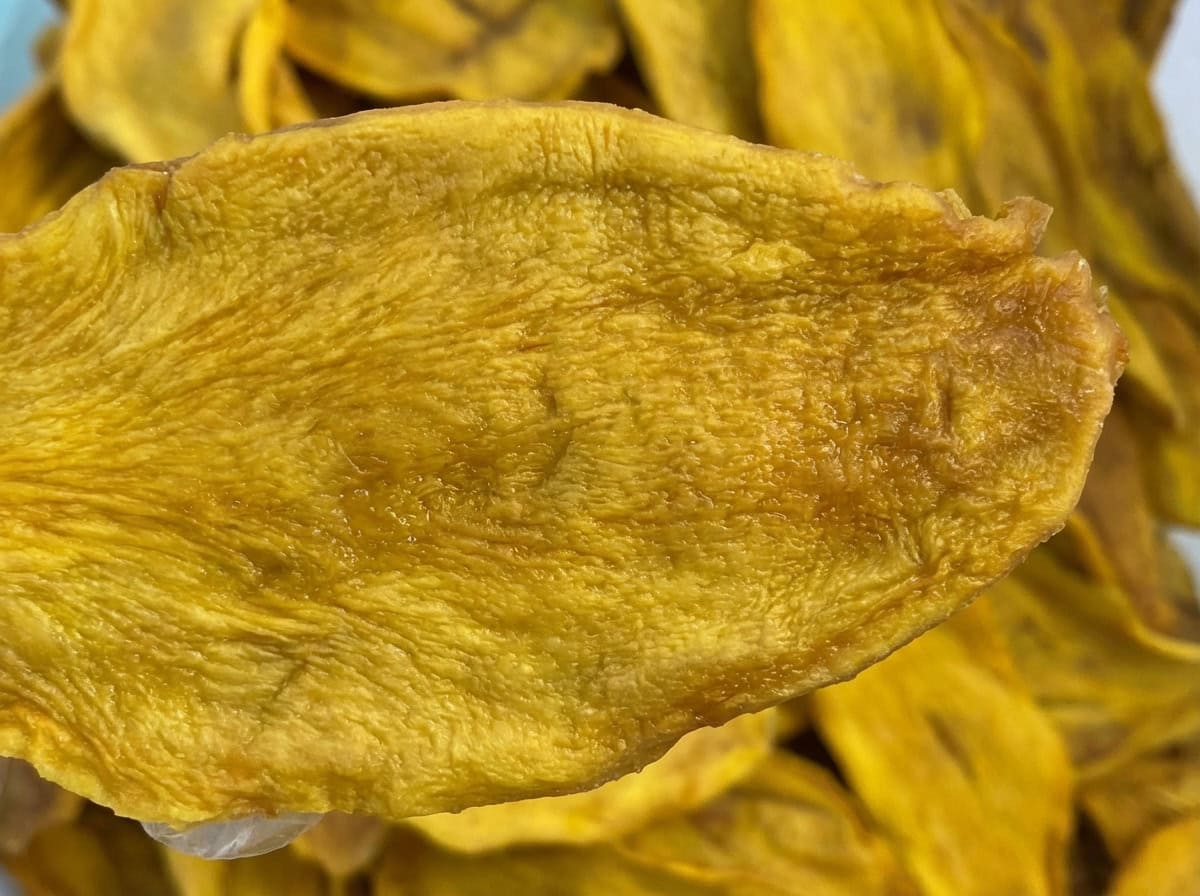
- Moisture content: 15–18% (target 16%), tolerance ±1.5%
- Water activity: ≤0.60 (target 0.55–0.58)
- Metal detection: Fe ≤1.5mm, Non-Fe ≤2.0mm, SUS ≤2.5mm
Packaging parameters:
- Bulk: 20kg net, PE-lined aluminum foil bag inside 5-layer export carton (50×40×20 cm)
- Retail OEM: Specify bag format, weight per unit, print file requirement, zip-lock or heat seal
- Nitrogen flush: Mandatory for aluminum foil barrier bags to inhibit oxidation
Compliance parameters:
- COA format: ISO 17025-accredited lab, batch-matched, all parameters per Section 7 of this guide
- Nutrition Facts label: FDA 2020–2025 format (US) or EU Regulation 1169/2011 (EU)
- Certificate of Origin: Form EUR.1 for EU (EVFTA); GSP Form A for US; standard C/O for UAE
- Phytosanitary Certificate: Issued by Vietnam Plant Protection Department
Logistics parameters:
- Container type: Reefer mandatory. Temperature setting: 15°C.
- Incoterms: FOB Cát Lái Port (standard), CIF, or DDP confirm before proforma invoice
- Port of loading: Cát Lái Port, Ho Chi Minh City (ocean freight), Tân Sơn Nhất (air freight)
Send this specification document to the supplier and request written confirmation that they can meet every parameter before the sample is dispatched. Any parameter they cannot confirm in writing is a negotiation or a disqualification, depending on which parameter it is.
Step 3 – Evaluate the Sample Correctly
Sample evaluation has three components. Most buyers complete one. Completing all three eliminates the primary failure modes that result in container losses.
Component 1 – Sensory evaluation (Day 1–3 after receipt):
- Color: Natural amber to deep orange. Not artificially bright yellow (sulfite indicator). Not dark brown (over-dried or stored at excessive temperature).
- Texture: Soft, chewy, pliable. Not hard and brittle (over-dried). Not sticky or wet (under-dried or cold chain failure during transit).
- Taste: Clean natural mango sweetness, no chemical aftertaste (sulfite indicator), no fermented or sour notes (microbial activity indicator).
- Uniformity: Consistent piece size and thickness. Minimal fines or broken pieces below 1cm.
Component 2 – Third-party lab verification (Day 5–15):
Send the sample to an ISO 17025-accredited laboratory in your market SGS, Eurofins, or equivalent. Request:
- Full sugar profile by HPLC: total sugars, glucose, fructose, sucrose, and added sugars as separate entries
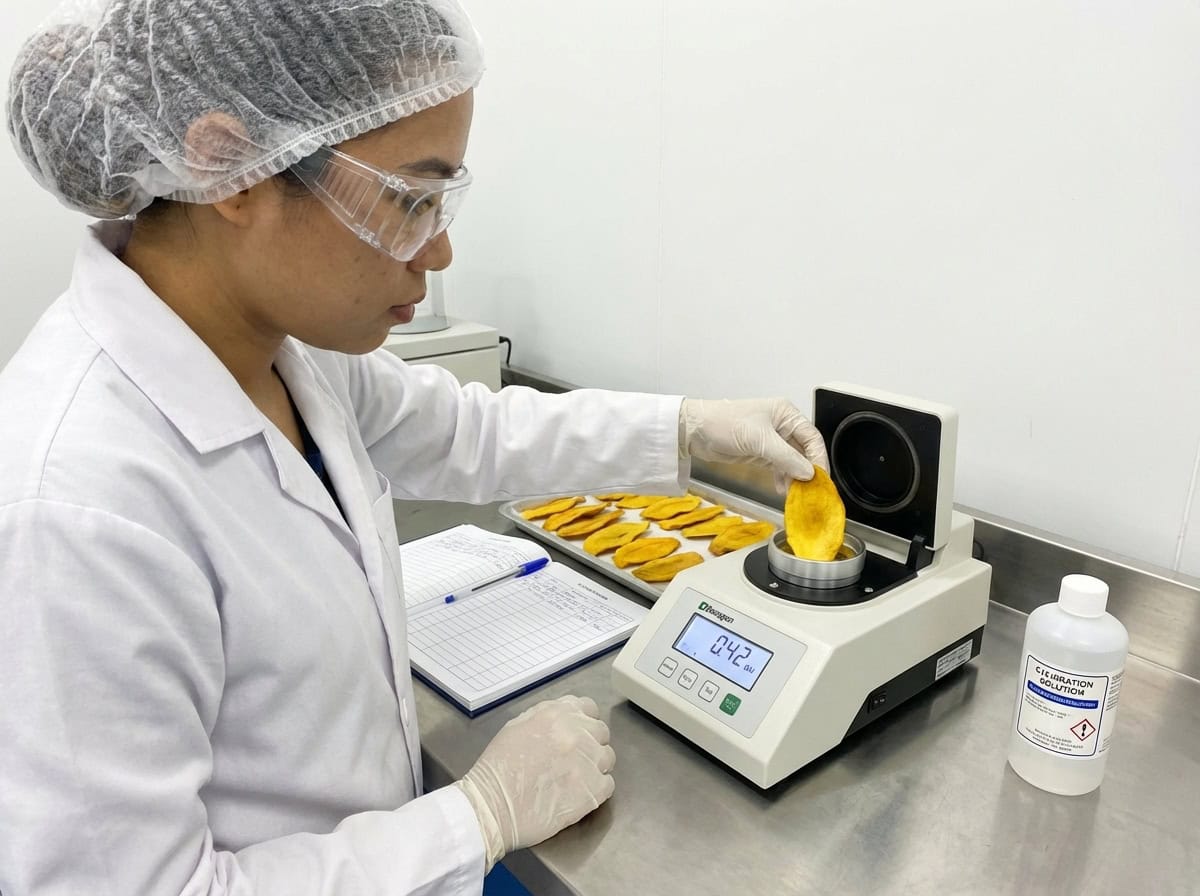
- Moisture content (AOAC 934.06)
- Water activity (Novasina or Decagon AquaLab method)
- SO₂ (Optimized Monier-Williams)
- Basic microbiological screen: TPC, E. coli, Yeast & Mold, Salmonella
Cost: approximately $200–$400 for full panel. Timeline: 5–10 business days. This investment eliminates the risk of a $20,000–$40,000 container loss on a parameter the supplier COA missed or misrepresented.
Component 3 – COA batch verification:
Request from the supplier the COA for the specific production batch the sample came from. Match the batch number and production date on the COA to the sample dispatch date. If the COA pre-dates the sample dispatch by more than 30 days, or if no batch number is provided, the COA does not correspond to the sample you received. This is the most common documentation manipulation in the dried fruit trade a COA from a compliant batch used to represent a non-compliant shipment.
All three components pass? Proceed to order placement. Any component fails? Identify which parameter failed, communicate the finding to the supplier, and re-evaluate. Do not proceed to a container order until all three pass on the same batch.
Step 4 – Place the Order on Confirmed Commercial Terms
Once the sample is approved, the commercial terms must be confirmed in writing on the proforma invoice before the deposit is paid. Five elements are non-negotiable.
1. Product specification reference. The proforma invoice must reference your specification document by version number or date. “Dried mango, as per specification agreed on [date]” is the minimum acceptable reference. This creates a contractual link between the spec you approved and the product that ships.
2. Container type: Reefer. The word “reefer” and the temperature setting (15°C) must appear on the proforma invoice. A proforma that specifies “20ft container” without “reefer” at “15°C” is a dry container order. Do not sign off on a proforma that does not specify this explicitly.
3. Documentation list. The proforma must list every document the supplier will provide: COA (ISO 17025 lab, batch-matched), Phytosanitary Certificate, C/O (specify EUR.1 for EU or GSP Form A for US), HACCP Certificate, ISO 22000, Commercial Invoice, Packing List, Bill of Lading. Any document missing from this list is a document you may not receive and a document you may need at customs.
4. Payment terms. Standard: T/T 40% deposit on order confirmation, 60% balance before shipment or against B/L copy. L/C at sight available for established buyers. Do not pay 100% upfront on a first order with any supplier.
5. Lead time confirmation. 20–30 days production after deposit confirmation for a 20ft container. A supplier who commits to 10 days on a first container order is either holding pre-produced inventory in which case ask when it was produced and request that batch’s COA or is overstating their capability. Either scenario requires clarification before the deposit is paid.
Step 5 – Verify Export Documentation Before the Container Loads
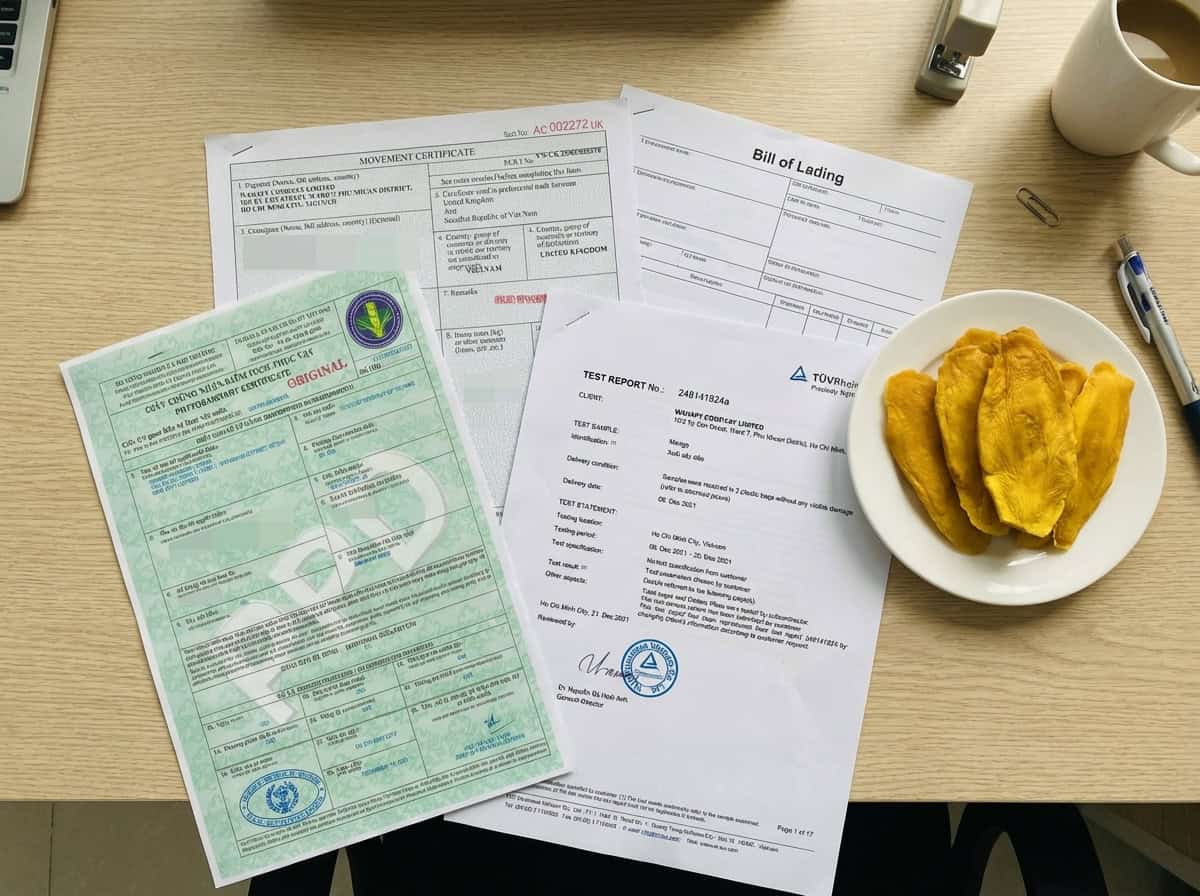
Export documentation is not a post-shipment administrative task. It is a pre-shipment verification that happens before the reefer is sealed and before the Bill of Lading is issued. A missing document discovered at the destination port costs 3–14 days of hold time, $500–$3,000 in customs broker fees, and the risk of a reefer sitting disconnected on a warm tarmac.
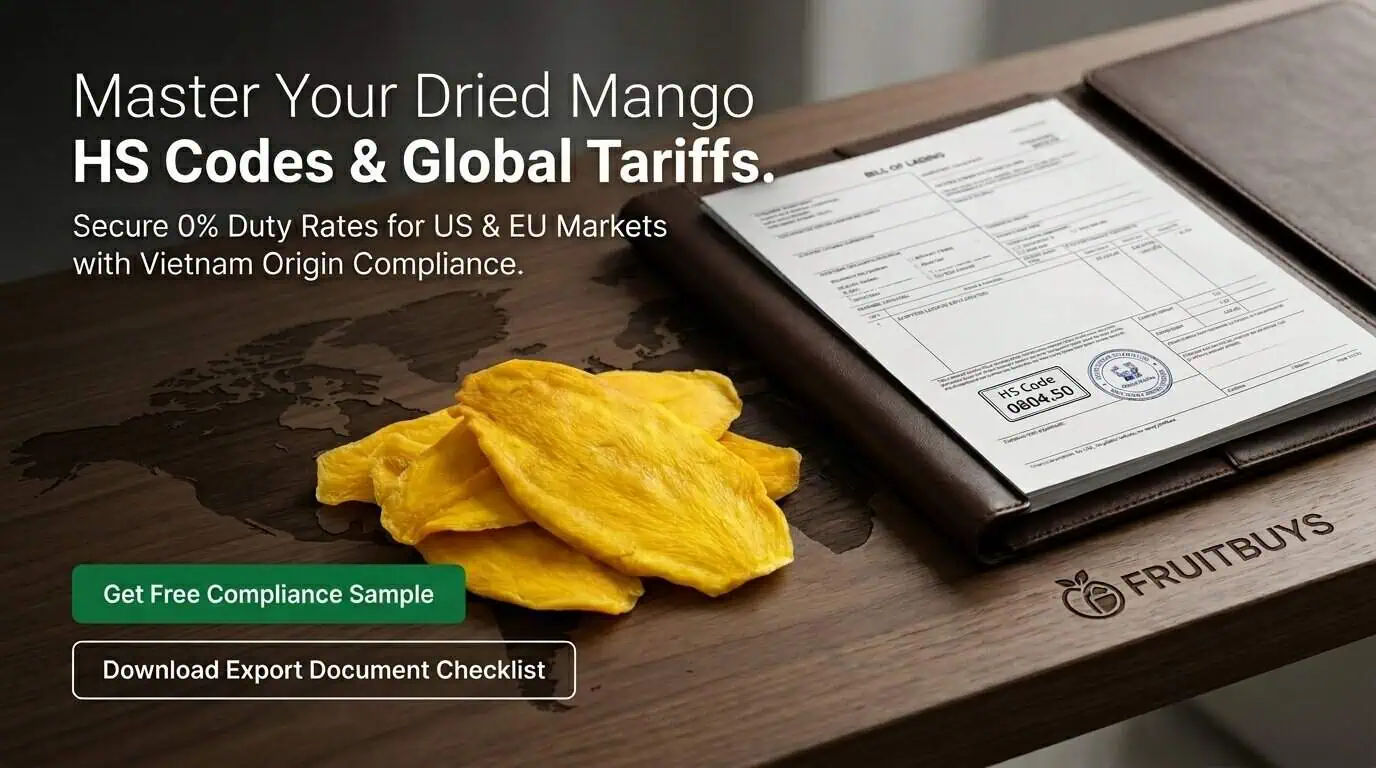
Master Export Documentation Checklist
| Document | Issued By | Required For | FRUITBUYS Prepares? | Verify Before Shipment |
|---|---|---|---|---|
| Certificate of Origin GSP Form A | Vietnam Customs | US preferential (Free) tariff | ✅ Standard | Check form number, exporter details, HS code match |
| Certificate of Origin EUR.1 | Vietnam Customs | EU EVFTA 0% tariff | ✅ Standard | Check signature, stamp, validity date |
| Certificate of Origin Standard | Vietnam Customs | UAE, Japan, other markets | ✅ Standard | Country of origin stated correctly |
| Phytosanitary Certificate | Vietnam Plant Protection Dept | All markets mandatory | ✅ Standard | Product description matches shipment; no erasures |
| HACCP Certificate | Certifying body | All markets | ✅ Standard | Current (not expired); facility name matches |
| ISO 22000 Certificate | Certifying body | All markets | ✅ Standard | Current; scope covers dried mango production |
| COA (ISO 17025 lab) | SGS / Bureau Veritas / Eurofins | All markets | ✅ Per batch | Batch number matches production date; all parameters present |
| Nutrition Facts Label | FRUITBUYS / designer | US (FDA format) / EU format | ✅ Standard | Added Sugars: 0g; serving size declared; all mandatory nutrients |
| Commercial Invoice | FRUITBUYS | All markets | ✅ Standard | Product description, HS code, FOB value, Incoterms |
| Packing List | FRUITBUYS | All markets | ✅ Standard | Carton count, net/gross weight, dimensions |
| Bill of Lading | Shipping line | All markets | Shipping line | Consignee details, reefer temperature noted |
| Halal Certificate | Halal certifying body | UAE market | ✅ On request | Issuing body approved by UAE authorities |
Request all documents in PDF before the container is sealed. Your customs broker needs them 3–5 business days before the estimated arrival at the destination port. Do not wait until the container arrives to start the documentation review.
Step 6 – Import Compliance at Your Destination Market
Your supplier handles Vietnamese export compliance. You handle import compliance at your end. Here is what that means by market.
United States
FDA facility registration: Your Vietnamese supplier must be registered as a foreign food facility under FDA 21 CFR Part 1, Subpart H. FRUITBUYS VIETNAM holds current FDA facility registration. Verify this before the first US shipment by asking for the registration number and checking it against the FDA FURLS database.
FSVP (Foreign Supplier Verification Program): As the US importer of record, you are required under FSMA to implement a written Foreign Supplier Verification Program for each foreign supplier and each food you import. Your FSVP must include: hazard analysis for the product, verification activities (which your COA per batch satisfies), and records retention. Your customs broker or a food safety consultant can help you establish FSVP documentation for your first Vietnamese import.
Customs entry: File under HTS 0804.50.80.10. General rate: 1.5¢/kg. With GSP Form A: Free. Your customs broker files the entry electronically with CBP. If your broker raises the Chapter 20 classification question (2008.99 for heat-treated product), FRUITBUYS provides full process documentation to support the Chapter 08 classification and a binding ruling request if needed.
FDA Prior Notice: Required for all food shipments to the US. Filed electronically through FDA’s Prior Notice System Interface (PNSI) at least 2 hours before arrival for shipments by road, 4 hours for air, and 8 hours for ocean. Your customs broker typically handles this as part of the entry filing.
European Union
EU importer of record: A legal entity established in an EU member state must act as the importer of record and take responsibility for the food’s compliance with EU regulations. If you are a non-EU buyer distributing into EU via a local partner, your EU partner is the importer of record.
EVFTA tariff claim: File entry under CN 0804.50.00 with EUR.1 Certificate of Origin. Duty: 0%. Without EUR.1: MFN rate applies (also 0% for this product, but EUR.1 belongs on file for audit compliance).
EU label compliance: Your retail packaging must comply with EU Regulation 1169/2011 nutrition declaration per 100g in kJ and kcal, allergen statement (contains: produced in a facility that processes tree nuts), country of origin (Vietnam), best before date, net quantity in metric, importer name and address.
General Food Law (Regulation 178/2002): Traceability is mandatory. You must be able to identify from which supplier and which batch any product in your supply chain came from. The batch-matched COA from FRUITBUYS provides the document trail.
UAE and GCC
ESMA registration: Products sold in the UAE must comply with UAE.S standards and be registered with the Emirates Authority for Standardization and Metrology (ESMA). Confirm registration requirements with your UAE customs broker before the first shipment.
12-digit HS code: Mandatory since January 2025. Verify the complete GCC 12-digit code with your UAE customs broker the base heading is 0804.50, but the full extension depends on product format.
Arabic-language label: Mandatory for retail packaging in the UAE. All nutrition information, ingredient declaration, and allergen statement must appear in Arabic.
Halal certification: Mandatory for market entry. Must be issued by a UAE-approved Halal certification body. FRUITBUYS VIETNAM provides Halal certification on request.
5% GCC import duty: Applied on the declared customs value at the UAE border. No FTA between Vietnam and GCC currently. Build this into your UAE landed cost model.
Step 7 – Cold Chain Management: Port to Warehouse
This step is where the most preventable post-arrival losses occur. The reefer managed temperature through 18–22 days of ocean transit. The product is at specification when the container arrives. What happens next determines whether it stays that way.
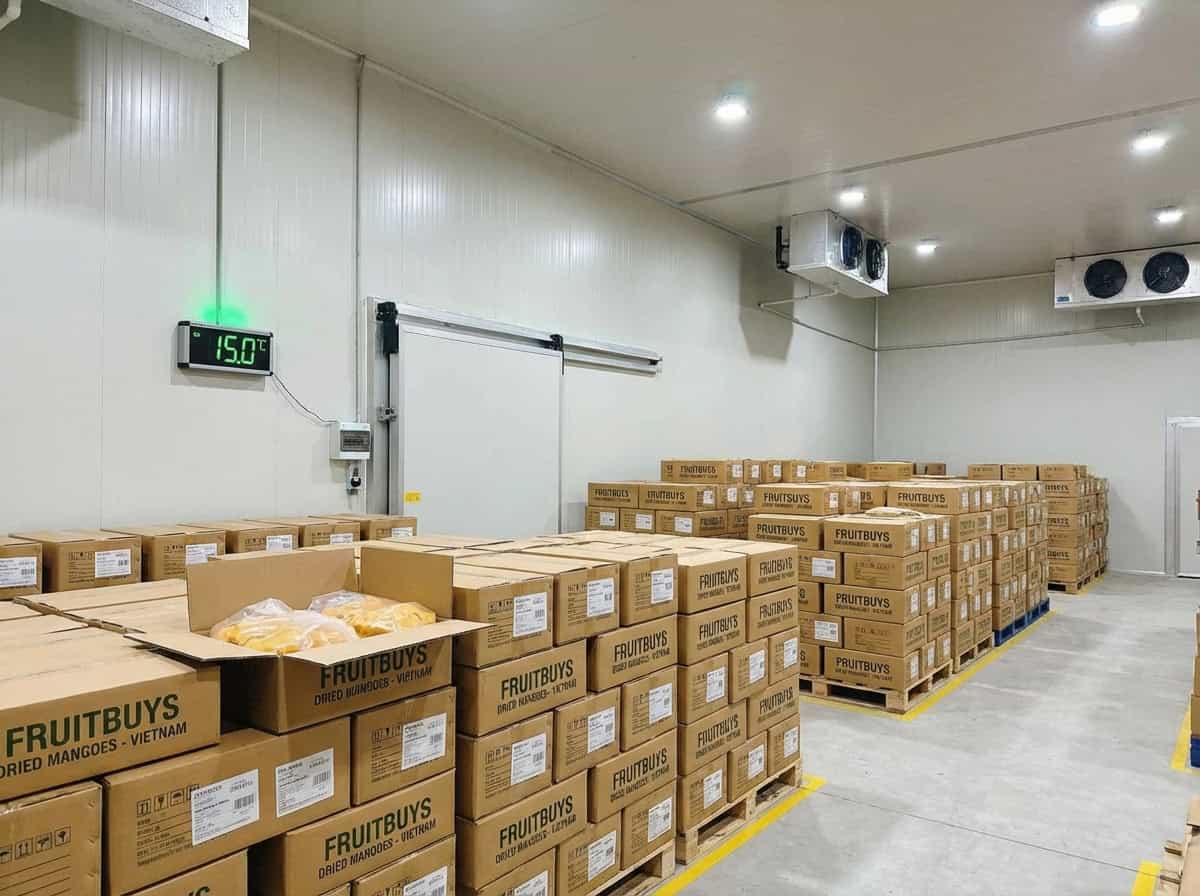
Pre-arrival action: Arrange cold storage warehouse acceptance at least 3 business days before estimated container availability at the port. Confirm the warehouse operates at 10–20°C with ≤65% RH. Confirm a refrigerated or insulated truck is available for the port-to-warehouse transfer.
At the port: Do not let the container sit unplugged at the port. CBP PNSI and FDA Prior Notice must be in order so customs clearance is immediate upon container availability. A 48-hour hold on an unplugged reefer in a summer port environment causes measurable quality degradation. Pre-file your customs entry 24–48 hours before the vessel arrives.
Container inspection at receipt: Before accepting the shipment, record the reefer temperature at the time of opening. If the temperature logger (request one from the shipping line or install your own) shows any breach above 20°C during transit, document it immediately. This is your dispute evidence if product quality has been compromised in transit.
Warehouse storage protocol:
- Temperature: 10–20°C (optimal: 15°C)
- Relative humidity: ≤65% RH
- Lighting: Away from direct sunlight or UV sources
- Stacking: No more than two carton layers on the floor compression damages aluminum foil barrier
- Rotation: FIFO strictly enforced
- Temperature log: Continuous monitoring with documented records
After opening a carton: Product resealed in zip-lock aluminum foil bag, stored at 2–8°C, consumed within 14 days.
Transit time reference for planning:
| Route | Ocean Freight Transit | Total Time: Order to Warehouse |
|---|---|---|
| Vietnam → US West Coast | 18–22 days | ~55–65 days from deposit |
| Vietnam → US East Coast | 28–35 days | ~65–75 days from deposit |
| Vietnam → Rotterdam (EU) | 28–35 days | ~65–75 days from deposit |
| Vietnam → Dubai (UAE) | 18–22 days | ~55–65 days from deposit |
What FRUITBUYS VIETNAM Handles at Every Step
This guide covers what you need to manage as the importer. Here is what FRUITBUYS VIETNAM manages on the supply side so you know exactly where your responsibility begins and ours ends.
| Import Step | FRUITBUYS Delivers | You Manage |
|---|---|---|
| Supplier qualification | Written process declaration; facility certifications; COA per batch | Verify through this guide’s scorecard |
| Product specification | Specification confirmation in writing before proforma | Write and send specification document |
| Sample evaluation | Sample + batch COA + tech spec sheet in 3–5 business days | Third-party lab test; sensory evaluation |
| Order confirmation | Proforma with reefer specification, document list, payment terms | Sign off; pay deposit |
| Export documentation | Full package (14 documents) pre-prepared before loading | Verify checklist; forward to customs broker |
| Cold chain in transit | Reefer 15°C from factory to port of loading | Cold chain from destination port to warehouse |
| Import compliance | FDA registration; process documentation for classification support | FSVP; customs entry; FDA Prior Notice; local labeling |
| Post-arrival | Next order quotation within 24 hours | Cold storage management; retail distribution |
Frequently Asked Questions
How do I find a reliable dried mango supplier in Vietnam?
Use the six-question qualification protocol in Step 1 of this guide. Ask specifically about osmotic pre-treatment, COA with added sugars as a separate 0g line item, SO₂ result by named test method, current HACCP and ISO 22000 certificates, post-production cold storage temperature, and production capacity. Any supplier who cannot answer all six in writing within 48 hours is not operating at export-grade standards. FRUITBUYS VIETNAM answers all six from the first inquiry.
What documents do I need to import dried mango from Vietnam to the US?
COA (ISO 17025 lab, batch-matched), Phytosanitary Certificate, GSP Form A (for Free tariff rate), FDA facility registration of Vietnamese supplier, FSVP documentation, FDA Prior Notice, Commercial Invoice, Packing List, Bill of Lading. Your customs broker files the CBP entry under HTS 0804.50.80.10. FRUITBUYS VIETNAM prepares all supplier-side documents as standard.
What is the minimum order quantity to import dried mango from Vietnam?
No minimum for trial and sample orders. Standard container orders: approximately 8.0–8.8 MT for a reefer 20ft, 17.6–19.0 MT for a reefer 40ft. OEM private label production starts at 1,000kg. FRUITBUYS VIETNAM does not use MOQ as a barrier to entry first orders can start at sample scale and grow from there.
How long does it take to import dried mango from Vietnam?
From deposit confirmation: 20–30 days production, then 18–35 days ocean freight depending on destination, then 5–10 days customs clearance and delivery. Total: approximately 55–75 days from deposit to warehouse. Plan your first order at least 90 days before your target in-market date to allow for sample evaluation and specification confirmation before the deposit.
Does dried mango from Vietnam need to be shipped in a reefer container?
Yes for no-added-sugar formats without preservatives. The product’s water activity (0.55–0.60) sits at the microbial safety boundary without the buffering effect of added sugar. Dry container transit in warm shipping lanes causes aw fluctuation, mold risk, and Maillard browning. Reefer at 15°C is mandatory, not optional. Budget $800–$1,500 per container above dry container cost.
What certifications should my Vietnamese dried mango supplier have?
Minimum for US, EU, and UAE market entry: HACCP, ISO 22000, FDA facility registration (US), C/O capability (EUR.1 for EU, GSP Form A for US), Phytosanitary certification, and COA from an ISO 17025-accredited third-party lab per batch. Halal certification is required for UAE. BRC or IFS is expected by major EU supermarket chains. Organic certification (EU 2018/848 or USDA NOP) is available on request from FRUITBUYS VIETNAM.
Start the Process This Week
The buyers who build strong Vietnamese dried mango supply chains are not the ones who researched longest. They are the ones who qualified a supplier, tested a sample, verified the documentation, and placed their first order while their competitors were still comparing Alibaba listings.
The process in this guide takes 90 days from first contact to first sale. That means an order placed this week delivers product to your warehouse in the third week of July. If your peak selling season is Q3 or Q4, that timeline is tight not impossible, but tight.
Contact FRUITBUYS VIETNAM now. We respond within 24 hours. We ship samples in 3–5 business days. We produce in 20–30 days. We prepare every document in the checklist above as standard. You manage your end of the border. We manage ours.
Contact FRUITBUYS VIETNAM:
- WhatsApp: +84-909.499.619
- Email: hotro@fruitbuys.vn
- Website: https://fruitbuys.com
- Office: 10/2 Ky Con, Cau Kieu Ward, Ho Chi Minh City
- Warehouse: 182 An Phu Dong 09, An Phu Dong Ward, District 12, Ho Chi Minh City