Dried Mango HS Code Guide: US, EU & UAE Classification

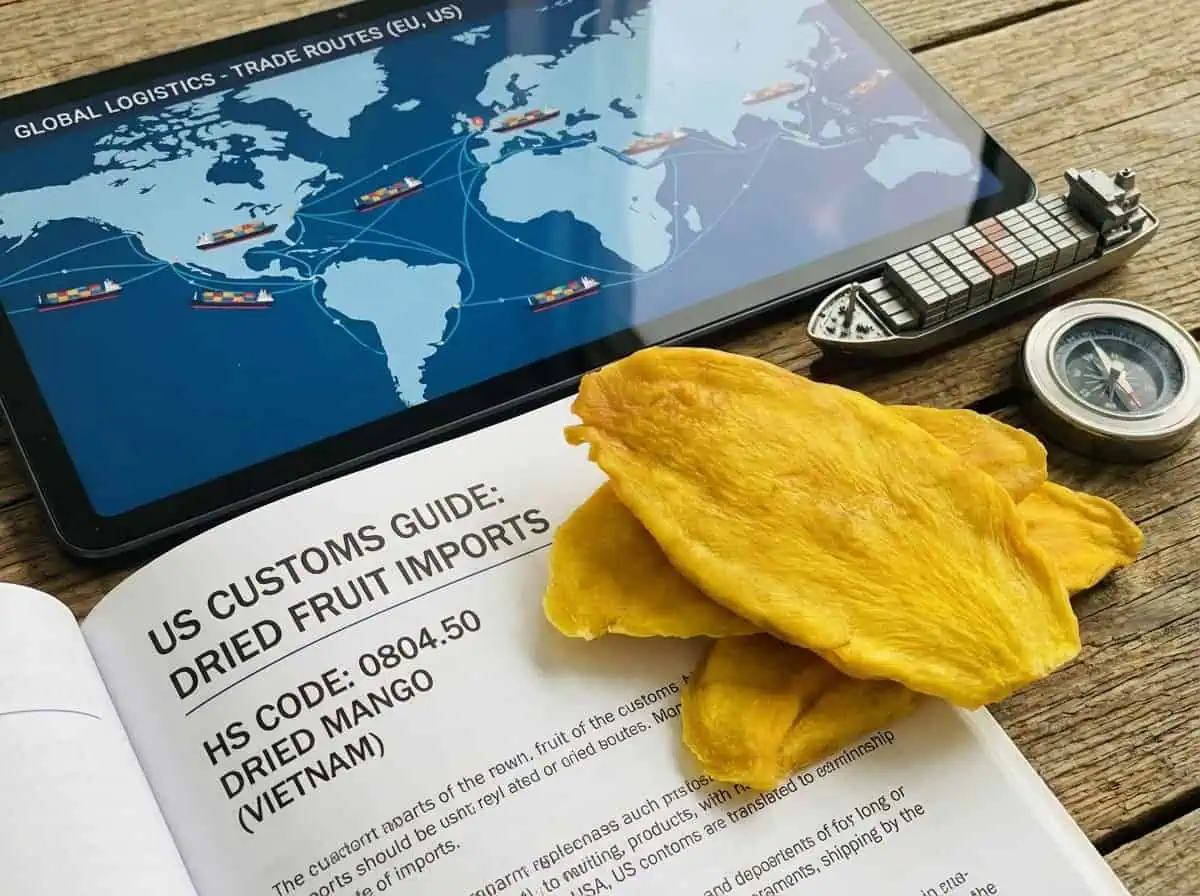
The HS code for dried mango is 0804.50 under the World Customs Organization Harmonized System the international classification baseline used by every major importing market. In the US, it extends to HTS 0804.50.80.10. In the EU, it is CN 0804.50.00. In the UAE and GCC, it is an expanded 12-digit code under the same 0804.50 heading, mandatory since January 2025.
Getting this code right before your container loads is not a formality. It determines your tariff rate, whether you can claim preferential treatment under EVFTA or GSP, and whether your import entry clears customs on arrival or triggers a classification dispute that holds your reefer container on a warm port tarmac while the clock runs on your product’s shelf life.
This guide gives you the full classification picture for US, EU, and UAE markets tariff rates, applicable trade agreements, documentation requirements, and the one classification risk flag that affects Vietnamese-origin dried mango specifically at US customs.
The HS Code System: How Dried Mango Is Classified
The Harmonized System organizes all traded goods into chapters, headings, and subheadings. Dried mango falls under Chapter 08 Edible Fruit and Nuts. The heading 0804 covers dates, figs, pineapples, avocados, guavas, mangoes, and mangosteens. Subheading 0804.50 specifically covers guavas, mangoes, and mangosteens.
The classification logic for dried mango no added sugar depends on two product characteristics: it contains no added sugar, and it has not been processed in a way that changes its fundamental character from “dried fruit” to “prepared or preserved fruit.” Chapter 20 Preparations of Vegetables, Fruit, Nuts covers products that have been prepared or preserved with added ingredients. A product with 0g added sugars that has been dried using hot air without chemical treatment remains correctly classified in Chapter 08, not Chapter 20.
This distinction matters. Chapter 08 tariff rates are generally lower than Chapter 20 rates, and Chapter 08 products access preferential trade agreements including EVFTA and GSP that Chapter 20 products may not. Correctly establishing your product as Chapter 08 is the foundation of every tariff benefit in this guide.
HS Code by Market: The Master Reference Table
| Market | HS / HTS / CN Code | MFN Tariff Rate | Preferential Rate (Vietnam Origin) | Preference Program | Document Required |
|---|---|---|---|---|---|
| Vietnam (Export) | 0804.50.90 | N/A | N/A | N/A | Commercial Invoice, Packing List |
| United States | 0804.50.80.10 | 1.5¢/kg | Free | GSP (Program A) | Certificate of Origin (GSP Form A) |
| European Union | 0804.50.00 | 0% (MFN) | 0% (EVFTA) | EVFTA | C/O Form EUR.1 (EVFTA) |
| UAE / GCC | 0804.50.XX (12-digit) | 5% | No FTA currently | — | COA, Halal cert, Arabic label |
| Japan | 0804.50 | Varies | Reduced (VJEPA) | VJEPA | Certificate of Origin Form VJ |
| United Kingdom | 0804.50.00 | 0% | 0% (UKVFTA) | UKVFTA | C/O REX or bilateral form |
Data sources: USITC HTS Database (US), EU TARIC (EU), GCC Customs Authority (UAE), Japan Customs Tariff Schedule, HMRC Trade Tariff (UK). Tariff rates current as of April 2026. Verify with customs broker before shipment rates and documentation requirements are subject to change.
United States: HTS 0804.50.80.10
The US Harmonized Tariff Schedule classifies dried mangoes under HTS 0804.50.80.10 with a general rate of 1.5¢ per kilogram.
For Vietnamese-origin dried mango, the applicable rate under the Generalized System of Preferences (GSP, Program A) is Free meaning 0% tariff at the US port of entry. To claim this rate, the exporter must provide a Certificate of Origin (GSP Form A), and the importer of record must file it with US Customs and Border Protection at entry. Without the Form A, your entry processes at the general rate of 1.5¢/kg not catastrophic on its own, but an unnecessary cost and an audit signal that your supplier’s documentation preparation is incomplete.
The classification risk you must know about before your first US shipment: Hot air drying (AD processing) involves applying heat 60–80°C for 8–14 hours to fresh mango slices. Most customs brokers classify the resulting product correctly under 0804.50 (dried fruit, no added ingredients, no alteration of fundamental character). However, some US customs brokers raise the possibility of classification under HTS 2008.99 “Fruit, nuts and other edible parts of plants, otherwise prepared or preserved” under Chapter 20 on the grounds that heat treatment constitutes “preparation.”
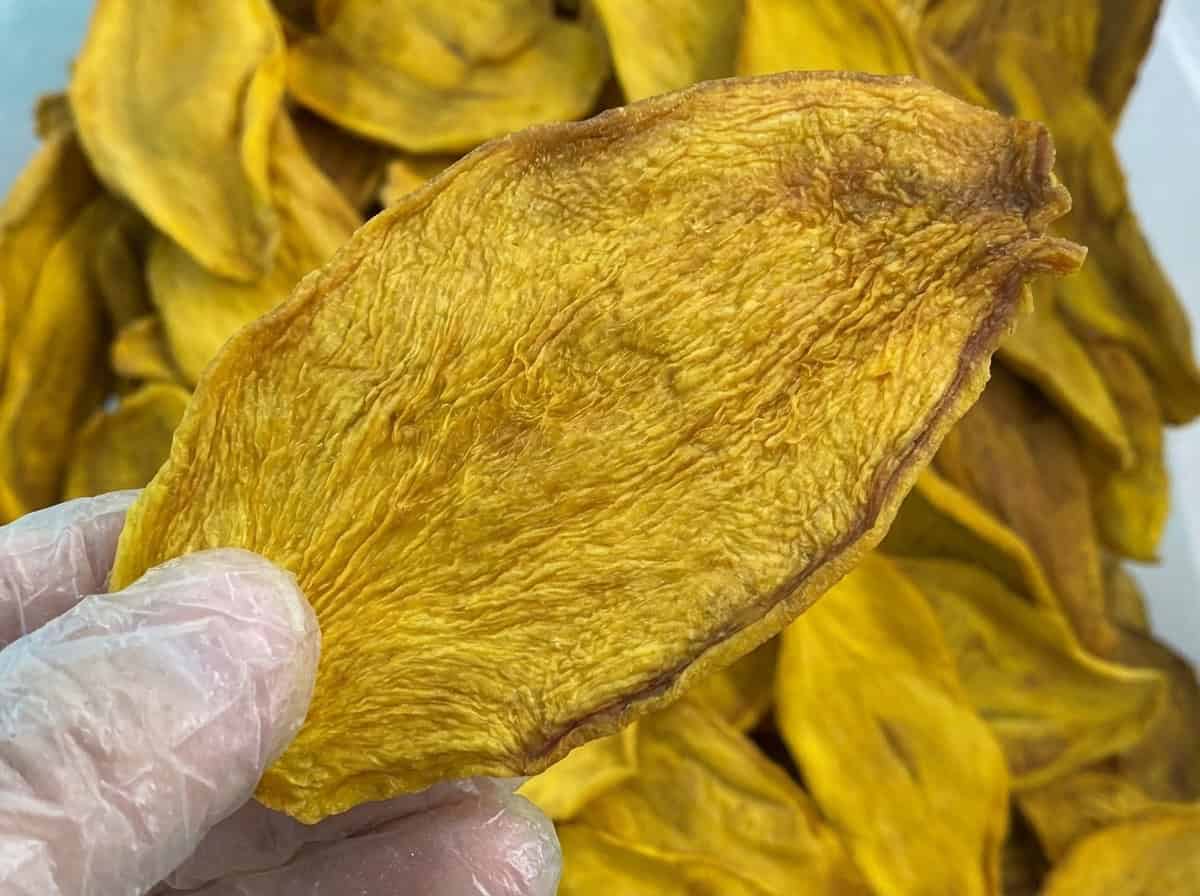
The counterargument and the legally stronger position is that hot air drying is the standard commercial process for producing dried fruit and does not introduce any ingredient, additive, or chemical treatment that would take the product out of Chapter 08. USDA and FDA treat air-dried fruit as a natural product, and the HS system explicitly lists dried mango within 0804.50.
If your customs broker raises this question, FRUITBUYS VIETNAM provides full process documentation: written production process description, COA confirming no added sugar and no chemical treatment, and the factory’s HACCP and ISO 22000 certificates. That documentation package supports a binding ruling request to CBP if needed. The cost of obtaining a binding ruling is administrative time. The cost of not having one and facing a classification dispute at the port is a held reefer container and a customs broker emergency fee.
Practical recommendation: Request a binding classification ruling from CBP before your first US shipment if your broker has any uncertainty. FRUITBUYS VIETNAM has the documentation to support the 0804.50.80.10 classification.
European Union: CN 0804.50.00
EU Combined Nomenclature classifies dried mango under CN 0804.50.00. The MFN (Most Favored Nation) tariff rate is 0% meaning even without a preferential trade agreement, dried mango from any origin enters the EU duty-free under standard conditions.
For Vietnamese-origin dried mango, the EU-Vietnam Free Trade Agreement (EVFTA) in force since August 2020 confirms and locks the 0% rate with a specific documentary requirement: C/O Form EUR.1 issued by Vietnamese customs authorities.
Why does the EUR.1 matter if MFN is already 0%? Two reasons:
First, while the current MFN rate is 0%, tariff schedules can change. EVFTA locks the preferential rate for Vietnamese origin regardless of future MFN schedule adjustments it is a contractual rate, not a schedule rate. Having EUR.1 documentation on file means your preferential rate cannot be challenged retroactively if the MFN rate changes.
Second, EU retail buyers and supermarket chain procurement teams increasingly request EVFTA documentation as part of their supplier audit process not because they are calculating tariff savings, but because C/O Form EUR.1 confirms origin verification, which is part of supply chain due diligence for ESG-focused retailers and sustainability-audited procurement programs.
Document checklist for EU market entry:
- C/O Form EUR.1 (EVFTA issued by Vietnam Customs)
- Phytosanitary Certificate (issued by Vietnam Plant Protection Department)
- HACCP Certificate
- COA from ISO 17025-accredited lab (SGS, Bureau Veritas, or Eurofins)
- EU-format Nutrition Facts label (Regulation 1169/2011)
- Commercial Invoice, Packing List, Bill of Lading
FRUITBUYS VIETNAM prepares EUR.1 as standard documentation on all EU-destined shipments. It is not a special request it is the default.
UAE and GCC: 0804.50.XX (12-Digit Code)
The UAE and GCC Customs Union classify dried mango under the 0804.50 heading with a 5% import duty applied at the GCC border.
Critical change effective January 2025: The GCC customs authority now requires a full 12-digit expanded HS code for all food product imports. The standard 6-digit international code (0804.50) is no longer sufficient for GCC customs entry. The complete 12-digit code must be verified with a UAE-licensed customs broker before your first shipment the specific digits beyond 0804.50 depend on product format, processing method, and packaging type, and the full code has not been standardized in public English-language documentation as of the date of this article.
Document checklist for UAE market entry:
- 12-digit HS code (verify with UAE customs broker before shipment)
- Halal Certificate mandatory for all food products entering UAE market. Must be issued by a UAE-approved Halal certification body. FRUITBUYS VIETNAM provides Halal certification on request.
- ESMA (Emirates Authority for Standardization and Metrology) registration
- COA from accredited third-party lab
- Arabic-language label mandatory for retail packaging in UAE
- Certificate of Origin
- Phytosanitary Certificate
The 5% GCC tariff is not waived under any current FTA between Vietnam and the GCC. It is a fixed landed cost that must appear in your UAE price model. On a reefer 20ft load of 8.0–8.8 MT, 5% duty on the declared customs value represents a material line item. Model it accurately before comparing landed cost against UAE-sourced alternatives.
Import Duty Comparison: What Each Market Actually Costs
For a buyer evaluating market entry costs across multiple destinations, the effective tariff rate is only one component of the customs cost picture. Documentation failures missing EUR.1, unclaimed GSP, incorrect HS code can eliminate preferential rates or trigger customs holds that cost more than the tariff saving.
| Market | MFN Rate | Vietnam Preferential Rate | Annual Saving (20ft reefer, ~$25,000 cargo value) | Key Risk |
|---|---|---|---|---|
| US | 1.5¢/kg (~0.5–0.8% ad valorem equivalent) | Free (GSP) | ~$125–$150 | Binding ruling if broker disputes Chapter classification |
| EU | 0% | 0% (EVFTA) | $0 (MFN already zero) | EUR.1 missing = no preference documentation for audit |
| UAE | 5% | 5% (no FTA) | No saving available | 12-digit code error = customs hold, reclassification fee |
| Japan | Varies by subheading | Reduced (VJEPA) | Varies | Form VJ required prepare 60 days in advance |
| UK | 0% | 0% (UKVFTA) | $0 (MFN already zero) | REX registration required for Vietnamese exporter |
The US GSP saving per container is modest in absolute terms approximately $125–$150 on a standard 20ft reefer load. The real value of claiming GSP is not the tariff saving itself. It is the documentation habit it creates. A supplier who prepares Form A correctly is a supplier who understands origin documentation, which is the same documentation infrastructure that supports FSVP compliance, EVFTA claims, and any future trade agreement benefits as Vietnam’s FTA network expands.
What “No Added Sugar” Means for HS Classification
This point is worth stating directly because it resolves a classification question that arises specifically for the no-sugar dried mango format.
Products that contain added sugar and have been processed with osmotic dehydration the sugar syrup pre-treatment described in FRUITBUYS VIETNAM’s complete sourcing guide are more vulnerable to Chapter 20 reclassification arguments, because the osmotic treatment introduces an added ingredient that could be characterized as “preparation.” A product with 15–25g of added sugar per 100g from osmotic treatment has a more complicated Chapter 08 defense than a product with 0g added sugar from direct hot air drying.

Dried mango no added sugar, produced by AD without osmotic pre-treatment, has the cleanest possible Chapter 08 classification argument: it is fresh mango, dried. No added ingredients. No chemical treatment. No change in fundamental character. The COA confirming 0g added sugars is not just a nutrition label document it is supporting evidence for the Chapter 08 classification that determines your tariff rate.
This is one of the underappreciated connections between product specification and customs compliance. Your supplier’s production process affects your classification risk. A supplier who uses osmotic treatment and calls it “no added sugar” creates both a label compliance problem and a classification defense problem simultaneously.
The Documentation Your Supplier Must Prepare
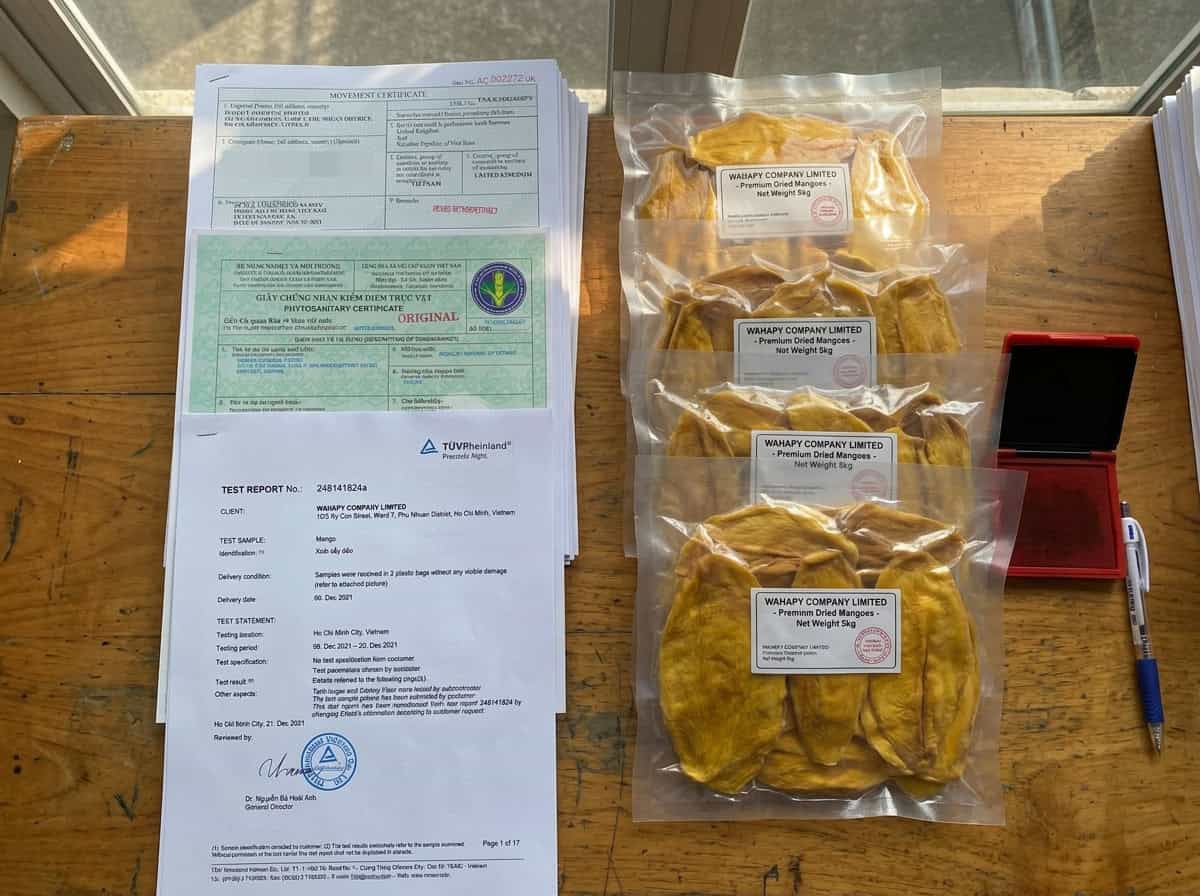
Tariff preferences and correct classification do not apply automatically. They require specific documents that must be prepared by the exporter in Vietnam before the container is loaded. A supplier who cannot prepare these documents costs their buyers money at the border through unclaimed preferential rates, customs holds, or reclassification fees.
| Document | Purpose | Market | FRUITBUYS Prepares? |
|---|---|---|---|
| Certificate of Origin (GSP Form A) | Claims Free rate under US GSP | US | ✅ Standard |
| C/O Form EUR.1 | Claims 0% EVFTA rate | EU | ✅ Standard |
| Certificate of Origin (standard) | General origin declaration | UAE, Japan, others | ✅ Standard |
| Phytosanitary Certificate | Plant product compliance | All markets | ✅ Standard |
| HACCP Certificate | Food safety management system | All markets | ✅ Standard |
| ISO 22000 Certificate | Food safety management system | All markets | ✅ Standard |
| COA (ISO 17025 lab) | Product specification verification | All markets | ✅ Per batch |
| Process declaration | Chapter 08 classification support | US (if queried) | ✅ On request |
| Halal Certificate | UAE market entry | UAE | ✅ On request |
| Nutrition Facts (FDA format) | US label compliance | US | ✅ Standard |
| Nutrition Facts (EU format) | EU label compliance | EU | ✅ Standard |
Every document in this table is prepared by FRUITBUYS VIETNAM as a standard part of every export shipment not as a premium service, not as a special request with an additional lead time, and not as a PDF emailed three days after the container has already loaded.
Frequently Asked Questions
What is the HS code for dried mango?
The international HS code for dried mango is 0804.50, under Chapter 08 (Edible Fruit and Nuts). In the US, the full HTS code is 0804.50.80.10. In the EU, the Combined Nomenclature code is 0804.50.00. In the UAE and GCC, it extends to a 12-digit code under the same 0804.50 heading, required since January 2025. Vietnam’s export classification is 0804.50.90.
What is the import duty on dried mango in the US?
The general tariff rate under HTS 0804.50.80.10 is 1.5¢ per kilogram. For Vietnamese-origin dried mango, the rate under the US Generalized System of Preferences (GSP Program A) is Free 0%. A Certificate of Origin (GSP Form A) must be provided by the Vietnamese exporter and filed by the US importer of record at customs entry to claim this rate.
Is dried mango from Vietnam duty-free in the EU?
Yes. Under the EU-Vietnam Free Trade Agreement (EVFTA), dried mango from Vietnam enters the EU at 0% tariff under CN code 0804.50.00. The MFN rate for this product is also 0% meaning duty-free entry applies regardless of origin. To document EVFTA compliance for audit purposes, importers should ensure their Vietnamese supplier provides C/O Form EUR.1 with every shipment.
What HS code do I use for no-sugar dried mango versus sweetened dried mango?
Both no-sugar and sweetened dried mango classify under 0804.50 as the base heading, provided the product has not been fundamentally transformed by preparation. No-added-sugar dried mango has a stronger Chapter 08 argument because it contains no added ingredients. Sweetened dried mango produced with osmotic dehydration may face Chapter 20 reclassification arguments from customs brokers in some markets. Verify with your customs broker and obtain a binding ruling if there is any classification uncertainty.
What documents do I need to import dried mango from Vietnam?
For US: COA (ISO 17025 lab), Phytosanitary Certificate, GSP Form A (for Free rate), FSVP compliance documentation, FDA facility registration of Vietnamese supplier, Nutrition Facts label in FDA format. For EU: COA, Phytosanitary Certificate, C/O Form EUR.1, HACCP Certificate, EU nutrition label. For UAE: COA, Phytosanitary Certificate, Halal Certificate, Arabic label, ESMA registration, 12-digit GCC HS code confirmation.
What is the GCC 12-digit HS code for dried mango?
The GCC requires expanded 12-digit HS codes for all food product imports from January 2025. The base heading is 0804.50. The complete 12-digit extension depends on product format and processing method and must be verified with a UAE-licensed customs broker before your first GCC shipment. FRUITBUYS VIETNAM provides full process documentation to support your broker’s classification determination.
Classification Confidence Starts With the Right Supplier
The HS code for your product is determined before the container loads by what is in the product, how it was processed, and what documentation your supplier can provide to defend that classification at the border.
A genuine no-added-sugar dried mango produced by hot air drying without osmotic pre-treatment has the strongest possible Chapter 08 classification argument. COA confirming 0g added sugars, process declaration confirming no chemical treatment, and HACCP and ISO 22000 certification confirming systematic quality management these are the documents that make your customs broker’s job straightforward and your tariff claim defensible.
FRUITBUYS VIETNAM prepares all of them as standard. GSP Form A for US shipments. EUR.1 for EU shipments. Halal certification for UAE on request. COA per production batch from SGS, Bureau Veritas, or Eurofins. Process declaration on request for any classification ruling support.
Contact FRUITBUYS VIETNAM today for a quotation and free samples. The documentation package that clears your customs entry ships with the product.
Contact FRUITBUYS VIETNAM:
- WhatsApp: +84-909.499.619
- Email: hotro@fruitbuys.vn
- Website: https://fruitbuys.com
- Office: 10/2 Ky Con, Cau Kieu Ward, Ho Chi Minh City
- Warehouse: 182 An Phu Dong 09, An Phu Dong Ward, District 12, Ho Chi Minh City