
Dried Mango No Added Sugar
The most expensive words on a dried mango spec sheet are “No Added Sugar” when nobody verifies them. Some suppliers run an osmotic pre-treatment with sugar syrup before drying, then rinse the surface: the sample passes the taste check, the spec sheet reads clean, and the container fails the buyer’s in-market lab test.
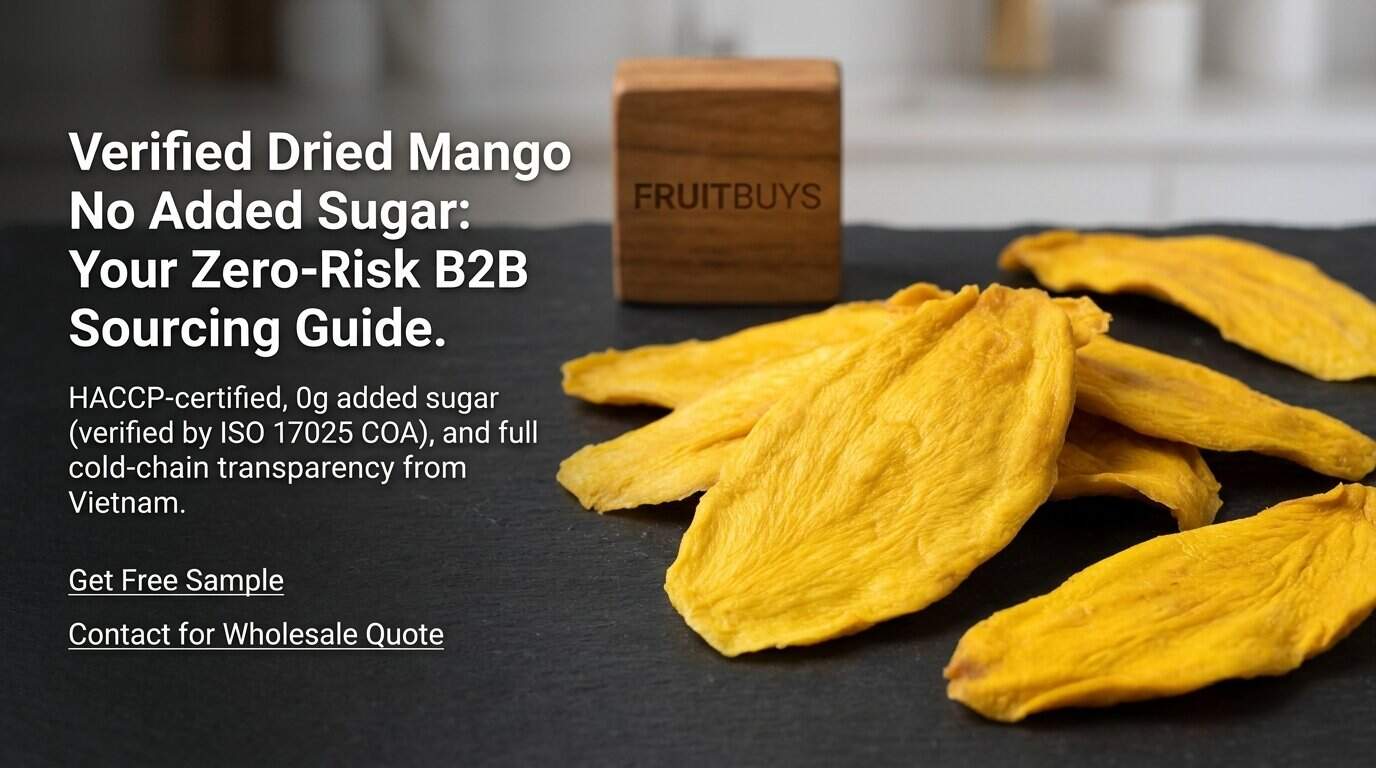
When the COA belongs to a different production batch than the goods in the container, the certificate tells you nothing about your shipment. Specify batch-matched COAs in your RFQ and verify the batch numbers before the container leaves.
This guide covers all of it. What “no added sugar” means at the processing level. What specifications to demand in every COA. Why this product requires cold chain logistics that most buyers discover too late. How to verify supplier claims before your container departs Vietnam. And how Vietnam compares with other origins on verifiable quality factors and landed cost structure.
What “No Added Sugar” Actually Means in Production
Most buyers treat “no added sugar” as a marketing label. Suppliers exploit that assumption. In dried mango production, there are three processing methods that produce structurally different products, and only one of them legitimately qualifies for a “no added sugar” claim under FDA 21 CFR 101.60 or EU Regulation 1169/2011.
Osmotic dehydration with sugar syrup — the fraud mechanism: Raw mango slices are soaked in a sugar syrup solution before the drying step. The syrup draws moisture out of the fruit through osmotic pressure while sugar molecules enter the cell structure. This reduces drying time, improves texture pliability, and lowers production cost. It also adds 15–25g of sugar per 100g that becomes embedded in the fruit tissue. Some suppliers rinse the surface after osmotic treatment to reduce surface stickiness and sweetness perception. The product may taste cleaner. A surface swab test may return lower sugar. But homogenized lab testing on a full sample will detect the added sugar every time. When your importer-of-record submits that product for FDA review or your retail buyer runs their own verification, the claim fails. The consequences run from product rework to retailer delisting and reputational damage that no discount recovers.
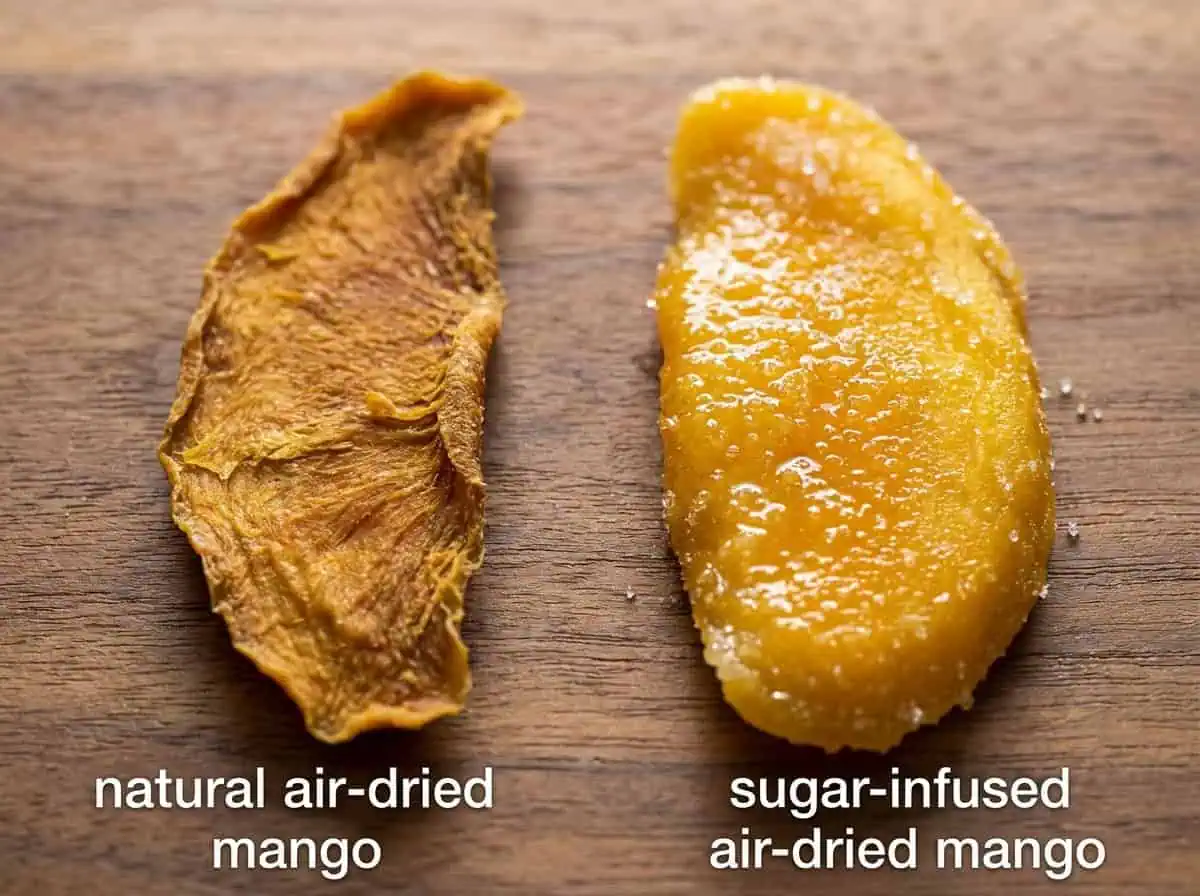
Hot air drying (AD) without osmotic pre-treatment — the legitimate method: Fresh ripe mango is sliced and passed through a controlled hot air drying chamber at 60–80°C for 8–14 hours. No sugar syrup. No osmotic soak. No chemical blanching agents. The sugars in the finished product are 100% naturally occurring glucose, fructose, and sucrose from the fruit itself typically 55–70g per 100g in dried form due to moisture concentration. This product carries a valid “No Added Sugars: 0g” entry on the nutrition facts panel and qualifies for the FDA “No Added Sugars” claim under 21 CFR 101.60. This is the only process FRUITBUYS VIETNAM uses.
Freeze-drying and vacuum frying — different product categories entirely: Freeze-dried mango removes moisture under vacuum at sub-zero temperatures, producing a light, airy, crispy product with 12–18 months ambient shelf life. Vacuum-fried mango is a chip format with oil content. Neither is a substitute for soft-dried in snacking or food ingredient applications. Both are upsell opportunities from the base soft-dried product. We cover that later.
The single most important question to ask every supplier before placing any order: “Do you use osmotic pre-treatment or sugar syrup at any stage before drying? Can you show me a COA with added sugars listed as 0g?” If the answer is vague, or if the COA shows total sugars but omits the added sugars breakdown as a separate line, that is a disqualifying signal. Walk away.
The Market You Are Entering
This is not a niche request from a small buyer segment. The global dried mango market was approximately $1.0–1.2 billion in 2025 and is growing at 6.2–7.6% CAGR through 2033. Within that market, the no-added-sugar and clean label sub-segment is growing faster sugar-free snack launches globally have tracked at 9.3% CAGR, and no/low sugar claims now account for 39% of all healthy snack product launches.
The consumer pull driving this is not a trend. It is a structural shift. 58% of US consumers are actively trying to reduce sugar intake. 43% inspect ingredient labels before purchasing in-store. 74% of US consumers prefer products with recognizable ingredients. A dried mango bag with an ingredient list reading “100% Mango (Mangifera indica)” sells that story in two words. An ingredient list reading “Mango, Sugar, Citric Acid” requires a marketing budget to explain away the sugar in a health food channel.
For distributors and retail buyers positioned in the natural, specialty, or clean label channel, carrying a product that cannot honestly claim “No Added Sugars” is a positioning problem before it is ever a quality problem. The buyers reading this guide already know that. The question is whether their current supplier is actually delivering it.
Why Vietnam Is the Right Source
Vietnam produces approximately 1 million tons of mango annually across 114,000+ hectares of cultivation. In 2024, mango exports exceeded $308 million a 43.5% increase year-over-year. The country exports into China, the US, Japan, South Korea, the EU, and Australia through established phytosanitary and compliance channels with government-backed certification infrastructure.
The cost structure advantages over Vietnam’s primary competitors are real and persistent, not cyclical.
| Origin | Pricing basis | Dominant Variety | No-Sugar Products Available? | OEM Flexibility | FTA Tariff Benefit |
|---|---|---|---|---|---|
| Vietnam | Quoted per RFQ: variety, format, packaging, volume, destination | Keo, Cát Chu, Hoà Lộc | Yes — AD method, COA-verified | High (MOQ from 1,000kg) | EU: 0% (EVFTA). US: confirm current rate with broker |
| Philippines | Quoted per RFQ: same parameters required | Carabao | Rare — most products sweetened | Limited | None significant |
| Thailand | Quoted per RFQ: same parameters required | Nam Dok Mai | Some — limited no-sugar SKUs | Low to Medium | No EU FTA |
| India | Quoted per RFQ: same parameters required | Alphonso, Kesar | Inconsistent batch-to-batch | Variable | Limited |
Vietnam’s raw material cost position among quality-certified origins is strong. A buyer sourcing from Thailand typically receives higher per-kilogram quotations for comparable product with no FTA benefit in the EU. Under EVFTA in force since 2020, qualifying Vietnamese dried mango enters the EU at 0% duty. For the US, confirm the current duty treatment with your customs broker before costing. Model the tariff differential into your landed cost calculation.
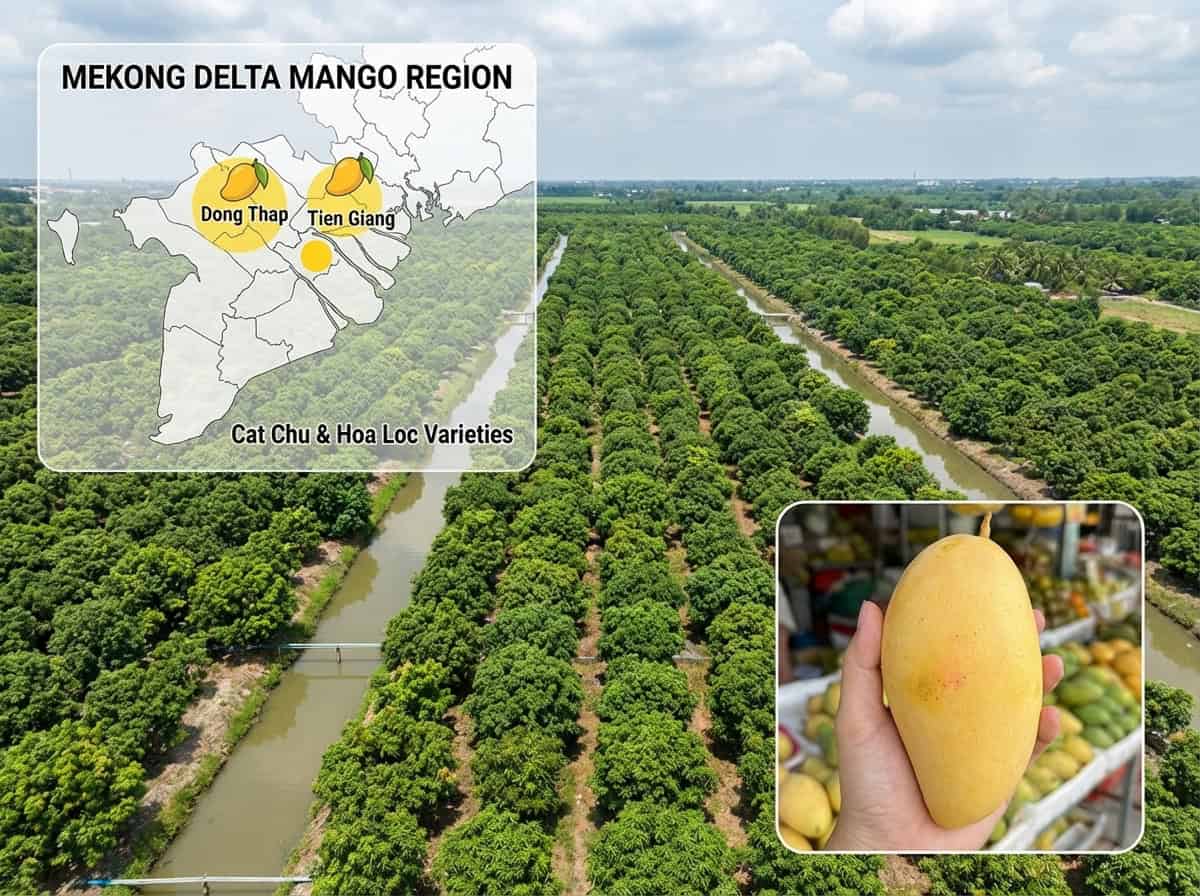
The Mekong Delta growing regions Đồng Tháp (14,000+ ha), Tiền Giang, An Giang provide fertile alluvial soil, mature irrigation infrastructure, and year-round supply capability through staggered planting. The Keo and Cát Chu varieties are available nearly year-round. The Hoà Lộc variety 20–22°Bx natural sugar content, buttery flesh with virtually no fiber — was described by the US Ambassador to Vietnam as “the best mango in the world.” It requires advance booking at least 60 days out due to seasonal constraints. For buyers who want a differentiated private label story, Hoà Lộc origin dried mango with 0g added sugar is the product.
Technical Specifications: What to Demand in Every COA
A supplier who cannot provide all of the following parameters in an ISO 17025-accredited COA before shipment is not operating at the standard required by US, EU, or UAE import markets. These are not optional requests.
Physical and Chemical Parameters
| Parameter | Required Specification | Commercial Significance |
|---|---|---|
| Moisture Content | 15–18% (target: 16%) | Below 18% controls microbial risk. Above 15% preserves soft-chewy texture. Tolerance ±1.5% batch-to-batch. |
| Water Activity (aw) | ≤0.60 (target: 0.55–0.58) | Below 0.60 inhibits most molds and pathogenic bacteria without preservatives. |
| pH | 3.5–4.5 | Natural mango acidity provides additional microbial control. |
| Total Sugars (natural) | 55–70g per 100g | 100% from naturally occurring glucose, fructose, sucrose. No external sugars present. |
| Added Sugars | 0g | The non-negotiable verification point. Must appear as a separate line on COA. |
| SO₂ Residue | <10 ppm (Not Detected) | Qualifies as sulfite-free under FDA standards. Required for clean label channel. |
| Bulk Density | ~0.55–0.65 g/cm³ | Affects packaging fill weight and container loading calculations. |
| Metal Detection | Fe ≤1.5mm, Non-Fe ≤2.0mm, SUS ≤2.5mm | Required for retail market entry. Request metal detection certificate per production run. |
Microbiological Limits
| Parameter | Acceptable Limit | Test Method |
|---|---|---|
| Total Plate Count (TPC) | ≤10,000 CFU/g | ISO 4833 / AOAC 990.12 |
| E. coli | ≤10 CFU/g (EU); <3 MPN/g (FDA) | ISO 16649-2 |
| Salmonella spp. | Not detected /25g | ISO 6579 / AOAC 2014.01 |
| Yeast & Mold | ≤1,000 CFU/g | ISO 21527 |
| Staphylococcus aureus | ≤100 CFU/g | ISO 6888 |
| Listeria monocytogenes | Not detected /25g | ISO 11290-1 |
COA results must come from an accredited ISO 17025 laboratory SGS, Bureau Veritas, Eurofins, or QUATEST 3. A COA from an unaccredited internal factory lab has no regulatory standing in any market you are importing into. If a supplier provides internal lab results as their primary quality documentation, that is a compliance gap, not a minor procedural issue.
The Cold Chain Problem Nobody Tells You
This is the section that most sourcing guides for dried mango skip. It is the single most common cause of product loss for buyers switching from sweetened dried mango to no-added-sugar formats.
Dried mango with no added sugar and no preservatives requires cold chain storage and reefer container shipping for ocean freight. It cannot be shipped in a dry container.
Here is the science. In standard sweetened dried mango, added sugar performs a function beyond flavor it lowers water activity by binding free water molecules. A product with 5% added sugar typically achieves aw of 0.50–0.55, which allows safe ambient temperature storage and dry container shipping. Remove the added sugar, and aw sits at 0.55–0.60. At that level, any temperature excursion above 25°C in an enclosed container which occurs routinely on equatorial shipping lanes creates conditions where mold can develop and Maillard browning accelerates, degrading both food safety and visual presentation. A dry container crossing the Pacific from Vietnam to Long Beach can see internal temperatures above 40°C on warm days. That is not a risk worth taking with a full container at stake.
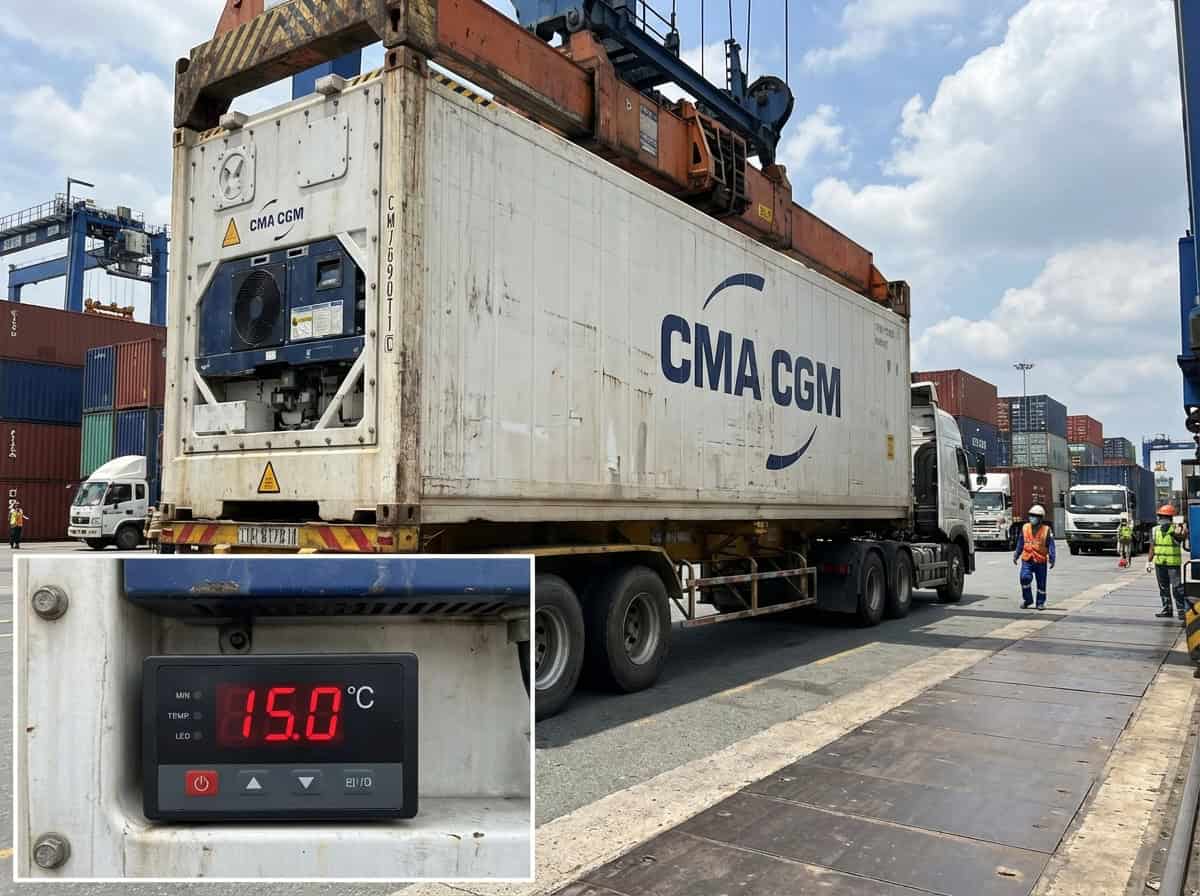
Storage and shipping requirements for dried mango no added sugar:
- Storage temperature: 10–20°C (optimal: 15°C)
- Relative humidity: ≤65% RH
- Ocean freight: Reefer container set at 15°C mandatory, no exceptions
- Air freight (samples/small orders): Insulated carton with gel packs, transit under 3 days, cold storage immediately upon receipt
- Shelf life sealed: 6–9 months from production date at correct temperature
- After opening: 2–8°C in sealed bag, use within 14 days
- Avoid direct light: Accelerates browning
The cost calculation your landed price must include: Reefer containers cost more than dry containers, and a reefer 20ft carries less product than an equivalent dry container because insulation walls reduce interior dimensions. Request the reefer surcharge and genset costs as a separate line above the dry container baseline in every quotation.
Any supplier quoting dried mango no added sugar for dry container shipment either does not understand their own product or is shipping a product modified with undisclosed preservatives. Ask directly. Get the answer in writing on the proforma invoice.
Request our full cold chain specification sheet with your free sample. Contact FRUITBUYS VIETNAM at fruitbuys.com/contact
How to Verify a Supplier’s “No Added Sugar” Claim
Supplier claims and supplier documentation are two different things. Here is the four-step verification protocol before committing to any container order.
Step 1 — Get the production process in writing. Ask specifically: “Do you use osmotic pre-treatment, sugar soaking, or sugar syrup at any stage before or during drying?” A legitimate no-sugar producer answers this question precisely and without delay. If the response is evasive, generic, or redirects to certifications without answering the process question, that is a signal.
Step 2 — Demand a COA with added sugars as a separate line showing 0g. Total sugars will legitimately be 55–70g per 100g for dried mango that is naturally concentrated fruit sugar and is expected. The added sugars line must read 0g. If the COA shows only “total sugars” without breaking out added sugars as a separate entry, it is not compliant with FDA 21 CFR 101.60 labeling standards and cannot support a “No Added Sugars” retail claim in the US market. Do not accept a COA that does not include this distinction.
Step 3 — Test the sample at an accredited lab before placing any order. A legitimate supplier ships samples within 3–5 business days. When the sample arrives, send it to an ISO 17025-accredited lab in your market SGS, Eurofins, or any accredited lab and request a full sugar profile using HPLC method. The test takes about 5–7 business days at an accredited lab — request the current fee when you book. If total sugar comes back above 75g per 100g for a claimed no-sugar product, added sugar is present. If added sugars appear as a separate detectable entry, the claim is fraudulent. Two weeks and one lab report eliminates the risk of a full-container loss.
Step 4 — Match the sample COA batch number to the production shipment. When you receive the sample, ask the supplier to send the COA for the specific production batch the sample came from, with the batch number and production date both visible. When your container order arrives, verify that the COA provided for the shipment matches a batch number from the correct production period. This one step eliminates the practice of providing a COA from a “clean batch” while shipping from a non-compliant production run. FRUITBUYS VIETNAM provides batch-matched COAs as standard procedure on every shipment not on request.
Nutrition Profile: What Your Buyers Are Looking At
The nutritional profile of genuine no-added-sugar dried mango is the product’s strongest retail positioning asset. The table below gives you the data your label designers, marketing teams, and retail buyers will ask for. Values are based on USDA FoodData Central for unsweetened dried mango, adjusted for 15–18% moisture content. Confirmed values per COA accompany every shipment.
Dried Mango No Added Sugar — Per 100g
| Nutrient | Per 100g | % Daily Value* |
|---|---|---|
| Energy | 314–320 kcal | 16% |
| Total Fat | 0.8–1.2g | 1% |
| — Saturated Fat | 0.3g | 1% |
| — Trans Fat | 0g | 0% |
| Cholesterol | 0 mg | 0% |
| Sodium | 160–165 mg | 7% |
| Total Carbohydrate | 78–82g | 28% |
| — Dietary Fiber | 2.0–2.4g | 8% |
| — Total Sugars | 66–70g | — |
| — Added Sugars | 0g | 0% |
| Protein | 2.0–2.5g | 4% |
| Vitamin C | 40–45 mg | 47% DV |
| Vitamin E | 4.0 mg | 27% DV |
| Copper | 0.28 mg | 31% DV |
| Vitamin B6 | 0.33 mg | 19% DV |
| Folate | 68 mcg | 17% DV |
| Vitamin A (RAE) | 65–70 mcg | 7% DV |
| Potassium | 270–280 mg | 6% DV |
- Based on 2,000 kcal diet. % DV per FDA 2020–2025 reference values.
Valid FDA label claims for this product:
- No Added Sugars” 21 CFR 101.60, Added Sugars: 0g
- Excellent source of Vitamin C: 47% DV (threshold: >20% DV)
- Excellent source of Copper: 31% DV
- Excellent source of Vitamin E: 27% DV
- Good source of Vitamin B6: 19% DV (threshold: 10–19% DV)
- Good source of Folate: 17% DV
Six valid FDA nutrient claims on one SKU. In a health food aisle where competing products fight for shelf space with one or two claims, this product arrives with a full claim set and an ingredient list that reads: 100% Mango (Mangifera indica). That is your retail buyer’s pitch. That is your end consumer’s decision point.
One allergen note for packaging: this product is processed in a facility that also handles cashew nuts. Label accordingly “Produced in a facility that also processes tree nuts (cashews)”.
HS Code and Import Compliance by Market
Documentation failures at customs cause hold time and additional broker fees per incident. Have the following prepared before the container departs Vietnam.
| Market | HS Code | Import Duty | Required Documentation |
|---|---|---|---|
| US | 0804.50.80.10 | 1.5¢/kg general; confirm current preferential rate with your customs broker | FDA registration, FSVP compliance, Phytosanitary certificate, COA (ISO 17025 lab), Nutrition Facts label FDA format, Certificate of Origin |
| EU | 0804.50.00 | 0% MFN; 0% EVFTA | HACCP certificate, ISO 22000, Phytosanitary certificate, C/O Form EUR.1 (EVFTA), EU nutrition label (Reg. 1169/2011) |
| UAE/GCC | 0804.50.XX (12-digit) | 5% | ESMA registration, Halal certificate, COA, Arabic label, GCC 12-digit code (mandatory from January 2025) |
| Japan | 0804.50 | Varies | JAS compliance documentation, Phytosanitary certificate, COA per batch, Japanese-language label |
US classification note: HS 0804.50.80.10 (Dried Mangoes) is the correct classification for AD-processed no-sugar mango under Chapter 08. Some US customs brokers may argue for 2008.99 (fruit otherwise prepared) due to the heat treatment involved in air drying. Request a binding CBP ruling before your first US shipment if your customs broker raises this question. FRUITBUYS provides full process documentation and COA to support any ruling application.
EU buyers: EVFTA eliminated tariffs on Vietnamese dried mango to 0% since 2020. A valid C/O Form EUR.1 issued by Vietnamese customs is required to claim the preferential rate at the EU border. Without it, your product clears at MFN also 0% for this product category but the EUR.1 belongs on file for audit purposes and demonstrates supply chain diligence to your retail buyers.
UAE buyers: As of January 2025, GCC requires a full 12-digit expanded HS code. Verify the complete code with your UAE customs broker before the first shipment. Halal certification is available from FRUITBUYS on request.
Available Formats and Applications
Dried mango no added sugar is not a single product format. What you specify in your purchase order determines which market it serves.
Slices (3–5mm thin cut) are the retail snacking standard. These go into 50g, 100g, 500g, and 1kg consumer bags. Target channel: health food retailers, natural food stores, e-commerce brands, specialty supermarkets.
Chunks and dice (2×3cm pieces or 5–8mm dice) are the food ingredient standard. These go into granola, muesli, trail mix, cereal bars, bakery fillings, ice cream, and yogurt toppings. Target buyer: food manufacturers, bakery chains, HORECA procurement. Moisture tolerance for food manufacturing use: 14–16% with aw target below 0.55 for applications involving coating or heat processing.
Small dice (3–5mm, aw <0.55) serve confectionery and high-moisture-sensitivity applications where moisture migration into surrounding food matrices must be minimized chocolate coating, protein bars, premium bakery.
Bulk packaging formats: 5kg and 10kg PE-lined aluminum foil bags inside 5-layer export cartons (20kg net, 50×40×20 cm). This is the standard format for all food manufacturing purchase orders.
OEM retail packaging: Custom brand labels, any weight from 50g to 1kg, aluminum foil laminate barrier bags. Minimum order for OEM: 1,000kg. FRUITBUYS manages design coordination and compliance label formatting for FDA and EU markets. Lead time for new OEM setup: 20–30 days after artwork approval.
The Freeze-Dried Upgrade: Same Mango, New Market
If you are building a mango product line, there is a format decision that expands your addressable market without changing your origin or your supplier.
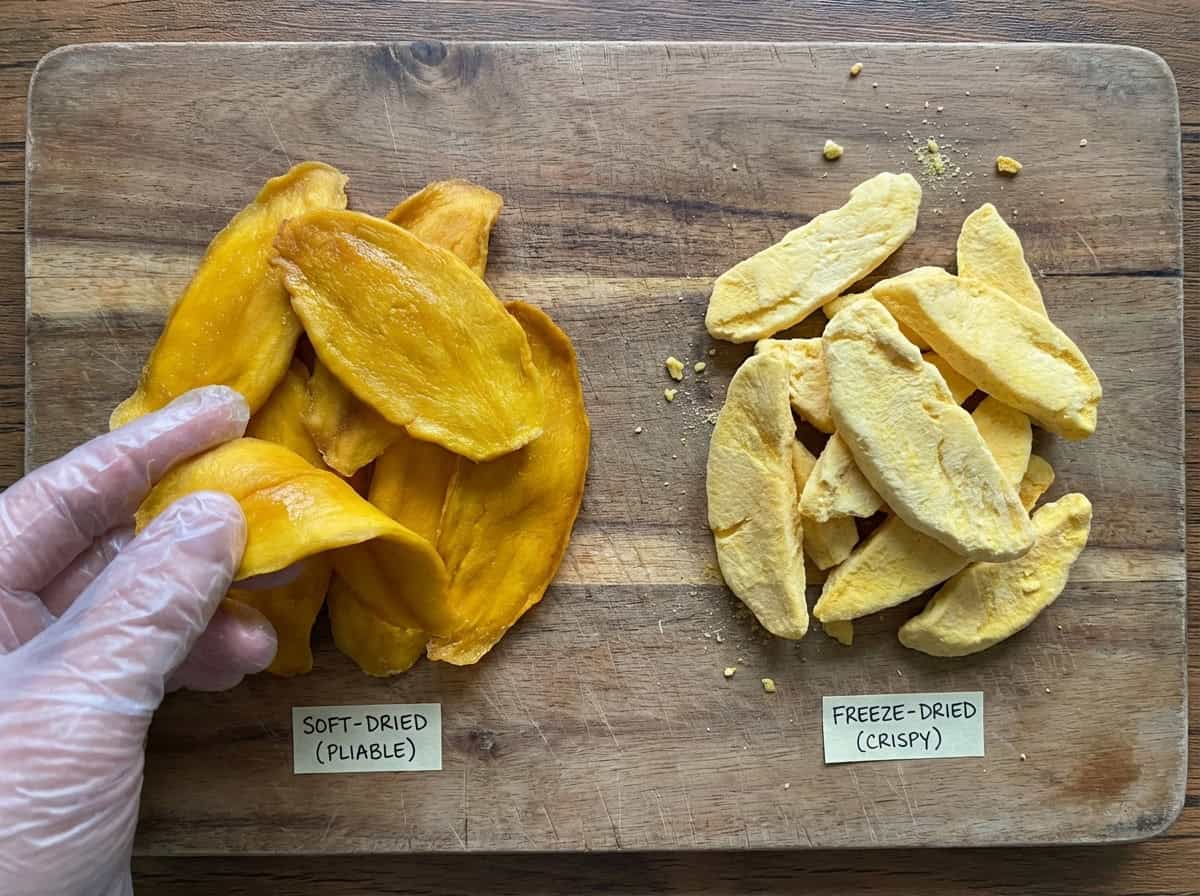
Freeze-dried mango uses the same Vietnamese mango same origin, same variety, same no-added-sugar qualification but the freeze-drying process removes moisture to below 3%, creating a light, crispy product. The practical differences for your product line are significant:
| Feature | Soft-Dried Mango (AD) | Freeze-Dried Mango |
|---|---|---|
| Texture | Soft, chewy, pliable | Crispy, airy, dissolves on tongue |
| Shelf life | 6–9 months at 10–20°C | 12–18 months at ambient temperature |
| Cold chain required? | Yes — reefer container | No — dry container |
| Per-gram retail positioning | Baseline | Higher — model against your channel margin before committing |
| Target channel | Health food, natural retail | Convenience, premium gifting, travel retail |
| Container shipping cost | Reefer surcharge applies | Standard dry container |
Soft-dried mango serves buyers who want chewy texture for direct snacking or food ingredient applications. Freeze-dried mango serves convenience channel buyers, premium gift packaging importers, and single-serve format brands who need ambient shelf life and are willing to pay the margin premium for it.
The same raw material. The same origin story. Two completely different market positions with different margin structures. A buyer who sources both from FRUITBUYS VIETNAM builds a mango product line across two market segments with a single supplier relationship and a single set of compliance documentation.
Freeze-dried mango powder takes that a step further functional ingredient for smoothie mix manufacturing, beverage flavoring, bakery applications, and ice cream. Margin on mango powder is the highest in the processing value chain.
What FRUITBUYS VIETNAM Delivers
FRUITBUYS VIETNAM is a B2B sourcing partner for Vietnamese dried fruits and healthy snacks, based in Ho Chi Minh City, working through qualified contract manufacturing partners. We manage quality control, export documentation, and logistics coordination across every shipment. Here is what distinguishes us from what you find through Alibaba directories or general B2B marketplaces.
Verified no-sugar process. Hot air drying only. No osmotic pre-treatment, ever. COA with added sugars at 0g per production batch. Third-party testing through SGS Vietnam, Bureau Veritas Vietnam, or Eurofins Vietnam all ISO 17025 accredited. You can send any batch we ship to your own lab at any time.
Cold chain disclosure from day one. Reefer container requirements are stated in every proforma invoice, not discovered after a damaged shipment. Your warehouse team receives written cold chain handling instructions with every order.
No minimum order for trial. Your first order can be a sample evaluation, a 100kg trial shipment, or a full container. We do not use MOQ as a barrier to entry. OEM packaging starts at 1,000kg.
Sample delivery in 3–5 business days. Free sample with full COA, technical spec sheet, and written process description. You test in your own lab. You decide based on your own data.
Complete export documentation, pre-prepared. C/O, Phytosanitary Certificate, HACCP Certificate, ISO 22000, COA with batch matching, Nutrition Facts in FDA and EU formats. Every document your customs broker needs is ready before the container loads. Production capacity: 500 MT per year (~42 MT per month). Lead time: 20–30 days for a 20ft container after deposit confirmation.
Pricing, Container Loading, and Commercial Terms
Incoterms: FOB (Cát Lái Port, Ho Chi Minh City), CIF, DDP. Port of loading: Cát Lái for ocean freight, Tân Sơn Nhất for air freight.
Payment: T/T — 40% deposit on order confirmation, 60% balance before shipment or against B/L copy. L/C at sight available for established buyers.
Container loading capacity:
| Container Type | Approximate Load | Net Weight |
|---|---|---|
| Reefer 20ft | 400–440 cartons × 20kg | ~8.0–8.8 MT |
| Reefer 40ft | 880–950 cartons × 20kg | ~17.6–19.0 MT |
Estimated transit times from Cát Lái Port:
- Vietnam to US West Coast: 18–22 days
- Vietnam to US East Coast: 28–35 days
- Vietnam to Rotterdam (EU): 28–35 days
- Vietnam to Dubai (UAE): 18–22 days
Pricing is not listed publicly because it depends on variety (Keo, Cát Chu, or Hoà Lộc), format (slices, chunks, or dice), OEM requirements, order volume, and frequency. Contact FRUITBUYS VIETNAM directly for a quotation specific to your requirements.
Frequently Asked Questions
Is dried mango without added sugar healthy?
Yes, within a balanced diet. Dried mango no added sugar contains naturally occurring sugars from the fruit concentrated because water is removed during drying, not because sugar was added. Per 100g, it delivers 47% of the Daily Value for Vitamin C, 31% DV for Copper, 27% DV for Vitamin E, and 17% DV for Folate. It carries valid FDA “No Added Sugars,” “Excellent source of Vitamin C,” and four additional nutrient content claims. For buyers positioning in health food retail, this is a product that sells itself on its label.
Does dried mango have added sugar?
It depends entirely on the processing method. Osmotic dehydration introduces 15–25g of added sugar per 100g. Hot air drying without osmotic pre-treatment produces 0g added sugar all sugars are naturally occurring from the fruit. Always request a COA from an ISO 17025 lab with added sugars listed as a separate line item showing 0g before placing any order.
How much sugar is in dried mango no added sugar?
Dried mango no added sugar contains 66–70g of total natural sugars per 100g and 0g of added sugars. The natural sugars are glucose, fructose, and sucrose from the ripe mango, concentrated approximately 5–6x during the drying process. This is not added sugar. It is the same sugar present in fresh mango, reduced in volume by moisture removal.
How long does dried mango last?
Sealed at 10–20°C, dried mango no added sugar lasts 6–9 months from the production date. Without added sugar and without preservatives, it has a shorter shelf life than sweetened formats and requires cold storage. Once opened: sealed at 2–8°C, consume within 14 days. For importers: reefer container ocean freight is mandatory. Any break in cold chain above 25°C during transit or warehousing reduces remaining shelf life.
What is the HS code for dried mango?
HS 0804.50 covers dried mango across most markets. US HTS: 0804.50.80.10 (1.5¢/kg general rate; confirm current preferential rate with your customs broker). EU CN: 0804.50.00 (0% under EVFTA for Vietnam since 2020). UAE/GCC: 0804.50.XX 12-digit code (5% duty; full 12-digit required from January 2025). US importers: request a binding CBP ruling if your customs broker raises questions about heat treatment classification.
Is dried mango keto-friendly?
Dried mango is high in natural carbohydrates (78–82g/100g) and natural sugars (66–70g/100g), which places it outside the carbohydrate limits of strict ketogenic diets. For buyers targeting the clean label channel where the priority is eliminating added sugars and preservatives rather than minimizing total carbohydrates, dried mango no added sugar is a strong product. For strict keto applications, freeze-dried mango in small controlled portions may be positioned as a treat item.
Where does dried mango come from?
The primary export origins are Vietnam, Philippines, Thailand, and India. Vietnam produces approximately 1 million tons annually across 114,000+ hectares, primarily in the Mekong Delta. In 2024, Vietnamese mango exports exceeded $308 million, a 43.5% increase year-over-year. Vietnamese varieties Keo (10–15°Bx), Cát Chu (18–20°Bx), and Hoà Lộc (20–22°Bx) produce excellent no-added-sugar dried products without flavor compromise because natural sweetness is high enough to require no supplementation.
What is the difference between dried mango with and without added sugar?
The difference is in the production process and in the nutritional outcome. Added sugar dried mango uses osmotic dehydration with sugar syrup before drying this adds 15–25g of exogenous sugar per 100g and allows dry container shipping due to lower water activity. No-added-sugar dried mango uses direct hot air drying with no pre-treatment 0g added sugar, all-natural ingredient list, but requires cold chain because water activity is higher without sugar’s binding effect. The label claim, the compliance documentation, and the logistics costs are all different products.
How is dried mango made commercially?
Commercial production of hot air dried mango no added sugar: (1) Fresh ripe mango graded by Brix level, (2) Washing with food-grade water, (3) Peeling and slicing to 3–5mm for retail or 2×3cm chunks for food manufacturing, (4) Hot air drying at 60–80°C for 8–14 hours, (5) Moisture testing (target: 15–18%) and aw testing (target: ≤0.60), (6) Metal detection screening (Fe ≤1.5mm, Non-Fe ≤2.0mm, SUS ≤2.5mm), (7) Visual grading and sorting, (8) Packing in nitrogen-flushed aluminum foil barrier bags, (9) Cold storage at 10–20°C before shipment.
What are the cold chain requirements for importing dried mango no added sugar?
Ocean freight: Reefer container at 15°C not negotiable. Air freight (samples/small orders): insulated carton with gel packs, transit under 3 days, cold storage on receipt. Warehouse: 10–20°C, ≤65% RH, away from direct light. Include the reefer surcharge above dry container costs as a separate budget line. Any supplier not specifying reefer container in their proforma invoice for this product is either uninformed or undisclosed about their preservative use.
Act Now
You have the specification table. You have the verification protocol. You have the cold chain requirements. You have the HS codes for your market. The product’s nutrition profile and valid label claims are in front of you.
There is one action left. Contact FRUITBUYS VIETNAM today. Request a free sample and a price quotation. We ship samples with full COA, batch-matched documentation, technical spec sheet, and cold chain handling instructions within 3–5 business days. You test in your own lab or with your own customers. If the product meets your specification, you place an order. We produce in 20–30 days.
No minimum order for the first shipment. No vague answers about the production process. No COA from a batch other than the one your sample came from. Every inquiry receives a response within 24 hours.
The clean label snack segment continues to grow. A sourcing decision made this quarter puts verified, compliant product on your shelves next quarter.
Contact FRUITBUYS VIETNAM:
- WhatsApp: +84-909.499.619
- Email: hotro@fruitbuys.vn
- Website: https://fruitbuys.com
- Office: 10/2 Ky Con, Cau Kieu Ward, Ho Chi Minh City
- Warehouse: 182 An Phu Dong 09, An Phu Dong Ward, District 12, Ho Chi Minh City