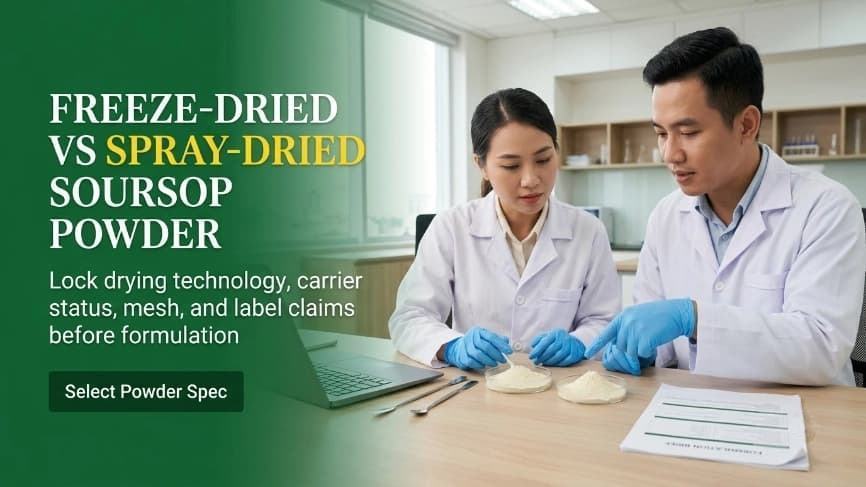
Freeze-Dried vs Spray-Dried Soursop Powder
Soursop powder is not one product. A beverage developer, importer or private-label buyer may say “soursop powder” and mean pure freeze-dried pulp powder, spray-dried powder with carrier, fruit powder blend, beverage premix or a retail SKU. Those routes carry different implications for ingredient declaration, mesh, dispersibility, caking, Nutrition Facts, HS review, packaging and claims.
The buyer must choose the powder technology before approving the sample, because powder route controls the final product identity. FruitBuys Vietnam supplies buyer-defined dried fruit powder through an integrated product supply model covering specification, QC, documentation, OEM/private label execution and export logistics coordination. The decision starts with application, not with a generic powder photo.
The First Question: Pure Fruit Powder or Formulated Powder?
Freeze-dried soursop powder and spray-dried soursop powder are different product routes.
The first decision is whether the buyer needs pure fruit-pulp powder or a formulated powder system with carrier or other ingredients.
Buyers should confirm application, ingredient declaration and destination market before requesting a powder sample.

A pure freeze-dried soursop powder usually starts from cleaned soursop pulp that is freeze-dried and milled into powder. A spray-dried soursop powder usually starts from a liquid feed such as juice or pulp preparation, then dries into powder through atomization and hot air. For fruit powders, spray drying often uses carrier agents because fruit juices contain low-molecular-weight sugars and acids that can create stickiness and wall adhesion during drying. (PubMed Central (PMC))
That difference affects the buyer’s product file. If the powder contains maltodextrin, gum Arabic, modified starch, anti-caking agent, added sugar, flavor or another fruit, the label and specification must disclose it. The buyer should not approve “soursop powder” until the ingredient statement is final.
FruitBuys connects this article to the full freeze-dried soursop B2B specification guide. The pillar guide gives the product route. This article owns the powder-technology decision.
How Freeze-Dried Soursop Powder Is Positioned
Freeze-dried soursop powder is the correct starting route when the buyer wants a powder derived from freeze-dried soursop pulp, with the fruit identity preserved in the ingredient statement as closely as the final formula allows. It is usually considered when the buyer needs a fruit-forward ingredient for beverage, smoothie, dairy, chocolate, bakery, dry mix or private-label powder development.
Freeze-drying process parameters affect physical properties of food materials, including shrinkage, density, porosity, color and texture. (FAO AGRIS) For powder buyers, this matters because the dried structure influences milling behavior, particle size, moisture sensitivity and handling.
A freeze-dried soursop powder specification should define:
| Specification Item | Buyer Decision |
|---|---|
| Ingredient statement | Pure soursop pulp or formulated powder |
| Mesh | Target screen size or particle range |
| Moisture | Release target |
| Aw | Release target |
| Color | Accepted natural range |
| Aroma | Buyer-approved sensory reference |
| Carrier status | None unless buyer-approved and declared |
| Anti-caking status | None unless buyer-approved and declared |
| Bulk density | Test-based data where required |
| Flowability | Application-trial requirement |
| Dispersibility | Beverage or premix-trial requirement |
| Packaging | Moisture-barrier pack matched to powder behavior |
For FruitBuys freeze-dried soursop, the locked product context uses 3–5% moisture and Aw <0.30. The buyer should connect powder release to freeze-dried soursop moisture and water activity control.
How Spray-Dried Soursop Powder Is Positioned
Spray-dried soursop powder is a different route. It often suits powder systems where the buyer prioritizes dispersion, processability, dosing behavior or blend design. The trade-off is that spray-dried fruit powders commonly involve carrier agents or formulation aids, especially when fruit sugars and organic acids make drying difficult.

A review on fruit-juice drying reports that carrier agents such as maltodextrin, gum Arabic and modified starch can improve powder stability, solubility, texture, flow properties and dispersibility. (Springer) Another critical review on spray drying of fruit and vegetable juices notes that carrier agents and drying parameters affect physicochemical and microstructural attributes of the powder. (ScienceDirect)
A spray-dried soursop powder specification should define:
| Specification Item | Buyer Decision |
|---|---|
| Liquid feed | Juice, puree, pulp or formulated feed |
| Carrier | Maltodextrin, gum Arabic, modified starch or other declared carrier |
| Carrier percentage | Buyer-approved formulation detail |
| Added sugar | Confirmed and declared if used |
| Flavor | Confirmed and declared if used |
| Moisture | Finished-powder release criterion |
| Aw | Finished-powder release criterion |
| Solubility/dispersibility | Application-trial requirement |
| Bulk density | Pack and dosing relevance |
| Flowability | Production and filling relevance |
| Caking | Storage and packaging relevance |
| Label status | Final ingredient declaration and Nutrition Facts route |
FruitBuys should not describe spray-dried powder as the same product as pure freeze-dried powder. It is a different technical and documentation route. Buyers exploring powder options can review the dried fruit powder portfolio and the dried soursop powder page for navigation.
Freeze-Dried vs Spray-Dried Powder: Decision Matrix
The better powder route depends on application, not general product preference.
Freeze-dried powder is usually selected when the buyer needs a fruit-pulp-based powder route with tighter ingredient-identity control.
Spray-dried powder may suit formulated powder systems, but the buyer must review carrier, label and documentation impact.

| Decision Area | Freeze-Dried Soursop Powder | Spray-Dried Soursop Powder |
|---|---|---|
| Starting material | Cleaned soursop pulp or dried pulp route | Liquid feed such as juice, puree or formulated feed |
| Main process | Freeze-drying, then milling | Atomization and hot-air drying |
| Carrier status | Can be carrier-free if specified and verified | Often uses carrier for powder stability and drying behavior |
| Ingredient declaration | May remain closer to fruit-pulp identity if pure | Depends on carrier and formula |
| Mesh control | Milling and sieving decision | Spray particle formation and post-process screening |
| Dispersibility | Requires application trial | Often formulated for dispersion, but must be tested |
| Caking risk | Moisture-sensitive; needs barrier packaging | Also moisture-sensitive; carrier may improve behavior |
| Sensory profile | Requires lot and application testing | Depends on feed, carrier and drying conditions |
| Nutrition Facts | Based on final pure or formulated product | Carrier and formula change values |
| HS review | Powder route review required | Powder or formulated product review required |
| Best-fit use | Fruit-pulp powder, dry mix, bakery, dairy, chocolate, premium formula development without unsupported claims | Beverage premix, instant powder systems, formulated blends |
| Buyer proof needed | Mesh, moisture, Aw, caking, ingredient statement, COA | Formula, carrier, solubility, moisture, Aw, Nutrition Facts, COA |
Do not use this table as a universal ranking. The correct route depends on what the buyer needs the powder to do. A pure fruit powder and a highly dispersible formulated beverage powder may serve different product strategies. The application logic sits in freeze-dried soursop applications for food manufacturers.
Carrier Status Is the Core Commercial Difference
Carrier status affects almost every downstream decision. It changes ingredient declaration, Nutrition Facts, claims, HS review, private-label artwork and buyer positioning.
Common carrier or formula questions include:
| Buyer Question | Why It Matters |
|---|---|
| Is the powder 100% soursop pulp? | Controls product identity and claims |
| Does it contain maltodextrin? | Changes ingredient declaration and Nutrition Facts |
| Does it contain gum Arabic or modified starch? | Changes formula and label route |
| Does it contain anti-caking agent? | Changes ingredient list and claims review |
| Does it contain added sugar? | Changes added-sugar labeling |
| Does it contain flavor? | Changes ingredient declaration |
| Is it a fruit blend? | Changes product identity and nutrition |
| Is it a beverage premix? | May change HS, label and application file |
The buyer should not allow carrier information to remain inside technical email threads. It must sit in the product specification and label file. This is why powder technology must connect to freeze-dried soursop Nutrition Facts for label development. A powder with carrier cannot copy the Nutrition Facts of pure freeze-dried soursop pulp powder.
Mesh, Particle Size and Application Performance
Mesh is not only a physical description. It affects mouthfeel, dispersion, dusting, caking, filling behavior, mixing, sedimentation and perceived product quality.

A powder specification should define:
| Parameter | Why It Matters |
|---|---|
| Mesh or particle range | Controls mouthfeel and dosing |
| Oversize | Prevents gritty texture or poor dispersion |
| Fines | Affects dusting and caking |
| Bulk density | Affects filling and serving basis |
| Flowability | Affects filling and manufacturing use |
| Dispersibility | Affects beverage and premix performance |
| Sedimentation | Affects drink systems |
| Caking | Affects storage and consumer use |
| Color | Supports finished-product appearance |
| Aroma | Supports sensory consistency |
A beverage developer may prioritize dispersibility and sedimentation. A bakery developer may prioritize flavor distribution in a dry mix. A chocolate developer may prioritize particle size and mouthfeel. A private-label powder buyer may prioritize spoonability, pouch handling and label clarity.
FruitBuys connects mesh and powder format to freeze-dried soursop formats and size selection. The format article defines product form. This article defines the powder-technology choice.
Caking, Aw and Moisture Sensitivity
Powder approval must include caking and moisture behavior.
A powder can look acceptable when freshly opened but fail after storage, repeated opening, repacking or humid handling.
Buyers should require moisture, Aw, packaging and application-trial evidence before approving bulk powder.
Fruit powders can show caking behavior linked to water sorption and glass-transition behavior. Studies on freeze-dried strawberry powder and freeze-dried mango powder evaluate water sorption, glass transition and caking properties, showing why powder stability cannot be approved by appearance alone. (ScienceDirect)

FDA defines water activity as available-water behavior under specified conditions, separate from total moisture. (U.S. Food and Drug Administration) For freeze-dried soursop powder, this matters because powder caking, clumping and flow loss can appear when moisture exposure increases, even if the original powder met the release target.
Powder buyers should control:
| Control Point | Buyer Requirement |
|---|---|
| Moisture | Finished-powder release value |
| Aw | Available-water release value |
| Packaging barrier | Protects powder after release |
| Seal integrity | Prevents localized moisture pickup |
| Storage condition | Prevents caking and clumping |
| After-opening instruction | Protects retail or foodservice use |
| Flowability | Confirms handling behavior |
| Caking observation | Confirms application and storage behavior |
Packaging review belongs in freeze-dried soursop packaging and shelf-life control. A powder sample in a small temporary pouch does not validate the final retail or bulk pack.
Beverage and Smoothie Powder Decision
Beverage buyers often ask for instant solubility, strong aroma, clean ingredient declaration and low caking risk at the same time. Those requirements may conflict. The buyer must prioritize.
A beverage powder brief should define:
| Requirement | Freeze-Dried Powder Question | Spray-Dried Powder Question |
|---|---|---|
| Ingredient identity | Must it be pure fruit powder? | Is carrier acceptable? |
| Dispersibility | Can the powder disperse under target use? | Which carrier and process support dispersion? |
| Sedimentation | Does fruit fiber settle? | Does formulation reduce sedimentation? |
| Mouthfeel | Is particle size acceptable? | Is particle design acceptable? |
| Label | Can the ingredient list stay clean enough for the buyer’s market? | Are carrier and additives acceptable? |
| Claims | Are “100% fruit” or “no added sugar” statements supportable? | Does formula block the claim? |
| Nutrition | Does final lab data support the panel? | Does carrier change carbohydrate and serving values? |
FruitBuys should not present spray-dried powder as automatically better for beverages or freeze-dried powder as automatically better for natural positioning. The buyer must test the actual powder in the actual beverage system.
Application trials should connect to freeze-dried soursop sample-to-bulk approval. A lab sample does not approve commercial powder unless the same specification, formula and pack can repeat.
Chocolate, Dairy, Bakery and Dry-Mix Decision
Soursop powder can also work outside beverage applications. Chocolate, dairy, bakery and dry-mix buyers should not copy beverage powder criteria.
| Application | Main Powder Concern | Required Proof |
|---|---|---|
| Chocolate | Particle size, moisture compatibility, mouthfeel | Mixing trial, Aw and sensory review |
| Dairy powder mix | Dispersibility, caking and acidity balance | Pilot blend and storage trial |
| Yogurt or dessert system | Hydration behavior and flavor release | Contact trial |
| Bakery | Heat exposure, color and flavor shift | Pilot bake test |
| Bar or filling | Moisture interaction and texture | Pilot formulation |
| Dry premix | Flowability, segregation and caking | Blend trial and pack test |
| Retail powder SKU | Spoonability, caking, label and pouch | Final-pack validation |
A powder can pass one application and fail another. A beverage powder may not suit chocolate. A pure freeze-dried powder may be strong for fruit identity but require dispersion testing. A spray-dried powder may behave better in one powder system but require carrier disclosure and nutrition recalculation.
Buyers should use freeze-dried soursop COA and laboratory testing to define the test file and freeze-dried soursop market readiness to confirm destination requirements before commercialization.
HS Code and Documentation Impact
Powder form changes the documentation path. At the six-digit HS level, UNSD lists 110630 as flour, meal and powder of products of Chapter 8. (UNSD) That classification reference is useful for planning pure fruit powder, but it does not automatically classify every soursop powder SKU.

The buyer should separate:
| Product Type | Documentation Risk |
|---|---|
| Pure freeze-dried soursop powder | Powder classification review required |
| Spray-dried powder with carrier | Ingredient and classification review required |
| Beverage premix | May require different product identity review |
| Fruit blend powder | Composition and essential character review |
| Retail powder pouch | Label and market-readiness review |
| Powder with nutrition claim | Lab and claims evidence required |
The detailed classification logic belongs in freeze-dried soursop HS code for pieces and powder. This article only flags why the powder route affects the document file.
Nutrition Facts and Claims Impact
A pure freeze-dried soursop powder and a carrier-containing spray-dried powder cannot share one Nutrition Facts panel. Carrier, added sugar, flavor, anti-caking agent or blend status changes the formula and nutrient values.
The buyer should confirm:
- Final ingredient statement
- Powder technology
- Carrier status
- Added-sugar status
- Serving size
- Final moisture
- Lab nutrition plan
- Destination label route
- Claims file
Do not claim “100% fruit,” “no added sugar,” “source of fiber,” “vitamin C,” “potassium,” “immune support,” “detox” or any disease-related benefit unless the final product data and destination rules support the claim. FruitBuys does not attach health or treatment claims to soursop powder.
Nutrition review belongs in freeze-dried soursop Nutrition Facts for label development. Claim control belongs in soursop marketing claims food brands must avoid.
Application Mapping

| Buyer Type | Application | Required Format | Proof Needed | FruitBuys Delivery |
|---|---|---|---|---|
| Beverage developer | Smoothie, instant drink or premix | Freeze-dried powder or spray-dried formulated powder | Mesh, carrier status, dispersibility, caking and ingredient declaration | OEM/Private Label Delivery and Documentation |
| Private-label brand | Retail soursop powder pouch | Final powder SKU | Nutrition Facts, claims file, pack validation and lot identity | OEM/Private Label Delivery |
| Importer | Bulk powder ingredient | Pure powder or formulated powder | COA, HS basis, ingredient statement and packaging file | Documentation and Export Logistics Coordination |
| QA manager | Supplier approval | Buyer-defined powder | Moisture, Aw, microbiology, mesh, caking and retained sample | Quality Control |
| Chocolate manufacturer | Inclusion or flavor system | Fine powder, crumble or micro-particle | Mouthfeel, particle size, Aw and mixing trial | Quality Control and Market Trial Support |
| Dairy manufacturer | Powder blend or topping system | Powder | Dispersibility, acidity interaction and caking review | MOQ Flexibility/Market Trial Support |
| Bakery manufacturer | Dry mix, filling or topping | Powder or crumble | Heat trial, flavor distribution and label impact | Quality Control |
| Regulatory reviewer | Destination-market file | Final powder SKU | Ingredient declaration, Nutrition Facts, HS code and claims support | Documentation |
Highest-Risk Decision: Approving “Soursop Powder” Without Carrier Status
The highest-risk shortcut is approving “soursop powder” without confirming whether the powder contains carrier or other added ingredients.
Carrier status changes ingredient declaration, Nutrition Facts, claims, HS review, application behavior and buyer positioning.
Buyers should approve powder only after the formula, technology route and documentation file are clear.
This mistake happens when a buyer evaluates only powder color, aroma or taste. The powder looks acceptable, but the document file remains incomplete. Later, the buyer discovers that the powder contains carrier, does not support a planned claim, changes the Nutrition Facts panel, behaves differently in the beverage trial or requires a different classification review.
The correct approval sequence is:
Application → powder route → ingredient statement → mesh / particle size → moisture and Aw → packaging → lab file → label and claims → sample-to-bulk approvalDo not reverse this sequence. A powder sample without formula disclosure is not enough for commercial approval. FruitBuys protects this decision through Quality Control, Documentation and OEM/private label workflow. Buyers should define this requirement in the freeze-dried soursop RFQ checklist.
Why FruitBuys Delivers This
FruitBuys Vietnam supplies export-ready dried fruit powder through an integrated product supply model. The buyer receives one configured product, one approved specification and one accountable supplier relationship.
OEM/Private Label Delivery aligns powder technology, ingredient declaration, serving basis, artwork input, Nutrition Facts and claims review. A private-label powder SKU cannot move forward if the powder route is undefined.
Quality Control defines mesh, moisture, Aw, caking, sensory, microbiology and retained-sample criteria. FruitBuys treats powder behavior as a release condition, not only as a product appearance issue.
Documentation connects specification, COA scope, laboratory report, HS basis, Nutrition Facts, claims file, packaging file and destination-market requirements.
MOQ Flexibility/Market Trial Support helps buyers evaluate freeze-dried powder, spray-dried powder or a powder system through application trials where operationally supported.
Export Logistics Coordination protects the approved powder condition through pack selection, carton planning, lot coding and document handover.
Buyer Checklist
Before requesting soursop powder, define:
- Intended application
- Powder route: freeze-dried, spray-dried, blend or premix
- Ingredient statement
- Carrier status
- Carrier type if used
- Added-sugar status
- Flavor or anti-caking status
- Target mesh
- Bulk density requirement
- Flowability requirement
- Dispersibility requirement
- Sedimentation concern
- Caking limit
- Moisture target
- Aw target
- Microbiology scope
- COA scope
- Nutrition Facts route
- HS review route
- Destination market
- Claims review
- Packaging structure
- Storage instruction
- Retained sample
- Sample-to-bulk approval rule
Do not approve powder until the formula and documentation route match the final commercial use.
Summary
Freeze-dried soursop powder and spray-dried soursop powder are different product routes. Freeze-dried powder generally starts from cleaned soursop pulp that is freeze-dried and milled, while spray-dried powder usually starts from a liquid feed and often uses carrier agents to improve drying and powder behavior.
Buyers should compare carrier status, mesh, moisture, Aw, caking, dispersibility, ingredient declaration, Nutrition Facts, HS review, packaging and market-readiness requirements. FruitBuys Vietnam supplies buyer-defined dried fruit powder through Quality Control, Documentation, OEM/private label delivery, market-trial support and export logistics coordination.
FAQ
Is freeze-dried soursop powder the same as spray-dried soursop powder?
No. Freeze-dried powder usually comes from freeze-dried pulp that is milled. Spray-dried powder usually comes from a liquid feed and may use carrier agents.
Which powder is better for beverages?
It depends on the beverage system. Buyers must test dispersibility, sedimentation, mouthfeel, carrier status, caking and ingredient declaration before approval.
Does spray-dried soursop powder contain carrier?
It may. Many fruit powder spray-drying systems use carrier agents to manage stickiness and powder behavior. The final ingredient statement must confirm the formula.
Can freeze-dried soursop powder be carrier-free?
It can be configured as carrier-free if the specification, process and documentation support that route. The buyer must confirm ingredient statement and test results.
Why does powder cake?
Powder can cake when moisture exposure, water sorption, glass-transition behavior, storage or packaging is not controlled. Buyers should review moisture, Aw and final packaging.
Does powder need a different HS review?
Yes. Powder requires its own classification review. Pure fruit powder and formulated powder should not be treated as the same document file.
What should buyers request first?
Define the application, carrier status and ingredient declaration before requesting a soursop powder sample.
Conclusion
Define the soursop powder application, carrier status and ingredient declaration before requesting a commercial powder sample.
References
- Nowak, D.; Jakubczyk, E. “The Freeze-Drying of Foods—The Characteristic of the Process Course and the Effect of Its Parameters on the Physical Properties of Food Materials.” Foods, 2020. DOI: 10.3390/foods9101488. (FAO AGRIS)
- Shishir, M.R.I.; Chen, W. “Trends of spray drying: A critical review on drying of fruit and vegetable juices.” Trends in Food Science & Technology, 2017. (ScienceDirect)
- “Impact of spray drying conditions on the reconstitution, efficiency and flow properties of spray dried apple powder—optimization, sensorial and rheological assessment.” PMC-indexed food science article, 2023. (PubMed Central (PMC))
- “Influence of carrier agents on nutritional, chemical, and antioxidant profiles of fruit juices during drying processes: a comprehensive review.” Discover Food, 2025. (Springer)
- Mosquera, L.H.; Moraga, G.; Martínez-Navarrete, N. “Critical water activity and critical water content of freeze-dried strawberry powder as affected by maltodextrin and Arabic gum.” Food Research International, 2012. (ScienceDirect)
- Cano-Chauca, M.; Stringheta, P.C.; Ramos, A.M.; Cal-Vidal, J. “Effects of maltodextrin and pulp on the water sorption, glass transition, and caking properties of freeze-dried mango powder.” Journal of Food Engineering, indexed record. (ScienceDirect)
- U.S. Food and Drug Administration. “Water Activity (aw) in Foods.” FDA Inspection Technical Guide. (U.S. Food and Drug Administration)
- United Nations Statistics Division. “HS 110630 — Flour, meal and powder; of the products of Chapter 8.” UNSD Classification Registry. (UNSD)