
Common Freeze-Dried Soursop Defects and Release Controls
Freeze-dried soursop defects rarely appear as one obvious failure. A sample can look acceptable while the bulk lot carries soft pieces, high fines, seed fragments, uneven color, clumping, powder caking or packaging damage. Importers, QA managers and private-label buyers should not approve the product with vague words like “nice color” or “crispy.” Those words do not release a commercial lot.
A buyer needs written defect limits before sample approval, because every defect affects application performance, shelf stability, consumer experience or documentation review. FruitBuys Vietnam treats defect control as a Quality Control and Documentation gate. The buyer should define what passes, what triggers hold, and what must be rejected before moving from sample to bulk.
A Good Sample Needs Defined Defect Limits
A good-looking sample does not prove that the bulk lot has acceptable defect control.
Freeze-dried soursop defects must be grouped by texture, color, odor, seed fragments, foreign matter, size, fines, breakage and packaging condition.
Buyers should approve the sample only after defining measurable release criteria.
A sample shows one production outcome. It does not define the limits for commercial release. The buyer must decide which variation remains normal and which variation becomes a defect. That decision should appear in the written specification, retained sample file and lot-release record.
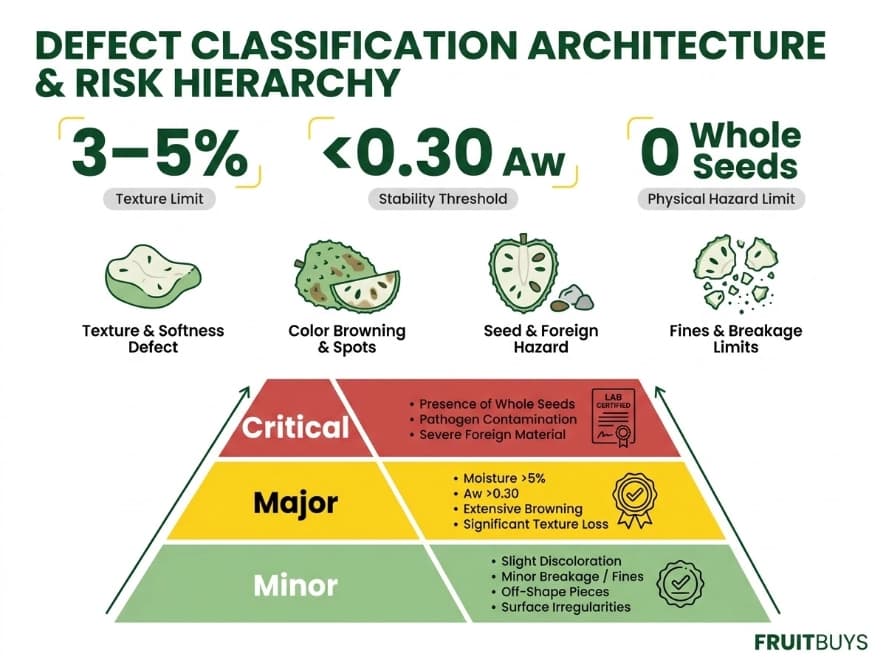
For freeze-dried soursop, defect control must connect to the product’s format. A half-moon slice exposes visual defects. A cube exposes size variation and center texture. Crumble exposes fines. Powder exposes caking, mesh control and upstream seed-removal discipline.
FruitBuys connects this defect article to the full freeze-dried soursop B2B specification guide. The pillar guide explains the product decision. This article owns the defect-control logic.
Texture Defects: Soft, Chewy, Collapsed or Over-Brittle
Texture decides whether freeze-dried soursop performs as a crisp fruit ingredient or becomes a rejected dried-fruit lot. The buyer should not approve texture only by hand feel. Texture must connect to moisture, Aw, format and packaging.
Common texture defects include:
| Texture Defect | Likely Root Cause | Buyer Consequence |
|---|---|---|
| Soft bite | Moisture pickup, incomplete drying or weak packaging | Product fails snack or inclusion use |
| Chewy texture | High residual moisture or uneven drying | Buyer rejects sample-to-bulk consistency |
| Collapsed pieces | Over-soft raw material or weak structure before drying | Poor visual presentation |
| Hollow weak structure | Format or process imbalance | High breakage |
| Over-brittle pieces | Excessively fragile format or handling stress | High fines and transport damage |
| Sticky surface | Humidity exposure after drying | Clumping and storage risk |
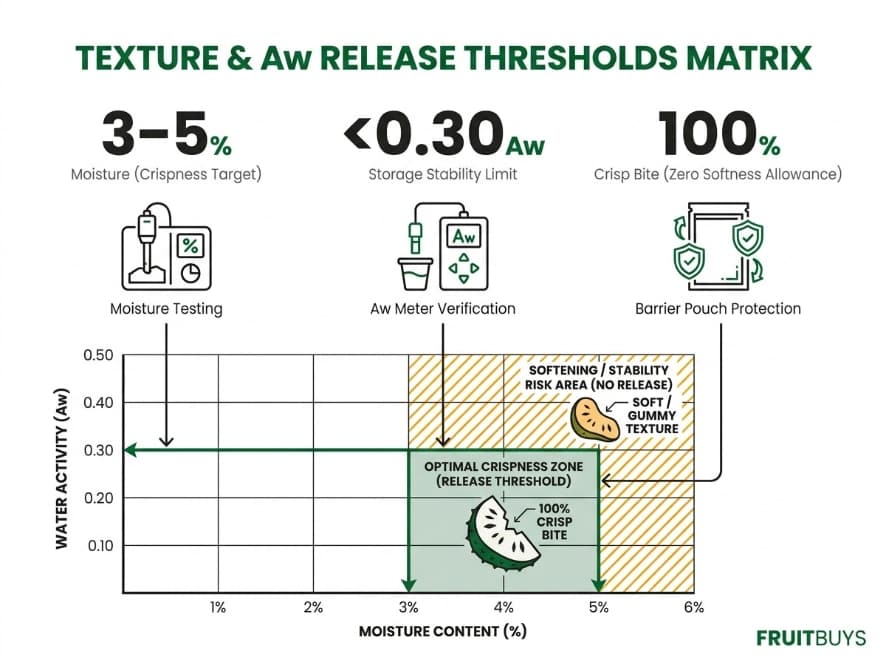
FDA water activity guidance explains Aw as a stability-related measure distinct from total moisture, and the same guidance states that Aw must reach a suitable level after drying and remain within an acceptable range during storage. That makes Aw a release-control point, not a decorative lab value (U.S. Food and Drug Administration).
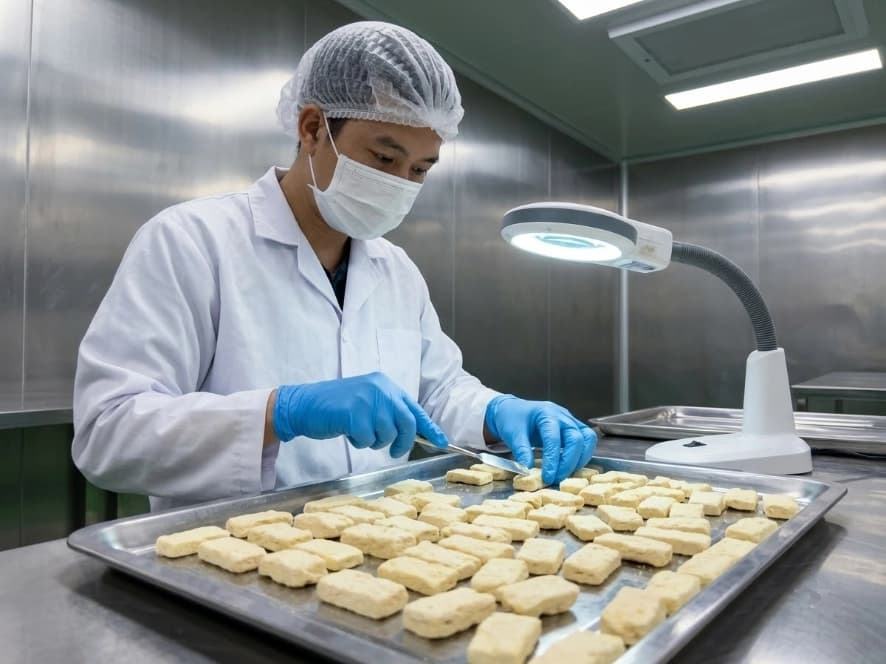
Buyers should connect every texture complaint to freeze-dried soursop moisture and water activity control. Moisture and Aw do not replace sensory review, but they make texture release measurable.
Color and Flavor Defects
Soursop pulp naturally ranges from ivory to pale cream. Some natural variation can be acceptable. The buyer should still define when variation becomes a defect.
Common color and flavor defects include:
| Defect | Risk Signal |
|---|---|
| Excessive browning | Raw-material delay, oxidation or processing exposure |
| Dark spots | Fruit defect, trimming gap or localized damage |
| Grey or dull tone | Storage exposure or raw-material issue |
| Fermented odor | Overripe fruit or delayed processing |
| Oxidized note | Packaging or exposure issue |
| Weak aroma | Under-mature fruit or raw-material variation |
| Harsh sourness | Maturity or formulation mismatch |
Freeze-drying process conditions can affect structural properties, color and texture of food materials, so finished appearance cannot be separated from raw-material and process control. (MDPI)
Color and flavor defects often start before drying. Over-soft fruit may create smearing, darkening and inconsistent structure. Under-mature fruit may reduce aroma and flavor balance. Buyers should review Vietnam soursop origin and maturity control before approving a visual standard.
The release file should not state only “natural color.” It should define the accepted range, defect examples and buyer-approved retained sample.
Seed and Foreign-Material Defects
Seed and foreign-material defects require strict control because they can trigger physical-defect complaints and shipment rejection. Soursop has many seeds, and weak preparation can leave whole seeds, seed fragments, peel residue or core fiber in the product.
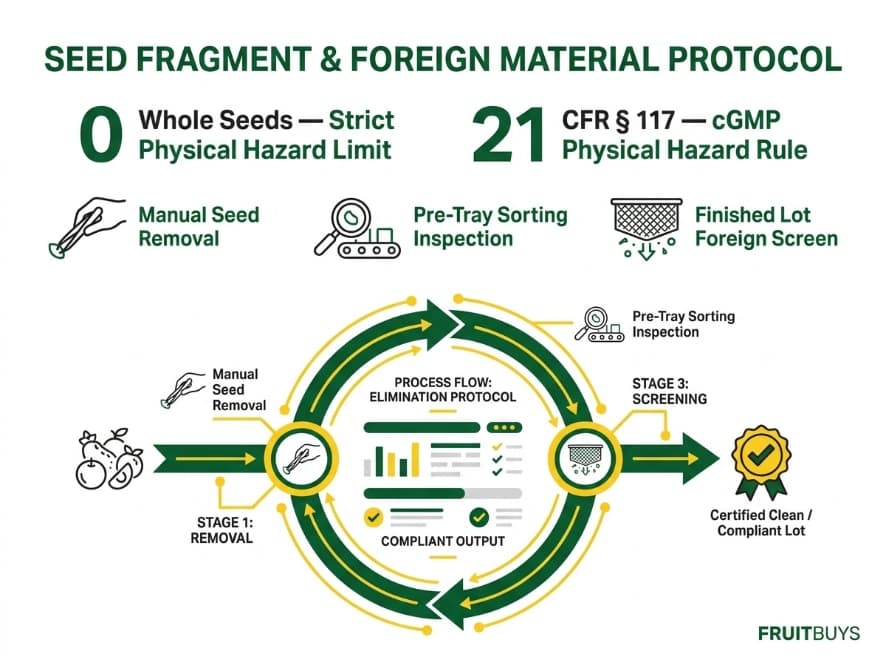
Key defect categories:
| Defect Type | Definition | Release Action |
|---|---|---|
| Whole seed | Visible complete seed in finished product | Reject or hold for investigation |
| Seed fragment | Broken seed piece or hard particle | Hold, investigate and define disposition |
| Peel residue | Non-target outer material | Hold or reject based on agreed limit |
| Core fiber | Fibrous non-target material | Hold or reject based on agreed limit |
| Foreign matter | Plastic, metal, glass, tool fragment or environmental material | Hold and investigate |
| Insect contamination | Visible insect or insect fragment | Hold, investigate and escalate |
FDA guidance on hard or sharp foreign objects states that such objects in food can cause traumatic injury and may create regulatory concern depending on size, product use and consumer exposure (U.S. Food and Drug Administration).
FDA cGMP literature also identifies foreign matter as a physical safety issue and discusses raw-material inspection, separation equipment and detection systems as possible controls depending on product and process suitability (U.S. Food and Drug Administration).
The buyer should not rely on a final visual check only. Seed control starts with fruit preparation and continues through pre-tray inspection, finished-product inspection and retained-sample review. FruitBuys separates this topic in soursop seed-removal and foreign-material control because seed defects need their own QA logic.
Size, Fines and Breakage Defects
Size defects affect application performance. A cube that is too large may not dry evenly or blend well. A crumble with too much dust may change product appearance. A snack slice with broken edges may fail retail presentation.
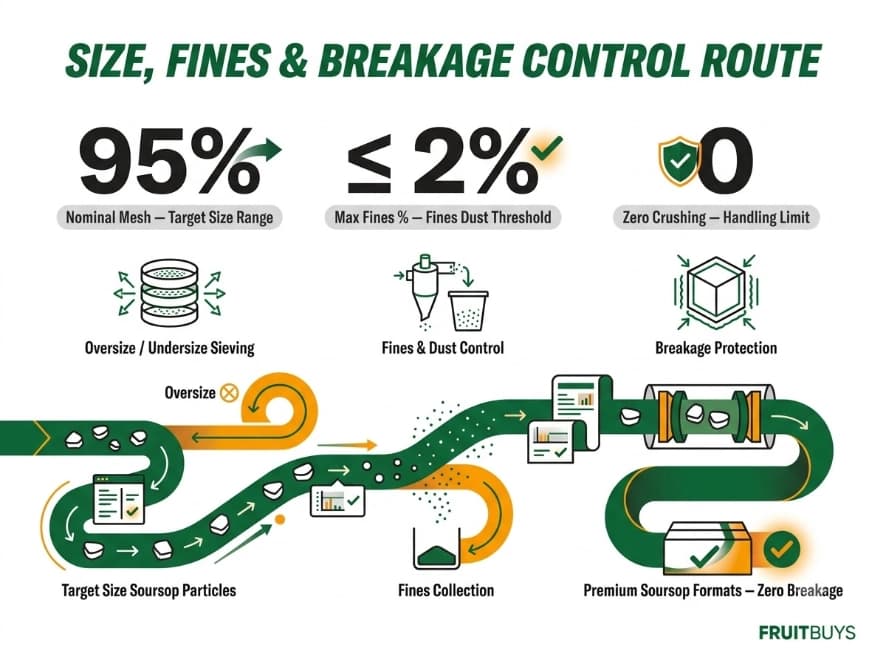
Common size and breakage defects include:
| Defect | Affected Format | Buyer Risk |
|---|---|---|
| Oversize pieces | Cubes, chunks | Uneven texture and application mismatch |
| Undersize pieces | Cubes, chunks, crumble | Poor dosing and visual inconsistency |
| Excessive fines | Cubes, crumble, powder | Dusting, blend imbalance and pack residue |
| Broken slices | Half-moon slices | Retail appearance failure |
| Crushed chunks | Chunks | Loss of intended format |
| Mixed format | All pieces | Specification mismatch |
| Powder lumps | Powder | Caking and poor application behavior |
The buyer should define nominal size, tolerance, oversize, undersize, fines and breakage before requesting a commercial sample. These values should not appear for the first time after the shipment arrives. Format ownership belongs in freeze-dried soursop formats and size selection. Defect control uses that format specification to decide accept, hold or reject.
Packaging-Related Defects
Packaging defects can destroy a product that passed drying and QA release.
Freeze-dried soursop can lose crispness, break, clump or absorb moisture if the pack, seal, carton or storage route fails.
Buyers should approve packaging together with defect limits, not after them.
Packaging-related defects include:
| Packaging Defect | Product Symptom |
|---|---|
| Weak moisture barrier | Soft pieces, high Aw, clumping |
| Seal contamination | Local moisture pickup |
| Pouch puncture | Texture loss and contamination risk |
| Excessive headspace compression | Broken slices or crushed chunks |
| Weak carton structure | High breakage |
| Poor liner closure | Bulk product softening |
| Humid repacking environment | Powder caking or piece clumping |
| Poor storage instruction | Shelf-life loss |
Packaging must protect the state achieved after drying. A lot can meet release moisture and Aw, then fail because post-drying exposure or packaging control is weak. This is why packaging should connect directly to freeze-dried soursop packaging and shelf-life control.
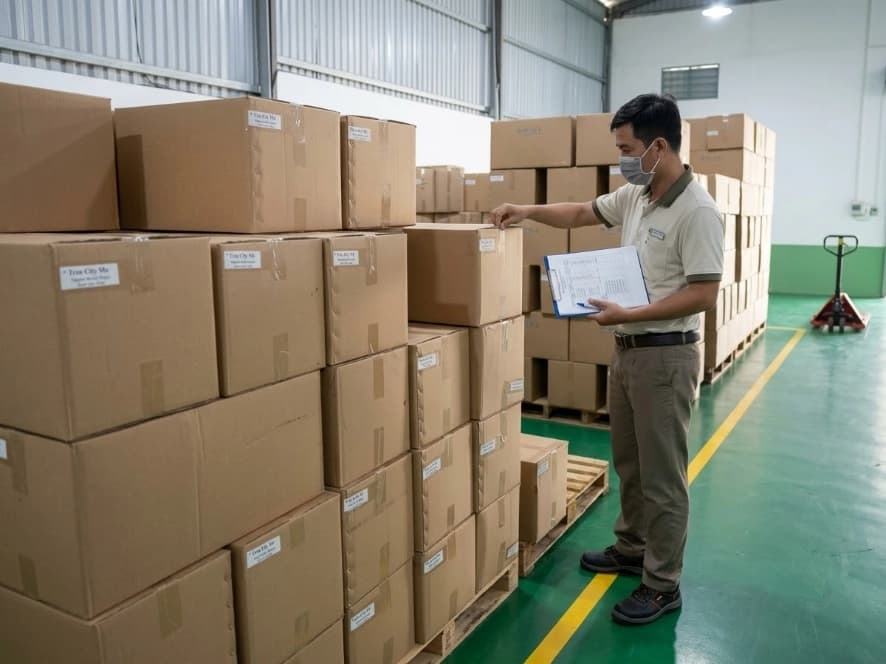
Export logistics also matters. Carton stacking, movement, compression and container conditions can increase breakage after the lot has already passed inspection. Buyers should connect breakage limits to freeze-dried soursop carton and container planning.
Low Aw Does Not Remove the Need for Defect Review
A low Aw value supports product stability, but it does not prove the product has no defects. It does not prove absence of pathogens, seed fragments, foreign matter, over-browning, caking or package damage.
Codex guidance for low-moisture foods states that pathogens such as Salmonella cannot multiply in these foods, but cells may remain viable for extended periods. (FAOHome) This point matters for buyer review: Aw is a release criterion, not a complete safety or quality certificate.
Defect review should include:
- Moisture and Aw
- Microbiology where required
- Foreign-material inspection
- Seed-fragment inspection
- Size and fines review
- Sensory assessment
- Packaging review
- Retained-sample comparison
- COA scope review
FruitBuys links this release process to freeze-dried soursop COA and laboratory testing. COA review should support defect control but cannot replace every visual and physical inspection.
Lot-Disposition Process: Accept, Hold, Rework Review or Reject
A buyer needs a lot-disposition system before the first commercial lot. Without it, every defect becomes a negotiation instead of a release decision.
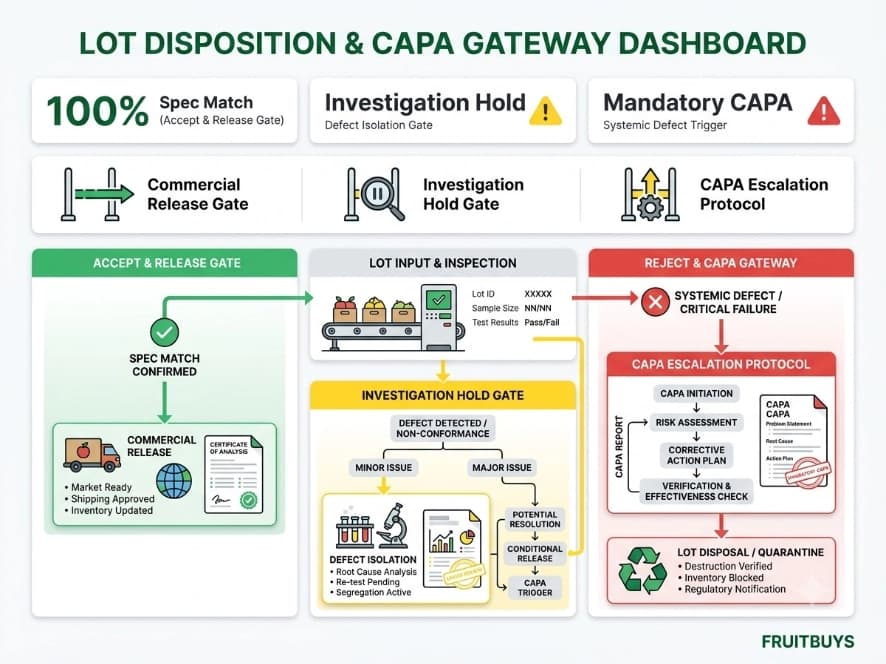
Use this structure:
| Status | When to Use | Buyer Action |
|---|---|---|
| Accept | Lot meets specification and retained sample | Release for packing or shipment |
| Conditional accept | Minor agreed deviation with written buyer approval | Document exception |
| Hold | Defect requires investigation | Stop release and request evidence |
| Rework review | Defect may be corrected without compromising specification | Approve only with written method |
| Reject | Defect violates safety, identity or agreed quality limit | Do not release |
| CAPA required | Repeated or systemic defect | Require corrective and preventive action |
Seed fragments, foreign matter, unexplained odor, high moisture, high Aw, pouch puncture and uncontrolled caking should not move directly into conditional acceptance. Those defects require hold and investigation. The lot-disposition file should connect to freeze-dried soursop sample-to-bulk approval. A retained sample gives the buyer a practical comparison point when disputes occur.
Application Mapping
| Buyer Type | Application | Required Format | Proof Needed | FruitBuys Delivery |
|---|---|---|---|---|
| Importer | Bulk distribution | Cubes, chunks or powder | Defect limits, COA scope, retained sample | Quality Control and Documentation |
| QA manager | Lot release | Buyer-defined format | Texture, color, seed, foreign matter and Aw review | Quality Control |
| Private-label snack brand | Retail fruit snack | Half-moon slices or chunks | Breakage limit, visual standard, packaging validation | OEM/Private Label Delivery |
| Cereal manufacturer | Fruit inclusion | Cubes or crumble | Size tolerance, fines limit, Aw compatibility | Quality Control |
| Beverage developer | Powder system | Powder | Mesh, caking review, seed-control record | Documentation and Market Trial Support |
| Logistics coordinator | Bulk shipment | Final commercial pack | Carton strength, breakage review, storage instruction | Export Logistics Coordination |
Highest-Risk Decision: Approving Bulk Without Defect Limits
The highest-risk shortcut is approving bulk production with only a sample photo and no written defect limits.
Without limits, the buyer cannot prove whether soft pieces, seed fragments, fines, color drift or clumping violate the approved product.
Buyers should define defect limits before approving the commercial sample.
This shortcut creates avoidable disputes. The supplier sees natural variation. The buyer sees a failed product. Both sides argue because no one locked the defect standard before production. A good defect file should define the product format, accepted appearance, rejectable defects, test values, inspection method, retained sample and lot-disposition rules.
It should also state which changes trigger buyer reapproval. FruitBuys controls this through Quality Control and Documentation. The buyer should not approve a commercial lot until the defect system supports the sample-to-bulk path.
Why FruitBuys Delivers This
FruitBuys Vietnam supplies export-ready freeze-dried soursop through an integrated product supply model. The buyer receives one configured product, one approved specification and one accountable supplier relationship.
Quality Control defines the defect categories, release criteria, retained sample and lot-review path. FruitBuys does not treat defects as cosmetic complaints after shipment. FruitBuys treats them as approval conditions before production.
Documentation turns the defect decision into reviewable evidence. FruitBuys aligns the specification, process records, inspection records, COA scope, retained sample and packing file.
Raw Material Sourcing Governance reduces defects before processing. Fruit maturity, softness and seed load influence cutting, seed removal, texture, color and pulp recovery.
OEM/Private Label Delivery connects defect control to consumer-facing execution. A private-label pouch must protect the format and product standard the buyer approved.
Export Logistics Coordination protects the released product during packing, carton handling and shipment planning.
Buyer Checklist
Before approving freeze-dried soursop, define:
- Product format
- Nominal size or mesh
- Accepted color range
- Sensory standard
- Texture standard
- Moisture target
- Aw target
- Whole-seed rule
- Seed-fragment rule
- Peel and core-residue rule
- Foreign-matter rule
- Oversize limit
- Undersize limit
- Fines limit
- Breakage limit
- Clumping or caking limit
- Packaging defect rule
- Retained sample
- COA scope
- Lot-disposition process
- CAPA trigger
- Change-control trigger for origin, process, format or packaging
Do not approve a sample until the defect file can guide a real bulk-lot decision.
Summary
Freeze-dried soursop defects include soft texture, chewy pieces, collapse, browning, off odor, whole seeds, seed fragments, peel residue, core fiber, foreign matter, oversize pieces, undersize pieces, fines, breakage, clumping and powder caking.
Buyers should control these defects through written specifications, retained samples, inspection records, moisture and Aw testing, COA review and packaging validation. FruitBuys Vietnam supplies buyer-defined freeze-dried soursop with Quality Control, Documentation, Raw Material Sourcing Governance, OEM/private label delivery and export logistics coordination.
FAQ
What defects matter most in freeze-dried soursop?
The main defects are soft texture, browning, seed fragments, foreign matter, high fines, broken pieces, clumping, powder caking and packaging damage.
Is a clean sample enough to approve bulk?
No. A sample needs written defect limits, retained-sample control, COA scope and lot-release criteria before it can support bulk approval.
Why do freeze-dried soursop pieces become soft?
Softness can come from incomplete drying, high Aw, post-drying exposure, weak packaging, seal failure or humid storage.
Are seed fragments a serious defect?
Yes. Seed fragments are non-target material and can create physical-defect complaints. Buyers should define seed-fragment limits before approving slices, chunks, crumbles or powder.
Is crumble the same as broken product?
No. Crumble must be intentional and defined by particle range. Broken product has uncontrolled size, fines and handling history.
Can low Aw replace microbiology testing?
No. Low Aw supports stability but does not prove sterility or remove the need for hygiene controls, microbiology review and COA documentation.
What should buyers request first?
Request the defect-limit file after defining format, moisture, Aw, packaging route and sample-approval criteria.
Conclusion
Define allowable freeze-dried soursop defect limits before approving the commercial sample for bulk production.
References
- U.S. Food and Drug Administration. “Water Activity (aw) in Foods.” FDA Inspection Technical Guide. Official FDA page.
- U.S. Food and Drug Administration. “CPG Sec. 555.425 Foods, Adulteration Involving Hard or Sharp Foreign Objects.” Revised 2005. Official FDA page.
- Codex Alimentarius Commission. “Code of Hygienic Practice for Low-Moisture Foods, CAC/RCP 75-2015.” Adopted 2015. Official Codex PDF.
- Nowak, D.; Jakubczyk, E. “The Freeze-Drying of Foods—The Characteristic of the Process Course and the Effect of Its Parameters on the Physical Properties of Food Materials.” Foods, 2020. MDPI article.