Soursop Seed Removal and Foreign-Material Control for Freeze-Dried Buyers
Seed removal decides whether freeze-dried soursop can move from an attractive sample to a controlled commercial lot. Importers, QA teams and private-label buyers should not approve pieces, crumbles or powder only because the sample looks clean. Soursop contains many seeds, and manual preparation can leave whole seeds, seed fragments, core fiber, peel residue or process-related foreign matter if the control point is weak.
A buyer should treat seed removal as a written specification requirement, not as a verbal promise. FruitBuys Vietnam links seed-removal control to raw-material intake, process flow, inspection records, defect limits, sample-to-bulk approval and lot release. Without that discipline, the buyer may approve a product that cannot repeat safely or consistently in bulk.
Why Soursop Seed Control Requires a Separate Specification
Soursop seed control deserves its own specification because whole seeds, seed fragments and core residues create different risks.
A clean sample does not prove that the same seed-removal control will hold in bulk production.
Buyers should request the process flow, defect limits and inspection records before approving the format.
The buyer should not let “seedless” remain undefined. In B2B freeze-dried soursop, seedless must refer to a controlled product condition: peel removed, core removed, seeds removed, seed fragments limited or absent under an agreed inspection method, and foreign matter not detected under defined inspection criteria.

FDA HACCP guidance defines a hazard as a biological, chemical or physical agent that can reasonably cause illness or injury if not controlled, and its HACCP principles require hazard analysis, monitoring, corrective action, verification and record keeping.
That framework supports a practical buyer rule: seed and foreign-material control must sit inside the process record, not only inside sales copy (U.S. Food and Drug Administration). FruitBuys handles this as part of Quality Control and Documentation. The buyer should review the full freeze-dried soursop specification guide before approving any commercial sample.
Seed-Removal Process Flow for Freeze-Dried Soursop
Seed removal begins before the knife touches the fruit. Fruit maturity, fruit softness and seed load affect how cleanly the pulp separates from the peel, core and seeds. Over-soft fruit can smear during preparation. Under-mature fruit can separate poorly and produce weak flavor. The raw-material stage should connect directly to the Vietnam soursop origin and maturity control article.

A practical seed-removal flow should include:
| Stage | Control Point | Buyer Evidence |
|---|---|---|
| Raw-material intake | Reject damaged, over-soft or visibly defective fruit | Intake record |
| Fruit cutting | Expose pulp, core and seed structure | Process flow |
| Peel and core removal | Remove non-target material before sizing | Work instruction |
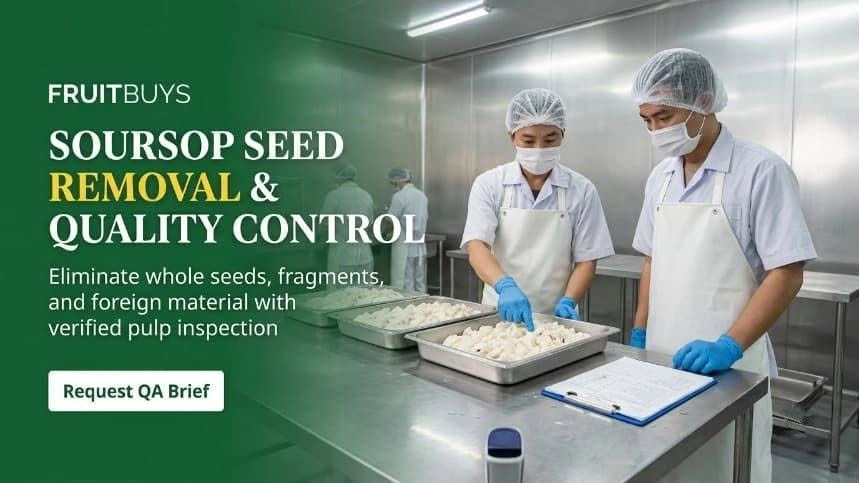
| Seed separation | Remove whole seeds before cutting to final format | Inspection record |
| Pulp inspection | Check visible seed fragments and core fiber | QC checklist |
| Format cutting | Prepare slices, cubes, chunks, crumbles or powder input | Format specification |
| Pre-tray inspection | Check pieces before freezing and drying | Line inspection record |
| Finished-product inspection | Check dried product after handling | Release record |
The process flow should stay simple, but it must show where the supplier controls seeds and foreign matter. If the supplier only says “manual cleaning,” the buyer lacks a release criterion. FruitBuys connects the seed-removal flow to the freeze-dried soursop process. The process article explains the full production route. This article owns the seed-specific risk.
Whole Seeds, Seed Fragments and Core Fibers Are Different Defects
A whole seed and a small seed fragment do not create the same inspection challenge. Whole seeds are easier to see during pulp preparation. Fragments can remain hidden in soft pulp, survive cutting and become harder to identify after drying. Powder increases the risk because grinding can conceal visual evidence if the process does not remove seeds first.

The buyer should separate three categories:
| Defect Category | Description | Commercial Impact |
|---|---|---|
| Whole seed | Visible seed remaining in pulp or finished pieces | Immediate rejection risk |
| Seed fragment | Broken seed piece or partial hard particle | Harder inspection and complaint risk |
| Core or peel residue | Fibrous or non-target fruit material | Sensory and appearance defect |
| Process foreign matter | Tool, glove, tray, plastic, metal or environmental material | Physical hazard and release risk |
FDA guidance on hard or sharp foreign objects states that such objects in food can cause traumatic injury, including injury to the mouth, throat, stomach or intestine, and the agency considers size, intended use and mitigating processing steps when evaluating regulatory concern. Buyers should not assume that later handling will remove hard particles unless the process can prove it. (U.S. Food and Drug Administration)
Seed fragments also matter because scientific literature has isolated acetogenins from Annona muricata seeds, and recent research has evaluated the toxicity behavior of acetogenin-rich seed extracts. This does not turn freeze-dried soursop pulp into a disease or toxicity claim; it simply reinforces the operating rule that seeds are non-target material and must not enter the finished product. (PubMed Central (PMC))
Foreign-Material Control Must Cover Raw Material, Tools and Handling
Foreign-material control cannot rely on one final inspection step.
Physical hazards can enter through raw material, tools, damaged equipment, packaging materials or poor handling discipline.
Buyers should require prevention, inspection and corrective-action records.
Foreign matter can enter the product at several points: raw fruit crates, cutting boards, knives, gloves, trays, drying shelves, packing tables, bags and cartons. The buyer should evaluate the whole handling route, not just the finished sample.

FDA cGMP literature identifies foreign matter as a physical safety issue and notes that extraneous objects can enter raw materials or processing through transport, equipment failure, accidents or negligence. It also lists raw-material inspection, separation equipment, metal detectors, X-ray machines and optical systems as possible controls or detection methods, depending on product and process suitability. (U.S. Food and Drug Administration)
For freeze-dried soursop, the correct control plan depends on the format. Slices and chunks need strong visual inspection because large pieces expose defects. Powder needs upstream seed control because final powder appearance may not reveal seed contamination. Metal detection only addresses certain metallic risks. It does not prove absence of seed fragments, peel, core fiber, plastic or other non-metallic materials.
FruitBuys does not claim one detection technology covers every risk. FruitBuys aligns the inspection method with the product format, the approved specification and the release requirement.
How Seed Defects Affect Each Product Format
Seed-control risk changes with format. Buyers should choose inspection criteria after selecting the intended product format, not before.
Half-Moon Slices
Half-moon slices show the fruit structure clearly. They expose core residue, seed cavities, broken edges and visual defects. They suit retail snack or garnish use, but they need strict visual inspection and breakage limits. Buyers should connect this format decision to freeze-dried soursop formats and size selection.
Cubes and Chunks
Cubes and chunks support cereal, granola, chocolate, dairy toppings and snack blends. They reduce some visual irregularity but can hide smaller seed fragments inside thicker pieces. The buyer should define piece size, maximum defect limit and inspection method.
Crumble
Crumble must be intentional, not the result of poor cutting or shipping damage. Because crumbles are smaller, seed fragments become more difficult to identify visually. Buyers should separate acceptable fruit crumble from hard seed particles.
Powder
Powder carries the highest seed-control sensitivity. Grinding must not become a way to hide poor seed removal. The buyer should confirm that seeds are removed before drying and milling, then verify ingredient declaration, mesh, carrier status and physical inspection expectations. Buyers comparing powder technologies should review freeze-dried versus spray-dried soursop powder only after confirming whether the intended product is pure freeze-dried powder or another powder system.
Application Risk
Seed fragments damage more than the product’s appearance. They affect consumer experience, application performance and QA approval. Direct snacks expose the defect immediately. Cereal and chocolate systems can amplify complaint risk if hard particles appear inside a mixed product.
Beverage powder can create trust issues because seed contamination may not be visible before use. Buyers can map the format risk through freeze-dried soursop applications for food manufacturers.
Inspection and Verification Records Buyers Should Request
A buyer should request evidence before approving a sample. The strongest evidence is not a paragraph claiming “carefully selected.” The strongest evidence is a file that links process flow, inspection point, defect limit, lot identity and corrective action.

Request these records:
| Record | Why It Matters |
|---|---|
| Process flow | Shows where seeds, peel and core are removed |
| Work instruction | Shows how operators remove and inspect seeds |
| Raw-material intake record | Links fruit condition to seed load and pulp recovery |
| In-process inspection checklist | Shows inspection before drying |
| Finished-product inspection record | Confirms release review after drying and handling |
| Defect-limit specification | Defines whole seed, seed fragment, peel and core tolerance |
| Corrective-action log | Shows how deviations are handled |
| Retained sample | Supports sample-to-bulk comparison |
| Lot code | Links raw material, process, inspection and COA |
The COA may not prove seed absence unless the COA scope includes physical inspection results. Many COAs focus on moisture, Aw, microbiology or contaminants. For seed removal, the buyer should request both the QA file and the lot-specific release record. The freeze-dried soursop COA and laboratory testing article should handle the testing file in detail.
Highest-Risk Decision: Approving Powder Without Upstream Seed Control
The highest-risk shortcut is approving soursop powder without confirming how seeds are removed before drying and milling.
Milling can reduce visible evidence of poor preparation while leaving ingredient, safety and complaint risks unresolved.
Buyers should approve powder only after reviewing seed-removal flow, ingredient declaration and sample-to-bulk controls.
Powder can look uniform even when the upstream process is weak. That makes documentation more important. The buyer needs to know whether the powder comes from cleaned pulp, whether any carrier or processing aid exists, whether seed removal occurs before drying, and how foreign-material risk is inspected before milling.

This risk also affects Nutrition Facts, claims and private-label artwork. A powder marketed as fruit pulp powder must match its actual ingredient statement. If seed material, carrier or another component enters the formula, the label and specification must reflect the truth. Buyers developing private-label products should link the seed-control file to the sample-to-bulk approval system before artwork release.
Application Mapping
| Buyer Type | Application | Required Format | Proof Needed | FruitBuys Delivery |
|---|---|---|---|---|
| Importer | Bulk ingredient distribution | Cubes, chunks or powder | Seed-removal flow, physical inspection record | Quality Control and Documentation |
| Private-label snack brand | Retail freeze-dried soursop snack | Half-moon slices or chunks | Visual defect limit, whole-seed absence, retained sample | OEM/Private Label Delivery |
| Cereal manufacturer | Fruit inclusion | Cubes or crumbles | Seed-fragment control, size tolerance, fines limit | Quality Control and sample-to-bulk consistency |
| Beverage developer | Powder application | Powder | Upstream seed removal, mesh, ingredient declaration | Documentation and OEM delivery |
| QA manager | Supplier approval | Buyer-defined format | Process flow, inspection point, corrective-action file | Quality Control and Documentation |
| R&D developer | Application trial | Cubes, crumbles or powder | Defect-free pilot sample and application feedback | MOQ Flexibility/Market Trial Support |
Why FruitBuys Delivers This
FruitBuys Vietnam supplies export-ready freeze-dried soursop under one accountable product relationship. The buyer does not need a loose sourcing route. The buyer needs one configured product, one approved specification and one documented release path.
Quality Control covers the seed-removal and inspection criteria. FruitBuys aligns the approved format with seed-removal flow, visual inspection, defect limits and finished-product review.
Documentation turns inspection into buyer evidence. FruitBuys aligns raw-material intake records, process flow, in-process checks, retained samples, physical release files and COA scope where applicable.
Raw Material Sourcing Governance reduces the seed-removal problem before production starts. Fruit maturity, softness and seed load affect separation efficiency, so sourcing and intake cannot sit outside QA control.
OEM/Private Label Delivery connects seed-control discipline to packaging and label integrity. A private-label product cannot carry clean artwork if the underlying ingredient statement and physical-defect control remain unclear.
Buyer Checklist

Before approving freeze-dried soursop, request:
- Raw-material intake specification
- Maturity and fruit-condition criteria
- Process flow showing peel, core and seed removal
- Definition of whole seed, seed fragment, peel residue and core fiber
- Inspection method by format
- Allowable defect limit
- Corrective-action procedure
- Retained sample policy
- Seed-control record for powder before milling
- COA scope and whether it includes physical inspection
- Change-control rule for origin, maturity, format or process route
- Sample-to-bulk comparison plan
A buyer should not approve the sample until the seed-removal control is written, reviewable and linked to the lot.
Summary
Freeze-dried soursop seed removal requires a separate QA specification because Annona muricata fruit contains many seeds, and fragments can create physical-defect and complaint risk. The buyer should confirm peel, core and seed removal before drying and milling.
Whole seeds, seed fragments, peel residue, core fiber and process foreign matter need separate inspection criteria. FruitBuys Vietnam controls seed-removal risk through Quality Control, Documentation, Raw Material Sourcing Governance and sample-to-bulk approval discipline.
FAQ
Why does soursop seed removal need its own article?
Because seed control affects safety, texture, defect limits, powder integrity and sample-to-bulk approval. It is not only a preparation step.
Can a COA prove that soursop has no seed fragments?
Only if the COA or QA file includes physical inspection criteria and lot-specific results. Many COAs focus on moisture, Aw, microbiology or contaminants.
Is visual inspection enough?
Visual inspection helps, but it depends on format and method. Powder needs strong upstream seed removal because final powder may not show visible seed defects.
Why is powder more sensitive?
Powder can hide weak seed-removal control after milling. Buyers should confirm cleaned pulp input, seed-removal flow, ingredient declaration and foreign-material inspection before approval.
Should seed fragments be treated as foreign material?
Yes. Seed fragments are non-target material in freeze-dried soursop pulp products. Buyers should define them separately from peel, core fiber and process foreign matter.
What should buyers request first?
Request the seed-removal flow, defect-limit specification and inspection record before approving slices, chunks, crumbles or powder.
Conclusion
Request the seed-removal flow and defect-limit file before approving freeze-dried soursop slices, chunks, crumbles or powder for sample-to-bulk production.
References
- U.S. Food and Drug Administration. “HACCP Principles & Application Guidelines.” Current FDA guidance page. (U.S. Food and Drug Administration)
- U.S. Food and Drug Administration. “CPG Sec. 555.425 Foods, Adulteration Involving Hard or Sharp Foreign Objects.” Revised 2005. (U.S. Food and Drug Administration)
- U.S. Food and Drug Administration. “Good Manufacturing Practices for the 21st Century for Food Processing: Section 2, Literature Review.” Current FDA page. (U.S. Food and Drug Administration)
- Scientific literature indexed on PMC and ACS Publications regarding acetogenin-rich Annona muricata seed extracts and seed-isolated acetogenins. (PubMed Central (PMC))