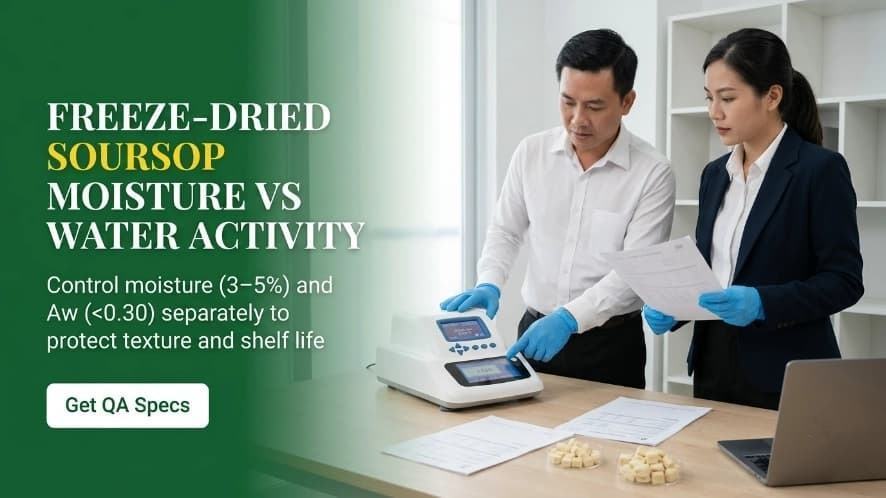
Freeze-Dried Soursop Moisture vs Water Activity
Freeze-dried soursop buyers should not approve a sample just because it feels crisp. A sample can show attractive texture on day one and still fail in storage, packing, shipping or application if moisture and Aw are not controlled separately. Moisture measures total water content. Aw measures available water behavior. Those two numbers do not tell the same story.
A buyer who requests only “moisture below 5%” leaves a gap in texture control, COA review and shelf-life validation. FruitBuys Vietnam uses moisture and Aw as linked but separate release criteria for freeze-dried soursop. The buyer needs a written specification, test method, sampling rule, packaging condition and sample-to-bulk approval gate before accepting commercial production.
Moisture and Aw Measure Different Product Conditions
Moisture tells the buyer how much total water remains in the product.
Aw tells the buyer how available that water is for stability, microbial growth potential and texture behavior.
Buyers should require both values in the release specification.
FDA defines water activity as the ratio between the vapor pressure of the food and the vapor pressure of distilled water under identical conditions. FDA also explains that water activity can be expressed from equilibrium relative humidity, and that temperature control matters during measurement. (U.S. Food and Drug Administration)
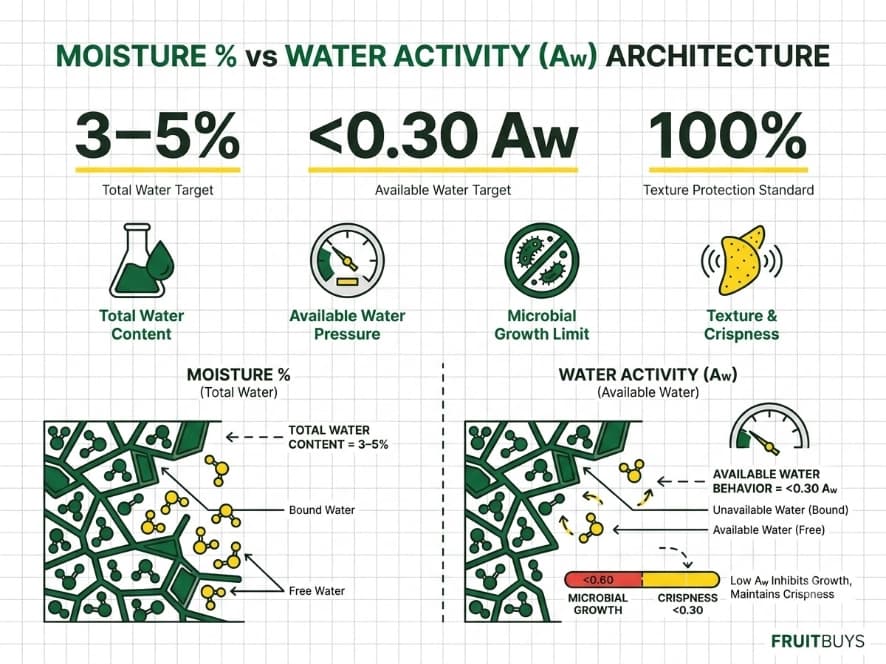
That definition matters for freeze-dried soursop because two products can show similar moisture content but behave differently after packing. One lot may stay crisp. Another lot may soften faster because the available water, product structure, packaging exposure or equilibration condition differs.
For B2B approval, the buyer should not ask for “dry product” as a subjective condition. The buyer should request a written specification that includes:
| Parameter | Required Control |
|---|---|
| Moisture | Total residual water target |
| Aw | Available-water release target |
| Sampling point | Where the sample comes from |
| Test method | How the value is measured |
| Instrument control | Calibration or verification |
| Release decision | Accept, hold or reject condition |
| Packaging link | Final pouch, liner and carton condition |
FruitBuys connects this topic to the full freeze-dried soursop specification guide. The pillar article gives the buyer the full product map. This article owns the moisture and Aw decision.
Product Targets for Freeze-Dried Soursop
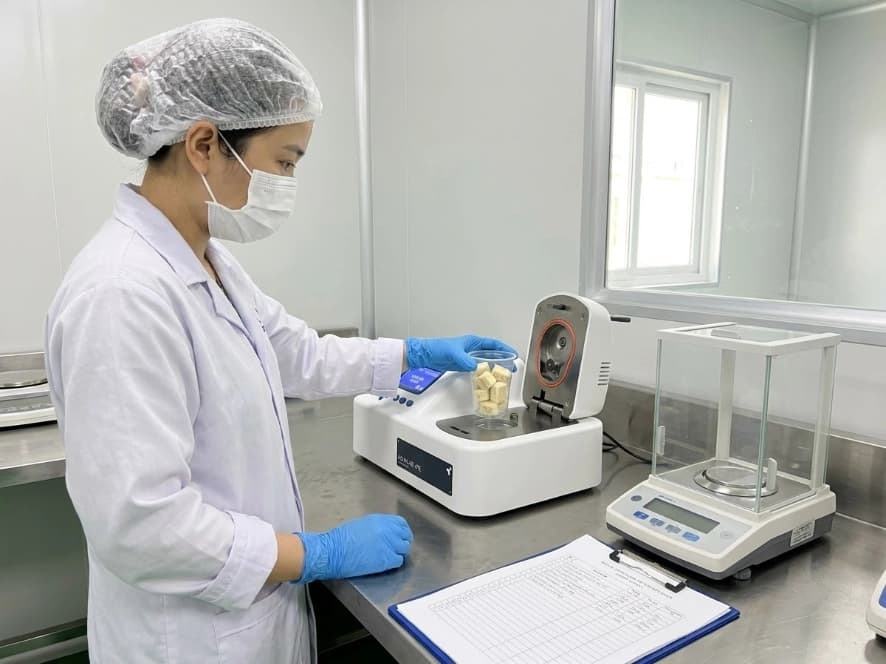
For the current freeze-dried soursop specification, the working targets are:
| Parameter | Target |
|---|---|
| Moisture | 3–5% |
| Water activity | Aw <0.30 |
| Texture | Light, porous and crisp |
| Release evidence | Lot-linked test result |
| Packaging condition | High-barrier moisture protection, validated by final pack |
These targets should appear in the product specification and COA plan. They should not remain inside an email, sales message or sample note. A food-science review of freeze-dried foods reports low final water content and water activity ranges across freeze-dried products, including Aw values from 0.08 to 0.330 in reviewed materials.
That range supports the technical logic of setting a low Aw target for freeze-dried foods, but it does not prove any specific FruitBuys lot result (PubMed Central (PMC)). The buyer must treat each lot as its own release decision. A past result does not approve a future shipment.
A sample COA does not approve a commercial lot. A technical benchmark does not replace lot-specific testing. The buyer can connect the finished value back to freeze-dried soursop process control because cutting thickness, tray loading, drying cycle, post-drying handling and packing exposure all influence final release.
What Causes Aw to Rise?
Aw can rise after the dryer if the process fails to protect the product. Freeze-dried soursop has a porous structure, and porous dried fruit can absorb moisture during handling, packing and storage. FDA states that water activity affects food stability and must reach a suitable level after drying and remain within an acceptable range during storage (U.S. Food and Drug Administration).
Common causes of Aw increase include:
| Cause | Buyer Consequence |
|---|---|
| Incomplete drying | Soft centers, unstable texture and release delay |
| Uneven slice or cube thickness | Mixed crispness within the same lot |
| Overloaded trays | Inconsistent drying across the batch |
| Long exposure after drying | Moisture pickup before packing |
| High packing-room humidity | Aw increase and texture loss |
| Weak pouch barrier | Softening during storage |
| Seal failure | Localized moisture pickup |
| Damaged carton or liner | Higher exposure during transit |
| Repacking in humid conditions | Clumping and sensory change |
The buyer should not look only at the dryer. A well-dried lot can still fail if the post-drying exposure and packaging route are weak. The packing environment must protect the Aw value achieved during drying. That is why moisture and Aw belong in both process review and packaging review. The detailed packaging decision sits in freeze-dried soursop packaging and shelf-life control.
Moisture Alone Does Not Protect Texture
A product can meet moisture range but still deliver weak texture. Moisture measures the total amount of water, not how that water behaves inside the product matrix. Aw tells the buyer whether available water has been controlled to the agreed release condition.
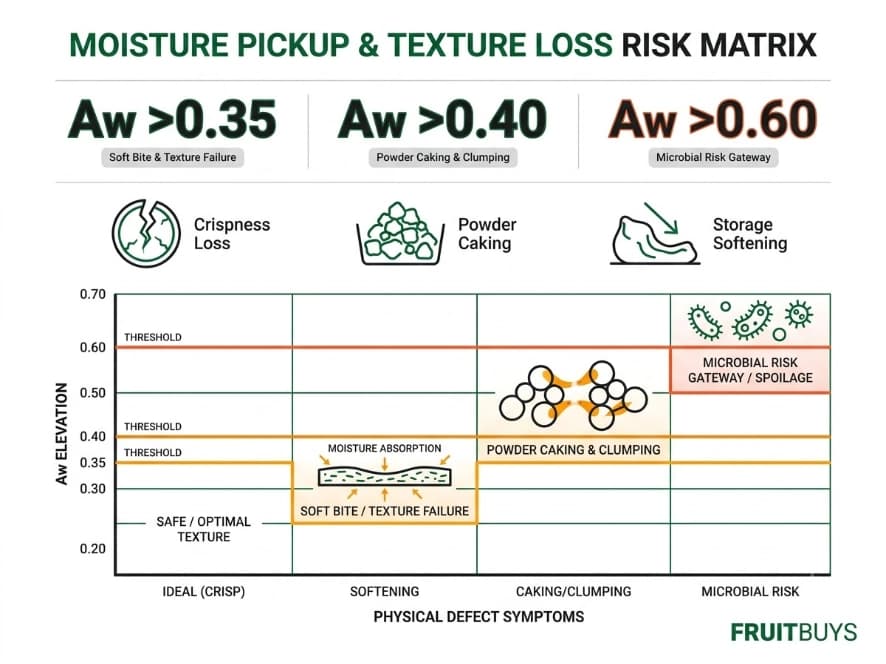
For freeze-dried soursop, texture failure can appear as:
- Loss of crispness
- Chewy bite
- Sticky surface
- Clumping
- Powder caking
- Darker surface
- Higher fines after handling
- Uneven rehydration
- Consumer complaint in retail snack format
Texture failure also depends on format. Half-moon slices expose edge breakage and softening quickly. Cubes and chunks can hide soft centers. Crumbles can turn into uncontrolled fines. Powder can cake before the buyer notices a sensory problem.
Buyers should review freeze-dried soursop formats and size selection before locking the moisture and Aw release plan. A powder specification should not copy the same handling criteria used for visible slices.
Low Aw Does Not Mean Sterile Product
Aw below the release target supports product stability, but it does not make freeze-dried soursop sterile.
Low-moisture conditions may stop microbial growth while allowing some microorganisms to survive for long periods.
Buyers should require microbiology controls and lot-linked documentation in addition to Aw.
Codex defines low-moisture foods as foods with Aw of 0.85 or below. The same Codex code states that pathogens such as Salmonella cannot multiply under these conditions, but cells can remain viable for extended periods, and low-moisture processing environments need strong hygienic controls.
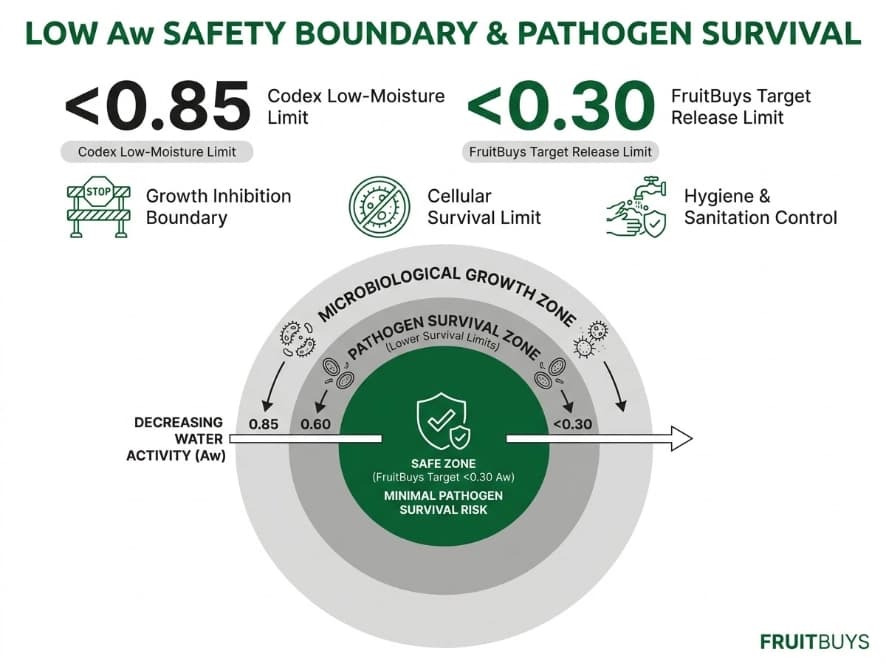
FAO and WHO also report that low-moisture foods were long perceived as low microbiological risk, but outbreaks have shown that bacteria can persist for long periods even when they cannot grow in those products. (Tổ Chức Y Tế Thế Giới)
This distinction protects the buyer from a dangerous shortcut. Aw controls growth potential. It does not replace sanitation, environmental control, microbiology testing, raw-material control, foreign-material inspection or COA review. FruitBuys links Aw to Quality Control and Documentation. Buyers should review the freeze-dried soursop COA and laboratory testing plan before accepting a lot release.
How Moisture and Aw Connect to Process Control
The freeze-dried soursop process must deliver a product that meets moisture and Aw targets consistently. That consistency starts with raw material and continues through cutting, drying, inspection and packing.
Key process drivers include:
| Process Driver | Link to Moisture/Aw |
|---|---|
| Fruit maturity | Affects pulp structure and drying behavior |
| Seed removal | Affects pulp damage and handling consistency |
| Cut thickness | Affects drying uniformity |
| Tray load | Affects water removal consistency |
| Drying cycle | Affects final moisture and Aw |
| Post-drying hold time | Affects moisture pickup |
| Packing humidity | Affects Aw after release |
| Packaging barrier | Protects the achieved Aw during storage |
Soursop maturity control matters because fruit condition changes how the pulp behaves during preparation. Fruit that is too soft can smear, trap moisture unevenly and produce weak pieces. Buyers should connect this to Vietnam soursop origin and maturity control.
Seed removal also matters. Seed fragments, core residues and damaged pulp can create inconsistent pieces and inspection risk. Buyers should connect physical preparation to soursop seed-removal and foreign-material control. Moisture and Aw should not sit at the end of the process as isolated numbers. They should connect back to the whole production route.
How Buyers Should Build an Aw Release Program
A strong Aw release program uses defined sampling, a confirmed method and a clear hold/release decision. FDA notes that water activity measurement can require equilibrium in the headspace above the sample and that temperature differences can affect the reading. (U.S. Food and Drug Administration)
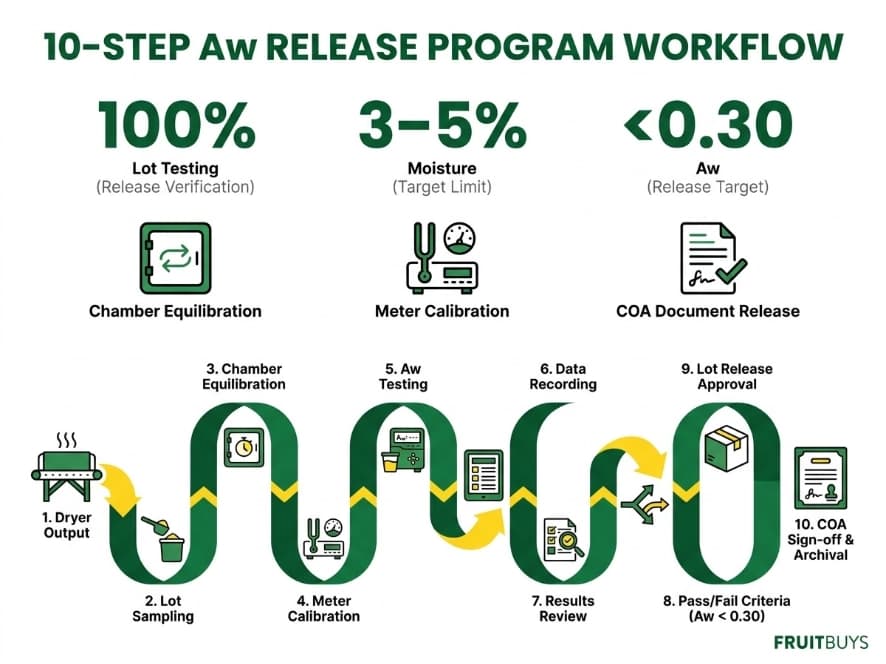
A practical release program should define:
| Release Element | Buyer Requirement |
|---|---|
| Sample identity | Lot number and production date |
| Sample location | Tray, bin, pack or finished carton |
| Sample condition | Before packing or after packing |
| Equilibration | Method-specific condition |
| Instrument | Type and calibration status |
| Replicate testing | Number of readings where required |
| Release limit | Moisture and Aw acceptance criteria |
| Hold limit | Condition requiring review |
| Corrective action | Drying review, packing review or lot hold |
| Record link | COA, laboratory report or QA release file |
The buyer should avoid vague phrases such as “Aw tested” or “dry enough.” The release file must show the number, method and lot connection. FruitBuys links this release program to freeze-dried soursop sample-to-bulk approval. A sample should not approve bulk unless the same moisture and Aw logic can repeat.
Symptoms of Moisture Pickup in Freeze-Dried Soursop
Moisture pickup shows itself before the buyer sees a laboratory failure. The product begins to lose the texture that made freeze-drying valuable.
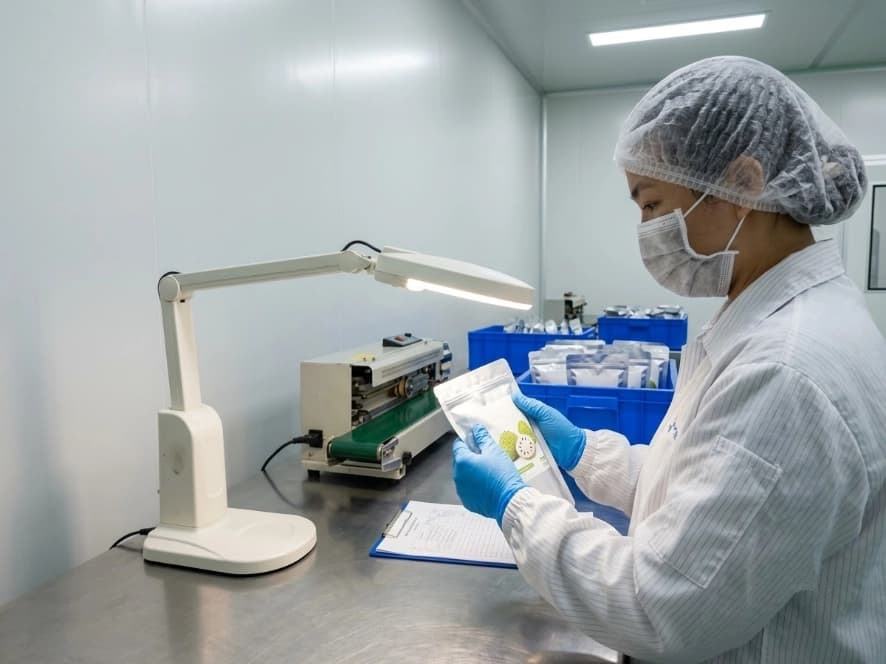
Common symptoms include:
| Symptom | Likely Control Gap |
|---|---|
| Soft bite | Aw increase or weak drying uniformity |
| Sticky surface | Moisture pickup after drying |
| Clumping | Packaging or humidity exposure |
| Powder caking | Hygroscopic behavior and weak barrier protection |
| Darker surface | Storage exposure or process variation |
| High fines | Texture weakening and handling breakage |
| Off odor | Storage or packaging issue |
| Uneven crunch | Cut thickness or tray-load variation |
A defect system should separate moisture-related defects from format-related defects, seed defects and packaging defects. Buyers can define that defect taxonomy through common freeze-dried soursop defects and release controls.
The buyer should not accept “it is still edible” as a release argument. The commercial question is whether the lot matches the approved texture, specification, application and package condition.
Application Mapping
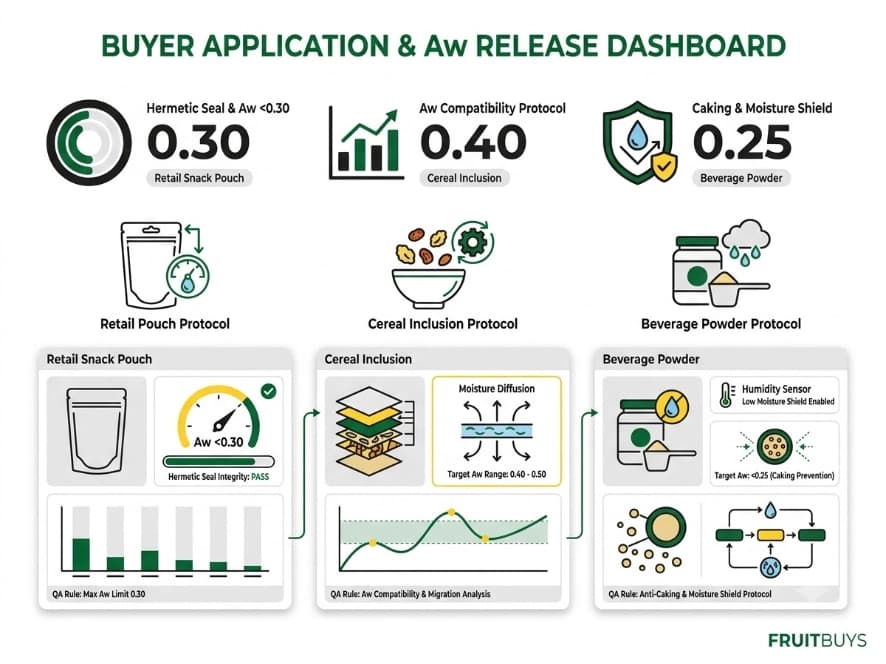
| Buyer Type | Application | Required Format | Proof Needed | FruitBuys Delivery |
|---|---|---|---|---|
| Importer | Bulk freeze-dried soursop distribution | Cubes, chunks or powder | Moisture, Aw and COA release file | Quality Control and Documentation |
| QA manager | Supplier approval | Buyer-defined format | Method, sampling rule and lot-linked Aw result | Quality Control |
| Private-label snack brand | Retail fruit snack | Half-moon slices or chunks | Crispness standard, moisture, Aw and packaging validation | OEM/Private Label Delivery |
| Cereal manufacturer | Fruit inclusion | Cubes or crumbles | Aw compatibility with cereal system and fines limit | Quality Control and sample-to-bulk consistency |
| Beverage developer | Powder application | Powder | Mesh, caking observation, moisture and Aw | Documentation and OEM delivery |
| Logistics coordinator | Bulk shipment planning | Final commercial pack | Packaging barrier, carton condition and storage instruction | Export Logistics Coordination |
Highest-Risk Decision: Accepting Moisture Data Without Aw
The highest-risk shortcut is accepting “moisture below 5%” without an Aw value.
That leaves the buyer unable to judge available-water behavior, texture protection and storage stability.
Buyers should require both moisture and Aw in the release specification and COA plan.
This shortcut usually appears during fast sample approval. The sample feels crisp. The supplier says the product is dry. The buyer approves. Bulk production then exposes the weakness: softened slices, powder caking, mixed texture or packaging-related moisture pickup.
The buyer loses leverage when the specification lacks Aw. Without the Aw target, it becomes harder to prove whether the product, packaging or storage route failed. A clear specification turns a subjective complaint into a measurable release decision.
FruitBuys controls this through Quality Control, Documentation and packaging alignment. The product should move from drying to packing with a defined release file, not a verbal assurance.
Why FruitBuys Delivers This
FruitBuys Vietnam supplies export-ready freeze-dried soursop through an integrated product supply model. The buyer receives one configured product, one locked specification and one accountable supplier relationship.
Quality Control defines the moisture and Aw release criteria. FruitBuys aligns the product format, process route, inspection record and release decision with the approved specification.
Documentation turns the release decision into buyer evidence. FruitBuys aligns the product specification, COA scope, laboratory report where required, retained sample and lot identity.
OEM/Private Label Delivery connects moisture and Aw to retail execution. A private-label snack needs a pouch and product condition that protect crispness until the approved shelf-life condition is validated.
Export Logistics Coordination protects the release state after packing. Carton configuration, handling route and storage instruction must support the product’s low-water-activity condition.
FruitBuys does not treat Aw as a decorative technical number. FruitBuys treats Aw as a buyer approval gate.
Buyer Checklist
Before approving freeze-dried soursop, request:
- Product format and size specification
- Target moisture range
- Target Aw limit
- Sample source and sample condition
- Test method
- Instrument verification or calibration reference
- Lot number
- Test date
- Packaging specification
- Packing-room exposure control
- COA scope
- Defect limits for soft texture, clumping and caking
- Retained sample
- Shelf-life validation plan for the final package
- Change-control rule for format, process, packaging or storage condition
Do not approve the sample unless the release criteria can repeat in bulk.
Summary
Freeze-dried soursop moisture and water activity must be controlled separately. Moisture measures total residual water, while Aw measures available-water behavior that affects texture, stability and microbial growth potential.
FruitBuys uses the working targets of 3–5% moisture and Aw <0.30 for freeze-dried soursop specification development. Low Aw does not make the product sterile, so buyers still need microbiology controls, COA review, packaging protection and sample-to-bulk approval.
FAQ
Is moisture the same as Aw?
No. Moisture measures total water content. Aw measures available water behavior. Freeze-dried soursop buyers should request both values.
What Aw target should freeze-dried soursop use?
The current working specification uses Aw <0.30. The final release limit must appear in the buyer-approved product specification and COA plan.
Is 3–5% moisture enough?
It is a useful moisture range, but it is not enough alone. The buyer should also require Aw, texture criteria, packaging control and COA review.
Does low Aw make freeze-dried soursop sterile?
No. Low Aw can prevent microbial growth, but some microorganisms can survive in low-moisture foods. Buyers still need sanitation, microbiology controls and lot documentation.
Why does freeze-dried soursop soften?
It can soften from incomplete drying, high packing-room humidity, long post-drying exposure, weak packaging, seal failure or poor storage.
Should powder use the same release criteria as slices?
It should share moisture and Aw control, but powder also needs caking, mesh, bulk-density and packaging review. Slices need stronger visual and breakage criteria.
What should buyers request first?
Request the lot-release specification after defining the format, packaging route, test method and acceptable texture.
Conclusion
Request the lot-release specification after defining the freeze-dried soursop format, packaging route and acceptable texture criteria.
References
- U.S. Food and Drug Administration. “Water Activity (aw) in Foods.” FDA Inspection Technical Guide. (U.S. Food and Drug Administration)
- Codex Alimentarius Commission. “Code of Hygienic Practice for Low-Moisture Foods, CAC/RCP 75-2015.” Adopted 2015.
- World Health Organization and Food and Agriculture Organization of the United Nations. “Ranking of low-moisture foods in support of microbiological risk management: meeting report and systematic review.” 2022. (Tổ Chức Y Tế Thế Giới)
- Nowak, D., Jakubczyk, E. “The Freeze-Drying of Foods — The Characteristic of the Process Course and the Effect of Its Parameters on the Physical Properties of Food Materials.” Foods, 2020. DOI: 10.3390/foods9101488. (PubMed Central (PMC))
- Prosapio, V., Norton, I. “Freeze-Drying of Plant-Based Foods.” Foods, 2020. DOI: 10.3390/foods9010087. (DOI)