Freeze-Dried Pineapple Process: Controls Behind the Finished Product
Freeze-dried pineapple process review starts with one uncomfortable truth: a good-looking sample does not prove a controlled lot. Buyers may see bright yellow pieces, a tray full of product or a freeze-drying chamber and assume the technical work is settled. That assumption breaks under QA review. Importers, procurement teams, R&D developers and private label buyers need the process record behind the product, not just the visual result.
A freeze-dried pineapple sample without process records is only evidence of appearance, not evidence of repeatable supply. FruitBuys treats the process as a chain of controls: raw-material intake, cutting, freezing, vacuum drying, secondary drying, unloading, sorting, packaging and lot release. If one control point stays vague, the buyer risks sample-to-bulk mismatch, soft texture, excess fines, documentation delay or rejected QA approval.
What Freeze-Drying Does to Pineapple
Freeze-drying removes frozen water from pineapple under low pressure through sublimation.
The process can protect structure and texture, but the finished product still needs moisture, Aw, packaging and lot-release proof.
Buyers should review the process record before approving bulk supply.

Food freeze-drying normally includes freezing, primary drying and secondary drying. A peer-reviewed food technology review describes freeze-drying as a process where water in the form of ice is removed from material under low pressure by sublimation, with the main steps covering product freezing, primary drying and secondary drying. (PubMed)
That process matters for export-ready freeze-dried pineapple because the buyer does not purchase a drying concept. The buyer approves a finished product with a defined format, moisture target, Aw target, packaging condition and documentation file.
Freeze-drying can preserve products such as fruits and vegetables, but USDA FSIS notes that shelf stability depends on the food and process context, not the word “freeze-dried” alone. (Ask USDA) Buyers should treat the process as one part of the approval route. It does not replace COA review, packaging proof or sample-to-bulk comparison.
Raw-Material Intake and Preparation
Pineapple process control starts before the fruit enters the freeze dryer. Variety direction, maturity, flesh firmness, sugar-acid balance, bruise level, eye-removal standard and trimming discipline affect the finished product.
FruitBuys should align raw material under Raw Material Sourcing Governance. That does not mean publishing an unsupported farm or facility claim. It means defining the intake conditions behind the supplied product.
A buyer should request these raw-material controls:
| Intake Control | Buyer Reason |
|---|---|
| Variety direction | Supports flavor, color and texture expectation |
| Maturity stage | Affects cutting, drying behavior and sensory result |
| Defect tolerance | Controls sorting loss and visual consistency |
| Peel and eye removal | Controls edible-flesh basis and trimming loss |
| Core handling | Affects texture and fiber perception |
| Pre-cut holding time | Controls enzymatic and handling risk |
| Traceability code | Links raw material to finished lot |
This section connects to fresh pineapple input and conversion control. Conversion ratio depends on what enters the weighing record. Whole fruit, peeled fruit, trimmed flesh and tray-loaded pieces produce different yield logic. If the buyer skips raw-material definition, the supplier can meet the word “pineapple” while changing the product behavior.
Why Cut Size Must Be Controlled Before Loading

Cut size is not cosmetic. It controls drying behavior, breakage risk, final texture and application performance. Thin pieces dry faster but break more easily. Thick pieces may hold more residual moisture if the process does not adjust for geometry. Uneven pieces create uneven drying, uneven sorting and uneven buyer experience.
A cut-size file should define:
| Format | Process Control Needed |
|---|---|
| Cubes | Length, width, thickness and broken-corner tolerance |
| Bites | Piece-size range, intact-piece expectation and visual standard |
| Slices | Thickness, diameter or length range and edge-breakage tolerance |
| Powder | Milling basis, mesh, carrier status and caking control |
This section must connect to pineapple format and size specification. A buyer should not approve “cubes” or “slices” without dimensional language. Format names are soft clay; specifications turn them into brick.
Cut size also affects moisture removal. The buyer should require a process record that shows the approved cut size went into the drying run. If the process starts with mixed thickness, the COA result may pass on a composite sample while some pieces behave differently in storage or application.
Freezing and Primary Drying Controls

Freezing sets the physical condition for drying. Primary drying removes ice through sublimation under low pressure. Process reviews identify freezing, primary drying and secondary drying as core freeze-drying stages, and process conditions can affect structural properties such as porosity, texture, density and color. (PMC)
For pineapple, buyers should care about these controls:
| Process Control | Why It Matters |
|---|---|
| Product load | Affects drying uniformity |
| Tray distribution | Affects heat and mass transfer |
| Freezing condition | Affects ice structure and finished texture |
| Chamber pressure | Supports sublimation conditions |
| Shelf or heat input | Affects drying rate and product condition |
| Drying endpoint | Controls residual moisture risk |
| Deviation record | Explains process interruption or abnormal result |
Do not let the word “vacuum” do all the work. A vacuum chamber image does not prove the pressure profile, product temperature, load size or endpoint. Buyers need batch records. Primary drying failures may appear later as soft centers, higher moisture, inconsistent texture, broken pieces or slow caking in powder. The process can look quiet, but the consequences arrive loudly.
Secondary Drying and Final Product Release
Secondary drying helps reduce residual bound water after primary ice removal.
Final release still depends on moisture, Aw, sorting, packaging timing and lot-specific COA results.
Buyers should require the finished-lot record, not only the drying-cycle description.

Secondary drying targets residual moisture after the main ice removal stage. Food freeze-drying reviews describe secondary drying as one of the main process steps, and process conditions can influence the final physical properties of the dried material. (PubMed)
For freeze-dried pineapple, secondary drying must connect to moisture and Aw release criteria. The submitted target range for this cluster is moisture 3–5% and Aw below 0.30, but those numbers remain targets until a current-lot COA confirms the actual result.
FDA guidance distinguishes Aw from moisture because water activity measures available water, not the total water percentage in the food. (U.S. Food and Drug Administration) That distinction matters after drying. A lot can have a moisture value that appears acceptable while Aw or packaging risk still needs review.
Final release should include:
| Release Control | Required Proof |
|---|---|
| Moisture | Result, method, lot identity |
| Aw | Result, method, lot identity |
| Product format | Same as approved sample |
| Sorting result | Fines, broken pieces and accepted pieces |
| Sensory check | Color, aroma, crispness |
| Packaging time | Time between unloading and sealing |
| COA | Current-lot release file |
| Deviation record | Process issues and decisions |
FruitBuys should not release the product because the cycle ended. FruitBuys should release the product because the lot meets the approved specification.
Unloading, Sorting and Moisture Exposure
Post-drying handling can destroy a technically good drying result. Freeze-dried pineapple leaves the dryer porous and moisture-sensitive. Exposure after unloading can soften pieces, increase caking risk in powder and weaken texture before packaging.
This section connects to packaging after freeze-drying. Packaging protects the condition created by drying. It does not merely hold the product.
Critical post-drying controls include:
- Unloading time
- Room humidity exposure
- Temporary holding condition
- Sorting table condition
- Foreign-matter control
- Piece breakage during handling
- Packing delay
- Seal integrity
- Carton handling
Low-moisture ready-to-eat foods still need sanitation control. FDA’s low-moisture guidance focuses on sanitation programs and corrective actions because dry food environments can still face pathogen contamination events (U.S. Food and Drug Administration).
This means the buyer should not let low moisture become a safety shortcut. Dryness supports stability. It does not erase handling discipline.
Process Records Buyers Should Review
A process record turns a sample into a verifiable product route. Without it, the buyer cannot know whether the sample condition can repeat in bulk.

The buyer should request:
| Record | What It Supports |
|---|---|
| Raw-material intake record | Variety direction, maturity and defect handling |
| Trimming and cutting record | Edible-flesh basis and cut-size control |
| Tray-loading record | Load weight and distribution |
| Freezing record | Pre-drying product state |
| Drying-cycle record | Batch condition and endpoint |
| Deviation record | Process abnormality and corrective action |
| Sorting record | Released pieces, fines and rejects |
| COA | Moisture, Aw and tested parameters |
| Packaging record | Seal, liner, carton and lot identity |
| Retained sample record | Sample-to-bulk comparison |
This section should link to COA and laboratory testing for freeze-dried pineapple. The COA does not replace process records, but it confirms tested lot results against the approved specification. A clean process file answers one question: can the buyer approve this exact lot for this exact application?
What Images Can and Cannot Prove
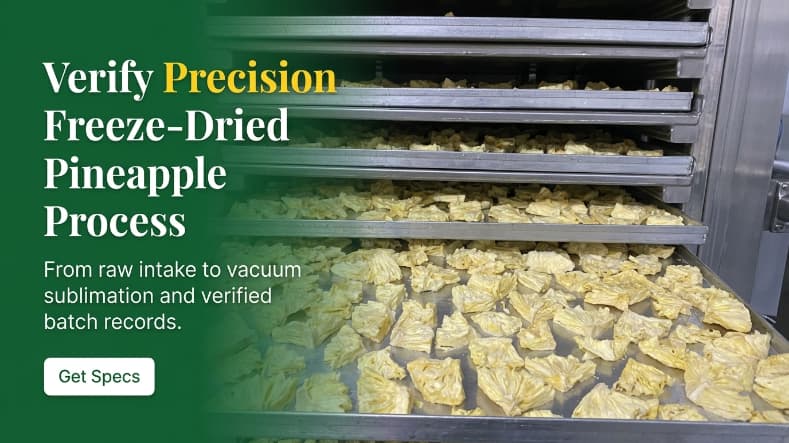
Images can show product appearance, tray layout or equipment type.
Images cannot prove ownership, certificate scope, drying conditions, laboratory results or lot release.
Buyers should treat photos as visual references and request records before approval.
The uploaded images in this project show useful operational cues: pineapple pieces on trays, porous finished texture, possible processing environment, equipment and raw material visuals. These images help illustrate product state. They do not prove process control.
Images cannot prove:
- FruitBuys owns the equipment
- A specific site holds a certificate
- The pictured product matches the buyer’s lot
- Moisture reached 3–5%
- Aw reached below 0.30
- Microbiology passed
- Packaging barrier supports shelf life
- The sample will match bulk product
- The process followed the same cycle every time
This distinction protects FruitBuys and the buyer. Product photography can support visual discussion. It cannot serve as QA evidence. The next step must connect to sample-to-bulk process verification. A buyer can use photos during sample review, but bulk release needs specification, COA, retained sample and documented comparison.
Highest Risk: Treating Equipment Photos as Process Proof
The highest risk appears when the buyer sees a freeze-drying chamber and stops asking technical questions. Equipment presence does not prove process discipline. A tray can sit in the right machine while the wrong cut size, load pattern, endpoint, handling condition or packaging delay damages the product.
This mistake creates operational consequences:
- The sample appears acceptable
- The buyer approves without process records
- Bulk uses a different load or cut-size profile
- Moisture, Aw or breakage shifts
- Packaging receives the product too late or under poor humidity control
- The buyer discovers soft pieces, excess fines or failed QA documents after delivery
FruitBuys should prevent this by keeping process proof inside the product file. The buyer should see a locked specification, process record, COA, retained sample reference, packaging record and release decision. A machine photo can start a technical conversation. It cannot end one.
Application Mapping
| Buyer Type | Application | Required Format | Proof Needed | FruitBuys Delivery |
|---|---|---|---|---|
| Importer | Bulk supplier qualification | Cubes, bites, slices or powder | Process record, COA, packaging file | Documentation and export readiness review |
| QA manager | Lot release | Any approved format | Moisture, Aw, method, deviation record | Quality Control |
| Procurement manager | Repeat supply approval | Approved SKU format | Process consistency and retained sample | Single-point commercial accountability |
| R&D developer | Recipe trial | Cubes, pieces or powder | Cut-size control and sample performance | Market Trial Support |
| Private label buyer | Retail pouch | Bites, slices or powder | Process file, nutrition path, packaging record | OEM/Private Label Delivery |
| Distributor | Replenishment | Same approved format | Repeatable specification and lot proof | Documentation and shipment coordination |
Why FruitBuys Controls the Finished Product Specification
FruitBuys supplies the finished freeze-dried pineapple product through one accountable route. The buyer does not need scattered claims from raw-material handling, drying, sorting, packaging and documentation. The buyer needs one product file that connects those controls.
Raw Material Sourcing Governance defines the fruit and intake basis. Quality Control defines cut size, moisture, Aw, sorting and release. Documentation connects process records, COA, laboratory proof and retained sample identity. Export Logistics Coordination protects the product after release through packaging and shipment readiness.
This model matters because freeze-dried pineapple can fail across invisible steps. A raw material issue can appear as color drift. A cut-size issue can appear as uneven drying. A packaging issue can appear as lost crispness. FruitBuys keeps the controls tied to one specification so the buyer can make a clear approval decision.
Buyer Checklist
Before approving freeze-dried pineapple process claims, request:
- Product format: cubes, bites, slices or powder
- Raw-material intake criteria
- Conversion basis and weighing points
- Cut-size specification
- Tray-loading record
- Freeze-drying batch or cycle record
- Deviation record
- Sorting record
- Moisture result and method
- Aw result and method
- COA and laboratory file
- Packaging time after unloading
- Packaging structure and seal record
- Retained sample code
- Sample-to-bulk comparison method
- Lot-release approval status
Reject any process claim that relies only on equipment photos or generic cycle language. The process must produce a release file.
Summary
Freeze-dried pineapple processing includes raw-material intake, cutting, freezing, primary drying, secondary drying, unloading, sorting, packaging and lot release. Buyers should verify process records, moisture, Aw, COA, packaging condition and sample-to-bulk comparison before approving bulk.
FruitBuys supplies freeze-dried pineapple through a controlled product route where raw material governance, QC, documentation and export logistics coordination support the finished product.
FAQ
What are the main steps in freeze-dried pineapple processing?
The main steps are raw-material intake, trimming, cutting, freezing, primary drying, secondary drying, unloading, sorting, packaging and lot release. Buyers should request records for the steps that affect the approved specification.
Does a freeze-drying machine photo prove process control?
No. A machine photo can show equipment presence or type. It cannot prove drying conditions, ownership, certificate scope, moisture, Aw, microbiology or current-lot release.
Why does cut size matter before drying?
Cut size affects drying uniformity, texture, breakage and residual moisture. Use pineapple format and size specification before approving cubes, bites, slices or powder.
Which records prove final moisture and Aw?
A current-lot COA and test method prove moisture and Aw results. Use moisture and Aw release criteria for the technical release logic.
Why does post-drying packaging matter?
Freeze-dried pineapple can absorb moisture after unloading. Packaging protects crispness, Aw condition and storage stability. Use packaging after freeze-drying.
Can freeze-drying replace microbiology review?
No. Freeze-drying and low Aw do not replace microbiology or sanitation review. Buyers should review the COA, method and sample identity.
Which article controls sample-to-bulk process proof?
Use sample-to-bulk process verification to compare the approved sample, process file, COA, packaging record and released bulk lot.
Conclusion
Request process-record review after defining the freeze-dried pineapple format, cut-size specification, moisture, Aw, packaging condition and lot-release criteria.
References
- Ciurzyńska, A., et al. The Freeze-Drying of Foods: The Characteristic of the Process Course and the Effect of Its Parameters on the Physical Properties of Food Materials. Foods, 2020. (PMC)
- Ciurzyńska, A., et al. The Freeze-Drying of Foods: The Characteristic of the Process Course and the Effect of Its Parameters on the Physical Properties of Food Materials. PubMed record, 2020. (PubMed)
- USDA Food Safety and Inspection Service. Does freeze-drying make food shelf stable? (Ask USDA)
- U.S. Food and Drug Administration. Water Activity (aw) in Foods. (U.S. Food and Drug Administration)
- U.S. Food and Drug Administration. Draft Guidance for Industry: Establishing Sanitation Programs for Low-Moisture Ready-to-Eat Human Foods and Taking Corrective Actions Following a Pathogen Contamination Event. (U.S. Food and Drug Administration)