Freeze-Dried Pineapple Moisture and Aw: B2B Release Criteria
Freeze-dried pineapple can look dry, crisp and stable in a sample tray, but that appearance does not prove the lot is ready for approval. Importers, QA managers, R&D teams and private label buyers need two separate controls before release: moisture content and water activity. One tells the buyer how much water remains in the product. The other tells the buyer how much water remains available for microbial, chemical and physical activity.
A supplier sample without moisture, Aw and lot identity gives the buyer a picture, not a release standard. FruitBuys treats moisture and Aw as measurable checkpoints inside the approved specification, COA file, packaging review and sample-to-bulk comparison. If the buyer skips this step, the product may lose crispness, cake, break during handling or enter documentation review with incomplete proof.
Moisture and Aw Are Not the Same Measurement
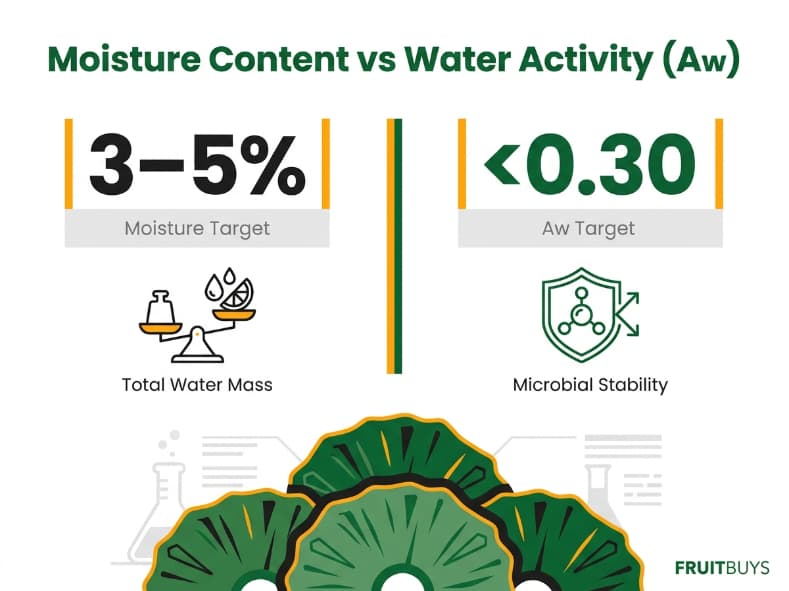
Moisture content measures total water in the product, while Aw measures available water.
A freeze-dried pineapple lot needs both values because texture, storage behavior and microbiology risk do not follow one number alone.
Buyers should request moisture, Aw, test method, sample identity and lot code before approving bulk release.
Moisture and Aw sit beside each other in a serious freeze-dried pineapple specification, but they do different jobs. Moisture content tells the buyer how much water remains in the product by mass. Aw tells the buyer how much of that water remains available to support microbial growth or other stability reactions.
The FDA describes water activity as a ratio tied to vapor pressure, not as a simple percentage of water in the food. That matters because two products can show similar moisture values while behaving differently in storage if their available water differs. (U.S. Food and Drug Administration)
For broader product qualification, moisture and Aw must connect back to technical qualification of freeze-dried pineapple. A buyer should not approve these values as isolated lab numbers. They belong inside a product specification that also covers format, size, fines, breakage, packaging and documentation.
The submitted target for freeze-dried pineapple is moisture at 3–5% and Aw below 0.30. FruitBuys can use those as target release criteria, but the buyer still needs a current-lot COA before treating them as proof. Target values guide production. COA results release the lot.
How Moisture Affects Product Condition
Moisture content affects texture, weight, caking behavior and storage response. In freeze-dried pineapple, excess moisture often shows itself through weaker crispness, clumping in powder, sticky surfaces or faster loss of eating quality after opening. A product can still look acceptable in a photo while carrying more moisture than the approved sample.
The buyer should review moisture by product format. Cubes and bites need enough dryness to protect crisp texture. Slices need the same dryness with stronger breakage control because thin edges fracture easily. Powder needs moisture control because small particles expose more surface area and can cake faster under poor packaging.
That means moisture must connect with pineapple format and size specification. A single moisture number does not tell the buyer whether cubes, slices and powder will behave the same way. Each format needs its own acceptance logic.
Moisture also affects commercial planning without using price logic. If a bulk lot gains moisture after release, the buyer may receive weaker texture, shorter usable storage time and more customer complaints. The damage rarely appears at once. It creeps into the product like humidity through a careless seal.
How Aw Affects Product Stability
Aw controls the availability of water, not the existence of water.
Low Aw can restrict microbial growth potential, but it does not prove that contamination never occurred.
Buyers should pair Aw results with microbiology testing, sanitation review and lot-specific COA documentation.
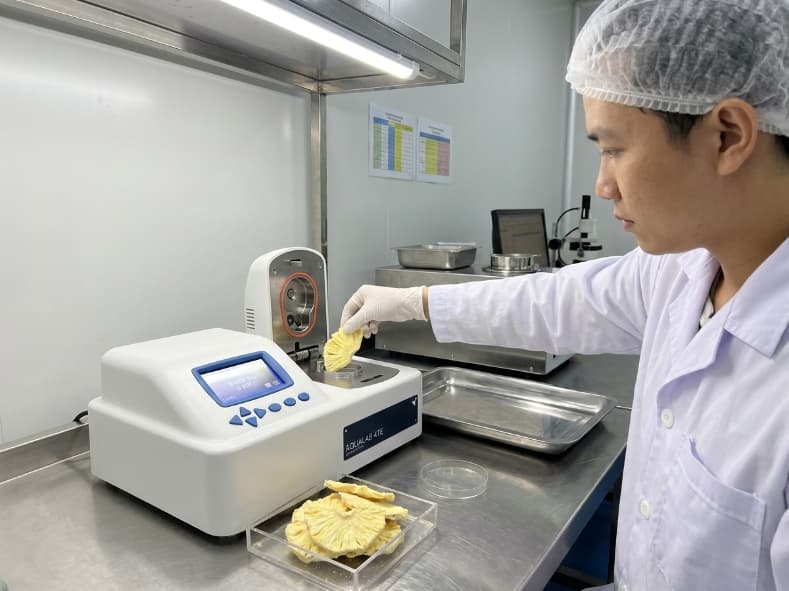
Aw matters because microorganisms need available water to grow. The FDA uses 0.85 as an important water-activity reference point in certain regulatory contexts, but freeze-dried pineapple targets a much lower Aw because it must protect dry texture and shelf stability under ambient handling. (U.S. Food and Drug Administration)
Aw below 0.30 gives the buyer a strong stability target for a crisp freeze-dried fruit format. It does not give the buyer permission to skip microbiology. Low Aw can stop or limit growth, but it does not automatically kill pathogens already present in the product or environment.
This is not a theoretical paperwork issue. Low-water-activity foods have been implicated as vehicles for foodborne pathogens, and scientific reviews note that some pathogens can survive for long periods in low-aw foods and dry processing environments. (PubMed)
For that reason, the Aw section must link directly to microbiology and COA requirements for freeze-dried pineapple. FruitBuys separates Aw control from microbiology review. Aw belongs in technical release. Microbiology belongs in food-safety proof. The buyer needs both.
Audit of the Submitted Targets: Moisture 3–5% and Aw Below 0.30
The submitted values create a practical starting point:
| Parameter | Submitted Target | Correct Buyer Handling |
|---|---|---|
| Moisture | 3–5% | Treat as specification target until current-lot COA confirms result |
| Aw | <0.30 | Treat as specification target until current-lot COA confirms result |
| Microbiology | Not yet supplied | Request lot-specific testing |
| Packaging barrier | Not yet supplied | Request pouch, liner and seal specification |
| Shelf-life validation | Not yet supplied | Do not treat shelf life as unconditional |
A buyer should not ask only, “Is the product dry?” That question lacks teeth. The correct question is: “Does this lot match the approved moisture and Aw limits under the stated test methods, after packaging, with the same format we approved in sample review?”
FruitBuys should lock the release file around five details:
- Product name and format.
- Lot code.
- Moisture result and method.
- Aw result and method.
- Release decision against the approved specification.
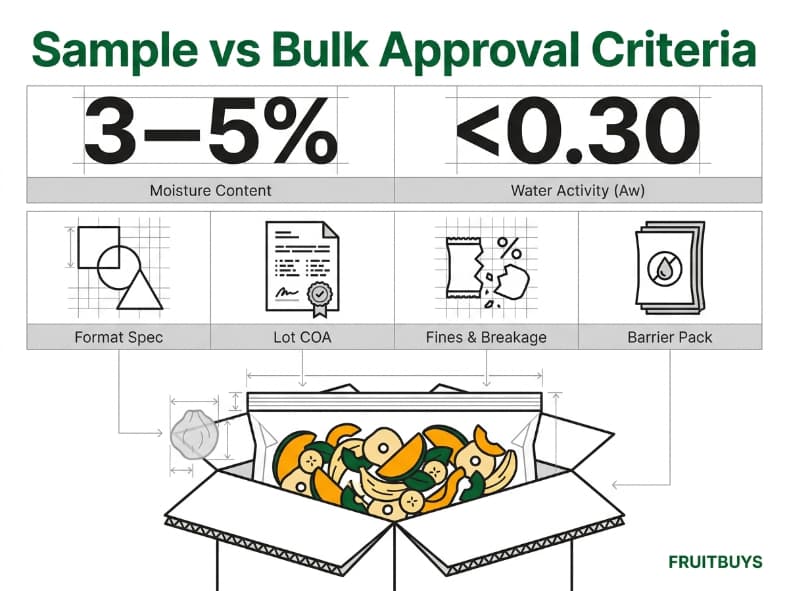
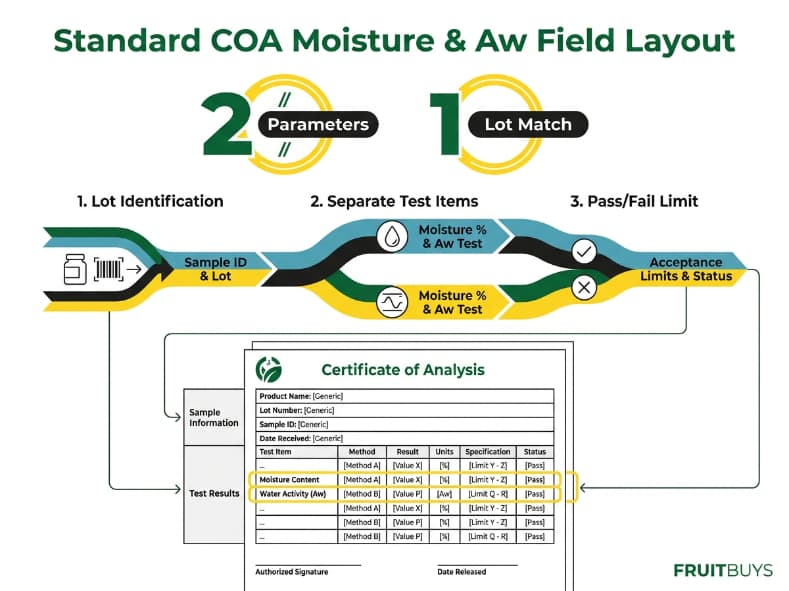
When one of those details disappears, the proof file loses commercial value. A moisture number without lot identity cannot release the product. An Aw number without method cannot support QA review. A COA without the approved specification gives the buyer a loose paper shield.
Sampling and Testing Requirements
ISO 21807 gives basic principles and requirements for physical methods used to determine water activity in food and feed products. That does not replace a supplier’s own test plan, but it confirms that Aw measurement should follow defined physical methods rather than casual internal language. (ISO)
The buyer should request these testing details before release:
| Test Area | Required Detail | Why It Matters |
|---|---|---|
| Sample identity | Lot code, product format, sampling date | Prevents use of unrelated results |
| Method | Moisture method and Aw method | Allows QA review and comparison |
| Instrument | Meter or laboratory method | Supports repeatability |
| Sample handling | Exposure time before testing | Protects accuracy for hygroscopic product |
| Result basis | Unit, decimal place, acceptance limit | Prevents vague pass/fail claims |
| Approval | QA release signature or status | Confirms the result triggered action |
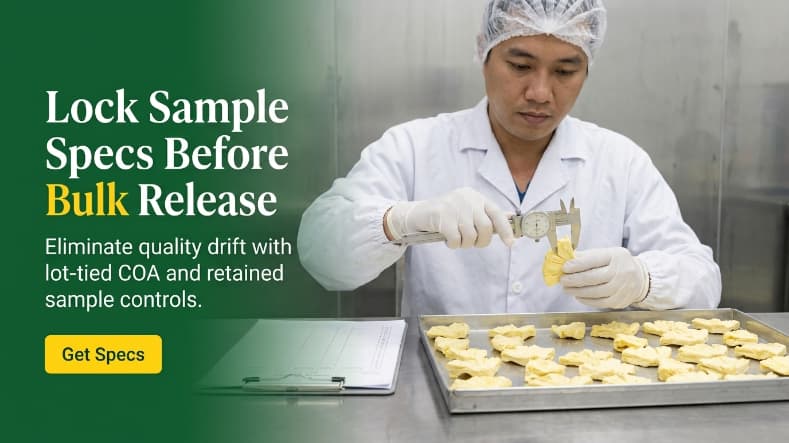
Freeze-dried pineapple absorbs moisture quickly when exposed to humid air. Sampling practice matters. If a sample sits open on a bench before testing, the result may no longer represent the packed lot. The same risk applies during repacking, retail pouch filling or R&D sample subdivision.
FruitBuys should treat sample handling as part of Quality Control, not an afterthought. The buyer should request a COA that identifies the exact tested sample and states results clearly enough for independent QA review.
Packaging Can Change the Result After Release
A freeze-dried pineapple lot can leave drying with acceptable moisture and Aw, then fail buyer expectations because packaging allowed moisture ingress. This is why the packaging file sits beside the COA. The lab result shows the product condition at test time. Packaging determines whether that condition survives storage and movement.
Dry products need packaging that controls water vapor exposure. The buyer should review inner pouch structure, seal condition, liner use, closure style and carton protection. If the buyer plans retail packing, repacking or private label filling, the review must include the time the product stays exposed before final sealing.
This section must connect to moisture-barrier packaging for freeze-dried pineapple. Packaging does not decorate the product. Packaging protects the release result. The shelf-life claim also depends on packaging. A 12–24 month target cannot stand alone as a universal statement. It must connect to final moisture, Aw, package barrier, seal integrity, storage condition, format and validation evidence.
Moisture and Aw in Sample-to-Bulk Comparison
Sample approval becomes dangerous when the buyer approves only appearance. Freeze-dried pineapple can show a strong yellow color, visible porous structure and good bite size while still failing technical criteria. Sample-to-bulk control must compare the approved sample with the bulk lot through measurable criteria.
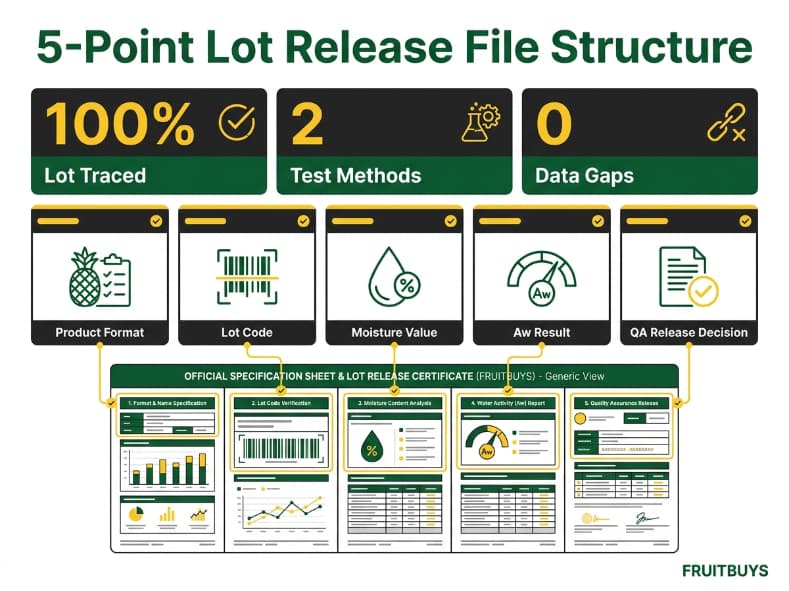
A serious comparison should include:
| Control Point | Sample Approval | Bulk Release |
|---|---|---|
| Format | Approved cube, bite, slice or powder | Same product definition |
| Moisture | Sample result or target | Lot COA result |
| Aw | Sample result or target | Lot COA result |
| Size | Reference range | Bulk size distribution |
| Fines | Accepted level | Bulk fines result |
| Breakage | Visual and weight basis | Bulk comparison |
| Packaging | Approved pack or liner | Actual packed configuration |
| Documentation | Sample file | Lot release file |
FruitBuys should connect this step with sample-to-bulk moisture and Aw control. Without this comparison, sample approval becomes a handshake with no spine. For private label buyers, the risk grows. A retail pouch can pass artwork review while the product inside lacks confirmed moisture, Aw or packaging validation.
That creates revision delays, repacking exposure and label-control risk. The buyer should link this review to private label pineapple approval workflow before approving artwork or retail pack configuration.
Highest Risk: Low Aw Treated as a Food-Safety Shortcut
Low Aw does not make freeze-dried pineapple sterile.
Some pathogens can survive in low-water-activity foods even when growth remains limited.
Buyers should require microbiology testing, sanitation controls and lot-based documentation before release.
This is the control point buyers cannot skip. Aw below 0.30 may support dry product stability, but it does not erase contamination history. FDA guidance for low-moisture ready-to-eat foods focuses on sanitation because pathogens can persist in dry production environments and finished low-moisture foods. (U.S. Food and Drug Administration)
A buyer who treats low Aw as a substitute for microbiology testing accepts blind risk. The product may not support rapid growth, but the buyer still needs evidence that the lot meets microbiology criteria.
This proof must name the organism or test group, method, unit, sample identity and result interpretation. FruitBuys should keep this distinction hard: Aw controls available water, microbiology controls product safety proof. They support each other, but they do not replace each other.
Application Mapping
| Buyer Type | Application | Required Format | Proof Needed | FruitBuys Delivery |
|---|---|---|---|---|
| Importer | Bulk distribution | Cubes, bites or slices | Moisture, Aw, COA, packaging file | Lot-based documentation and release review |
| QA manager | Supplier approval | Any approved format | Test method, sample identity, microbiology panel | Quality Control and Documentation |
| R&D developer | Cereal, granola or confectionery trial | Small cubes or pieces | Moisture, Aw, fines, breakage | Application-specific sample control |
| Beverage developer | Dry mix or smoothie blend | Powder | Moisture, Aw, mesh, caking check | Locked powder specification |
| Private label buyer | Retail pouch | Bites or slices | Moisture, Aw, nutrition, package barrier | OEM/private label delivery |
| Distributor | Multi-SKU replenishment | Approved channel format | COA, storage conditions, sample comparison | Export Logistics Coordination |
Why FruitBuys Delivers This Through One Controlled Product Route
FruitBuys supplies freeze-dried pineapple as one approved product, not as a loose collection of sample, factory claim, lab file and shipping task. Moisture and Aw sit inside the Quality Control pillar. COA and test reports sit inside Documentation. Packaging and storage controls sit inside Export Logistics Coordination.
That structure matters because moisture risk crosses departments. Raw material maturity affects drying behavior. Cut size affects moisture removal. Packaging affects moisture pickup. Documentation affects buyer release. FruitBuys keeps these control points tied to the same product specification and one accountable supplier relationship.
The buyer does not need dramatic claims. The buyer needs a release file that can survive QA review. FruitBuys should supply the approved format, retain the sample reference, align the COA, verify packaging conditions and release the lot only against the locked specification.
Buyer Checklist
Before approving freeze-dried pineapple, request:
- Product format: cubes, bites, slices or powder
- Moisture target and current-lot result
- Aw target and current-lot result
- Test method and sample identity
- Lot code on COA and packing documents
- Microbiology panel and result interpretation
- Packaging structure, liner or pouch specification
- Seal and moisture-barrier review
- Storage condition statement
- Retained sample comparison
- Fines and breakage tolerance
- Bulk release decision against the approved specification
Do not accept verbal confirmation in place of a release file. Verbal confirmation cannot defend the buyer when product softens, cakes or fails QA document review.
Summary
Freeze-dried pineapple moisture and Aw are separate release controls. Moisture measures total water content, while Aw measures available water that affects stability and microbial growth potential.
FruitBuys treats moisture 3–5% and Aw below 0.30 as target criteria that require current-lot COA confirmation. Buyers should review test method, lot identity, microbiology, packaging barrier and sample-to-bulk comparison before approving bulk release.
FAQ
What moisture target should buyers request for freeze-dried pineapple?
Buyers can use 3–5% as a target range, but they should require a current-lot COA before release. The result must identify product format, lot code, test method and acceptance limit.
Is Aw below 0.30 enough to approve the product?
No. Aw below 0.30 supports dry-product stability, but it does not replace microbiology testing, packaging review or sample-to-bulk comparison.
Why do moisture and Aw both matter?
Moisture measures total water. Aw measures available water. A buyer needs both because texture, caking, storage response and microbial growth potential depend on different water-related properties.
Can low Aw make freeze-dried pineapple sterile?
No. Low Aw can limit growth potential, but it does not prove sterility or remove the need for sanitation and microbiology controls.
Which article should I read for COA requirements?
Use COA and laboratory testing for freeze-dried pineapple when reviewing microbiology, contaminants, nutrition testing, method details and lot-specific proof.
Which article should I read for packaging risk?
Use moisture-barrier packaging for freeze-dried pineapple when checking pouch structure, seal control, shelf-life support and moisture pickup risk.
How should I compare sample and bulk lots?
Use sample-to-bulk moisture and Aw control. Compare moisture, Aw, size, fines, breakage, packaging and COA against the approved sample and specification.
Conclusion
Request moisture, Aw and microbiology file review after confirming the intended pineapple format, packaging configuration and bulk-release criteria.
References
- U.S. Food and Drug Administration. Water Activity (aw) in Foods. (U.S. Food and Drug Administration)
- ISO. ISO 21807:2004, Microbiology of food and animal feeding stuffs, Determination of water activity. (ISO)
- U.S. Food and Drug Administration. Draft Guidance for Industry: Establishing Sanitation Programs for Low-Moisture Ready-to-Eat Human Foods. (U.S. Food and Drug Administration)
- Beuchat, Komitopoulou, Beckers, Betts, Bourdichon, Fanning, Joosten and Ter Kuile. Low-water activity foods: increased concern as vehicles of foodborne pathogens. (PubMed)
- U.S. Food and Drug Administration. Hazard Analysis and Risk-Based Preventive Controls for Human Food: Draft Guidance for Industry. (U.S. Food and Drug Administration)