
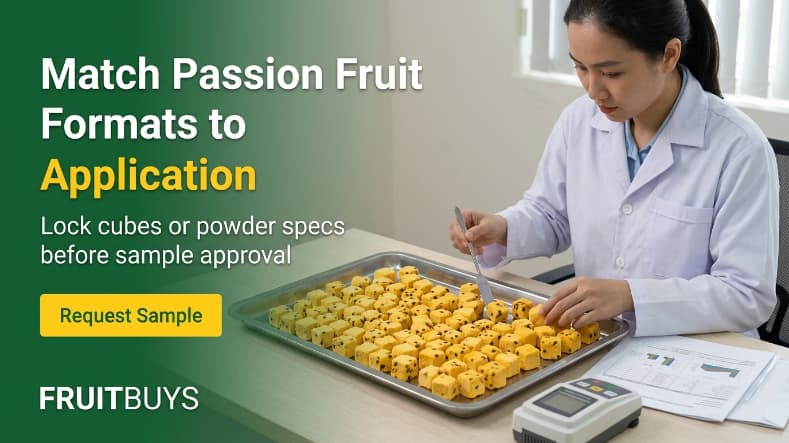
Freeze-Dried Passion Fruit Applications for Food and Beverage R&D
Freeze-dried passion fruit applications fail when buyers choose by flavor first and application second. Passion fruit delivers strong acidity, aroma and visual energy, but R&D teams still need the right format. Cubes behave as visible inclusions. Powder behaves as a blending ingredient. Seed-on cubes can work well in snack pouches, granola, chocolate and toppings. Powder can work better in beverages, bakery fillings, dairy systems and premixes.
The wrong choice turns a sharp tropical note into caking, softening, broken pieces, uneven dosing, or visible seed particles in the wrong product. Application fit must control the format before the buyer approves the sample. FruitBuys supplies freeze-dried passion fruit through a locked specification, sample-to-bulk criteria, packaging alignment and lot-based documentation, so the buyer tests the product that will actually enter production.
Application Depends on Format, Not Product Name Alone
Freeze-dried passion fruit must be selected by application, not by product name alone.
Cubes, powder, seed-on material and seedless material create different behavior in processing, storage and final product texture.
Buyers should define the application before requesting samples.
“Freeze-dried passion fruit” is not a complete R&D brief. The buyer still needs to define whether the final product needs visible fruit pieces, smooth blending, sharp acidity, seed visibility, clean appearance, controlled dosing, or stable pouch texture.
This article should connect to freeze-dried passion fruit B2B guide, because application choices sit inside the wider product decision. It also connects to passion fruit cubes and powder, because cubes and powder require separate physical criteria, packaging logic and COA structure.
The working technical targets remain moisture 3–5% and Aw below 0.30. Those values matter in every application, but they do not solve every use-case problem. A cereal buyer cares about breakage and crunch. A beverage buyer cares about mesh, seed particles and dispersion. A chocolate buyer cares about moisture migration. A private label buyer cares about sample approval, label data and packaging control.

Retail Snack Pouches
Freeze-dried passion fruit cubes fit retail snack pouches when the buyer wants visible product identity and a crisp bite. Seed-on cubes can make the fruit recognizable because the black seed particles signal passion fruit immediately.
The main control points are:
| Retail Snack Requirement | Buyer Risk if Ignored |
|---|---|
| Cube size | Irregular pieces weaken visual consistency |
| Breakage | Excess broken pieces reduce pouch appeal |
| Fines | Powder residue settles at the bottom |
| Seed distribution | Texture and appearance drift between lots |
| Moisture | Cubes lose crispness |
| Aw | Storage stability becomes harder to assess |
| Packaging | Weak barrier or seal creates softening risk |
A snack sample should not pass on flavor only. A buyer should test handling, pouch appearance, bite, moisture pickup and retained sample comparison. If the product will carry a consumer label, the buyer must also control Nutrition Facts, ingredient statement and shelf-life support.
This use case should link to sample-to-bulk consistency and packaging and shelf-life controls. FruitBuys handles retail pouch development through OEM / Private Label Delivery and Quality Control. The product, pouch, label inputs, coding, release criteria and retained sample must move together.
Granola and Cereal Inclusions
Granola and cereal require freeze-dried passion fruit pieces that survive blending and remain visible in the finished mix. Cubes or smaller cube cuts can work, but the buyer must define size and breakage tolerance before approval.
The product enters a rough environment. It may pass through mixing, packing, transport and shelf handling before the consumer sees it. Weak cubes become dust. Oversized cubes may separate from the blend. Excess fines can coat other ingredients and change the appearance of the mix.

For granola and cereal, the RFQ should define:
- Cube size range
- Broken-piece limit
- Fines limit
- Seed-on acceptance
- Target crispness
- Moisture and Aw
- Packaging after blending
- Sample test inside the actual granola or cereal matrix
This application should link to cubes versus powder selection, moisture and Aw requirements and freeze-dried passion fruit RFQ checklist. A buyer who approves clean cubes in a sample pouch but does not test them inside the blend has not finished R&D. The final application, not the sample bag, makes the product prove itself.
Chocolate and Confectionery Inclusions
Freeze-dried passion fruit can bring sharp acidity and visible contrast to chocolate and confectionery systems. Small cubes or controlled fragments usually make more sense than large pieces because the buyer needs distribution, bite control and consistent piece identity.
Chocolate applications demand caution. The buyer must review moisture, Aw, piece size, surface dust and packaging exposure before production. A cube with too much moisture or unstable handling can create texture problems or inconsistent product appearance.
FDA’s water-activity guidance states that water activity affects food stability and must be controlled after drying and during storage. That principle matters when a dry fruit inclusion enters another food system where texture and storage behavior must stay stable. (U.S. Food and Drug Administration)

For chocolate and confectionery, buyers should request:
| Control Point | Why It Matters |
|---|---|
| Small cube or fragment size | Controls distribution and bite |
| Fines level | Limits dust on finished pieces |
| Moisture and Aw | Supports stability review |
| Seed visibility | Affects appearance and texture |
| Sensory profile | Controls acidity balance |
| Packaging exposure | Protects product before use |
This section should link to water-activity control for freeze-dried passion fruit and approved sample and production-lot comparison.
Bakery and Dessert Applications
Bakery and dessert buyers should decide whether they need flavor distribution or visible fruit pieces. That decision separates powder from cubes.
Powder fits:
- Fillings
- Creams
- Glazes
- Dessert powders
- Dough systems that need uniform flavor
- Fruit-flavored dry mixes
Cubes fit:
- Toppings
- Decorations
- Layered desserts
- Visible inclusions after baking or assembly
- Formats where the buyer wants fruit identity
Powder needs mesh, carrier status, caking control, bulk density and dispersion review. Cubes need size, breakage and moisture control. A bakery buyer should not assume that powder fully dissolves or that cubes survive heat, hydration or mixing without testing. The product must be tested inside the buyer’s actual process.
This application should connect to passion-fruit powder specification and passion fruit cubes and powder. The strongest bakery brief names the process condition. A filling system, cookie dough, cream, frosting and dry premix do not stress the ingredient the same way. FruitBuys can align samples better when the buyer states the process, not only the finished-product category.
Dairy and Frozen Dessert Systems
Dairy and frozen dessert applications split into two paths: topping use and blended use. For toppings, cubes can work when the buyer wants visible fruit identity and texture. The buyer should test rehydration, softening, seed mouthfeel and color behavior. For blended systems, powder may work better because it can distribute flavor more evenly.
Dairy applications should review acidity carefully. Passion fruit has a strong acidic profile. That can support a clear tropical note, but it may also change sensory balance or processing behavior. R&D must test the product in the final base.
For dairy and frozen dessert systems, the RFQ should state:
- Topping or blended application
- Cube size or powder mesh
- Seed visibility tolerance
- Desired acidity level
- Hydration behavior
- Color expectations
- Moisture and Aw
- Packaging after opening
This section should link to application specific passion fruit formats, seed-on and seedless passion fruit formats and sample-to-bulk consistency. FruitBuys treats dairy application samples as R&D references, not final proof. The buyer still needs lot release, retained sample comparison and documentation before bulk approval.
Beverage and Premix Applications
Beverage applications usually start with powder, not cubes.
The buyer must define mesh, seed particles, carrier status, dispersion, caking and flavor intensity before approval.
A tasting sample does not prove dosing behavior in a beverage system.
Freeze-dried passion fruit powder can fit beverage premixes, smoothie powders, instant drink concepts and fruit-flavor systems. The buyer must decide whether visible seed particles are acceptable. Seed-on powder may carry black specks. Seedless or low-particle powder may fit cleaner beverage systems.
Powder does not automatically dissolve cleanly. It may disperse, suspend, clump, sediment, or require mixing energy. The buyer should test powder inside the actual beverage process rather than judging a spoon sample.
Freeze-dried passion-fruit juice research has evaluated water sorption kinetics and hygroscopic equilibrium, including the role of processing conditions and anti-caking agents. That supports the practical point that passion-fruit powder requires moisture-control discipline in packaging and handling. (Wiley Online Library)

For beverage and premix use, ask for:
| Requirement | Control Point |
|---|---|
| Mesh range | Particle feel and dispersion |
| Carrier status | Ingredient declaration and flow behavior |
| Seed particles | Visual appearance and mouthfeel |
| Bulk density | Filling and dosing control |
| Caking review | Usability after opening |
| Moisture and Aw | Storage and flow stability |
| Sensory test | Acidity and aroma balance |
This application should link to powder mesh and carrier requirements, packaging and shelf-life controls and COA and laboratory-testing requirements.
Ingredient Distribution and Repacking
Ingredient distributors often need both cubes and powder because their buyers serve different product lines. That does not mean one specification can cover both formats.
A distributor should request separate product files:
| File | Cubes | Powder |
|---|---|---|
| Product specification | Required | Required |
| Ingredient statement | Required | Required |
| Moisture and Aw | Required | Required |
| Physical criteria | Cube size, breakage, fines | Mesh, density, caking |
| COA template | Format-specific | Format-specific |
| Packaging file | Breakage and barrier control | Caking and barrier control |
| Retained sample | Required | Required |
If the distributor repacks or sells to multiple manufacturing accounts, documentation discipline becomes heavier. The distributor must track lot identity, storage conditions, open exposure, pack configuration and customer-specific requirements. This section should link to lot-based laboratory documentation and buyer specification brief.
FruitBuys supports this route through Documentation, Quality Control and Export Logistics Coordination. The goal is not to widen the product list. The goal is to keep each format traceable and usable for the buyer’s downstream customers.
Private Label Snack and Ingredient SKUs
Private label buyers must treat application as a label and packaging decision, not only a product decision. A retail snack pouch, powder jar, stick pack, ingredient pouch and foodservice inner pack all require different controls.
For private label cubes, the buyer should define:
- Consumer pack size
- Cube size
- Seed visibility
- Breakage tolerance
- Moisture and Aw
- Nutrition Facts route
- Shelf-life support
- Pouch structure
- Retained sample
- Claim review
For private label powder, the buyer should define:
- Mesh
- Carrier status
- Caking control
- Seed particle visibility
- Serving route
- Label language
- Pouch or jar format
- Inner seal or closure
- Storage after opening
This section should link to freeze-dried passion fruit private label and freeze-dried passion fruit Nutrition Facts. A private label product fails when artwork moves faster than specification. The label should not outrun the formula. The pouch should not outrun the packaging evidence. The launch file should not outrun the COA scope.
Application Mapping
| Buyer Type | Application | Required Format | Proof Needed | FruitBuys Delivery |
|---|---|---|---|---|
| Snack brand | Retail fruit pouch | Cubes | Cube size, breakage, moisture, Aw, packaging | OEM/Private Label Delivery |
| Granola manufacturer | Cereal inclusion | Cubes or small pieces | Size retention, fines, blend test | Quality Control and sample alignment |
| Chocolate producer | Fruit inclusion | Small cubes or controlled fragments | Moisture, piece size, sensory test | Application-matched specification |
| Bakery R&D team | Filling, cream, dry mix, topping | Powder or cubes | Mesh, heat test, hydration, sensory review | Format-specific sample support |
| Dairy developer | Topping or blended product | Cubes or powder | Rehydration, seed tolerance, acidity | Sample-to-bulk release alignment |
| Beverage developer | Premix or smoothie powder | Powder | Mesh, dispersion, carrier status, caking | Product configuration and documentation |
| Ingredient distributor | Multi-application resale | Cubes and powder | Separate specifications and COA files | Lot-based documentation |
| Private label owner | Retail snack or powder SKU | Cubes or powder | Label data, packaging file, retained sample | OEM/Private Label Delivery |

Why FruitBuys Maps Product Format to Application
FruitBuys supplies freeze-dried passion fruit as a configured product under one approved specification. Application mapping prevents the buyer from testing the wrong sample and approving the wrong bulk criteria.
Raw Material Sourcing Governance aligns pulp suitability, maturity direction and seed route with the buyer’s application. MOQ Flexibility/Market Trial Support allows a buyer to test format, packaging and application route when operationally supported. Quality Control ties the selected format to moisture, Aw, size, mesh, breakage and sensory criteria.
Documentation links the specification, COA, laboratory report and retained sample to the lot. OEM/Private Label Delivery aligns product format with pouch, label inputs, coding and release conditions.
The buyer does not need scattered product guesses. The buyer needs one product route where the application defines the sample, the sample defines the specification and the specification controls the bulk release.
Buyer Checklist
Before selecting freeze-dried passion fruit for food or beverage applications, confirm:
- Does the application need visible fruit identity?
- Does the product need cubes, powder, or both?
- Are visible passion-fruit seeds acceptable?
- Does the product need a seedless route?
- Does the buyer need crisp texture, dispersion, or flavor distribution?
- What cube size or powder mesh will the process tolerate?
- Will the product face mixing, heat, hydration, coating, or repeated opening?
- Does the specification include moisture 3–5%?
- Does the specification include Aw below 0.30?
- Does the COA include format-specific criteria?
- Does the packaging protect against softening, caking and breakage?
- Does the sample represent the final application?
- Does any application change trigger new sample approval?
Use freeze-dried passion fruit RFQ checklist before requesting samples.
Summary
Freeze-dried passion fruit applications depend on format selection. Cubes suit visible inclusions, snack pouches, granola, chocolate, toppings and mixed fruit formats. Powder suits beverages, bakery fillings, dairy blends, dry mixes and formulation systems.
Buyers should define seed status, cube size, powder mesh, moisture, Aw, packaging and COA scope before sample approval. FruitBuys supplies application-matched freeze-dried passion fruit through locked specification, sample-to-bulk comparison, documentation and OEM/private label delivery.
FAQ
Which applications suit freeze-dried passion fruit cubes?
Cubes suit retail snack pouches, granola, cereal, chocolate inclusions, bakery toppings, yogurt toppings and visible fruit applications. Buyers should control cube size, breakage, moisture and Aw.
Which applications suit freeze-dried passion fruit powder?
Powder suits beverage premixes, smoothie powders, bakery fillings, dairy blends, dessert powders and dry-mix systems. Buyers should define mesh, carrier status, dispersion and caking criteria.
Are seed-on cubes suitable for granola?
Yes, when the buyer accepts visible seeds and tests cube breakage inside the blend. The specification should define size, fines, moisture and Aw.
Is passion-fruit powder suitable for beverages?
Yes, when the powder meets the buyer’s mesh, dispersion, seed-particle and caking requirements. A tasting sample alone cannot prove beverage performance.
Can freeze-dried passion fruit work in chocolate?
It can work as a controlled inclusion when piece size, moisture, Aw, fines and sensory balance match the chocolate application.
Should applications use the same COA?
No. Cubes and powder may share some safety tests, but physical release criteria differ. The COA or release file should match the selected format.
When should a buyer request a new sample?
Request a new sample when format, seed status, cube size, powder mesh, packaging, moisture target, Aw target, or final application changes.
Conclusion
Request an application-matched sample after defining processing conditions, target texture, seed visibility and final packaging.
References
- U.S. Food and Drug Administration. Water Activity (aw) in Foods. Inspection Technical Guide. (U.S. Food and Drug Administration)
- U.S. Food and Drug Administration. Guidance for Industry: Measures to Address the Risk for Contamination by Salmonella Species in Food Containing a Peanut-Derived Product as an Ingredient. (U.S. Food and Drug Administration)
- Cal-Vidal, J.; Falcone, M. Processing Conditions Affecting the Hygroscopic Behavior of Freeze-Dried Passion Fruit Juice. Journal of Food Science, 1985. DOI: 10.1111/j.1365-2621.1985.tb10451.x. (Wiley Online Library)



