Will Freeze-Dried Mango Stay Crunchy in Cereal, Chocolate or Yogurt? Choosing the Right Format
Freeze-dried mango is single-ingredient mango (Mangifera indica L.) from the freeze-dried fruit range, sold as slices, cubes, bites and granules for snacks, cereals, bars, chocolate and dairy.
It stays crunchy only where it stays dry. In a dry cereal or snack mix, a well-chosen cube keeps its bite for the shelf life of the pack. In yogurt, ice cream or a moist bar binder, uncoated pieces lose their crunch within minutes to weeks, whatever the cut. So the format decision is really two decisions: which cut survives your process without breaking, and whether your product lets the fruit stay dry at all. Get either wrong and you pay twice: once for broken pieces you cannot use, and again for a pilot that has to be rerun.
Which cut should I choose for my application?
Match the cut to the mechanical and moisture stress in your process, not to what looks best in the sample bag.
| Your application | Main risk | Format that works | Spec points to lock |
|---|---|---|---|
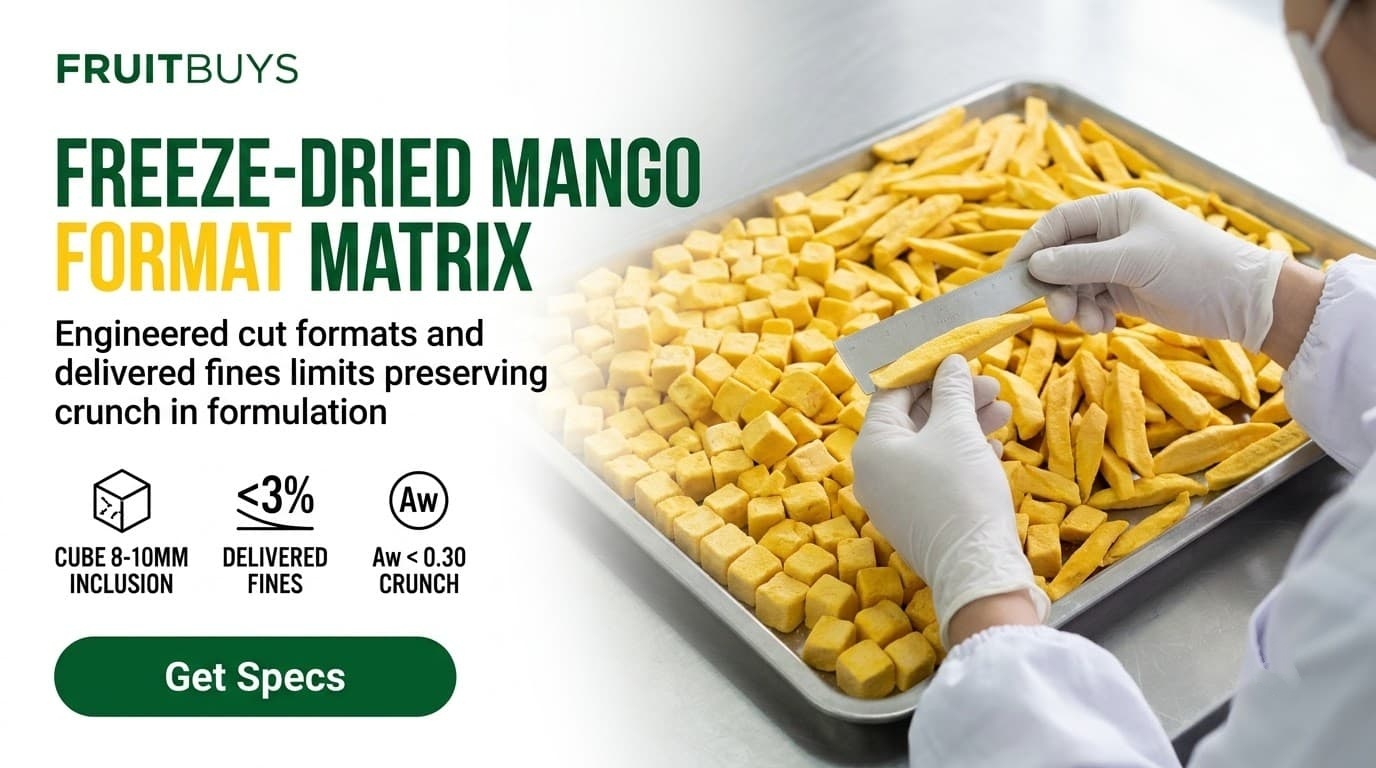
| Cereal, granola, dry snack mix | Breakage in tumble mixing and transport | Cube 8–10 mm (3/8 inch) or bites 10–12 mm | Fines <3% at delivery; use at 10–15% of the mix |
| Pressed cereal or snack bar with moist binder | Moisture moves from binder into fruit, soft in 2–4 weeks | Cube 6–8 mm plus granules 3–5 mm | Inclusion ≤15–20% by weight; add last, press cold |
| Chocolate pieces and coated snacks | Fruit takes up moisture before coating | Cube 5–10 mm or slices for enrobing | Coat promptly after opening; 5–12% fruit in chocolate as a starting point |
| Yogurt, ice cream, cold drinks | Water uptake within minutes | Not bare pieces. Cube ~5 mm coated in fat or compound chocolate | Coated fruit at 6–10% in yogurt as a trial start |
| Baked goods | Heat plus dough moisture | Granules 2–4 mm in the dough for flavor and color; slices only as post-bake decoration | Expect softening above 60 °C for over 30 minutes without a fat barrier |
| Retail snack pouch | Breakage in shipping; softening from weak packs | Slice 6–7 mm or bites 12–15 mm | Slice thickness ≥6 mm; breakage <5% |
| Fruit tea and toppings | Dissolving too fast | Cube ~5 mm | Low water activity; holds shape a few minutes in hot water |

The usage rates are starting points for a pilot, not validated formulations. The sizes and fines limits are the ones we recommend buyers put in the specification; they reflect how the cuts behave in production, not a regulatory requirement.
Why does freeze-dried mango break so easily, and how much will I lose?
Because freeze-drying leaves a light, porous structure that is crisp for the same reason it is fragile, and the thinner the cut, the more it breaks. Slices lose about 8–10% as broken pieces during sorting at the factory; dice lose about 4–5%. More breaks in your own mixer and in transit.
Thin slices are the weak point. Below about 4 mm, breakage in handling can run above 25%. That is why we recommend 6 mm or more for slices that need to arrive whole, and cubes rather than slices for anything that will be tumbled or conveyed.
What that costs you: unusable kilograms = kilograms bought × fines at delivery. On a 10-tonne cereal order, the difference between 8% and 3% fines is 500 kg of fruit that either sieves out as waste or ends up as dust in your pack, which raises your real cost per usable kilogram. How sorting losses feed into price is covered in why freeze-dried mango costs what it does. Put a delivered-fines limit in the specification, and check it with a sieve at receiving.

Why does it go soft in yogurt or a cereal bar, and can I prevent it?
Because the fruit is far drier than anything around it, so it pulls in water until it loses its crunch; you can slow that with a fat barrier and a dry binder, but you cannot stop it in a wet product. Freeze-dried mango leaves the factory at water activity below 0.30. Yogurt sits close to 1.0. Bar binders are often above 0.6. The water moves toward the fruit.
- Yogurt and dairy. Bare pieces soften within minutes. Either coat cubes in fat or compound chocolate so the barrier slows the water, or accept that the fruit is there for flavor and color, not crunch.
- Bars. Keep inclusions at 15–20% of bar weight or less, add them at the last mixing step, and press cold. If the binder is well above 0.6, expect softening within 2–4 weeks unless the fruit is coated or the binder is reformulated drier.
- Cereal and snack mixes. Here freeze-dried mango works well, because the other components are also dry. The risk moves to packaging: once the pack is opened in a humid kitchen, the fruit is the first thing to soften.

Bench test before you pilot: put a few pieces into your actual base and time how long they stay crisp at your storage temperature. If they fail within hours, no cut size will fix it; change the base, the coating or the fruit form instead.
Does cultivar affect how the pieces hold up?
Yes. Firmer, lower-fiber fruit with more solids cuts cleaner and breaks less. Dry matter in mango flesh ranges from about 15% to 22% across published cultivars. Higher dry matter gives a denser, sturdier piece after drying, which matters most for cubes that will be tumbled. Fibrous fruit tends to tear when cut thin and gives ragged slices.
For Vietnamese supply, specify the cultivar by name. Cát Chu is sweet with good color and low fiber, well suited to slices; ask your supplier which cultivar they use for cubes and whether it changes between seasons. The fruit criteria themselves belong in the freeze-dried mango specification.
How do I design a pilot that passes the first time?
Run it in your real base, at your real process conditions, with a sample cut exactly as the bulk will be cut, and measure breakage and crispness over time rather than on day one.
- Request the exact format. A sample of slices is not a test for cubes. Ask for the size, tolerance and grade you will buy.
- Test in your process. Mix at your mixer speed and time. Sieve the output and weigh what falls through.
- Hold samples. Check crispness at day 1, week 2 and week 4 at your storage temperature.
- Check the delivered fines. Sieve a sample of the incoming bag before mixing, so you know how much breakage was already in the product.
- Start at the reference usage rate and adjust: granola 10–15%, chocolate 5–12%, yogurt 6–10%.
If the fruit softens in week 2, change the base or the coating before you change the supplier.

What should the format specification include?
- Format and size: e.g. cube 8 mm ±1 mm, or slice 6–7 mm thick
- Delivered fines: e.g. <3% for cereal and granola, measured by a named sieve
- Breakage: e.g. <5% broken pieces for whole slices
- Moisture and water activity: 3–5% and <0.30, both on the COA with the lot code
- Packaging: barrier pouch or liner with nitrogen flush, and bag size that is used up quickly once opened, see the packaging and shelf-life guide
Hold every supplier to the same spec, including us. A supplier that cannot state size tolerance and delivered fines is selling you a sorting problem.

Decision rule
- Product is dry (cereal, granola, snack mix) → cube 8–10 mm, fines <3%.
- Product has a moist binder → cube 6–8 mm or granules, ≤15–20% inclusion, add last, press cold, or coat.
- Product is wet (yogurt, ice cream) → coated cubes, or accept flavor and color without crunch.
- Product is baked → granules in the dough, slices only after baking.
- Whole slices must arrive intact → slice ≥6 mm, breakage <5% in the spec.
Where freeze-dried mango does not fit
If your product rehydrates the fruit before it is eaten, you are paying for a crisp structure that disappears. In sauces, fillings and long-baked goods, air-dried or frozen mango usually delivers the same eating result at lower cost. We would rather tell you that before the pilot than after it. How freeze-dried compares with air-dried mango for each use is set out in freeze-dried vs dried mango.
FAQ
How much water does freeze-dried mango take up when rehydrated?
About 2.5 to 2.8 times its weight within 10 minutes, keeping around 80–85% of its shape. That is useful for smoothie and dessert applications where the fruit is meant to soften.
Can I use the fines?
Yes, in applications where shape does not matter, such as flavor blends or fillings. Ask whether your supplier can sell them as a separate grade rather than leaving them mixed into whole cuts.
Talk to us about your application
Designing a new formulation, or troubleshooting fruit that softens? Tell us your product base, how hard the fruit is mixed, and the shelf life you need. FruitBuys will recommend the cut size, the moisture-barrier approach and the spec limits to test before you order bulk. Reach our team from the freeze-dried mango product page.
Sources & Technical References
- FruitBuys Vietnam: “Premium Freeze Dried Mango”: formats (slices, cubes, bites, granules), release targets of 3–5% moisture and water activity below 0.30. (https://fruitbuys.com/product/freeze-dried-mango)
- Asian Food Science Journal: “Morphological, Physical and Biochemical Characteristics of Mango Varieties”: flesh dry matter and fiber of Amelie, Kent and Keitt. (https://journalafsj.com/index.php/AFSJ/article/download/511/1021)
- Google Patents: “GB2523449A”: cereal bar inclusions preferably not exceeding 20%, more preferably 15%, by weight. (https://patents.google.com/patent/GB2523449A/en)
Basis note: recommended cut sizes, delivered-fines and breakage limits, the thin-slice breakage figure, bar softening time and cube behavior in tea are FruitBuys field guidance for specification design, not validated test results. Sorting losses (slice 8–10%, dice 4–5%), usage rates, the 60 °C heat limit and rehydration figures are industry benchmarks. The 500 kg example is a calculation.