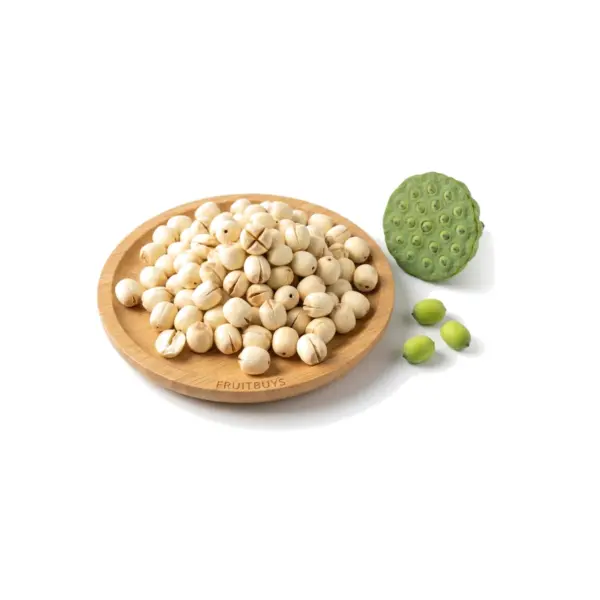
Freeze-Dried Lotus Seeds
Freeze-dried lotus seeds are the shelled, cored kernels of Nelumbo nucifera, steam-blanched and freeze-dried to ≤5% moisture and water activity ≤0.30. They are crisp and ready to eat from the bag, and rehydrate in 10–15 minutes in warm water instead of an overnight soak. They are not makhana (fox nut, Euryale ferox), which comes from a different water plant.
Our kernels come from Dong Thap, Vietnam’s lotus province, whose fresh lotus seeds carry a national geographical indication (No. 00145). You buy cored ivory kernels with no oil, no added sugar and no soaking step, shipped dry at 3.85–5.5 tonnes per 20ft container. On a snack shelf that is a crunchy plant-protein kernel with one word on the ingredient line; on a mooncake, congee or dessert line it is the soak tank and the overnight shift taken out of the process. Kernels, halves and pieces sit in the freeze-dried fruit and vegetable range; powder is specified on its own page.
Product specification
| Parameter | Specification |
|---|---|
| Ingredient | 100% mature lotus seeds (Nelumbo nucifera), shelled, skinned, cored and steam-blanched; no sugar, salt, oil, colours or preservatives; processed without sulphur fumigation, sulfites or bleaching agents |
| Formats | Whole cored kernels (standard), halves, pieces; powder on a separate specification |
| Kernel size | 12–16 mm, natural sort (standard grade); precision sizing 12–14 mm or 14–16 mm on request for automated retail packing and gift lines |
| Coreless | ≥99%: count 100 kernels, at most one with the green plumule |
| Broken | ≤3% in whole-kernel grade |
| Colour / texture / flavour | Natural ivory white to light cream; crisp, light and porous; mild, nutty, lightly sweet, chestnut-like |
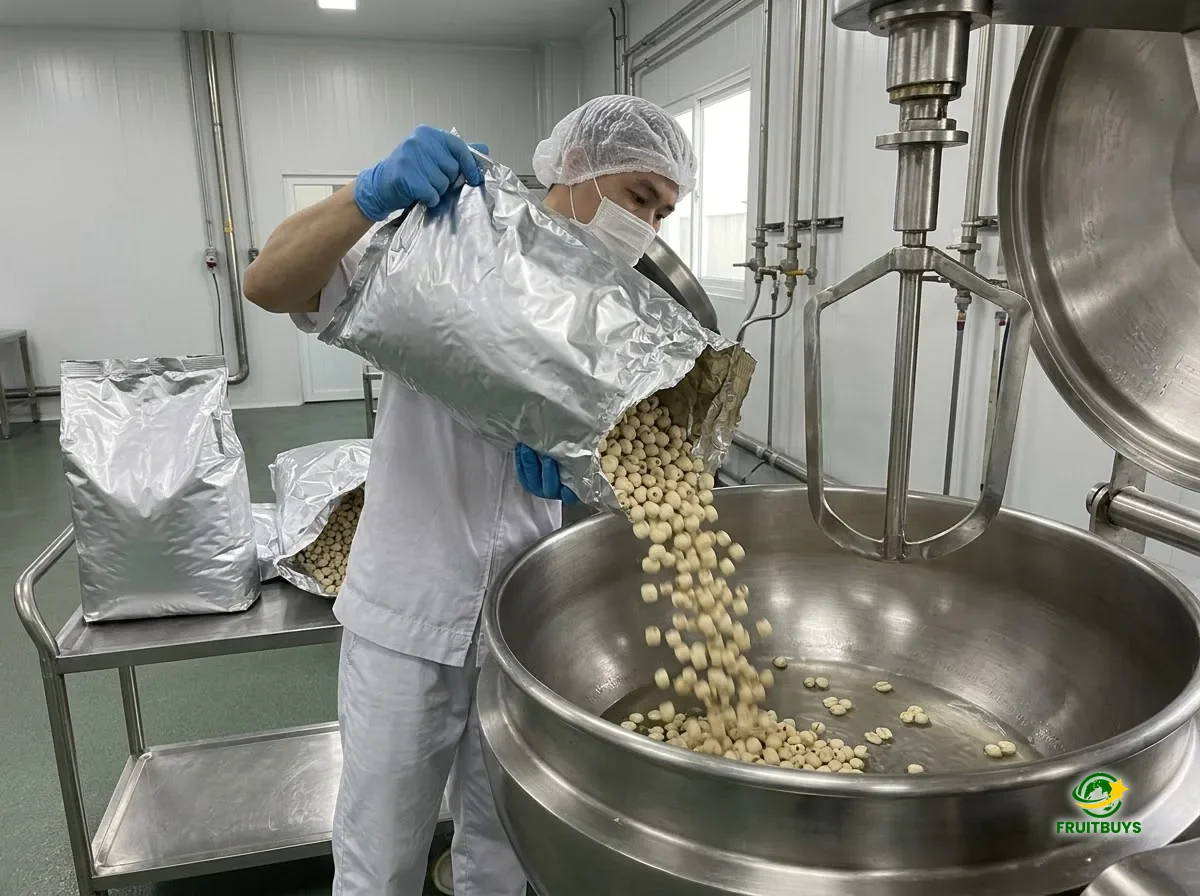
| Process | Steam-blanched 5–10 minutes, frozen at −30 °C for 6–8 hours, then freeze-dried |
| Moisture | 1–4% at chamber exit; ≤5.0% contract ceiling at release |
| Water activity | ≤0.30 |
| Total plate count | ≤10⁴ CFU/g; inclusion grade on request (e.g. TPC <1,000 CFU/g) |
| Yeasts & moulds | ≤10² CFU/g |
| E. coli | <10 CFU/g |
| Salmonella | Not detected / 25 g |
| Rehydration | 10–15 minutes in warm water, or straight into congee, soup and dessert bases |
| Fresh-to-dry | About 10–12 kg of fresh seeds in the green husk, or 5.5–6.5 kg of fresh shelled kernels, per 1 kg |
| Shelf life | 12 months at ≤25 °C, RH ≤60%; 18–24 months in cool storage at ≤18 °C, RH ≤50% |
| HS code | 1212.99 (EU CN 1212 99 95) for plain kernels; 2008.19 for seasoned, roasted or coated kernels |
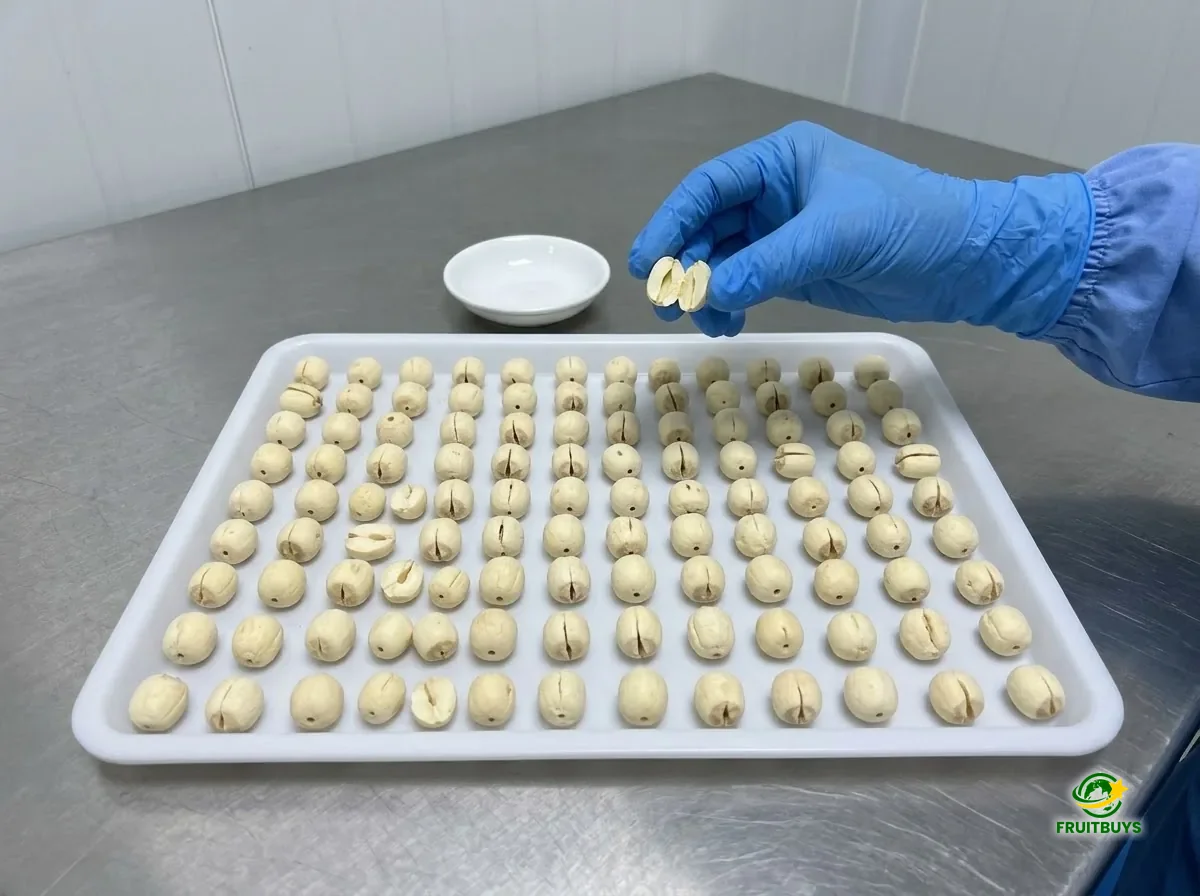
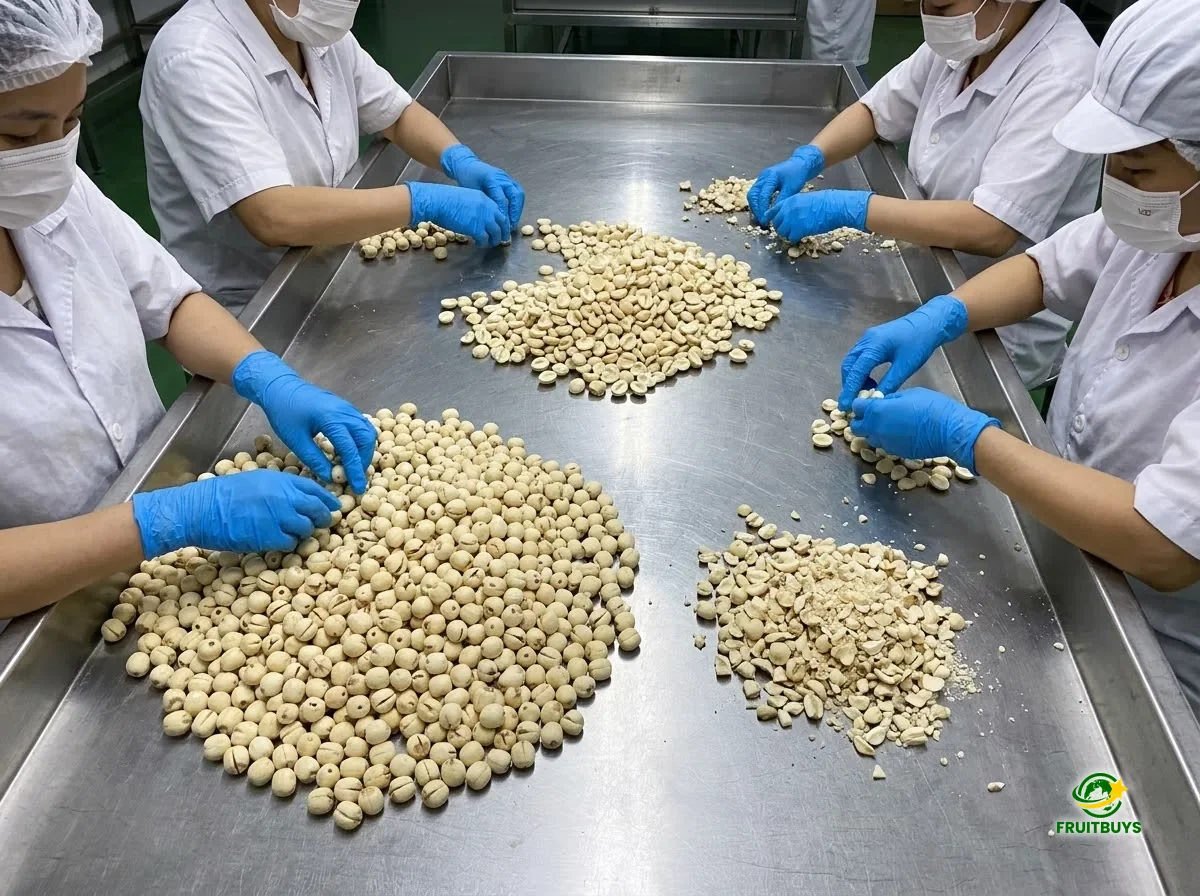
The core decides whether a batch is sellable. The green plumule inside every lotus seed is bitter, and one missed core in a spoonful of paste is the complaint a dessert brand remembers. Each kernel is cored before blanching, which leaves a small hole at one end: that is the coring mark, not damage. Count 100 kernels from your sample; at ≥99% coreless you find no more than one green core.
Split lines are not breakage. Coring and drying open fine natural split lines along the kernel. A kernel with split lines still holds its shape through cooking and on the snack shelf, so it counts as whole. Halves and pieces count toward the ≤3% broken limit in whole-kernel grade. If your line runs paste or inclusions, buy halves or pieces as their own format and pay for whole kernels only where your customer sees them.
Ivory is the colour of an honest kernel. Steam blanching stops the browning enzymes and sets the starch, so the dried kernel is ivory and crisp instead of grey and chalky, and it softens evenly when cooked. Bright chalk-white dried lotus seeds are the look QA teams associate with sulphur fumigation or bleaching. These kernels are processed without either, and a sulfite result below 10 mg/kg is available on request for your QA file.
Freeze-dried or heat-dried lotus seeds: what changes on your line
| Freeze-dried (this product) | Traditional heat-dried | |
|---|---|---|
| Before cooking | 10–15 minutes in warm water | 4–8-hour or overnight soak |
| From the bag | Crisp, ready to eat | Hard; not a snack |
| Colour | Natural ivory | Ivory to beige; bright white often means bleaching or sulphur |
| Cooking | Softens evenly within minutes | Old stock can stay hard after long cooking |
| Plant impact | No soak tanks, no overnight shift, no souring in a long warm soak | Soak tank floor space and labour every batch |
The soak is where heat-dried seeds cost money that never shows on the quote. In a warm plant, a long soak starts to sour and ferment, and the tank, the water and the overnight labour come back every batch. With freeze-dried kernels a mooncake or instant-congee line goes from bag to kettle in one session. The texture, cooking and cost trade-offs per application are in which lotus seed format fits your snack, dessert or paste line, and the paste-line detail in freeze-dried lotus seeds for mooncake paste.
Yield: how a quote should add up
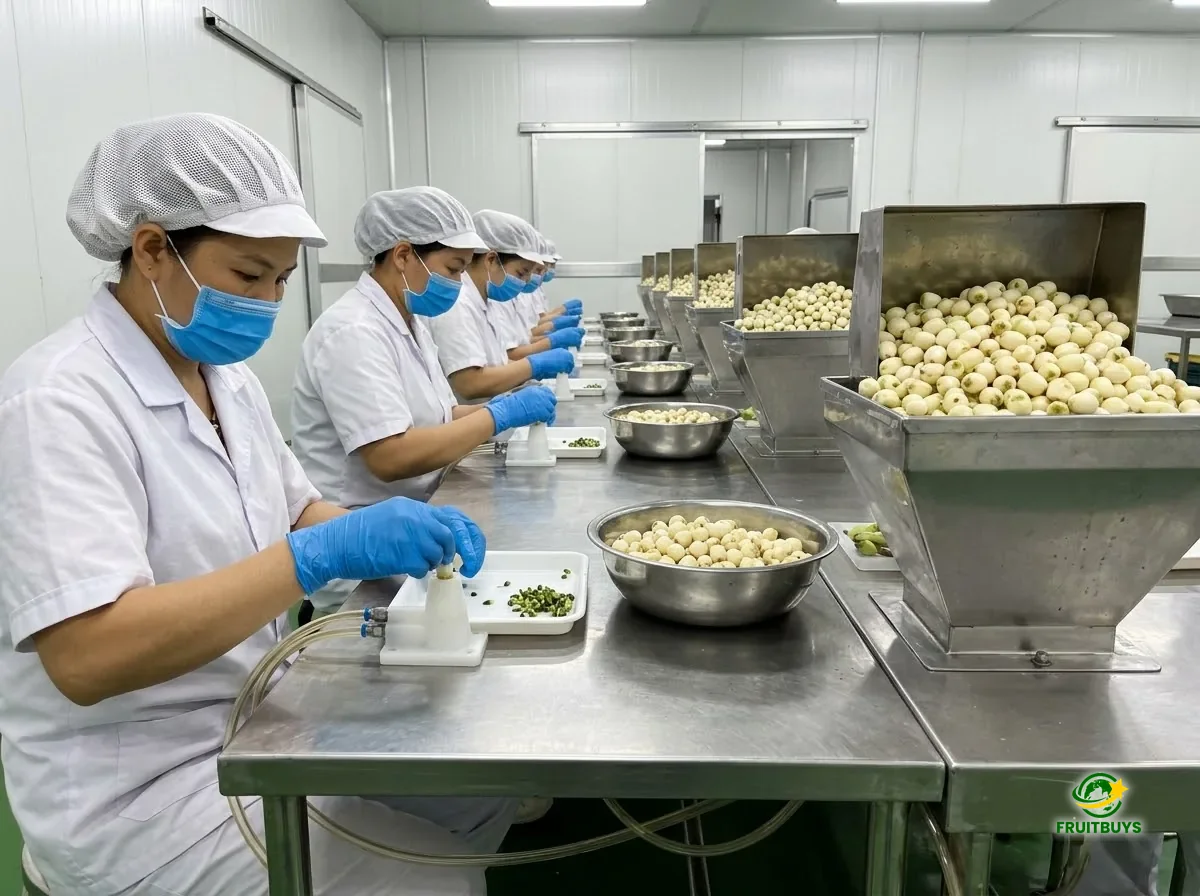
About 10–12 kg of fresh seeds in the green husk, as bought at the pond, or 5.5–6.5 kg of fresh shelled kernels, make 1 kg of freeze-dried lotus seeds. The weight goes to empty seeds and sorting, skinning, coring, blanching and fines. On paper the dry matter alone gives about 4.2 kg of shelled kernels per kilo; real lines never reach that.
Use the shelled figure to test a quote: multiply the local price of fresh shelled kernels by 5.5–6.5, then add drying and packing. Offers built on 3.2–3.5 kg are buying wetter kernels, missed cores or a looser broken grade. The full mass balance is in how many kilograms of fresh lotus seeds make 1 kg freeze-dried, and how the kernels are blanched and dried in how lotus seeds are freeze-dried.
Nutrition (per 100 g)
| Nutrient | Amount | % DV* |
|---|---|---|
| Calories | 350 kcal | |
| Total fat | 1.5 g | 2% |
| Saturated fat | 0 g | 0% |
| Sodium | 5 mg | 0% |
| Potassium | 1,410 mg | 30% |
| Total carbohydrate | 70 g | 25% |
| Dietary fibre | 11 g | 40% |
| Total sugars | 2 g (0 g added) | |
| Protein | 20 g | 40% |
Typical values for 100% freeze-dried lotus seeds; natural variation by origin, season and maturity applies. Lot nutrition panel available for label artwork.
About 20 g of protein and 11 g of fibre per 100 g, with protein supplying roughly 23% of energy: a plant-protein, high-fibre base for high-protein and clean-label lines. On an EU panel the values read 1,470 kJ / 350 kcal, carbohydrate 59 g, fibre 11 g, protein 20 g and salt 0.01 g, which reach the EU levels for “high protein”, “high fibre” and “high in potassium” (70% NRV) from one ingredient. The kernel is vegan and naturally gluten-free; a lot gluten test is available when your pack carries a gluten-free claim. US per-serving claims and the label workings are in what 100 g of freeze-dried lotus seeds puts on your label. For your printed label, FruitBuys samples your commercial lot and arranges the panel in FDA or EU format.
Formats and applications
| Format | Best for | Working note |
|---|---|---|
| Whole cored kernels | Ready-to-eat snack packs, seasoned crunchy kernels, dessert cups, visible-kernel fillings, chè and tong sui kits | The shape sells; whole kernels hold through cooking |
| Halves | Lotus seed paste, congee and porridge cups, sweet soups | Faster to cook down; lower cost per kg than whole |
| Pieces | Granola, muesli, cereal and bar inclusions, paste bases, tea blends | Even dosing on the line; the lowest cost per kg of the kernel formats |
| Powder | Paste and filling bases, beverage and cereal powders, plant-based milks | Skips soaking and wet milling; see the powder page |
In wet bases, add whole kernels at the point of consumption to keep the crunch, or simmer briefly for a soft, cooked bite. Seasoned, honey-glazed or chocolate-coated kernels are available as ODM from 500 kg per SKU; the porous kernel takes the coating after drying.
If you want a puffed, popcorn-light seed, that is makhana, a different plant, and India shipped about 7,265 t of it in 2025-26, about 40% to the US (Government of India data). That demand is a shelf FruitBuys kernels fit: a denser, nuttier crunch, seasoned to your recipe as ODM. If your canned dessert or paste line needs soft wet seeds, rehydrate the kernels for 15 minutes at your plant: you ship a dry ambient product at about one-sixth of the shelled weight instead of paying freight on water. The species, texture and label differences are set out in lotus seeds vs makhana.
Planning for Mid-Autumn: mooncake paste is milled in August. For Mid-Autumn 2027 (15 September), confirm orders by May–June for July arrival.
Lotus seed powder
Freeze-dried lotus seed powder is milled from the same cored kernels to 80–100 mesh, 100% lotus seed with no carrier or anti-caking agent. It goes straight into the paste kettle with water, sugar and fat, which removes both the soak and the wet milling. Specification and RFQ are on the freeze-dried lotus seed powder page.
Looking for the root rather than the seed? Lotus root grows underground in the same Dong Thap ponds and is specified on the freeze-dried lotus root page.
Packaging
| Item | Detail |
|---|---|
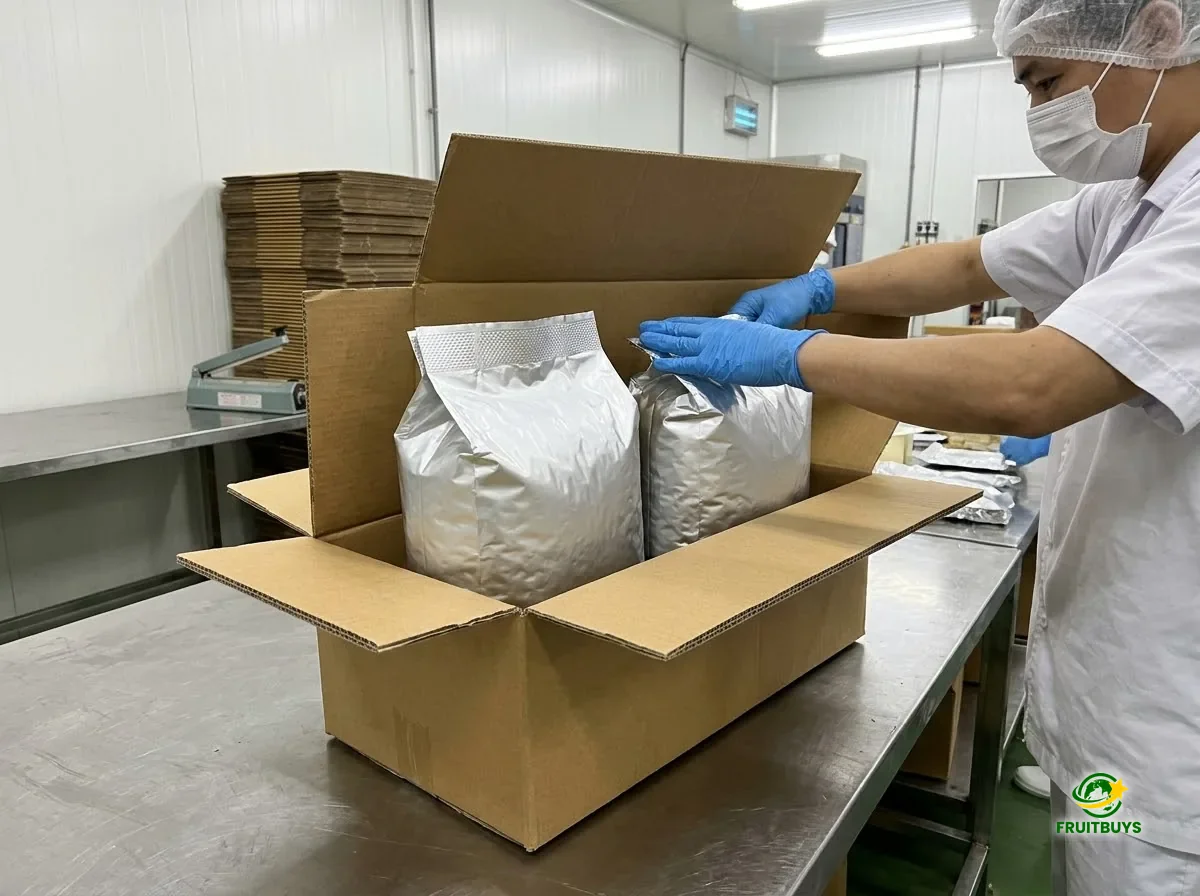
| Bulk | 1–5 kg sealed aluminium-foil PE bags, gently vacuumed with a food-grade silica gel sachet, no nitrogen flush, in 5-ply cartons |
| Carton | 58 × 28 × 34 cm, 7–10 kg net depending on cut and packing; custom cartons on request |
| Retail (OEM) | 30 g–500 g aluminium-foil zip pouches, or custom sizes |
| Shelf life | 12 months at ≤25 °C, RH ≤60%; 18–24 months in cool storage at ≤18 °C, RH ≤50%; unopened foil bag with desiccant |
Starch-rich kernels pick up humidity fast once a bag is open, so bulk bags are sized to one production batch: open one, use it through, and every other bag stays crisp until its turn. If a bag must be reopened, reseal it at once with a fresh desiccant sachet. Bag build, storage and what water activity tells you about shelf life are in how freeze-dried lotus seeds are packed and how long they last.
Commercial terms and container planning
| Term | Detail |
|---|---|
| Production capacity | 100 MT/year |
| 20ft, floor-loaded | About 550 cartons: 3,850–5,500 kg net |
| 40ft HC, floor-loaded | About 1,100 cartons: 7.7–11 t net |
| Palletised | On request |
| Container type | Standard dry container; no reefer |
| Supply | Main harvest July to September; one season’s contract covers a year of call-offs |
| Production lead time | 20–30 days per 20ft after deposit |
| Samples | Prepared in 3–5 working days, then express courier |
| OEM / ODM / private label | MOQ 500 kg per SKU |
| Payment | T/T 40% deposit, 60% before shipment or against copy B/L; L/C at sight |
| Incoterms | FOB, CIF, DDP (sea and air) |
| Port of loading | Cat Lai Port or Tan Son Nhat Airport |
Dense kernels keep freight per kilo low. Most freeze-dried fruit fills a container by volume long before it reaches its weight limit. Lotus seed kernels are compact, so the same 550 cartons carry 3.85–5.5 t net, and every kilo carries a smaller share of the sea freight. Halves and pieces pack at the top of the range. Carton layouts, the six-layer option for hot or rainy routes and a freight-per-kilo worked example are in how many cartons of lotus seeds fit in a container.
Quality and documents
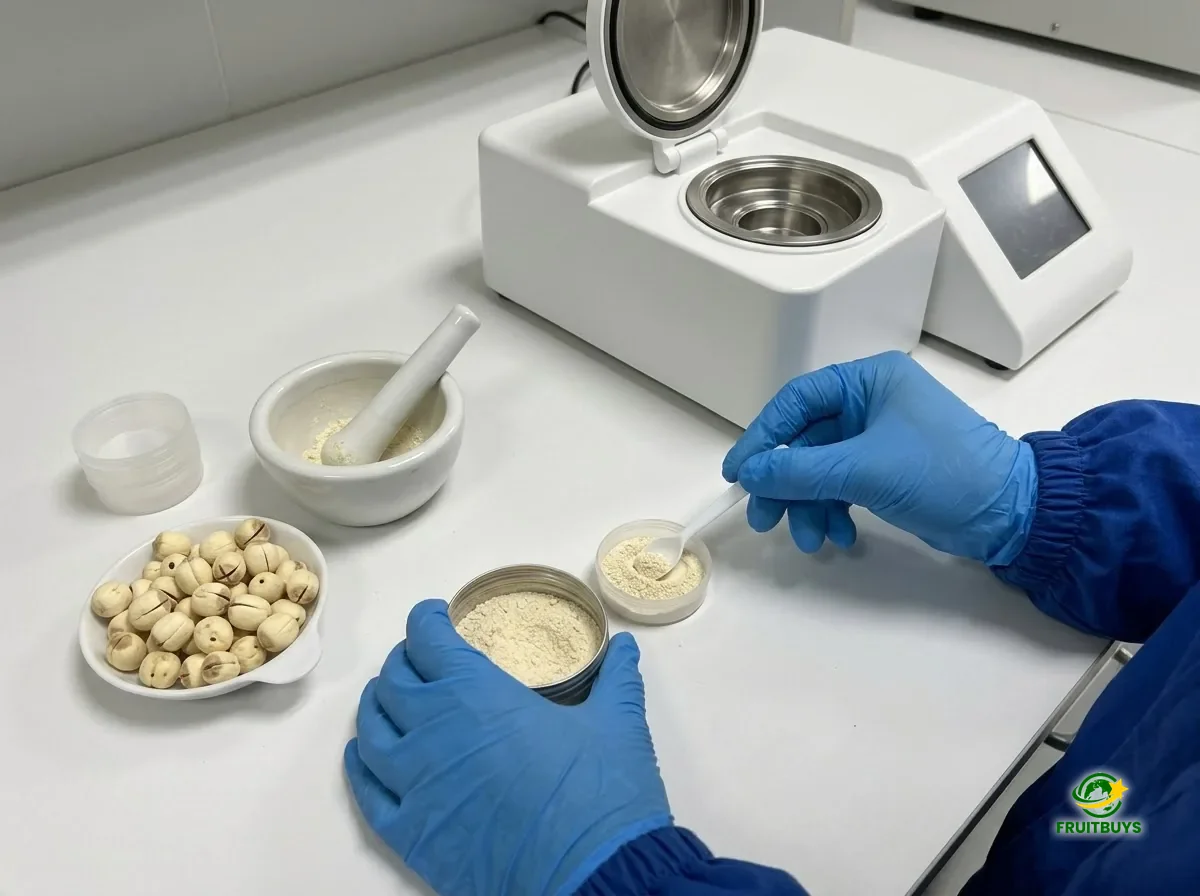
- Every lot: COA from an independent ISO/IEC 17025 accredited laboratory for moisture, water activity, total plate count, yeasts & moulds, E. coli and Salmonella.
- Heavy metals, aflatoxin and residues: the standard lot COA covers release indicators: moisture ≤5%, Aw ≤0.30 and microbiology. Lotus seeds take up minerals from pond soil, so control starts at source in Dong Thap growing areas. For FCL orders or project requirements, FruitBuys arranges heavy-metal (Pb, Cd, As, Hg), aflatoxin and pesticide-residue testing before stuffing at an independent ISO/IEC 17025 accredited laboratory.
- On request: sulfite result below 10 mg/kg, Listeria and Enterobacteriaceae for ready-to-eat use, gluten, and a nutrition panel for label artwork.
- Inclusion grade: a tighter microbiology limit (e.g. TPC <1,000 CFU/g) for chocolate, dairy, ice cream and bar lines, confirmed on each lot COA.
- Trial orders: ship with a free release QC log (moisture, water activity, sensory); third-party testing on trial lots is arranged on request.
- Retained sample: kept from every container lot for its full shelf life, up to 24 months.
- Facility control: one qualified processing facility is locked per contract. Any change needs prior written notice and re-approval of the pre-shipment sample. You have audit access.
- Facility compliance & certifications: HACCP, ISO 22000, US FDA Facility Registration and BRC (qualified processing facility). Halal certification available on request.
- Shipment documents: commercial invoice, packing list, bill of lading, COA, Certificate of Origin Form EUR.1 for the EU and UK or Form CEPA for the UAE, and a phytosanitary certificate with every shipment as part of FruitBuys’ standard export dossier.
What each line of the COA should prove, and the limits to write into your contract, are in what a freeze-dried lotus seed COA should show.
Import and labeling
Plain freeze-dried lotus seeds are exported under 1212.99 (EU CN 1212 99 95), the code on the Vietnam export declaration. The invoice, spec and COA all describe the goods the same way, “lotus seeds, steam-blanched and freeze-dried, unseasoned”, so your broker files the national line at entry without queries. In the US Harmonized Tariff Schedule, line 1212.99.92 carries a free general rate of duty; the final rate follows the line declared at entry. Seasoned, roasted or coated kernels are prepared foods and move to 2008.19, which carries its own duty, so cost an ODM snack line on that code from the start.
For the EU and UK, a Form EUR.1 under the Vietnam trade agreements travels with the shipment and claims preferential treatment; your broker can check the current rate for the declared CN line on the EU Access2Markets tariff and rules-of-origin tool. For the UAE, a Form CEPA goes with every shipment. Lotus seeds are not on the EU list of foods under increased border checks, so an EU-bound container goes through routine official controls. Every container carries the same dossier: commercial invoice, packing list, bill of lading, COA, certificate of origin and phytosanitary certificate.
The pack label is short: one ingredient, “lotus seeds”. Use the species Nelumbo nucifera in your spec and never “makhana” or “fox nut”, which name a different plant. Duty by market, the residue and metal panels and the processing factor for comparing results with fresh-seed limits are in what HS code freeze-dried lotus seeds ship under.
Verify the sample in five steps
- Count the cores. Split 100 kernels. At most one should show the green plumule.
- Sort the broken. Set aside halves and pieces; in whole-kernel grade they stay within 3%. Fine split lines on a whole kernel are not breakage.
- Check the colour. Natural ivory to light cream, even across the bag. Chalk-white kernels are the ones to question.
- Read the water activity within a minute. Seal kernels in the meter chamber within 60 seconds of opening the bag; at or below 0.30 the lot was dried and sealed right. Keep the second sealed pouch for your own lab.
- Rehydrate for 15 minutes. Warm water, then bite and cook the kernels the way your product will. They should soften evenly with no hard centre. Approve the pre-shipment sample in writing; it becomes the reference for your container.
How to sample a container lot and keep bulk matching the approved sample is in the buyer’s guide to freeze-dried lotus seeds. Where the seeds grow and when they are harvested is in where Vietnam’s lotus seeds come from.
FAQ
Is lotus seed the same as makhana?
No. Lotus seeds come from Nelumbo nucifera; makhana, or fox nut, comes from Euryale ferox, a different water plant, and is sold popped. The comparison is in lotus seeds vs makhana.
Do freeze-dried lotus seeds need soaking?
No. They are crisp and ready to eat from the bag, and rehydrate in 10–15 minutes in warm water for cooking. Heat-dried lotus seeds need a 4–8-hour or overnight soak.
Are they fried or puffed?
Neither. The kernels are steam-blanched, frozen and dried under vacuum, with no oil. The crunch comes from the porous structure left by freeze-drying.
How long do they last?
12 months at ≤25 °C, RH ≤60%, or 18–24 months in cool storage at ≤18 °C, RH ≤50%, in the unopened foil bag with desiccant.
Is lotus seed the same as lotus root?
No. The seeds grow in the pod above water; the root grows in the pond mud below. Both come from Dong Thap, and the root is on the freeze-dried lotus root page.
Do you supply seasoned or coated kernels?
Yes, as ODM from 500 kg per SKU: sea salt, chilli-lime, honey or chocolate coatings to your recipe. They ship under HS 2008.19.
Why are the kernels ivory, not white?
Ivory to light cream is the natural colour of a blanched, freeze-dried lotus seed. Bright white usually comes from bleaching or sulphur. A sulfite result below 10 mg/kg is available if your QA team wants it on file.
What is the minimum order for private label?
500 kg per SKU for OEM, ODM and private-label packing.
Request a sample and quote
Send these 12 details and we return a specification, sample and terms in one reply:
- Destination country and port
- Application: snack, mooncake or paste, dessert or congee, cereal inclusion, tea blend or beverage
- Format: whole kernels, halves, pieces or powder
- Grade: kernel size (12–16 mm or a precision size), whole-kernel broken limit, and inclusion-grade microbiology if needed
- Moisture / Aw target, if tighter than standard
- First-order volume: trial, LCL, 20ft or 40ft HC
- Annual volume and call-off rhythm, including any Mid-Autumn deadline
- Packaging: bulk bag size or retail pouch size
- Private label or ODM seasoning: artwork status and labelling market
- Extra tests required by your market or customer
- Preferred Incoterm and payment term
- Target delivery date