
Freeze-Dried Strawberry COA and Laboratory Testing Requirements
A freeze-dried strawberry sample can pass visual review and still leave the buyer without enough evidence to release the bulk lot. Color, crispness and aroma do not identify the production lot, prove moisture or Aw, establish microbiological status, resolve pesticide-residue questions or confirm that the laboratory method fits the buyer’s market route.
Procurement may see a product sample, while QA needs a specification and test file, regulatory teams may need another layer of evidence before the same product can move into a destination market. The real question is not whether a COA exists, but whether the COA proves the exact freeze-dried strawberry lot the buyer is being asked to approve. FruitBuys treats COA review as part of controlled product release, tied to Quality Control, Documentation, packaging and shipment identity.
A COA Is a Lot-Release Signal, Not a Universal Certificate
A useful COA identifies the exact product and lot, then reports results against the agreed specification.
It does not automatically prove future lots, every market requirement, laboratory accreditation scope or every food-safety condition.
The buyer should be able to trace each important result back to the product being packed and shipped.
Start with the freeze-dried strawberry supplier guide before reviewing individual test values. A COA is strongest when it sits inside a complete approval system rather than functioning as an isolated attachment.
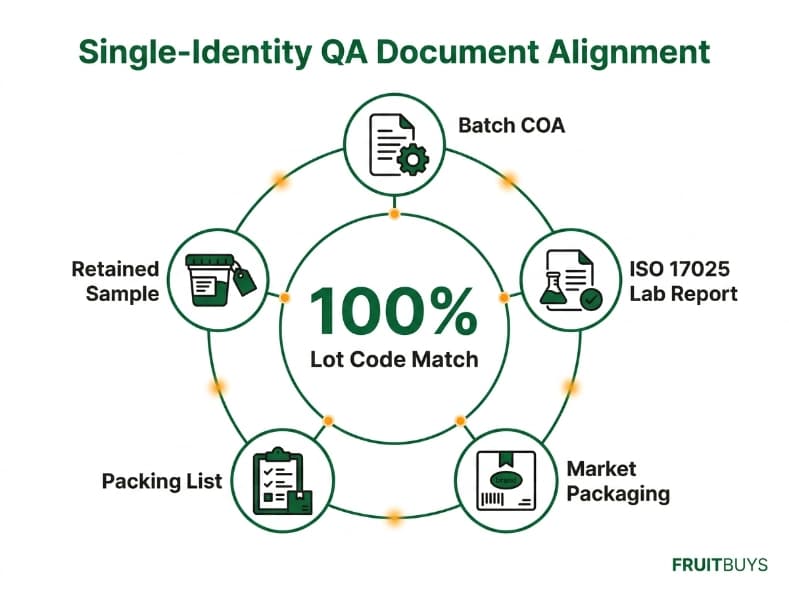
At minimum, the buyer should be able to connect:
| Release Element | What the Buyer Should Verify |
|---|---|
| Product identity | Freeze-dried strawberry, exact format/formula |
| Lot code | Same code across COA, pack and shipment file |
| Specification | Agreed release criteria |
| Sample date | Relevant to the released lot |
| Test method | Identified or traceable |
| Actual result | Reported against the applicable criterion |
| Laboratory/QA source | Clear origin of the result |
| Retained sample | Physical reference linked to the lot |
| Packaging identity | Same released product and pack route |
| Packing list | Same product description and lot identity |
This gives procurement, QA and regulatory reviewers observable evidence rather than requiring them to accept a broad statement such as “tested product.”
A COA should also be distinguished from an underlying laboratory report. The supplier may issue a COA using internal and/or external test results; the laboratory report provides deeper method, sample and analytical information where required. One does not automatically substitute for the other.
Lot Identity Comes Before the Numbers
A technically impressive result has little value if the buyer cannot establish which product it represents.
A disciplined review begins with:
Approved specification
        ↓
Product/format
        ↓
Lot code
        ↓
Sample identity
        ↓
Laboratory result
        ↓
COA
        ↓
Retained sample
        ↓
Packing list/packed goods
This matters particularly when FruitBuys supplies different formats. Whole strawberries, slices, bites, granules and powder can have different physical acceptance rules and, in some cases, different testing considerations.

The buyer should therefore avoid using:
- an old COA to release a new production lot;
- a slice COA to release powder without an approved sampling basis;
- a development-sample report as proof of recurring production;
- a generic specification as evidence that the current lot actually met it.
The freeze-dried strawberry process provides the process context behind the finished lot. The COA then becomes one release checkpoint within that process rather than a standalone trust symbol.
Moisture and Aw Need Separate Results
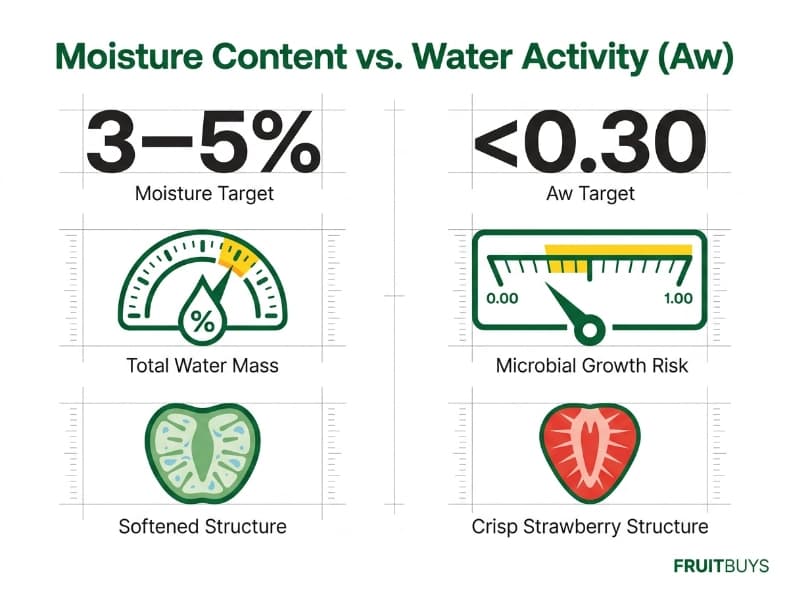
FruitBuys uses the following working release targets for this product program:
Moisture: 3–5%
Aw: <0.30
These are two different measurements. The FDA water activity guidance defines water activity through the relationship between the vapor pressure of water in the food and that of pure water under the same conditions; it is therefore not simply another name for total moisture content. (U.S. Food and Drug Administration)
For a buyer, the observable proof should be straightforward:
| Parameter | What to Request |
|---|---|
| Moisture | Lot result + agreed method/reference |
| Aw | Lot result + agreed method/reference |
| Lot code | Same lot as packed product |
| Format | Exact released format |
| Specification | Agreed target or acceptance range |
| Retained sample | Stored under the agreed condition |
Use moisture and water activity specification for the technical relationship between these two controls. A crisp piece is sensory evidence. It is not a moisture or Aw test.
Low Aw Does Not Make Microbiology Disappear
Aw control can restrict microbial growth, but it does not demonstrate that contamination never occurred or that pathogens are absent.
Low-moisture food safety therefore depends on sanitation, preventive controls, sampling logic and appropriate verification—not product testing alone.
The microbiology panel and acceptance criteria should be agreed for the buyer’s product, application and market route.
FDA continues to list its January 2025 draft guidance for sanitation programs in low-moisture ready-to-eat foods as draft guidance in its current 2026 FSMA guidance materials. The guidance addresses sanitation, pathogen-contamination events and corrective actions for low-moisture RTE processing. (U.S. Food and Drug Administration)
For this FruitBuys product program, a working buyer-defined microbiology route may consider:
- APC/total aerobic count
- Yeast and mold
- Enterobacteriaceae where relevant
- E. coli
- Salmonella
- Staphylococcus aureus where risk assessment justifies it
The final panel, sampling plan, method and acceptance limits must be locked before release. Numeric microbiological limits should not be copied from another freeze-dried fruit, another buyer or another destination market without confirming applicability.
The strongest signal is not a long list of organism names. It is a coherent system:
Risk assessment
+
agreed panel
+
defined method
+
identified lot
+
actual result
+
release decision
Pesticide Residue Testing Needs Special Attention for Dried Product
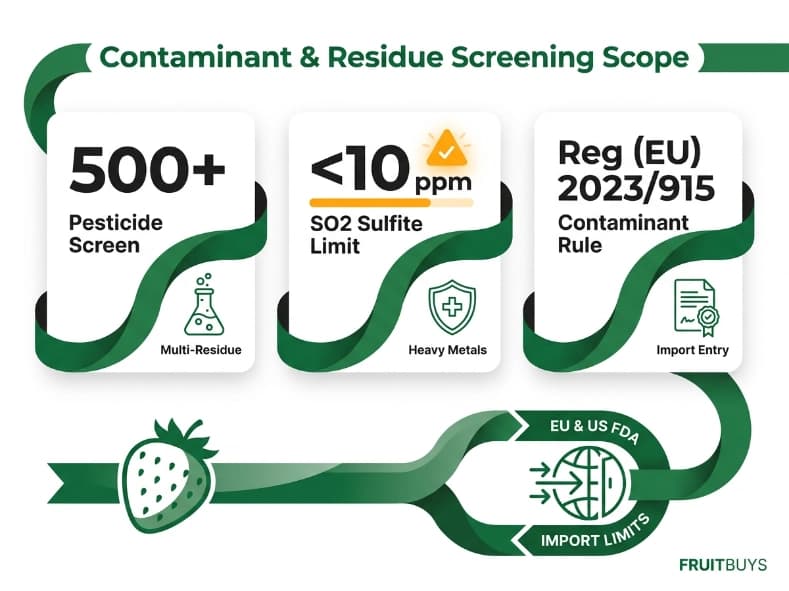
Pesticide-residue review is especially important for freeze-dried fruit because drying is a processing operation and residue concentrations in a processed product may differ from those in the corresponding raw agricultural commodity.
The current consolidated EU pesticide MRL framework under Regulation (EC) No 396/2005 governs maximum residue levels for pesticides in or on food and feed of plant and animal origin. (EUR-Lex)
More importantly for freeze-dried strawberry, the European Commission’s March 2025 information note on Article 20 and processing factors explains that where specific MRLs are not established for a processed product, changes in residue level caused by processing may need to be taken into account. It defines a processing factor as the ratio between residue concentration in the processed product and the relevant unprocessed product. (Food Safety)
This creates an important buyer-control point:
Do not automatically compare every freeze-dried strawberry residue result with a fresh-strawberry number without reviewing the applicable processed-food approach.
For EU-bound programs, the RFQ should therefore define:
- The destination market
- Pesticide multi-residue scope
- Raw vs processed sample basis
- Laboratory reporting limits
- Active substances relevant to the buyer’s program
- Processing-factor documentation where applicable
- Importer or regulatory-review expectations
FruitBuys handles this under Raw Material Sourcing Governance, Quality Control and Documentation rather than presenting one generic residue panel as universally sufficient.
Contaminant Testing Should Be Risk- and Market-Specific
A common sourcing mistake is to copy the same “heavy metals panel” into every RFQ regardless of commodity, market and regulatory applicability. The European Commission confirms that maximum levels for certain contaminants in food are set under Commission Regulation (EU) 2023/915.
The regulation has been amended over time, so the buyer should review the current applicable version and commodity scope rather than rely on a historical spreadsheet (EUR-Lex). For freeze-dried strawberry, FruitBuys should therefore not publish a universal contaminant limit without product- and market-specific support.
A stronger buyer instruction is:
Destination market
        ↓
Applicable food category
        ↓
Relevant contaminant requirement
        ↓
Required analytical method
        ↓
Lab capability
        ↓
Lot result
This avoids two errors at once: testing parameters that are irrelevant while failing to test the parameters that actually matter.
Powder Requires Its Own Proof Layer
Freeze-dried strawberry powder should not inherit the complete release file from whole fruit or slices.
Powder development may add controls for:
- Mesh/particle distribution
- Carrier status
- Ingredient statement
- Moisture
- Aw
- Bulk density where required by the application
- Flow or caking behavior
- Microbiology after milling
- Packaging barrier
- Nutrition basis for retail/private-label programs
Carrier status is particularly important. A 100% strawberry powder and a powder formulated with another ingredient are not the same product definition. If a buyer is evaluating powder, the COA should be read together with the product specification rather than expected to contain every application characteristic.
Laboratory Accreditation Is Not the Same as Method Applicability
A laboratory logo or accreditation statement should not end the buyer’s review. ISO states that ISO/IEC 17025:2017 establishes requirements for laboratory competence, impartiality and consistent operation. ISO also explains that the standard enables laboratories to demonstrate competence and generate valid results. (ISO)
For B2B approval, ask the next question:
Does the relevant laboratory scope cover the method needed for this test?
The buyer may need to verify:
| Laboratory Question | Decision Value |
|---|---|
| Is the laboratory accredited? | Establishes competence framework |
| What is the accredited scope? | Shows which tests/methods are covered |
| What method was used? | Determines analytical relevance |
| What is the reporting limit? | Determines whether buyer criteria can be assessed |
| What matrix/sample was tested? | Connects result to product |
| What lot was sampled? | Connects report to shipment |
| When was it tested? | Establishes release relevance |
ISO/IEC 17025 should therefore be treated as a strong laboratory-competence signal, not as automatic proof that every test on every report fits the buyer’s requirement.
COA Scope Must Follow the Destination Market
A lot COA and a market-access file solve different problems.
For U.S. imports, the current FDA FSVP rule requires applicable importers to maintain a foreign supplier verification program and perform risk-based activities to verify that imported food meets applicable U.S. food-safety requirements. FDA’s FSVP materials were updated again in 2026. (U.S. Food and Drug Administration)
For EU programs, pesticide residue assessment, processing-factor treatment and contaminant review can change the testing file needed for the product. (Food Safety)
For Dubai-market routes, Dubai Municipality currently lists services to register and assess a food item and to release imported food consignments for sale in the local market. (Dubai Municipality)
Use freeze-dried strawberry market readiness for USA, EU and UAE before locking the test matrix. The decision rule is simple: test scope should follow the actual destination and application, not a universal “export COA” template.
Nutrition Data Is a Different Proof Question
Nutrition analysis may be needed for private-label or retail programs, but Nutrition Facts should not be treated as a substitute for lot-release testing. Use freeze-dried strawberry nutrition facts and label basis when the buyer needs to move from ingredient qualification to label development.
The nutrition file should answer:
- Exact formula
- Final product format
- Carrier status
- Serving basis
- Analytical or calculation basis
- Destination-market label route
The COA answers a different question: whether the released lot meets its agreed specification. Keeping these two evidence streams separate prevents a polished nutrition panel from being mistaken for QA release proof.
Packaging Must Protect What the COA Released
Laboratory testing occurs at a point in time. Packaging determines whether the released product condition can be protected afterward.
The buyer should therefore connect COA review with:
Moisture / Aw release
+
approved inner pack
+
seal condition
+
storage instruction
+
retained sample
+
lot coding
A lot that passes Aw at release can still create a buyer-side problem if packaging integrity or open-pack handling is poor. This is why FruitBuys connects Quality Control with Documentation and Export Logistics Coordination instead of treating testing as the final step.
The Highest Risk: A Generic COA Attached to a Specific Shipment
A generic COA can create the appearance of control without proving the lot being shipped.
The document should identify the exact product, format, lot and relevant test basis, and it should connect to the retained sample and packing file.
When those links are missing, the buyer should treat the evidence as incomplete rather than infer compliance.
Consider the difference:
Weak signal
COA available.Verifiable release signal
Product: Freeze-Dried Strawberry
Format: approved format
Lot: matching shipment lot
Moisture: lot result
Aw: lot result
Microbiology: agreed panel
Residue/contaminant scope: destination-aligned where required
Test method/lab: identifiable
Retained sample: linked
Packing list: matching lot
Release status: documented
This is the shift from marketing assurance to buyer-verifiable evidence. Use the freeze-dried strawberry RFQ and supplier approval checklist before final supplier approval so the required proof is requested before the lot is produced and packed.
Application Mapping
| Buyer Type | Application | Required Format | Proof Needed | FruitBuys Delivery |
|---|---|---|---|---|
| Importer | Bulk ingredient | Whole, slices, chunks, powder | Lot COA, lab reports, market-specific test review, packing-list match | Documentation + Export Logistics Coordination |
| QA/QC Manager | Lot release | Any approved format | Specification, moisture, Aw, microbiology, retained sample | Quality Control + Documentation |
| R&D Developer | Inclusion/topping/beverage | Application-specific | Format data, physical criteria, moisture/Aw, microbiology where relevant | Market Trial Support + Quality Control |
| Private-Label Brand | Retail pouch or powder SKU | Pieces or powder | COA, nutrition basis, ingredient status, packaging file | OEM/Private Label Delivery |
| Regulatory Reviewer | USA/EU/UAE | Final approved format | Destination-specific residue, contaminant and document review | Documentation |
| Procurement Manager | Supplier approval | Buyer-selected format | Same test basis across sample and bulk, lot-specific proof | Single-point commercial accountability |
Explore Additional FruitBuys Product Routes
Once the strawberry test matrix is locked, buyers developing a broader assortment can apply the same lot-based evidence logic to adjacent FruitBuys categories.
| Product Route | Buyer Use |
|---|---|
| freeze-dried fruit range | Additional crisp fruit inclusions, snacks, toppings and private-label SKUs |
| dried fruit formats | Chewier fruit formats with different moisture and texture requirements |
| fruit powder applications | Beverage, bakery, dairy, dry-mix and formulation programs |
| veggie chips | Savory crispy-snack and assortment development |
These are product-navigation routes, not evidence of specification or compliance. Each product still requires its own specification, lot identity, COA, testing scope and market review.
Why FruitBuys Delivers This
FruitBuys supplies freeze-dried strawberry through one Integrated Product Supply Model rather than presenting QA documents as disconnected paperwork. Under Quality Control, FruitBuys aligns the approved product specification with moisture, Aw, physical criteria, agreed microbiology and other release requirements.
Under Documentation, FruitBuys connects lot code, COA, laboratory evidence, retained sample, packing list and shipment identity. Under Raw Material Sourcing Governance, residue and raw-material suitability questions are addressed upstream of finished-product release.
Under OEM/Private Label Delivery, the product and test file are connected to ingredient, nutrition and packaging decisions. Under Export Logistics Coordination, the released lot and its documentation remain aligned through packing and handover. The buyer receives one documented product release path under one accountable supplier relationship.
Buyer Checklist
Before approving freeze-dried strawberry COA and laboratory testing, verify:
- Exact product name
- Exact product format
- Formula/carrier status where relevant
- Lot code
- Production or packing date
- Sample identity
- Sample date
- Specification version
- Moisture result and method
- Aw result and method
- Agreed microbiology scope
- Microbiology methods
- Pesticide-residue scope where required
- Processed-product/processing-factor review where relevant
- Contaminant scope where required
- Nutrition test basis where relevant
- External laboratory name
- Laboratory accreditation status where required
- Relevant accreditation scope
- Analytical reporting limits
- Retained sample identity
- Packaging identity
- Packing-list match
- Destination-market requirement
- QA release status
- Change-control trigger
The objective is not to collect more PDFs. It is to make the release decision easier to verify.
Sumary
Freeze-dried strawberry COA review should connect the exact product, format, lot code, moisture, Aw, microbiology scope, laboratory method, retained sample and shipment identity. FruitBuys uses 3–5% moisture and Aw <0.30 as working release targets, subject to lot verification.
Pesticide and contaminant testing should follow the buyer’s destination market and product route; EU processed-food residue assessment may also require consideration of processing factors. FruitBuys manages COA and laboratory evidence through Quality Control, Documentation, raw-material governance and export logistics coordination.
FAQ
What should a freeze-dried strawberry COA show?
It should identify the product, format and lot and report the agreed release parameters, methods or laboratory references, results, specification limits and release status.
Is Aw <0.30 enough to prove microbiological safety?
No. Aw control does not prove absence of contamination. Microbiology, sanitation controls, sampling and the agreed food-safety program remain separate parts of the release decision.
Should pesticide results for freeze-dried strawberry be compared directly with fresh-fruit MRLs?
Not automatically. For EU programs, processed-product assessment may require consideration of changes caused by processing and applicable processing factors.
Does ISO/IEC 17025 mean every lab result is automatically acceptable?
No. It is a laboratory competence standard. Buyers should still verify the relevant accreditation scope, method, reporting limit, sample matrix and lot identity.
Should every freeze-dried strawberry lot use the same contaminant panel?
Not necessarily. The panel should follow the product risk, buyer specification, application and destination-market requirements.
Does the COA replace the laboratory report?
Not always. A COA can summarize release results, while the underlying laboratory report may provide more detailed sample, method and analytical information.
What is the biggest COA approval mistake?
Accepting a generic or historical COA that does not match the exact lot, format, retained sample and packed goods being released.
Conclusion
Freeze-dried strawberry laboratory testing creates value only when the evidence can travel from the test result to the exact lot the buyer receives. Moisture, Aw, microbiology, residue review, contaminant scope and other parameters should be defined by specification and market need, then connected to lot identity, retained sample, packaging and shipment documentation. FruitBuys supplies that product through one controlled release path rather than asking the buyer to infer quality from a sample or certificate image.
Request the exact lot COA, underlying laboratory scope, test methods, retained sample and destination-market test matrix before approving freeze-dried strawberry bulk release.
References
- U.S. Food and Drug Administration. Water Activity (aw) in Foods. FDA Inspection Technical Guide. FDA water activity guidance. (U.S. Food and Drug Administration)
- U.S. Food and Drug Administration. Draft Guidance for Industry: Establishing Sanitation Programs for Low-Moisture Ready-to-Eat Human Foods and Taking Corrective Actions Following a Pathogen Contamination Event. January 2025. FDA low-moisture RTE draft guidance. (U.S. Food and Drug Administration)
- International Organization for Standardization. ISO/IEC 17025:2017 — General requirements for the competence of testing and calibration laboratories. ISO/IEC 17025. (ISO)
- U.S. Food and Drug Administration. Foreign Supplier Verification Programs for Importers of Food for Humans and Animals. Current FDA rule and guidance materials. FDA FSVP final rule. (U.S. Food and Drug Administration)
- European Parliament and Council. Regulation (EC) No 396/2005 on maximum residue levels of pesticides in or on food and feed. Current consolidated text dated 12 May 2026. EUR-Lex Regulation (EC) No 396/2005. (EUR-Lex)
- European Commission, DG SANTE. Information note on Article 20 of Regulation (EC) No 396/2005 as regards processing factors, processed and composite food and feed. Rev. 1, 19 March 2025. European Commission processing-factor guidance. (Food Safety)
- European Commission. Contaminants — Legislation. Current EU framework referencing Commission Regulation (EU) 2023/915. EU contaminants legislation. (Food Safety)
- Dubai Municipality. Food Safety Department — Services for Food Traders and Establishments. Dubai food item and imported-consignment services. (Dubai Municipality)