
Freeze-Dried Pineapple Nutrition Facts: How Buyers Verify Label Data
Freeze-dried pineapple Nutrition Facts can damage a buyer’s label approval when the data comes from a copied panel, rounded serving values or a database calculation without product-specific verification. Importers, QA managers, private label buyers and R&D teams should not treat nutrition data as a design task. It is a product-control task. The label must match the actual product format, ingredient statement, moisture condition, serving basis, market rules and laboratory report.
A beautiful retail pouch cannot repair a wrong Nutrition Facts panel. FruitBuys treats nutrition verification as part of Documentation, Quality Control and OEM / Private Label Delivery. If the buyer approves artwork before validating the nutrition file, the product can face label revision, delayed release, internal QA rejection or market-entry friction.
Why Nutrition Data Must Match the Exact Product
Freeze-dried pineapple nutrition data must match the actual product, format and ingredient statement.
Cubes, bites, slices and powder may require different review because moisture, particle size, carrier use and serving basis can change label values.
Buyers should request laboratory-backed nutrition data before approving retail label or private label artwork.
Nutrition data does not exist in a vacuum. It belongs to a specific product. Freeze-dried pineapple cubes, bites, slices and powder may share the same fruit identity, but they can differ in moisture, particle size, broken-piece fraction, carrier status and packaging basis.
This article sits under freeze-dried pineapple product qualification . A buyer cannot qualify a product by sample appearance alone. The buyer must connect product format, COA, laboratory data, packaging and label information into one approval file.
The FDA explains that the Nutrition Facts label gives nutrient information based on a serving of food and uses % Daily Value to show how much a nutrient in that serving contributes to a total daily diet. (U.S. Food and Drug Administration)
That means the serving basis matters. A per-serving panel and a per-100-g technical value are not the same output. FruitBuys should verify nutrition data through the same product route used for bulk release. The label should not trail behind the product like a hurried suitcase.
Audit of the Uploaded Nutrition Facts Panel
The uploaded label shows a serving size of 28.35 g and two servings per container. The panel lists 110 kcal, 25 g total carbohydrate, 2 g dietary fiber, 20 g total sugars, 0 g added sugars, 1 g protein, 30 mg calcium, 320 mg potassium and 433.8 mg iron per serving.
The iron value blocks publication. FDA lists iron Daily Value at 18 mg for adults and children 4 years and older. (U.S. Food and Drug Administration) The label’s 433.8 mg iron value corresponds mathematically to about 2410% Daily Value. The percentage calculation fits the number entered. The problem is the number itself.
A nutrition approval file should treat the uploaded panel as a warning signal, not as usable artwork input.
| Label Item | Observed Issue | Buyer Decision |
|---|---|---|
| Serving size | 28.35 g | Needs category and package review |
| Calories | 110 kcal | Requires source basis |
| Total sugars | 20 g | Requires product-specific validation |
| Added sugars | 0 g | Requires ingredient and process confirmation |
| Iron | 433.8 mg / 2410% DV | Do not publish without laboratory confirmation |
| Potassium | 320 mg | Requires source basis |
| Per-100-g conversion | Mathematical only | Internal review, not final label proof |
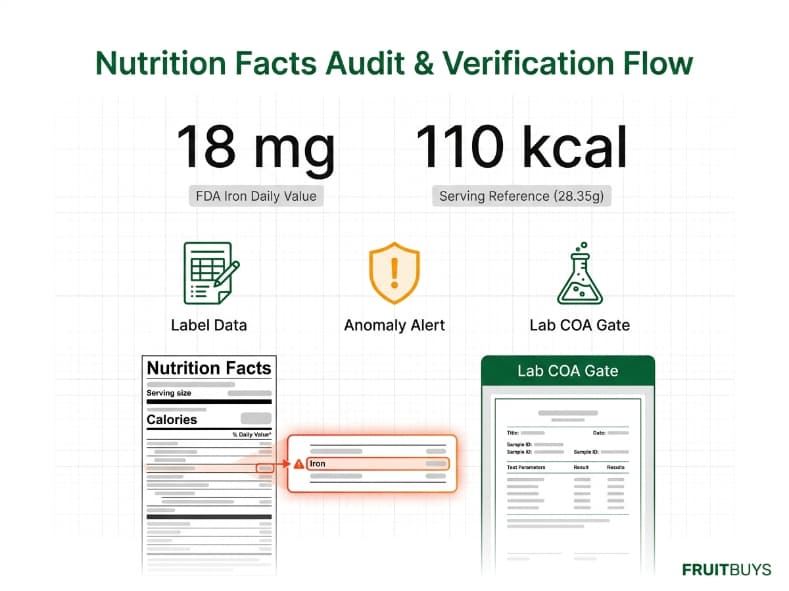
Do not “fix” the iron value by guessing a decimal point. Do not rewrite 433.8 mg as 43.38 mg, 4.338 mg or 0.4338 mg. Only a valid laboratory report or verified source file can correct the value.
Why Mathematical Conversion Does Not Create Laboratory Data
A per-serving label can be converted into a per-100-g table with arithmetic. That conversion may help internal review, but it does not create laboratory data. It multiplies values that may already be rounded, estimated or entered incorrectly.
Using the uploaded 28.35 g serving, the conversion factor is about 3.527. That turns 110 kcal into about 388 kcal per 100 g and 25 g carbohydrate into about 88 g per 100 g. Those derived values may look useful, but they carry the defects of the original panel.
FDA’s nutrition labeling database guidance recognizes the use of databases in label development, but it frames them as tools for preparing nutrient information that must meet labeling requirements, not as a license to copy unsupported values across products. (U.S. Food and Drug Administration)
The buyer should separate three data types:
| Data Type | Use | Limit |
|---|---|---|
| Laboratory nutrition report | Strongest basis for product label | Must match sample and product |
| Database calculation | Development support | Must be validated for product fit |
| Mathematical conversion | Internal review | Cannot correct bad input data |
| Supplier brochure value | Early screening | Not enough for label approval |
| Old label panel | Historical reference | Cannot release new artwork by itself |
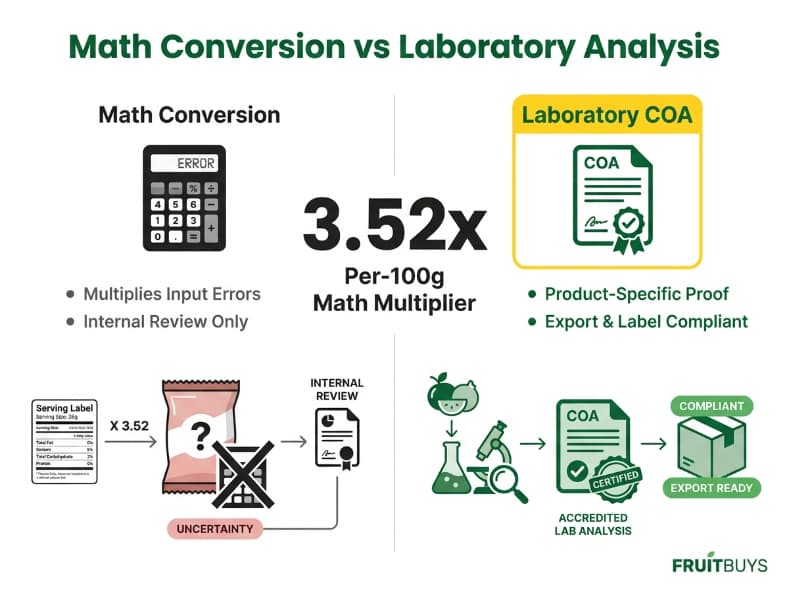
Nutrition data needs sample identity. A report should name product, format, lot or sample code, date, method or laboratory basis, reporting units and reviewer. If the document cannot identify what was tested, it cannot control a buyer’s label.
Laboratory Nutrition Panel Requirements
A laboratory nutrition report should support the exact product the buyer plans to sell or use. A powder with carrier, a snack bite, a slice and a bulk ingredient may need separate review. This section links to laboratory testing and report verification. Nutrition testing belongs inside the QA file, not in a designer’s layout folder.
A practical laboratory nutrition panel should include:
| Nutrient Area | Buyer Review Point |
|---|---|
| Energy | Calculation basis and unit |
| Total fat | Reported value and rounding |
| Saturated fat | Required label line where applicable |
| Trans fat | Required label line where applicable |
| Cholesterol | Required label line where applicable |
| Sodium | Required line for U.S. label |
| Total carbohydrate | Key dried fruit value |
| Dietary fiber | Method and basis |
| Total sugars | Product-specific validation |
| Added sugars | Ingredient and process review |
| Protein | Reported value and label treatment |
| Vitamin D | Required U.S. label line |
| Calcium | Required U.S. label line |
| Iron | Must be corrected by valid report |
| Potassium | Required U.S. label line |

FDA’s current Nutrition Facts format includes vitamin D and potassium along with calcium and iron as listed nutrients. (U.S. Food and Drug Administration) This matters because older panels, foreign layouts or copied templates may miss required elements or carry values in the wrong format. FruitBuys should request a nutrition file that supports the intended destination label. The buyer should reject any panel that cannot trace back to product-specific evidence.
US and EU Label Architecture
U.S. and EU nutrition labels use different presentation logic.
U.S. labels use serving-based Nutrition Facts with % Daily Value, while EU prepacked foods generally use a nutrition declaration built around energy and nutrients per 100 g or 100 ml.
Buyers should confirm the destination label format before approving artwork.
The U.S. Nutrition Facts panel works around serving size, nutrient declarations and % Daily Value. FDA guidance also includes rounding rules that affect how values appear on the label. (U.S. Food and Drug Administration) A technically correct unrounded laboratory value can still appear differently after label rounding.
EU food information rules require nutrition information for prepacked foods under the Food Information to Consumers framework. The European Commission states that the mandatory nutrition declaration provides energy value and amounts of fat, saturates, carbohydrate, sugars, protein and salt. (Food Safety)
A buyer should not use one label architecture for every market.
| Label Area | U.S. Direction | EU Direction |
|---|---|---|
| Basis | Serving size and %DV | Usually per 100 g or 100 ml |
| Calories / energy | Calories | kJ and kcal |
| Sodium / salt | Sodium | Salt |
| Added sugars | Required line where applicable | Not same structure as U.S. panel |
| Vitamins / minerals | Specific required label lines | Declared under EU rules when applicable |
| Rounding | FDA rounding rules | EU tolerance and format review |
| Language | English for U.S. retail | Destination language requirements |
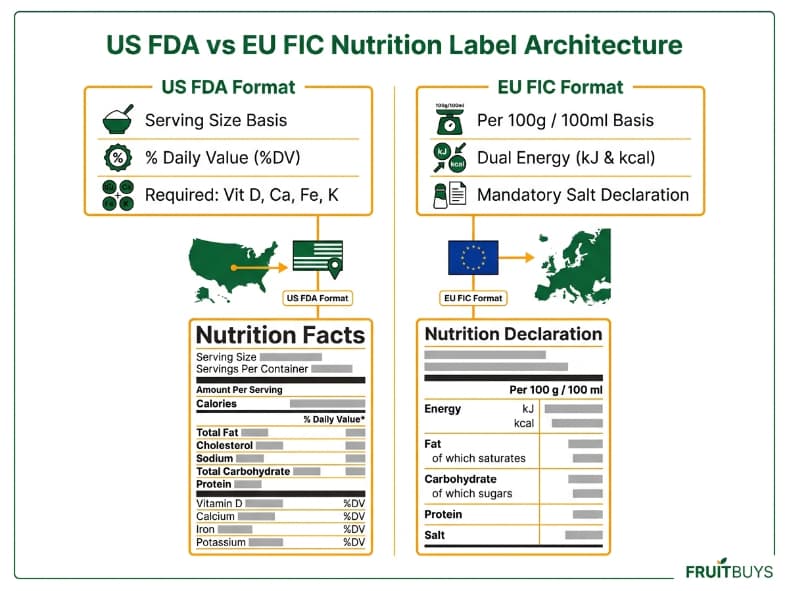
Do not let a U.S. Nutrition Facts panel become the EU nutrition declaration by translation alone. The data basis and presentation requirements differ.
Added Sugars, Ingredient Statement and Fruit Powder
The uploaded label lists 0 g added sugars. That claim can be correct only if the ingredient and process support it. It cannot come from assumption. FDA explains that added sugars include sugars added during processing, sugars packaged as sweeteners and sugars from syrups, honey or certain concentrated fruit or vegetable juices (U.S. Food and Drug Administration).
A freeze-dried pineapple product made only from pineapple may support a no-added-sugar position, but the buyer must confirm ingredient statement, formulation and processing route. Powder creates another gate. Pineapple powder may be 100% ground freeze-dried pineapple, or it may include a carrier or anticaking ingredient.
If a carrier exists, the ingredient statement, nutrition data, allergen review, label wording and application performance can all change. This point links to pineapple format and ingredient specification. FruitBuys should never let “powder” travel without carrier status and mesh definition.
Private label buyers should verify:
- 100% pineapple or formulated product
- Carrier status
- Added sugar status
- Anticaking agent status
- Allergen statement
- Ingredient declaration order
- Nutrition basis
- Market-specific label wording
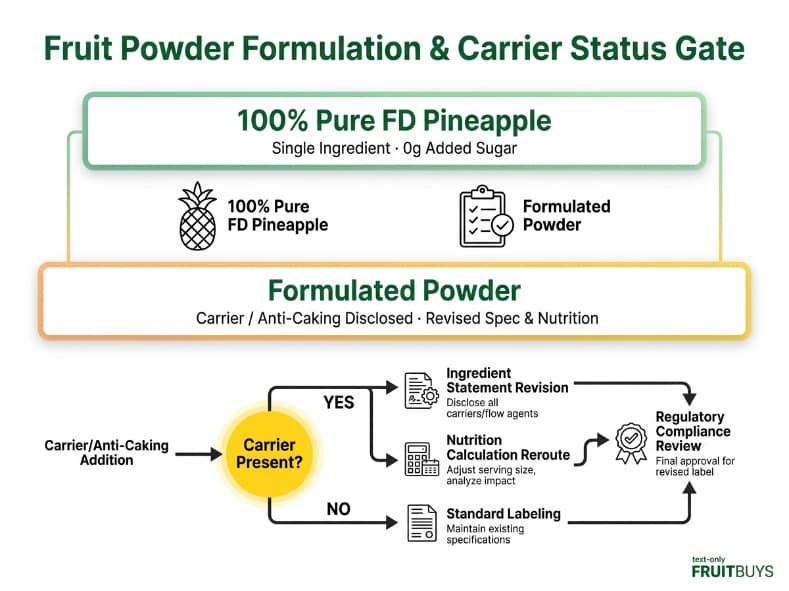
A clean label file starts with the product formula. Artwork comes later.
Moisture Basis and Nutrition Concentration
Freeze-dried pineapple concentrates solids because water is removed. That does not mean every nutrient value can be guessed by multiplying fresh pineapple data. Moisture level changes final concentration, and product-specific processing can affect measured values.
This section connects to moisture and Aw release criteria. Moisture affects weight basis and nutrient concentration. Aw affects stability review. They serve different decisions, and neither one replaces nutrition testing.
A nutrition report should identify the product condition at the time of testing. If one lot tests at a different moisture level than another lot, per-100-g nutrient concentration can shift. The buyer should not build label data from a moisture value that does not match the approved product.
For freeze-dried pineapple, nutrition review should follow this path:
Product format
→ ingredient statement
→ moisture condition
→ laboratory report
→ serving basis
→ market label rules
→ artwork approval
Skipping the moisture condition invites invisible error. A dry product is not a fixed mathematical object. It still needs tested data.
Packaging, Serving Size and Retail Label Approval
Retail packaging affects serving basis, label panel space, pouch size, net quantity and consumer-facing claims. A 28.35 g serving on the uploaded label may be reasonable for some snack formats, but it still needs category, package and regulatory review before use.
This section connects to retail pouch and packaging review. A label cannot be approved independently from the pack. The same product in a bulk bag, a small snack pouch and a blended private label pouch may require different label review.
FDA serving-size guidance addresses reference amounts customarily consumed and serving size-related issues under the Nutrition Facts framework. (U.S. Food and Drug Administration) Buyers should confirm the applicable product category and package format before locking serving size.
A retail label approval file should include:
| Label Input | Required Source |
|---|---|
| Product name | Approved specification |
| Net weight | Packaging brief |
| Serving size | Regulatory label review |
| Servings per container | Pack size calculation |
| Nutrition Facts | Lab or validated data source |
| Ingredient statement | Formula file |
| Allergen statement | Facility and ingredient review |
| Storage instruction | Packaging and stability file |
| Country or origin statement | Documentation review |
| Lot and date coding | Packaging and traceability file |
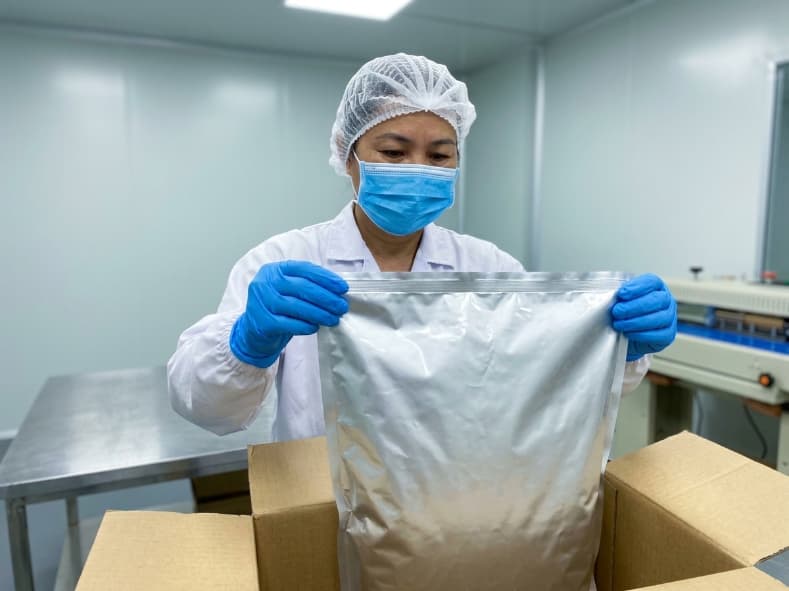
Artwork should not move ahead of these inputs. If it does, the buyer builds the label on wet cement.
Nutrition Data in Private Label Delivery
Private label execution fails when product, nutrition and packaging move on separate tracks. The buyer may approve a pouch design while FruitBuys still needs final nutrition data, ingredient statement, packaging structure or shelf-life language.
This section connects to private label pineapple approval workflow. OEM/Private Label Delivery must align product format, nutrition report, pack size, pouch structure, label text and revision control.
Private label approval should lock:
- Product format
- Ingredient statement
- Carrier or additive status
- Nutrition source file
- Serving basis
- Pack size
- Storage statement
- Destination-market label format
- Artwork revision
- Final approval sign-off
One revision can trigger another. If powder includes a carrier, the ingredient statement changes. If the ingredient statement changes, added sugar or allergen review may change. If serving size changes, Nutrition Facts presentation changes. If packaging changes, storage language may change. FruitBuys should not treat private label artwork as graphic decoration. It is a controlled output of the product file.
Highest Risk: Publishing the Uploaded Iron Value
The uploaded iron value should not be published.
The percentage calculation aligns with FDA’s 18 mg Daily Value, but the declared amount itself requires laboratory confirmation.
Buyers should hold artwork approval until the nutrition report corrects or validates the iron line.
This is the hard stop in the current dataset. The uploaded label’s iron line is not a small formatting issue. It is a release-blocking data issue.
The label states iron at 433.8 mg and 2410% DV per 28.35 g serving. FDA’s Daily Value table identifies iron at 18 mg, so 433.8 mg divided by 18 mg produces 24.1, or 2410%. (U.S. Food and Drug Administration) The math confirms that the %DV likely followed the entered iron number. The buyer still needs to verify the entered iron number.
Possible causes include:
- Misplaced decimal point
- Unit error
- Copied value from another field
- Wrong sample
- Wrong nutrient line
- Software input mistake
- Data-entry error
- Unverified database mapping
Do not infer the correct value. Do not publish the panel. Do not send it to artwork as a “draft” without a visible hold. A draft label tends to become a live label when deadlines tighten. FruitBuys should request a corrected laboratory nutrition report and then update the label file through controlled revision.
Application Mapping
| Buyer Type | Application | Required Format | Proof Needed | FruitBuys Delivery |
|---|---|---|---|---|
| Private label buyer | Retail snack pouch | Bites or slices | Nutrition report, serving basis, ingredient statement | OEM/Private Label Delivery |
| Importer | Market entry review | Cubes, bites, slices or powder | Destination label format and nutrition file | Documentation |
| QA manager | Label approval | Any approved format | Lab report, source file, revision control | Quality Control |
| R&D developer | Dry-mix formulation | Powder | Mesh, carrier status, nutrition data | Product specification alignment |
| Distributor | Multi-channel SKU | Retail or bulk format | Pack-specific label and storage information | Documentation and packaging alignment |
| Procurement manager | Supplier approval | Approved format | Data source, COA link and sample identity | Single-point supplier accountability |
Why FruitBuys Controls Nutrition Data as Part of the Product File
FruitBuys supplies freeze-dried pineapple as one configured product. Nutrition data must follow that same route. It cannot sit outside the product specification as a loose table copied into artwork.
Documentation controls the source of nutrition values. Quality Control connects the values to the tested product. OEM/Private Label Delivery aligns nutrition data with pouch size, label panel, ingredient statement and revision approval.
This discipline protects the buyer’s release decision. The buyer should know which product was tested, which format was approved, which label basis applies and which artwork version carries the final data. Without that chain, the label becomes a small document with a large liability tail. FruitBuys should give buyers the file they can defend: specification, ingredient statement, nutrition report, serving calculation, destination label review and final approval record.
Buyer Checklist
Before approving freeze-dried pineapple Nutrition Facts, request:
- Product format: cubes, bites, slices or powder
- Ingredient statement
- Carrier or additive status
- Added sugar review
- Product sample identity
- Nutrition laboratory report
- Report date and basis
- Moisture condition at testing
- Serving size basis
- Per-100-g values where required
- U.S. Nutrition Facts review if applicable
- EU nutrition declaration review if applicable
- Rounding rule review
- Pack size and servings per container
- Storage statement
- Artwork revision number
- Final label approval sign-off
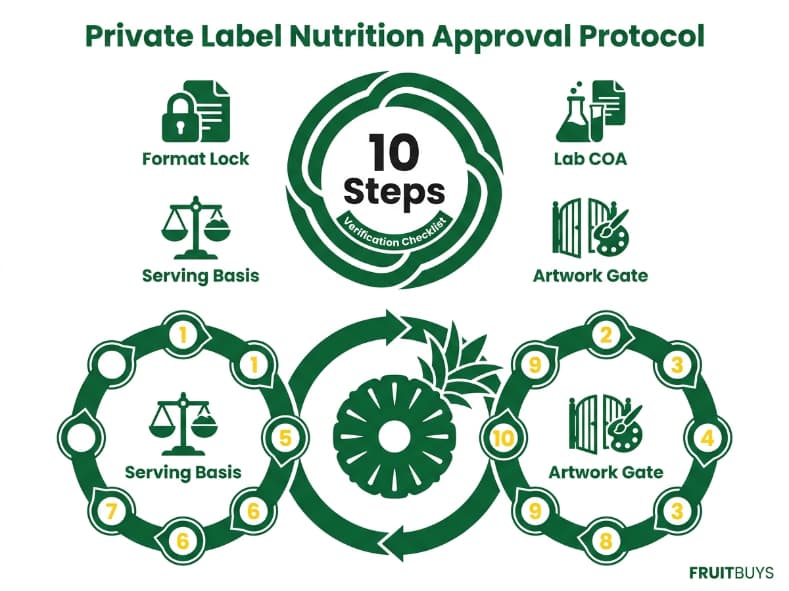
Reject any nutrition panel with an unresolved iron value. That error does not need debate. It needs correction.
Summary
Freeze-dried pineapple Nutrition Facts must match the exact product format, ingredient statement, moisture condition, serving basis and destination label rules. The uploaded label cannot support publication because the iron declaration is abnormal and requires laboratory verification.
FruitBuys aligns nutrition data through Documentation, Quality Control and OEM/private label approval so buyers can connect product specification, laboratory report, packaging and artwork before label release.
FAQ
Can the uploaded Nutrition Facts panel be published?
No. The iron value is abnormal and requires laboratory verification. The label should not move into artwork or publication until the nutrition source file is corrected.
Why is the iron line a hard stop?
The label states 433.8 mg iron and 2410% DV. The %DV math aligns with FDA’s 18 mg Daily Value, but the declared iron amount itself needs verified laboratory support.
Can I convert the 28.35 g serving values to 100 g?
You can use conversion for internal review. Do not treat it as laboratory data. Rounded or incorrect input values stay flawed after conversion.
Does pineapple powder need separate nutrition review?
Yes. Use pineapple format and ingredient specification because powder may involve mesh changes, carrier status, caking controls and different label inputs.
Which article covers laboratory report review?
Use laboratory testing and report verification to check sample identity, method, report scope, COA connection and lot documentation.
Which article covers private label approval?
Use private label pineapple approval workflow to align product format, nutrition data, packaging, artwork inputs and approval revisions.
Does moisture affect nutrition values?
Yes. Moisture changes the concentration basis per 100 g. Use moisture and Aw release criteria before finalizing label data.
Conclusion
Request nutrition laboratory review after confirming the freeze-dried pineapple format, ingredient statement, serving basis, pack size and destination label requirements.
References
- U.S. Food and Drug Administration. What’s on the Nutrition Facts Label. (U.S. Food and Drug Administration)
- U.S. Food and Drug Administration. Guidance for Industry: Guide for Developing and Using Data Bases for Nutrition Labeling. (U.S. Food and Drug Administration)
- U.S. Food and Drug Administration. Daily Value and Nutrition Facts Label Guidance. (U.S. Food and Drug Administration)
- U.S. Food and Drug Administration. Added Sugars on the Nutrition Facts Label. (U.S. Food and Drug Administration)
- U.S. Food and Drug Administration. Food Labeling Guide, Appendix H: Rounding the Values According to FDA Rounding Rules. (U.S. Food and Drug Administration)
- U.S. Food and Drug Administration. Guidance for Industry: Serving Sizes of Foods That Can Reasonably Be Consumed At One Eating Occasion. (U.S. Food and Drug Administration)
- European Commission. Nutrition Labelling. (Food Safety)