How Much Sugar in Dried Mango? Added vs Natural Sugar

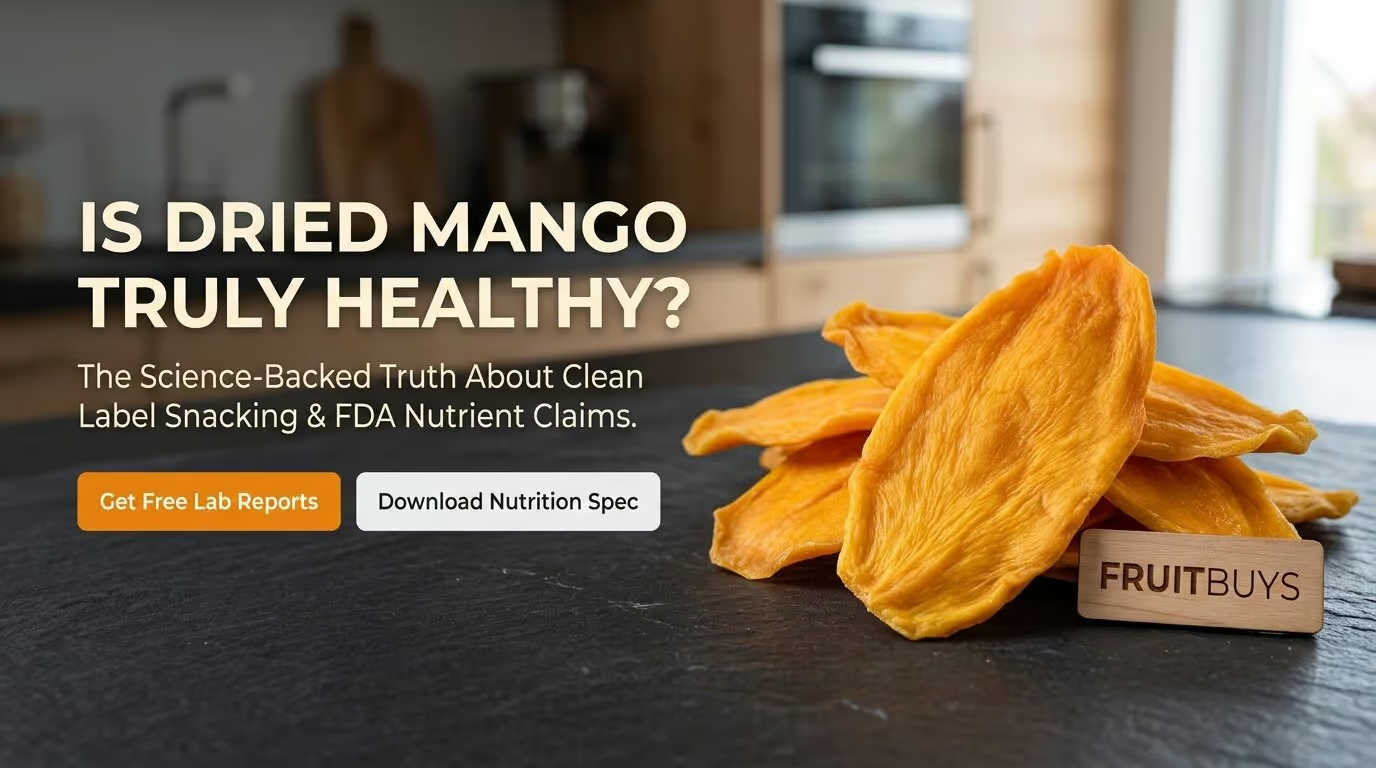
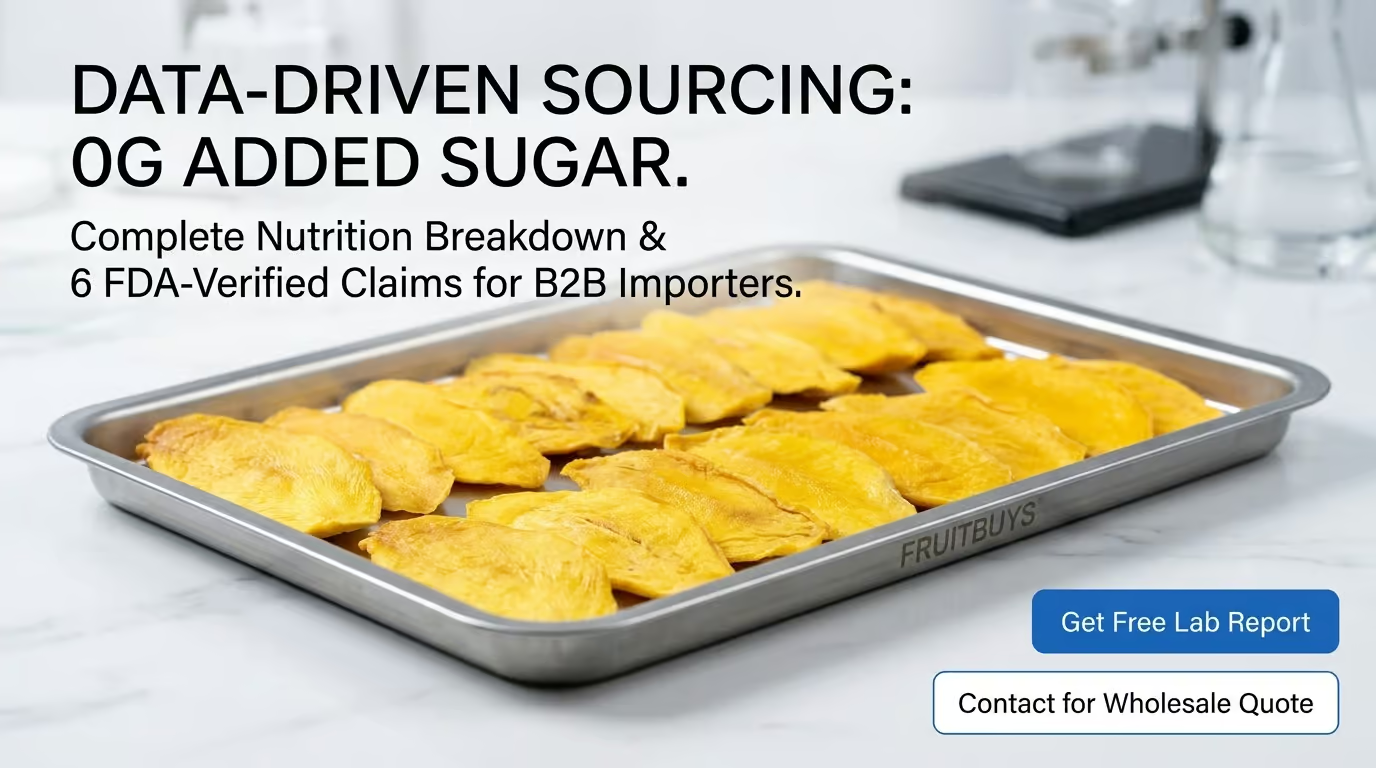
Dried mango no added sugar contains 66–70g of total sugars per 100g and 0g of added sugars. All sugar present is naturally occurring from the fruit glucose, fructose, and sucrose concentrated during the drying process. No exogenous sugar was introduced at any stage of production. That is the direct answer to how much sugar is in dried mango. Everything below explains what that number means, why it matters for your product label, and why not all dried mango on the market carries the same answer.
Why Dried Mango Sugar Numbers Look High
The total sugar figure 66–70g per 100g is high by any surface comparison. It is higher than most candy bars by raw weight. It is higher than most sweetened breakfast cereals. Read without context, it disqualifies dried mango from every health-conscious channel before the conversation starts.
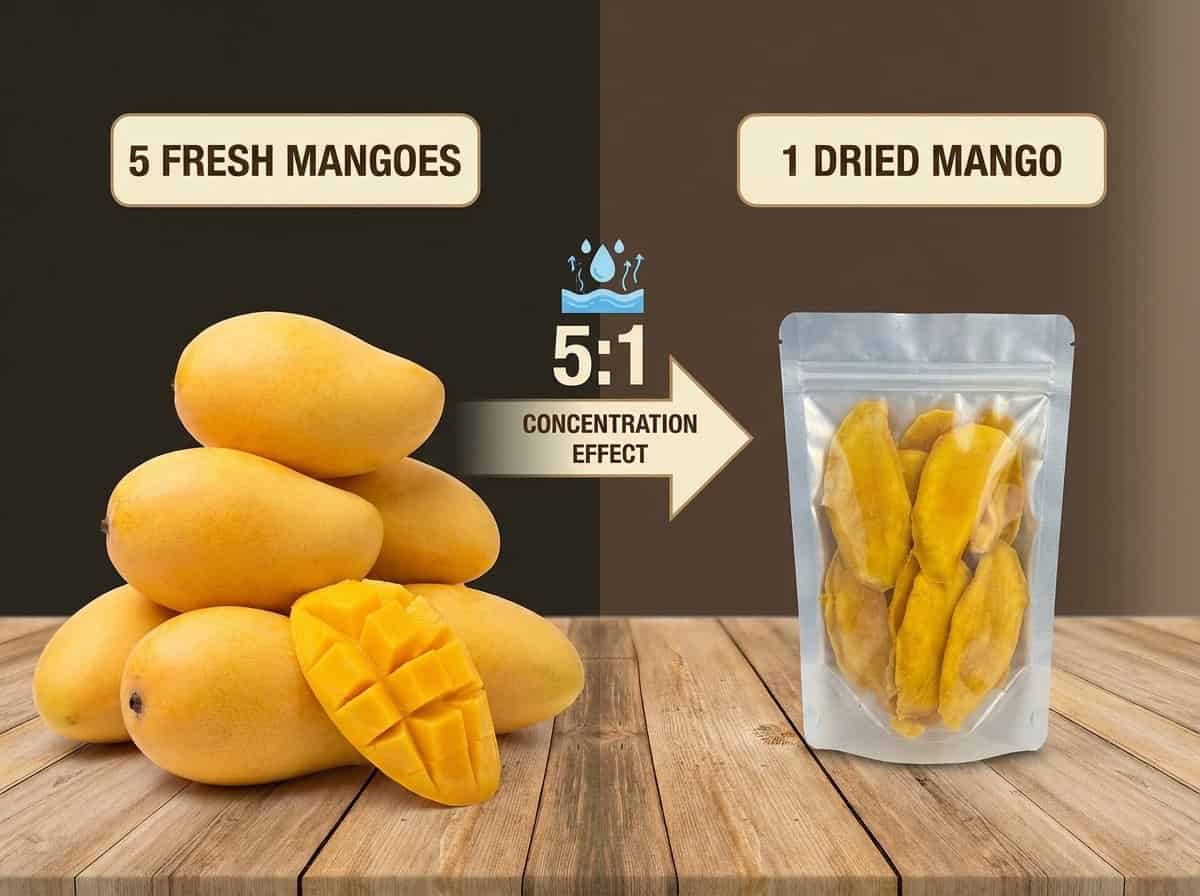
The context is this: fresh ripe mango contains approximately 13–14g of sugar per 100g of fresh weight. When you remove 75–80% of the water from that mango through hot air drying, the fruit solids concentrate. The sugar that was spread across 100g of fresh mango is now present in approximately 20–22g of dried mango. Per 100g of dried product, that concentration produces a total sugar reading of 66–70g.
No sugar was added. The number is high because the fruit shrank, not because sugar was introduced.
The analogy is direct: 100g of sun-dried tomatoes contains roughly 37g of sugar. 100g of fresh tomatoes contains about 2.6g. The drying process concentrates everything calories, vitamins, minerals, and sugars by removing water. The sun-dried tomato is not a candy. Neither is no-added-sugar dried mango.
This distinction is not just educational it has legal weight. Under FDA 21 CFR 101.60, a product qualifies for the “No Added Sugars” claim when the manufacturer has not introduced any sugar or sugar-containing ingredient during processing, regardless of how high naturally occurring sugars are. A product with 68g of natural fruit sugars per 100g and 0g added sugars carries a legally valid “No Added Sugars” declaration. A product with 55g total sugars per 100g that includes 20g of osmotic treatment sugar does not and cannot carry that claim under any compliant labeling framework.
How Added Sugar Gets Into “No-Sugar” Dried Mango
This is the mechanism that buyers sourcing for the clean label channel most need to understand. The fraud is not crude it is structural, and it survives casual inspection.
Osmotic dehydration is a pre-drying treatment used widely in Southeast Asian dried fruit production. Raw mango slices are submerged in a concentrated sugar syrup solution before the drying step begins. Osmotic pressure drives water out of the fruit cells and sugar molecules into them. This reduces drying time, improves texture pliability, and lowers production cost. It also introduces 15–25g of exogenous added sugar per 100g of finished product.
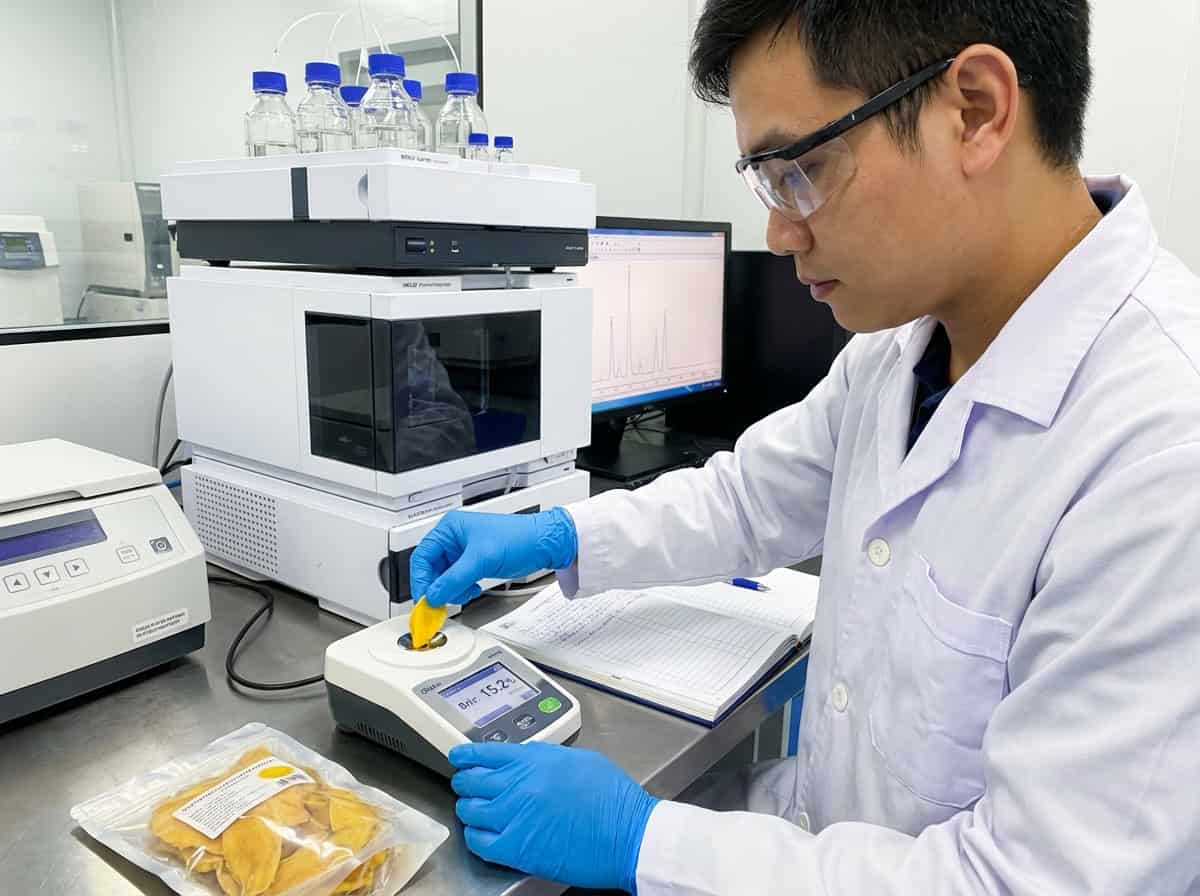
After the osmotic soak, some producers rinse the surface of the mango slices to reduce visible stickiness and surface sweetness. The product may taste less obviously sweet. Surface testing may return lower sugar readings. But the added sugar is embedded in the cellular structure of the fruit. A full homogenized sample analyzed by HPLC at an ISO 17025-accredited laboratory will detect it.
When that product arrives at a US, EU, or UAE importer who tested only for total sugars on the surface of the sample, it passes the informal check. When the importer’s retail buyer, a regulatory inspector, or an independent lab commissioned by a consumer advocacy group tests the same product on full homogenization, the added sugar appears. The “No Added Sugars” label claim fails. The product is mislabeled under FDA 21 CFR 101.60.
The penalty is not theoretical. US importers carry FSVP (Foreign Supplier Verification Program) responsibility for the accuracy of product labels. A mislabeled “No Added Sugars” claim is a FDA compliance failure with consequences that include product recall, import alert, and importer of record liability.
The only way to verify that a supplier is not using osmotic pre-treatment is to ask directly, receive a written process declaration, and confirm through third-party lab testing of a homogenized sample with added sugars as a separate HPLC-tested line item.
Sugar Content by Vietnamese Mango Variety
Not all Vietnamese dried mango carries the same natural sugar concentration. The variety determines the Brix level of the raw fruit, which directly determines the natural sugar density in the finished product.
| Variety | Natural Brix (Fresh) | Profile | Natural Sugar Concentration (Dried) |
|---|---|---|---|
| Keo | 10–15°Bx | Balanced sweet-sour, moderate fiber | Lower end of 66–70g range |
| Cát Chu | 18–20°Bx | Deep sweetness, low fiber, intense aroma | Mid to upper range |
| Hoà Lộc | 20–22°Bx | Butter-smooth, richest natural sweetness | Upper range, no sugar needed for premium flavor |
This table has a direct implication for brand managers: the variety you source determines the natural sweetness depth of your product independent of any sugar addition. Hoà Lộc dried mango at 20–22°Bx natural Brix produces a product with exceptional sweetness perception from purely natural fruit sugars. A retailer positioning that product as “intensely sweet, no added sugar” is making an accurate claim backed by the fruit’s inherent Brix level.
Dried Mango vs. Other Snacks: Sugar in Context
The total sugar figure only has commercial meaning when compared against the alternatives competing for the same shelf space or the same consumer dollar.
| Product | Total Sugar per 100g | Added Sugar | Notes |
|---|---|---|---|
| Dried mango no added sugar | 66–70g | 0g | All natural fruit sugar |
| Dried mango with added sugar | 70–85g | 15–25g | Osmotic pre-treatment |
| Sweetened dried cranberries | ~65–72g | ~40–50g | Most sugar is added |
| Raisins (no added sugar) | ~59–67g | 0g | Natural grape sugar concentration |
| Milk chocolate bar | ~52–55g | ~45–50g | Mostly added sucrose |
| Granola bar (standard) | ~28–35g | ~15–25g | Lower total, significant added portion |
| Fresh mango | ~13–14g | 0g | High water content, pre-concentration |
The comparison that matters for retail positioning: dried mango no added sugar has a similar total sugar count to raisins a product with decades of “natural healthy snack” positioning but with a broader micronutrient profile including Vitamin C (47% DV), Vitamin E (27% DV), and Copper (31% DV). Sweetened dried cranberries, a direct competitor in the health snack category, carry significantly higher added sugar at a comparable total sugar level. The category play for no-added-sugar dried mango is clear.
What This Means for Specific Dietary Channels
Clean label and natural food retail: The “No Added Sugars” claim is the primary differentiator in this channel. Total sugar level is secondary clean label buyers understand fruit concentration. Added sugar is the disqualifier. A COA confirming 0g added sugars is the document that makes the claim defensible on the shelf.
Diabetic-conscious consumers: Dried mango no added sugar contains only naturally occurring fruit sugars glucose, fructose, and sucrose without the additional glycemic load of exogenous added sugars. Whether dried mango is appropriate for individual diabetic dietary management is a clinical decision beyond the scope of this article. For brand positioning: the distinction between 0g added sugars and 20g added sugars matters for how a diabetic-conscious buyer evaluates the product. A label that accurately states “Added Sugars: 0g” alongside the natural total sugar content gives that buyer the information they need to make their own decision. Obscuring either number with misleading labeling is a regulatory and ethical failure.
Keto channel: Dried mango is high in total carbohydrates (78–82g per 100g) and is not compatible with strict ketogenic macronutrient targets of 20–50g net carbs per day. For buyers serving the keto channel, freeze-dried mango in small controlled portion formats may position as an occasional treat item. For the broader low-sugar snacking channel where the goal is eliminating added sugars rather than minimizing all carbohydrates dried mango no added sugar is a strong product with a clean, verifiable claim.
How to Verify a “No Added Sugar” Claim on Your Label
For brand managers, private label buyers, and distributors who need this claim to be audit-proof:
- Request a COA from an ISO 17025-accredited lab (SGS, Bureau Veritas, Eurofins) with added sugars listed as a separate line item showing 0g
- Confirm the COA was generated from a full homogenized sample using HPLC sugar analysis method not surface swab or total sugar titration only
- Match the COA batch number to the production date of the shipment you received
- Request a written supplier declaration that no osmotic pre-treatment or sugar-containing ingredient is used at any stage of production
- Cross-verify total sugars against the expected concentration factor: fresh mango at 13–14g sugar per 100g, dried at 15–18% moisture should yield 66–72g total sugars per 100g. A result above 75g on a claimed no-added-sugar product is a signal requiring explanation
This five-step check costs under $200 in third-party lab fees and eliminates the risk of a label compliance failure that costs orders of magnitude more to resolve.
What “0g Added Sugars” Does for Your Retail Position
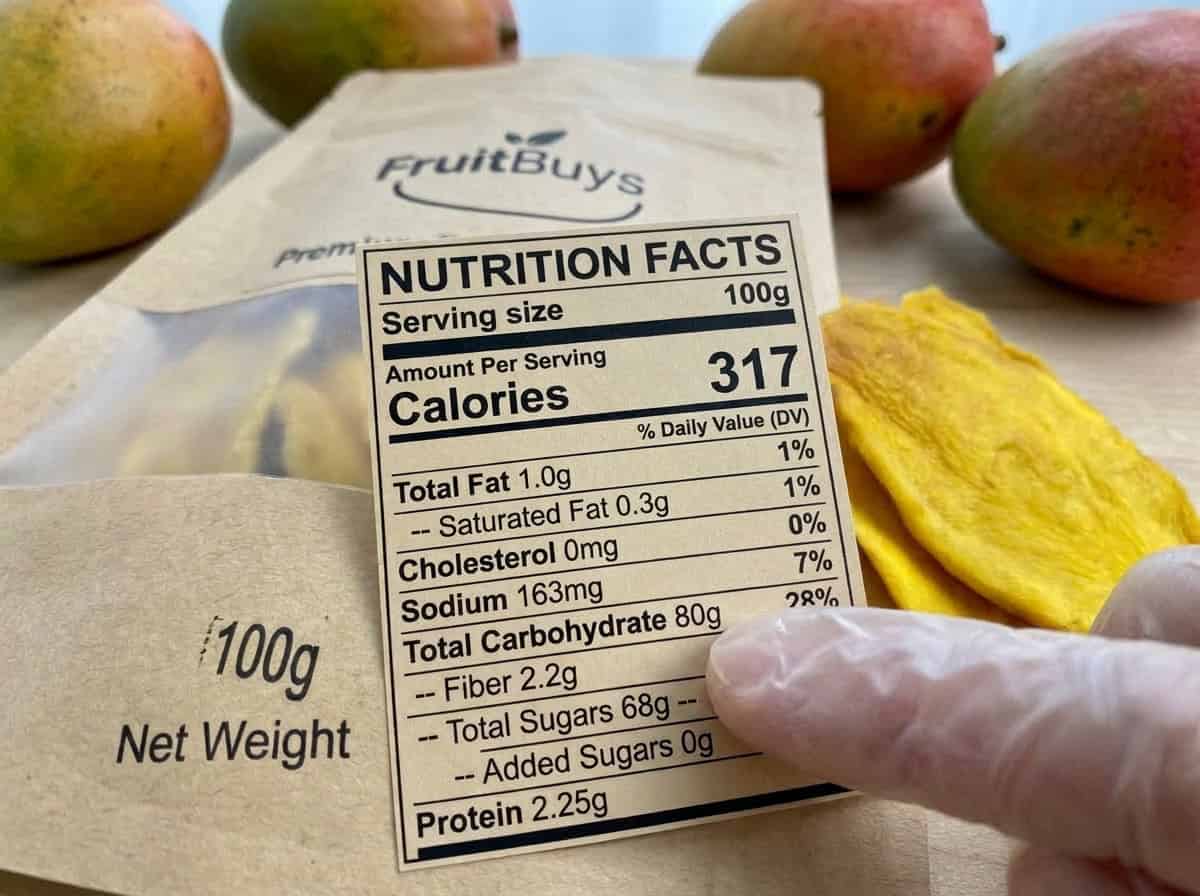
Six words on a Nutrition Facts panel “Added Sugars: 0g” determine which retail channel your product can enter, which health claims your label can carry, and which consumer segment your brand reaches.
A product with those six words, one-ingredient declaration, and valid “Excellent source of Vitamin C” claim positions in the premium natural snack channel at a price point that absorbs sourcing cost and cold chain cost and still returns a margin above 65%. A product without those six words competes on price in the commodity dried fruit aisle against suppliers who will always undercut on cost because they are not managing quality they are managing volume.
The difference starts at the supplier level, before the label is designed, before the packaging is printed, and before the first unit is sold.
Request a free sample with COA confirming Added Sugars: 0g. Contact FRUITBUYS VIETNAM at fruitbuys.com/contact
Frequently Asked Questions
Is dried mango high in sugar?
Dried mango is high in naturally occurring fruit sugar 66–70g per 100g total sugars because the drying process removes water and concentrates fruit solids by approximately 5x. It contains 0g of added sugars when produced by hot air drying without osmotic pre-treatment. Whether that makes it “high in sugar” depends entirely on what you are comparing it to and whether you distinguish between naturally concentrated fruit sugars and sugars introduced during manufacturing.
How much added sugar is in dried mango?
Properly produced dried mango no added sugar contains 0g of added sugars. Dried mango produced using osmotic dehydration with sugar syrup contains 15–25g of added sugars per 100g. The two products look similar and may taste similar, but they carry different nutrition labels, different regulatory classifications, and different compliance profiles for the health food channel. Always verify through COA from an ISO 17025 lab.
Is dried mango good for diabetics?
That is a clinical question requiring individual medical advice. From a product labeling standpoint: dried mango no added sugar contains 0g added sugars and 66–70g of naturally occurring fruit sugars per 100g. Whether the natural sugar load is appropriate for a specific individual’s diabetic management plan is a question for their healthcare provider, not a product label. What the label can honestly state is “No Added Sugars” and “one ingredient” giving diabetic-conscious consumers accurate information to make their own decision.
Does dried mango have more sugar than fresh mango?
Yes, per 100g by weight. Fresh mango contains approximately 13–14g of sugar per 100g. Dried mango contains 66–70g per 100g. The difference is concentration, not addition. Removing 75–80% of the water from fresh mango concentrates all nutrients and sugars proportionally. The sugar content per gram of original fresh fruit is unchanged there is simply less water in the comparison.
What is the difference between total sugars and added sugars on a label?
Total sugars includes all sugars present in the product naturally occurring from the food itself plus any added during manufacturing. Added sugars is a subset of total sugars that counts only exogenous sugars introduced during processing. A dried mango with 68g total sugars and 0g added sugars tells you all sugar came from the fruit. A product with 68g total sugars and 20g added sugars tells you 20g was introduced by the manufacturer. The FDA “No Added Sugars” claim governs the added sugars line not total sugars.
How do I know if my dried mango supplier is adding sugar?
Request a COA from an ISO 17025 lab with added sugars listed as 0g on a full homogenized sample. Ask the supplier in writing whether they use osmotic pre-treatment or sugar syrup before drying. Total sugar above 75g per 100g on a claimed no-sugar product is a flag. Surface testing only, or a COA with total sugars but no added sugars line, is insufficient for US FDA label compliance.
One Claim. One Supplier. One Decision.
“Added Sugars: 0g” is the most commercially powerful claim this product category offers in the current clean label market. 58% of US consumers are reducing sugar intake. Retailers are ranging no-added-sugar products across every snack category. The claim is in demand. The product that backs it with verifiable documentation not just a spec sheet, but a batch-matched COA from an ISO 17025 lab is the product that belongs in that channel.
Contact FRUITBUYS VIETNAM for free samples with full COA confirming every sugar parameter: total sugars, added sugars, natural sugars by HPLC. Samples ship in 3–5 business days. The documentation that makes your label claim defensible ships with the product.
Contact FRUITBUYS VIETNAM:
- WhatsApp: +84-909.499.619
- Email: hotro@fruitbuys.vn
- Website: https://fruitbuys.com
- Office: 10/2 Ky Con, Cau Kieu Ward, Ho Chi Minh City
- Warehouse: 182 An Phu Dong 09, An Phu Dong Ward, District 12, Ho Chi Minh City