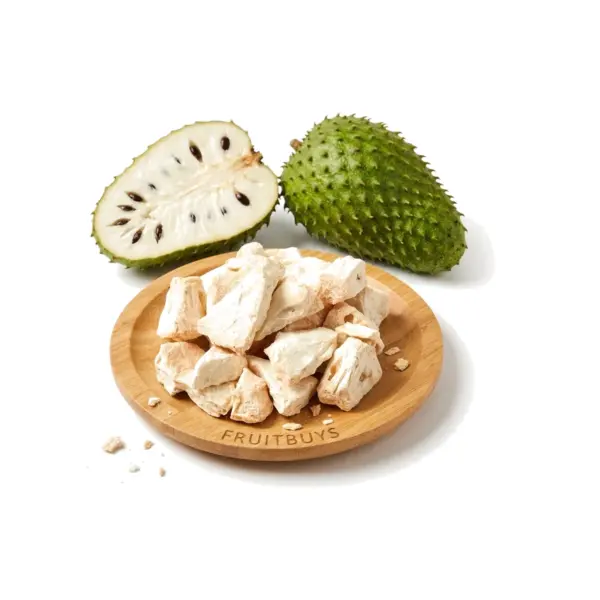
Freeze-Dried Soursop (Guanábana)
Freeze-dried soursop is the ripe pulp of Annona muricata, pulled apart by hand into its natural segments, deseeded, and vacuum freeze-dried to ≤5% moisture and water activity ≤0.30. It eats crisp from the bag, turns back into a creamy, purée-like pulp in water, and carries one word on your ingredient line: soursop. FruitBuys supplies it from the Mekong Delta of Vietnam as natural pulp pieces, crumble and powder, processed at qualified partner facilities under FruitBuys’ own deseeding and release protocol.
Break a piece and you see the fibre strands of the fruit, then taste the sweet-sour guanábana note that Latin American and Caribbean shoppers know from batido and jugo. One kilogram replaces about 8 kg of whole fruit and the hand peeling and deseeding that goes with it. A 20 ft container carries 3.9–4.4 t of pieces with no reefer, the pulp of roughly 29–37 t of fresh fruit. It belongs to our freeze-dried fruit range; the milled form has its own page, freeze-dried soursop powder.
Product specification
| Parameter | Specification |
|---|---|
| Ingredient | 100% ripe soursop pulp (Annona muricata L.); no added sugar, carrier, colours, flavours or preservatives |
| Guaranteed specifications | Moisture ≤5.0% and Aw ≤0.30 on every lot COA; no maltodextrin carrier, no added colour, no added sugar |
| Grade | Premium (fine) grade: 100% ripe pulp, hand-separated and deseeded, zero whole seeds and no visible seed fragments in the release sample, no green peel or spine fragments, no dark browning |
| Formats | Natural pulp pieces 20–45 mm long and 10–20 mm thick, with natural variation; broken pieces/crumble 2–8 mm; powder 60–80 mesh |
| Process | Peeled and split; pulp hand-separated into segments while seeds are pressed out; spread in one layer on stainless trays; quick-frozen and vacuum freeze-dried |
| Colour | Natural white to light cream, slight beige allowed, no dark browning |
| Texture / taste | Crisp and porous with natural fibre strands, melting into a creamy bite; sweet-sour soursop aroma, no foreign odour |
| Broken pieces | ≤10% by weight in the pulp-pieces grade; tighter grading on request |
| Moisture | ≤3% at release; ≤5.0% contract limit |
| Water activity | ≤0.30 |
| Total plate count | ≤10⁴ CFU/g |
| Yeasts and moulds | ≤10² CFU/g |
| E. coli / Salmonella | <10 CFU/g / not detected in 25 g |
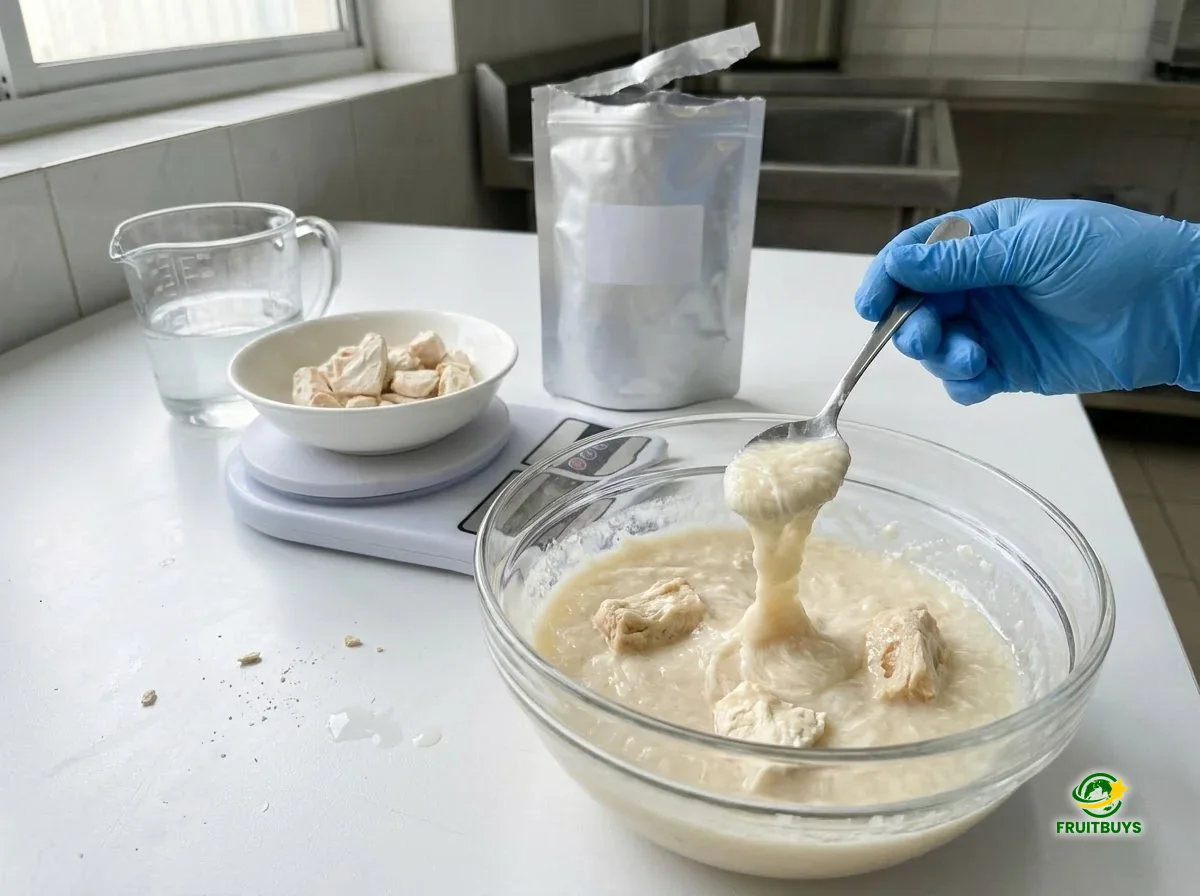
| Rehydration | About 1 part freeze-dried pulp + 5–6 parts water for a fresh-pulp equivalent |
| Fresh-to-dry | 7.5–8.5 kg whole fresh fruit (about 5 kg deseeded pulp) per 1 kg |
| Shelf life | 18–24 months in the original sealed bulk foil bag with desiccant, stored cool at ≤18 °C, RH ≤50%; 12 months for the sealed bulk bag at ≤25 °C, RH ≤60%, and once repacked into retail pouches. |
| HS code | 0813.40 pieces and crumble; 1106.30 powder |
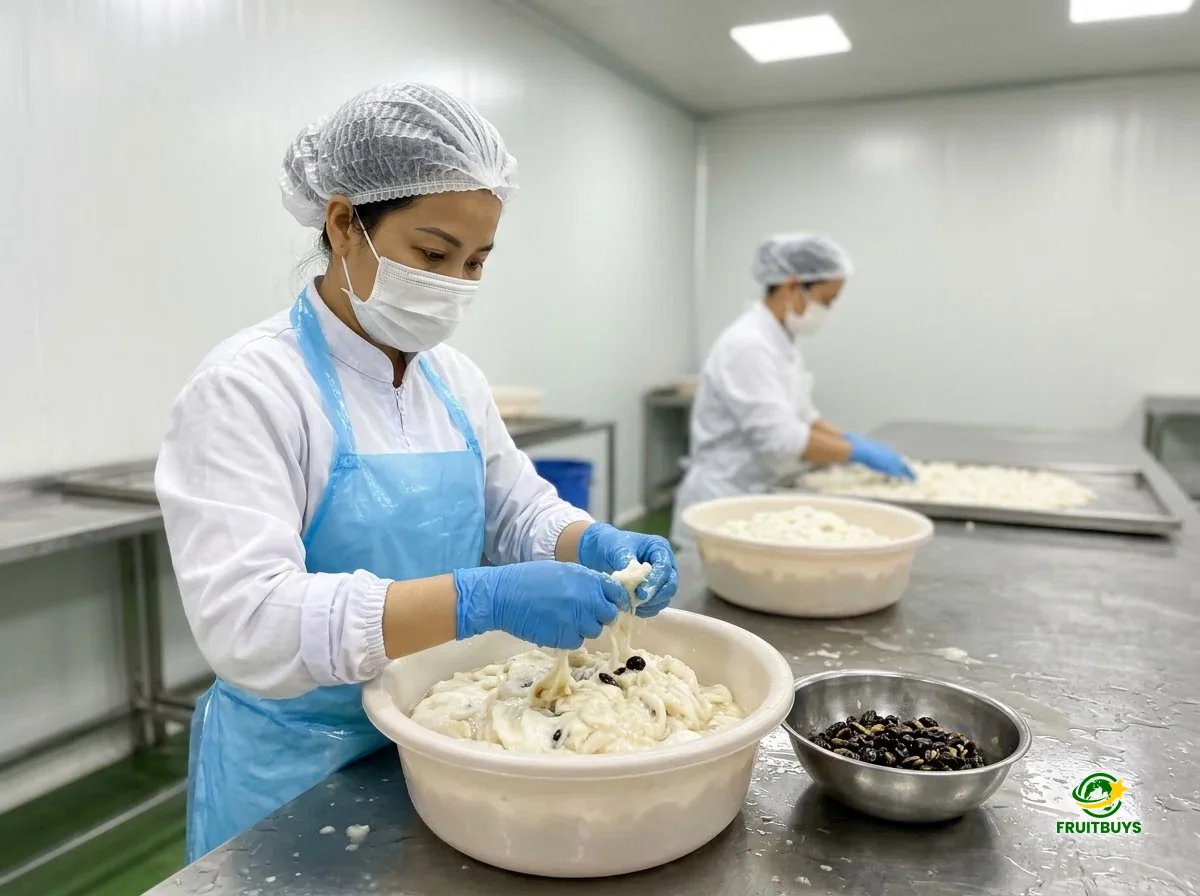
Why the pieces are segments, not cubes. Fresh ripe soursop pulp is soft and fibrous and will not hold a knife cut. FruitBuys sets the preparation protocol at its partner facility: each fruit is peeled and split, and the pulp is pulled apart by hand along its natural segments while every seed is pressed out in the basin. The pulp is then spread on trays and frozen as it is. What reaches you keeps the shape and the fibre of the fruit, which is the quickest way for your customer to see that the snack is real pulp and not a moulded piece. If you are offered cut soursop, ask whether it was sawn from a frozen pulp block: it rehydrates the same way, but the segment look and the fibre strands are gone.
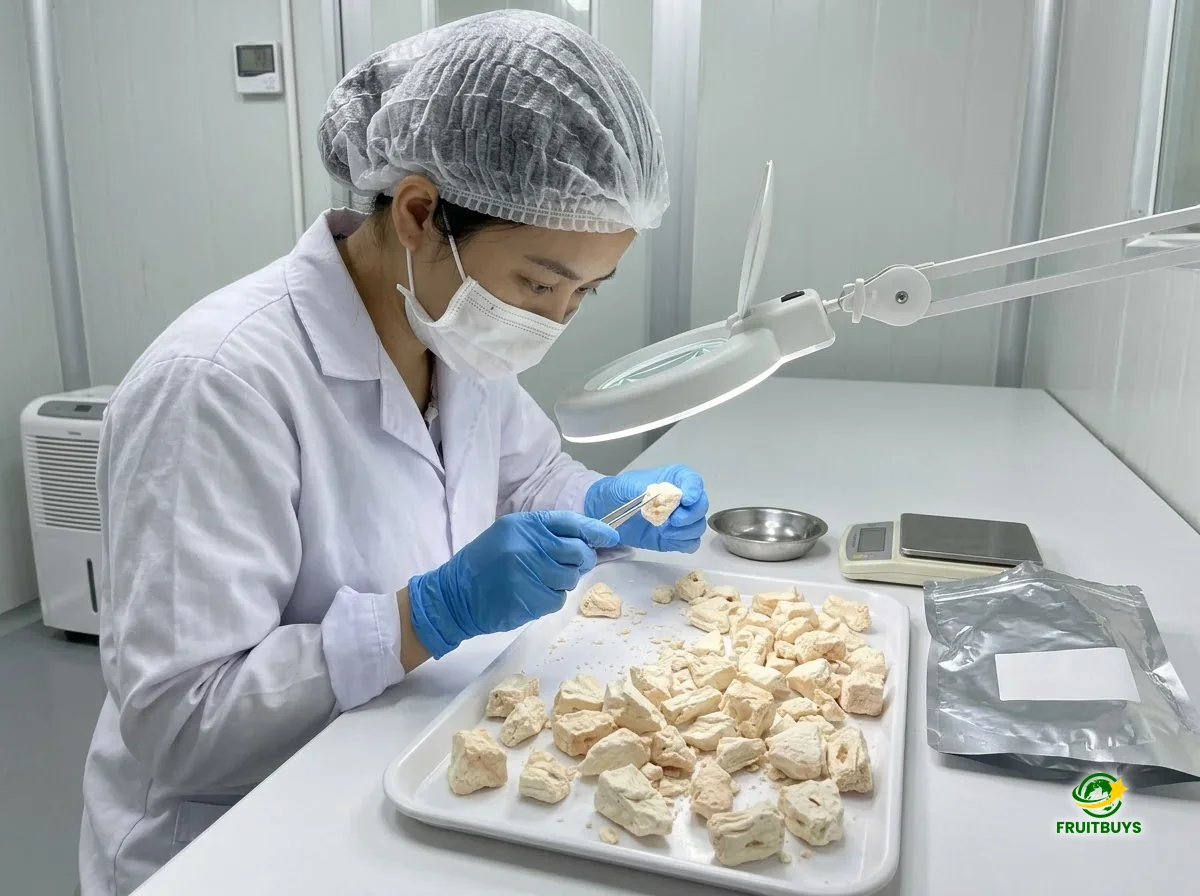
The seed work is done before it reaches your plant. Hand deseeding is followed by manual sorting on the line, and every lot is released only when the release sample shows zero whole seeds and no visible seed fragments. Your blades and mills stay clear of hard seed pieces, and your powder or yogurt base stays white with no dark specks. A tighter fragment limit can be written into your pre-shipment sample (PSS). The growing areas, the season and each preparation step are in where Vietnam’s soursop comes from.
Freeze-dried, frozen pulp or soft-dried: what changes for you
| Freeze-dried (this product) | Frozen soursop pulp | Soft-dried soursop | |
|---|---|---|---|
| Ingredient line | Soursop | Soursop | Soursop, sugar (by grade) |
| Storage | Ambient, dry warehouse | Freezer at −18 °C | Ambient |
| Weight shipped per kg of FD equivalent | 1 kg | About 5 kg (around 81% water), in a reefer | Not comparable (higher moisture, added sugar) |
| After opening | Crisp from the bag; rehydrates with water | Thawed pieces typically lose 5–10% of their weight as drip | Soft and chewy |
| Best for | Snacks, inclusions, dry mixes, drinks made to order | Juice lines that use liquid pulp every day | Sweet snack packs |
Frozen pulp still makes sense for a juice plant with freezer space that runs guanábana every day. Freeze-dried pays back when the pulp has to sit in a dry mix, travel far without a cold chain, or serve several lines from one ambient stock. To check the drip figure on your own frozen pulp, weigh a frozen block, thaw it in the chiller, drain it for 30 minutes and weigh it again. The full cost comparison is in frozen soursop pulp vs freeze-dried. For a soft, chewy snack, see soft-dried soursop.
Nutrition (per 100 g)
| Nutrient | Amount | % DV* |
|---|---|---|
| Calories | 343 kcal | |
| Total fat | 1.6 g | 2% |
| Saturated fat | 0.3 g | 1% |
| Cholesterol | 0 mg | 0% |
| Sodium | 73 mg | 3% |
| Potassium | 1,445 mg | 31% |
| Total carbohydrate | 87.6 g | 32% |
| Dietary fibre | 17.2 g | 61% |
| Total sugars | 70.4 g (0 g added) | |
| Protein | 5.2 g |
Typical values for 100% freeze-dried soursop; natural variation by origin, season and ripeness applies. Lot nutrition panel available for label artwork.
17.2 g fibre and 1,445 mg potassium per 100 g, with no added sugar. On an EU panel (energy about 1,470 kJ / 350 kcal; salt 0.18 g) that reaches the levels for “high fibre”, “high potassium”, “low fat” and “low sodium”, plus “no added sugars”. In the US, a 40 g serving is an excellent source of fibre and a good source of potassium. The sugar is the fruit’s own, so “low sugar” is not available. Drying at low temperature keeps far more of the fruit’s natural vitamin C than heat drying; for an on-pack vitamin C figure, FruitBuys samples your commercial lot and arranges the panel in FDA or EU format. The product is vegan and naturally gluten-free, with none of the top-9 or EU-14 allergens as ingredients. Which claims fit your pack, market by market, is in what you can print on a freeze-dried soursop label.
Formats and applications
| Format | Best for | Carton (58 × 28 × 34 cm) | Per 20 ft | Per 40 ft HC |
|---|---|---|---|---|
| Natural pulp pieces | Single-ingredient fruit snack, trail mix, gift packs | 7–8 kg | 3.9–4.4 t | 7.7–8.8 t |
| Broken pieces/crumble 2–8 mm | Cereal, granola, yogurt and ice-cream toppings, bakery, confectionery | 9–10 kg | 5.0–5.5 t | 9.9–11 t |
| Powder 60–80 mesh | Smoothie and drink blends, bubble tea, ice cream, desserts | 18–20 kg | 9.9–11 t | Planned at 20–21 t |
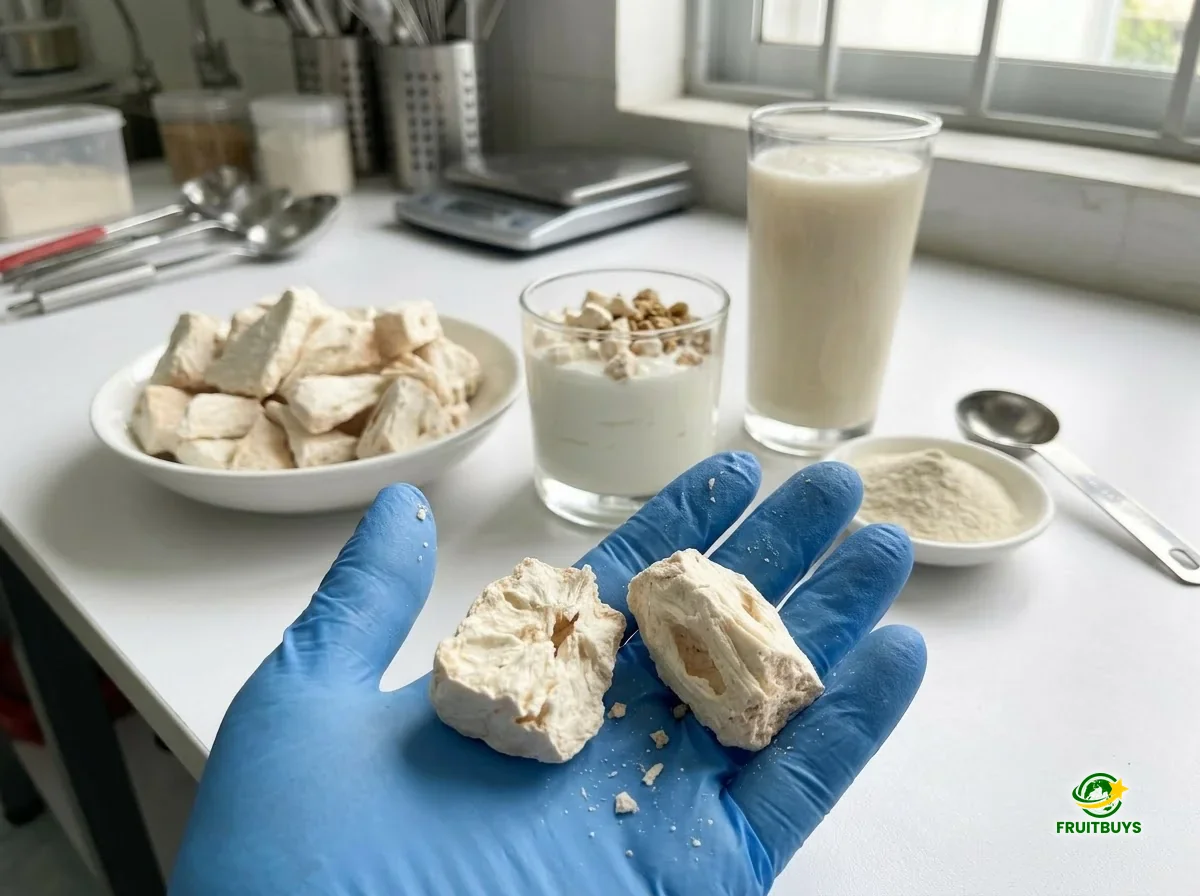
Buy the format your customer sees. When the soursop is blended, rehydrated or milled, crumble or powder gives you the same pulp for less freight: powder packs 18–20 kg into the carton that holds 7–8 kg of pieces, which roughly halves sea freight per kilogram. Keep whole pieces for packs where the segment is the product.
Starting points from FruitBuys’ application support, to adjust in your own trial: 5–10 g powder per 250–350 ml drink; 3–8% powder in ice cream or yogurt; crumble straight into granola and cereal. Blends with mango, pineapple or passion fruit are available for smoothie mixes. At Aw ≤0.30 the crumble sits in a dry mix without pulling moisture from the flakes around it. Format by application and pilot advice are in which freeze-dried soursop format fits your line.
Packaging
| Item | Detail |
|---|---|
| Bulk | 1–5 kg sealed aluminium-foil PE bags, soft vacuum, food-grade silica gel sachet, no nitrogen flush, in 5-ply cartons |
| Carton | 58 × 28 × 34 cm; pieces 7–8 kg, crumble 9–10 kg, powder 18–20 kg net |
| Retail (OEM) | 30 g / 50 g / 100 g / 500 g aluminium-foil zip pouches, or custom sizes; digital print from 3,000–5,000 pouches per SKU, rotogravure from 500 kg per SKU |
| Shelf life | 18–24 months in the original sealed bulk foil bag with desiccant, stored cool at ≤18 °C, RH ≤50%; 12 months for the sealed bulk bag at ≤25 °C, RH ≤60%, and once repacked into retail pouches. |
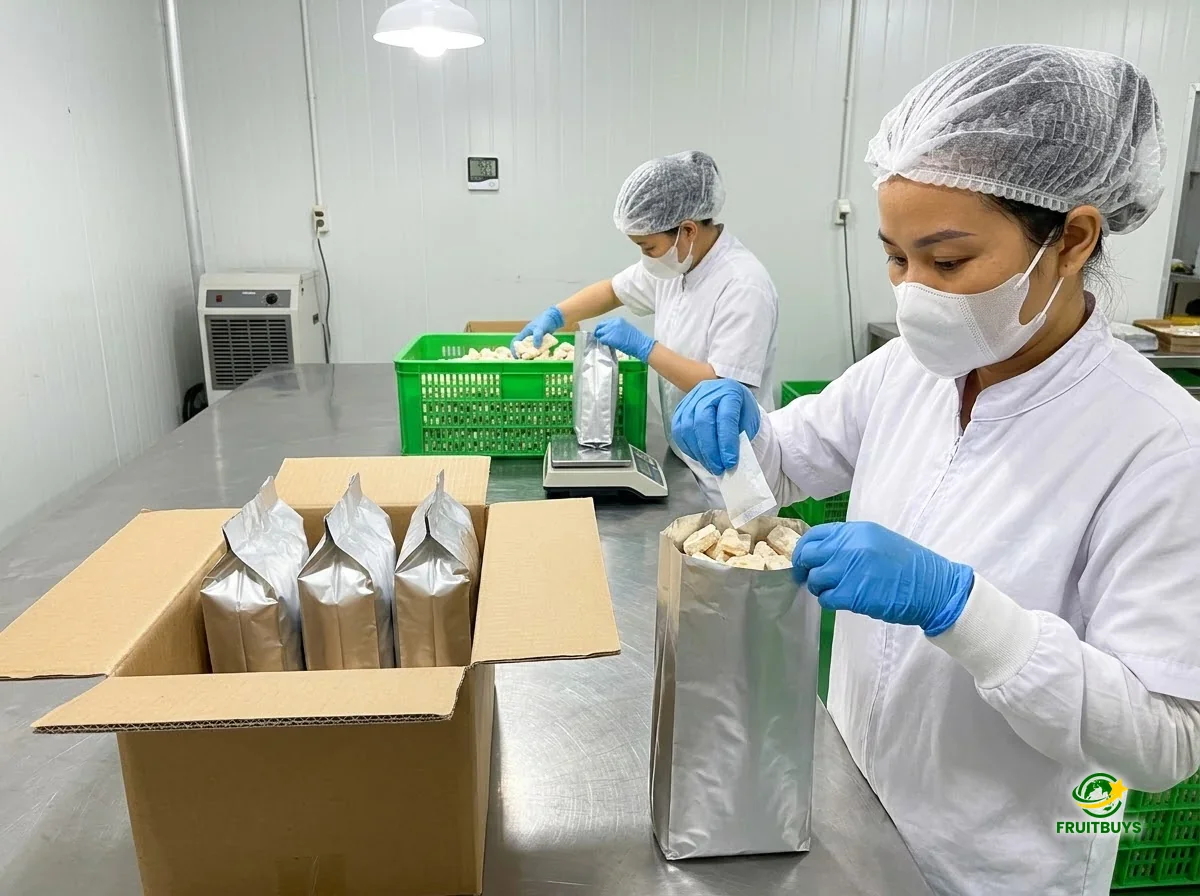
Soursop is rich in natural sugar, and it draws moisture once the air goes above 40% RH. That is why FruitBuys sizes every bulk bag to one production batch: open one bag, use all of it, and the rest stay crisp in their foil until their turn. Open powder in a room below 40% RH, keep opened bags out of the fridge unless they are airtight, and store cartons on pallets off the floor.
Commercial terms and container planning
| Term | Detail |
|---|---|
| Production capacity | 100 MT/year contracted |
| 20 ft, floor-loaded | About 550 cartons: 3.9–4.4 t pieces, 5.0–5.5 t crumble, 9.9–11 t powder |
| 40 ft HC, floor-loaded | About 1,100 cartons (±20–30): 7.7–8.8 t pieces, 9.9–11 t crumble; powder planned at 20–21 t net within container and road weight limits |
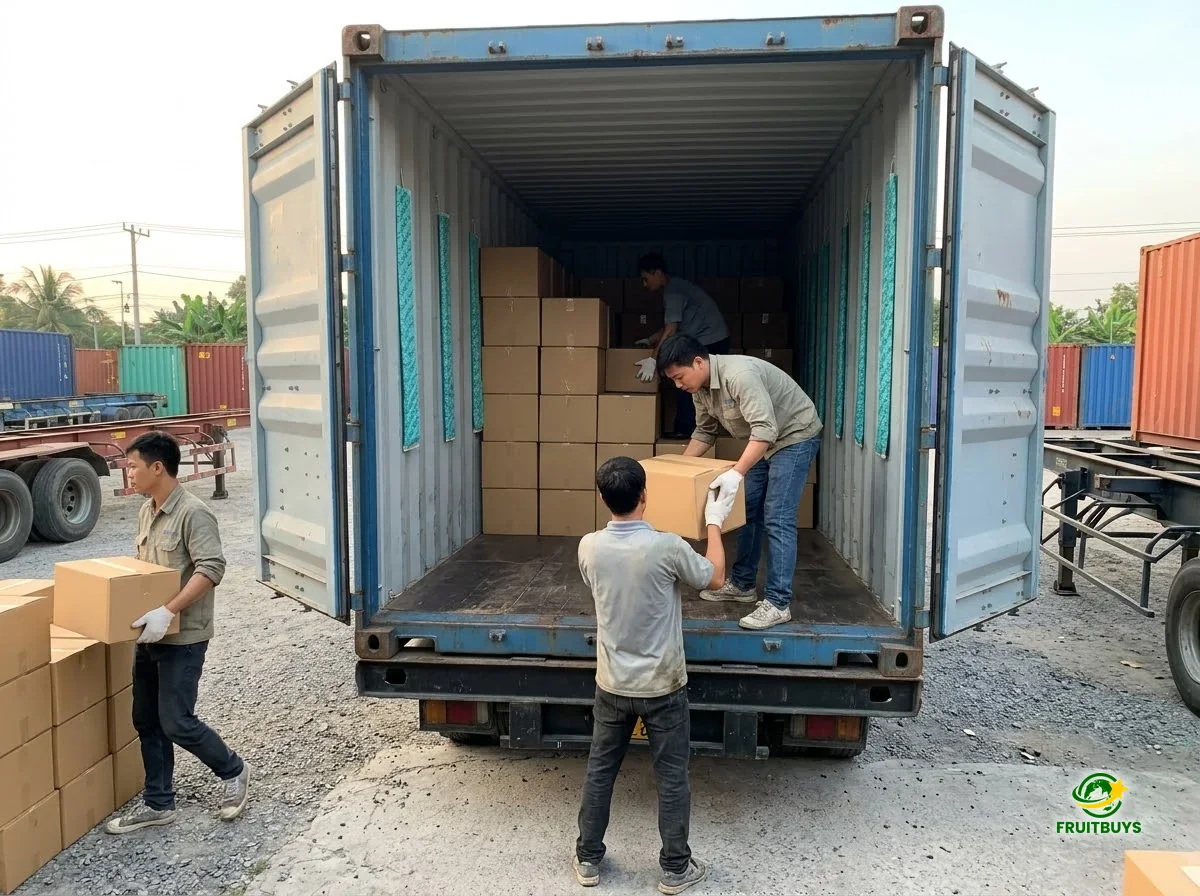
| Palletised | 1,200 × 1,000 mm pallets, 30–36 cartons each; 20–21 pallets per 40 ft HC (about 600–750 cartons), for forklift unloading in place of hand unloading |
| Container type | Standard dry container; no reefer |
| Trial orders | 50–100 kg by air or LCL, or shared on a pallet or container with other FruitBuys freeze-dried lines |
| Mixed loads | A full container shared with other FruitBuys products costs about 15–20% less in logistics per kg than LCL |
| Production lead time | 20–30 days per 20 ft after deposit |
| Samples | Prepared in 3–5 working days, then courier or airline |
| OEM / ODM / private label | MOQ 500 kg |
| Payment | T/T 40% deposit, 60% before shipment or against copy B/L; L/C at sight |
| Incoterms | FOB Cat Lai, CIF (sea and air) |
| Port of loading | Cat Lai Port or Tan Son Nhat International Airport, Ho Chi Minh City |
One origin, two crop windows. The fruit comes from the Mekong Delta: Tien Giang, including the Tan Phu Dong specialty growing area, plus Hau Giang, Ben Tre, Long An and Tra Vinh along the Tien and Hau rivers. Soursop is harvested all year. The rainy-season main crop from May to October gives the steadiest volumes, and the November–April off-season brings smaller fruit with denser, sweeter pulp. Book your annual programme around the main crop for the widest availability. Vietnam’s fruit and vegetable exports reached an estimated record US$8.4 billion in 2025, up 18% (VINAFRUIT estimate), and soursop is one of the Mekong Delta’s established orchard crops.
About 7.5–8.5 kg of whole fruit go into each kilogram, and peel, core and seeds take 30–38% of the fruit weight. A quote built on far less fruit is usually buying wetter pieces or under-ripe pulp; the arithmetic is in how much fresh soursop makes 1 kg freeze-dried.
Quality and documents
- Every container lot: COA from an independent ISO/IEC 17025 accredited laboratory for moisture, water activity, total plate count, yeasts and moulds, E. coli and Salmonella, plus sensory and defect checks for colour, odour, seed fragments and peel.
- Heavy metals and residues: lead, cadmium, arsenic, mercury and multi-residue pesticides are tested on request or per destination market. FruitBuys arranges independent testing at an accredited laboratory of the buyer’s choice, such as Eurofins or SGS in Vietnam, before the container is sealed, in 3–5 working days.
- On request: a nutrition panel in FDA or EU format for your label.
- Trial orders: an in-house QC log per batch for moisture, water activity and sensory; third-party testing on trial lots at net lab cost, credited in full to the first container order.
- Pre-shipment sample: 100–200 g from the packed lot in two sealed foil pouches with desiccant, one for your sensory check and one kept sealed for your lab.
- Retained sample: kept from every container lot for its full shelf life, up to 24 months.
- Facility control: FruitBuys locks one qualified partner facility per contract. Any change needs prior written notice and re-approval of the pre-shipment sample, and you keep audit access.
- Facility certifications: HACCP, ISO 22000, US FDA Facility Registration and BRC (qualified processing facility). Halal certification available on request.
- Shipment documents: commercial invoice, packing list, bill of lading, COA, Certificate of Origin Form EUR.1 for the EU and UK or Form CEPA for the UAE, and a phytosanitary certificate with every shipment as part of FruitBuys’ standard export dossier.
Claims on packaging, appearance, breakage or water activity are accepted within 14 days of unloading, and lab results within 30 days. What each line of the COA should show is in what a freeze-dried soursop COA should show.
Import and labeling
Pulp pieces and crumble are exported under 0813.40, other dried fruit; powder goes under 1106.30, flour and powder of Chapter 8 fruit. FruitBuys writes the invoice, spec and COA with the same description, “freeze-dried soursop (Annona muricata) pulp pieces, no added ingredients, moisture ≤5%”, and prepares them with your customs broker so the entry line and the documents match on the first filing.
In the US Harmonized Tariff Schedule, the MFN reference rate is 2.5% for pieces and crumble (0813.40.90) and 9.6% for powder (1106.30.40); your customs broker confirms the total duty on the entry. A US drink or ice-cream plant with its own cold mill and dry room can bring in crumble and mill it in-house; one without that equipment saves the milling and caking risk by buying powder.
For the EU, a Form EUR.1 under EVFTA brings pieces and crumble (CN 0813 40 95) in at 0% duty, against the 2.4% MFN rate; your broker can check the current measure in the EU TARIC database. Form EUR.1 also covers the UK, and a Form CEPA goes with every shipment to the UAE.
Fresh soursop is hard to bring into the US: fresh fruit from Mexico was approved in 2024 on condition of quarantine irradiation, under the APHIS import decision, and it moves mostly by air. Freeze-dried soursop is a processed food and needs no quarantine irradiation, so it ships by sea in a dry container. On your pack, name the ingredient “soursop” or “guanábana” and keep the label to food claims: the product is fruit pulp only, never leaf, leaf powder or a supplement.
Verify the sample in five steps
- Look at the colour. White to light cream across the bag. Grey or dark-brown patches point to over-ripe fruit or heat damage.
- Check for seeds. Spread 100 g on a white tray: no whole seeds, no black fragments, no green peel or spines.
- Read the water activity within a minute. Seal pieces in the meter chamber within 60 seconds of opening the pouch; at or below 0.30 the lot was dried and sealed right. Keep the second sealed pouch for your own lab.
- Rehydrate 1 to 5. Add 5–6 parts water to 1 part pulp and stir: you should get a creamy pulp with the fruit’s aroma and no stale note.
- Taste it dry. A crisp bite that melts, sweet-sour, with no burnt or cardboard note. Approve the pre-shipment sample in writing; it becomes the quality reference for your container.
FAQ
Can I get freeze-dried soursop cubes or slices?
FruitBuys does not cut soursop. Fresh ripe pulp is too soft to dice, and cut shapes are sawn from frozen pulp blocks, which gives up the natural segment. FruitBuys supplies natural pulp pieces, crumble sieved to 2–8 mm, and powder. If you need small, even pieces for a topping, specify crumble by sieve size.
Is graviola powder the same as freeze-dried soursop powder?
Not always. Much of the “graviola powder” sold online is milled leaf. FruitBuys supplies fruit pulp only, as pieces, crumble or 100% fruit powder.
Does it contain added sugar?
No. The sweetness is the fruit’s own sugar; nothing else goes into the bag.
Can a US brand call it “healthy”?
Under FDA’s updated “healthy” rule, fruit with no added ingredients qualifies automatically, and 100% freeze-dried soursop pulp falls in that group; your label review confirms the final claim. Compliance with the new rule is required from 25 February 2028.
Is soursop safe to eat?
The pulp is a normal food; the safety concerns people read about relate to the seeds and leaves, which are removed. More detail is in soursop side effects.
How long does it last?
18–24 months in the original sealed bulk foil bag with desiccant, stored cool at ≤18 °C, RH ≤50%; 12 months for the sealed bulk bag at ≤25 °C, RH ≤60%, and once repacked into retail pouches.
What is the minimum order?
Trial orders from 50–100 kg by air or LCL, and 500 kg for OEM, ODM and private label.
Request a sample and quote
Send these 11 details and we return a specification, sample and terms in one reply:
- Destination country and port
- Application: snack, cereal or granola, yogurt or ice cream, drink or smoothie mix, bakery
- Format: natural pulp pieces, crumble (state sieve size), or powder
- Moisture / Aw target, if tighter than standard
- Seed-fragment limit, if tighter than standard
- First-order volume: trial, LCL, 20 ft or 40 ft HC, floor-loaded or palletised
- Annual volume and call-off rhythm
- Packaging: bulk bag size or retail pouch size
- Private label: artwork status and labelling market
- Extra tests required by your market or customer
- Preferred Incoterm, payment term and target delivery date