
Freeze-Dried Dragon Fruit Applications for Snacks, Cereals, Beverages and R&D
Freeze-dried dragon fruit applications look attractive on a product sheet, but a buyer cannot approve an application from color alone. Red slices can make a snack pouch look strong and still break in bulk. Cubes can fit cereal visually and still create fines after mixing. Powder can deliver a bright pink cue in a drink base and still clump, settle or force label changes when carrier status was never locked. Importers, food manufacturers, R&D teams and private label brands should choose the format by application, not by catalogue image.
The application fails when the sample passes visually but the product matrix was never tested. FruitBuys treats dragon fruit application development as a controlled route: format selection, moisture and Aw review, packaging alignment, COA scope and sample-to-bulk release.
Match the Format to the Application
Freeze-dried dragon fruit should be matched to the application before the buyer approves the sample.
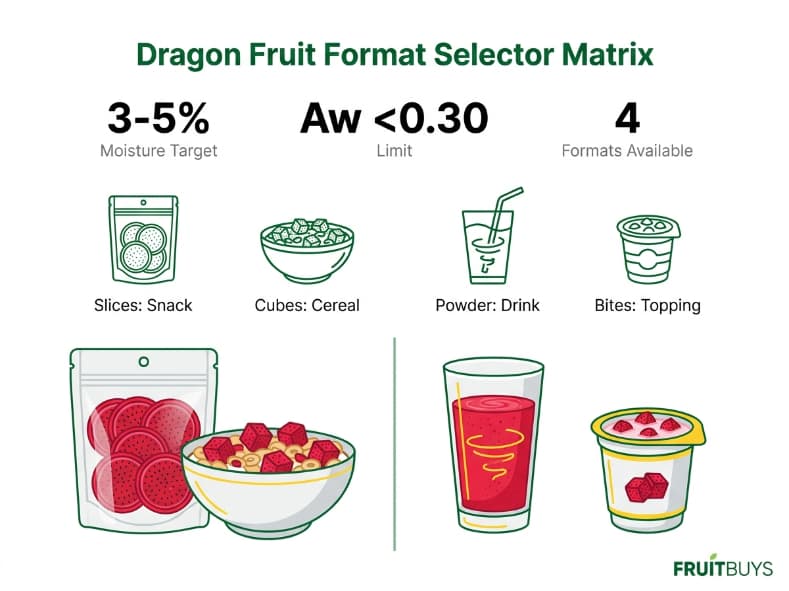
Slices, bites, cubes and powder behave differently in texture, moisture exposure, breakage, dispersion and label review.
Buyers should define the finished use case before locking format, packaging and COA scope.
Freeze-dried dragon fruit can support snack, cereal, granola, dairy, bakery, beverage and dry-blend concepts. The mistake starts when the buyer asks for “dragon fruit” instead of defining the job the product must perform. Buyers qualifying the full category should first review the freeze-dried dragon fruit buyer guide.
A dragon fruit drying study reported that fresh dragon fruit is highly perishable because of high moisture content and compared freeze-dried dragon fruit slices and pulp with other drying routes. That supports a direct application rule: drying method and product form affect quality attributes, so buyers need format-specific approval. (Observatorio Latinoamericano)
Use this first filter:
| Application | Better Starting Format | Core Proof Needed |
|---|---|---|
| Retail snack | Slices or bites | Visual standard, breakage, moisture, Aw, packaging |
| Cereal and granola | Cubes or small bites | Size tolerance, fines, moisture migration, COA |
| Yogurt topping | Cubes, bites or slices | Texture, microbiology, color behavior, packaging |
| Beverage powder | Powder | Mesh, carrier status, dispersibility, clumping, COA |
| Bakery and confectionery | Powder or small granules | Heat behavior, color stability, ingredient file |
| Foodservice garnish | Slices or bites | Visual consistency, carton protection, storage |
| Private label pouch | Slices, bites or powder | Artwork inputs, Nutrition Facts basis, pack file |
Buyers can review FruitBuys’ freeze-dried fruit portfolio for category structure, but final application approval still requires a dragon-fruit-specific specification. The buyer should also confirm the freeze-dried dragon fruit format selection before locking slices, bites, cubes or powder.
Retail Snack Applications
Retail snack buyers usually choose slices or bites. Slices show fruit identity. Bites give easier portioning and stronger snack-mix flexibility. Both formats need visual discipline.
Retail snack applications require:
- Red-flesh or white-flesh decision
- Accepted-piece definition
- Thickness or size range
- Broken-piece limit
- Fines limit
- Moisture target
- Aw target
- Packaging structure
- Retained master sample
- Lot-specific COA
The buyer should treat the retail pouch as part of the application, not as a packaging detail. A slice that looks good in a hand-packed sample may break under bulk filling or shipment. A bite format can shift into irregular fragments when sorting rules stay vague. Moisture gain can turn a crisp snack into a soft product before the buyer reaches shelf review.
For snack category planning, FruitBuys’ healthy indulgence snacks can support internal navigation, but the SKU must still pass product-specific format and packaging review. The strongest retail snack route uses a retained master sample, a written specification and the packaging and shelf-life controls before artwork approval. Without those controls, the buyer signs off on a mood board, not a product.

Cereal and Granola Applications
Cereal and granola buyers need repeatability. They do not only need a visually attractive dragon fruit piece. They need a piece that survives mixing, packing, distribution and final bowl appearance.
Cubes and small bites usually work better than large slices for cereal and granola. They distribute more evenly through the blend and allow better portion control. The buyer still needs breakage and fines criteria because freeze-dried pieces can fracture under mixing and vibration.
A cereal or granola specification should define:
| Control | Why It Matters |
|---|---|
| Cube or bite size | Controls distribution and visual load |
| Size tolerance | Reduces inconsistent serving appearance |
| Fines limit | Prevents dusting and color smears |
| Moisture | Supports crispness and dry-blend stability |
| Aw | Supports storage condition review |
| Packaging | Reduces breakage and moisture gain |
| COA | Confirms lot-specific release data |
FDA explains that water activity affects food stability and should reach a suitable level after drying while remaining within an acceptable range during storage. That point matters when freeze-dried dragon fruit enters dry blends where moisture migration can change texture. Buyers should align the application file with the moisture and Aw release requirements [FD-DF-05]. (U.S. Food and Drug Administration)
A cereal buyer should not approve cubes without a mixing test. A granola buyer should not approve bites without breakage after handling review. The product must survive the real application, not only the sample table.

Beverage and Smoothie Applications
Dragon fruit powder should be treated as an ingredient system, not just a ground fruit format.
Mesh, carrier status, dispersibility, color behavior, moisture, Aw and packaging control its performance in beverages.
Buyers should test the powder in the intended drink matrix before approving bulk release.
Beverage and smoothie applications usually require powder. Red-flesh dragon fruit powder often attracts buyers because it can deliver a strong pink or magenta visual cue. That color can support smoothie mixes, dry drink blends, plant-based beverages, dairy drinks and functional-looking concepts. It does not prove nutrition, antioxidant effect or health performance in the buyer’s finished product.
A 2024 study on freeze-dried dragon fruit powder reported moisture, Aw, solubility and hygroscopicity values and incorporated the powder into a plant-based drink. The study supports the need for application-specific testing, especially when the buyer expects color, dispersion and handling performance from powder. (Observatorio Latinoamericano)
Beverage buyers should define:
- Fruit-only or formulated powder status
- Carrier identity if present
- Mesh or particle-size distribution
- Cold-water dispersion
- Hot-water behavior where relevant
- Sedimentation behavior
- Dosage level
- Color release
- Flavor impact
- Microbiology panel
- Moisture and Aw
- Inner-pack size
- Reseal and open-pack handling
Powder can clump when it absorbs moisture. Pure fruit powder and carrier-containing powder can behave differently. A buyer who asks only for strong color risks receiving a powder that fails during filling, blending or after opening.
FruitBuys should align the powder sample with the buyer’s application matrix and the dragon fruit powder specification before approval. A water test alone cannot release a powder for a protein drink, smoothie base or dairy system unless water represents the actual end use.

Dairy, Yogurt and Ice Cream Applications
Dairy and frozen-dessert applications require tighter QA review because texture, microbiology, color behavior and rehydration all matter. Dragon fruit can enter dairy products as powder, cubes, bites or crumble-style inclusions, but each route changes the approval file.
For yogurt topping, the buyer may need visible pieces that hold shape and do not soften too quickly. For yogurt base or ice cream color, the buyer may use powder and test color release. For layered dessert cups, slices or bites may serve visual presentation.
Dairy application testing should review:
| Use Case | Format | Required Test |
|---|---|---|
| Yogurt topping | Cubes, bites or slices | Texture, moisture migration, microbiology |
| Ice cream inclusion | Cubes or bites | Freeze-thaw behavior, texture, breakage |
| Yogurt base color | Powder | Dispersion, color behavior, ingredient status |
| Dessert layer | Slices or bites | Visual standard, softening rate, storage |
| Plant-based dairy | Powder | Matrix behavior and sensory impact |
Color requires special caution. Betalain pigments, including those linked with red pitaya and other natural colorant systems, can be affected by environmental and processing factors such as temperature, pH, water activity, oxygen and light. Buyers should test color in the actual dairy or plant-based matrix instead of assuming dry powder color will remain identical. (PubMed)
Do not convert color into a health claim. Color supports product identity. The buyer’s label and claim file must remain separate from visual approval.

Bakery and Confectionery Applications
Bakery and confectionery buyers often consider dragon fruit powder for color, fruit identity and tropical positioning. The powder route can work, but heat, pH, moisture, fat, sugar system and processing time can change the final result.
A bakery buyer should not approve powder from dry color alone. The powder should enter the actual dough, batter, filling, coating or cream system. The buyer should review color before baking, after baking and after storage.
Bakery and confectionery specifications should include:
- Powder type
- Carrier status
- Mesh
- Dosage
- Heat exposure
- PH or formula condition where relevant
- Color after processing
- Moisture and Aw
- Ingredient statement
- Nutrition Facts basis
- Allergen and cross-contact review
- COA scope
The betalain stability review cited above notes that environmental and processing factors affect pigment stability. That supports a practical R&D rule: bakery use needs heat and storage testing, not just dry-powder approval. (PubMed)
Small pieces can also serve confectionery and bakery toppings, but they need separate breakage and moisture controls. A topping that works on a chilled dessert may not work on a baked product. The buyer should test the final application, not borrow approval from another category.

Foodservice and Topping Applications
Foodservice buyers often need visual consistency, simple handling and stable product presentation. Slices, bites and cubes can work for dessert garnish, smoothie-bowl topping, yogurt bars, café menus and catering kits.
The main risks are practical:
- Pieces break during handling
- Open packs absorb moisture
- Staff reseal bags poorly
- Color shifts under display lighting
- Product softens near wet ingredients
- Serving appearance changes over time
Foodservice packs should usually define smaller inner-pack weights when repeated opening creates moisture exposure. Large bags can look efficient operationally, but they can fail if staff open and close them many times in a humid kitchen.
A foodservice specification should include:
| Item | Control |
|---|---|
| Format | Slices, bites or cubes |
| Visual standard | Retained sample or approved photo reference |
| Piece size | Serving appearance and portion control |
| Breakage limit | Presentation quality |
| Moisture and Aw | Texture and storage stability |
| Pack size | Opening frequency and humidity control |
| Storage instruction | In-use handling |
| Lot code | Complaint and traceability review |
Foodservice buyers should not approve the same package used for industrial bulk unless the use pattern matches. The pack must fit the kitchen, not only the warehouse. The buyer should connect foodservice pack decisions to the packaging and shelf-life controls.
Moving From R&D Sample to Bulk
R&D success does not equal bulk approval.
The buyer must confirm that the bulk lot matches the approved sample in format, moisture, Aw, ingredient status, packaging and COA.
Sample-to-bulk consistency should become the release gate before shipment.
This is the highest-risk stage. A sample can pass in the R&D lab because a technician handled it carefully, opened it once and used it immediately. Bulk product faces production, packing, storage, loading, transit and receiving. The product route becomes longer, and weak specifications begin to leak.
The R&D-to-bulk file should connect:
- Application target
- Approved format
- Dosage level
- Ingredient statement
- Moisture target
- Aw target
- Size or mesh tolerance
- Color reference
- Packaging structure
- Open-pack handling
- COA scope
- Microbiology panel
- Retained sample
- Lot code
- Release approval
Low-moisture foods still need sanitation and contamination control. FDA’s 2025 draft guidance for low-moisture ready-to-eat foods discusses sanitation programs, environmental monitoring and corrective actions for pathogen contamination events; FDA also highlights limitations of relying only on product testing to verify elimination of pathogen contamination. (U.S. Food and Drug Administration)
That matters for application buyers. R&D teams can approve taste and color. QA must still approve the release file. Procurement must still confirm the bulk product follows the same specification. Private label teams must still align artwork with the actual formula and destination.
FruitBuys should close this gap through the sample-to-bulk consistency criteria: the sample, specification, packaging file, COA and lot identity must point to the same product. QA should also apply the COA and laboratory testing requirements before bulk release.
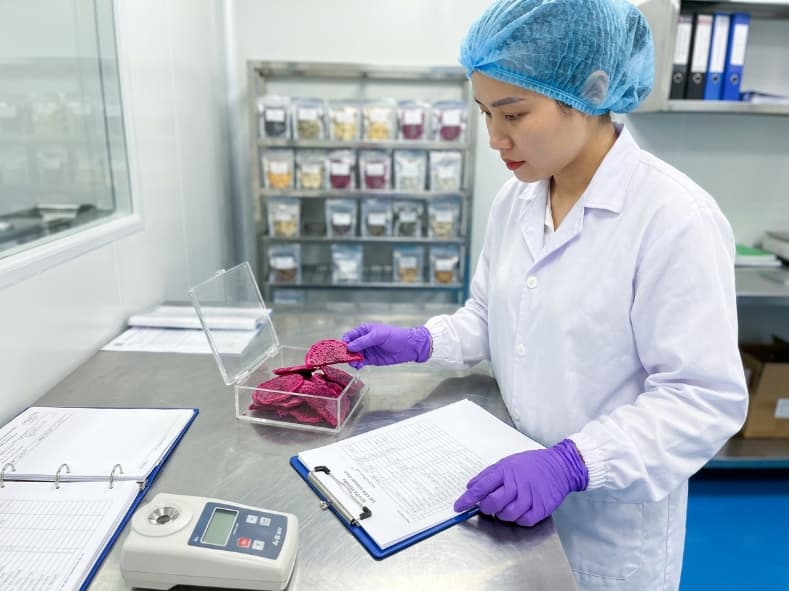
Application Mapping
| Buyer Type | Application | Required Format | Proof Needed | FruitBuys Delivery |
|---|---|---|---|---|
| Importer | Ambient retail snack | Slices or bites | Visual standard, moisture, Aw, breakage, packaging and lot COA | Quality Control and Documentation |
| Cereal producer | Dry fruit inclusion | Cubes or small bites | Size tolerance, fines, moisture migration and retained sample | Format control and release review |
| Granola producer | Tropical inclusion | Cubes or bites | Breakage limit, moisture, Aw and packaging protection | Packaging alignment and sample-to-bulk control |
| Beverage developer | Smoothie or drink base | Powder | Mesh, carrier status, dispersibility, color behavior and COA | Application-ready specification |
| Dairy developer | Yogurt, ice cream or plant-based dairy | Powder, cubes or bites | Microbiology, texture, color behavior and moisture review | QA documentation and product-format control |
| Bakery developer | Dough, batter, filling or dry mix | Powder | Heat behavior, ingredient file, dosage and particle size | R&D sample alignment and documentation |
| Foodservice distributor | Topping or garnish | Slices or bites | Visual standard, pack size, storage instruction and breakage limit | Export Logistics Coordination |
| Private label brand | Retail pouch SKU | Slices, bites or powder | Artwork inputs, Nutrition Facts basis, packaging file and release criteria | OEM / Private Label Delivery |
Why FruitBuys Delivers This
FruitBuys supplies freeze-dried dragon fruit as an export-ready product under one accountable supplier relationship. The buyer does not need a scattered set of samples for snack, beverage, bakery and dairy trials. The buyer needs one selected application route with a format, specification, packaging file and release proof.
Under Raw Material Sourcing Governance, FruitBuys aligns red-flesh or white-flesh material with the application target. Under Quality Control, FruitBuys verifies format, size, mesh, moisture, Aw, breakage, fines and sensory reference. Under Documentation, FruitBuys connects COA, laboratory reports, ingredient statements, packaging files and lot identity to the actual goods. Under OEM/Private Label Delivery, FruitBuys aligns application choice with pack size, artwork inputs and destination label review. Under Export Logistics Coordination, FruitBuys checks carton, inner pack and handling conditions against product fragility and moisture exposure.
The application decision drives the product file. If the buyer wants beverage powder, FruitBuys reviews mesh, carrier status and clumping risk. If the buyer wants cereal cubes, FruitBuys reviews size and fines. If the buyer wants retail slices, FruitBuys reviews visual standard and breakage. For retail SKUs, these decisions should move through the private label dragon fruit delivery workflow. One product name cannot serve every application without disciplined specification control.
Buyer Checklist
Before approving freeze-dried dragon fruit for a food application, confirm:
- Target application
- Red-flesh or white-flesh variant
- Format: slices, bites, cubes or powder
- Size, thickness or mesh
- Dosage level
- Ingredient and carrier status
- Added ingredient status
- Moisture target
- Aw target
- Microbiology panel
- Color reference
- Application test condition
- Breakage and fines limit
- Solubility or dispersibility where relevant
- Heat behavior where relevant
- Packaging structure
- Inner-pack weight
- Open-pack handling
- Storage instruction
- COA scope
- Retained sample
- Private label artwork impact
- Change-control triggers
Do not approve the application from a sample alone. Approve it from the finished-use test, specification, package and lot-release file.
Summary
Freeze-dried dragon fruit can support retail snacks, cereal and granola inclusions, beverage powders, dairy toppings, bakery systems, foodservice garnish and private label SKUs. Slices and bites serve visual snack and topping applications. Cubes support controlled inclusions.
Powder supports beverage, bakery and dairy formulation but requires mesh, carrier, clumping, color and packaging review. Buyers should verify moisture, Aw, microbiology, packaging, COA and sample-to-bulk consistency. FruitBuys supplies application-ready freeze-dried dragon fruit through specification control, QA documentation and private label delivery.
FAQ
Which freeze-dried dragon fruit format works best for snacks?
Slices and bites usually fit retail snack use. Buyers should control visual standard, size, breakage, moisture, Aw and packaging.
Which format works best for cereal and granola?
Cubes or small bites usually work better because they distribute more evenly. The buyer still needs size tolerance, fines control and moisture review.
Can dragon fruit powder work in beverages?
Yes, when the powder specification matches the drink system. Buyers should review mesh, carrier status, dispersibility, sedimentation, color behavior and COA.
Can dragon fruit powder work in bakery?
Yes, but the buyer must test heat behavior, dosage, color change, ingredient status and final product appearance before bulk approval.
Is red dragon fruit better for all applications?
No. Red works well where strong color matters. White can fit lighter snack, topping and mixed-fruit applications. Proof decides the final route.
Does application testing replace COA?
No. Application testing shows performance in the buyer’s product. COA confirms lot-specific release data. Both controls serve different purposes.
When should a buyer request a new sample?
Request a new sample when variant, format, mesh, carrier, packaging, dosage, destination or application matrix changes.
Conclusion
Submit the target application, format, pack type and destination so FruitBuys can review the sample, specification and application proof before bulk approval.
References
- A. Iqbal and co-authors. Impact of Different Drying Methods on the Phenolic Composition, In Vitro Antioxidant Activity, and Quality Attributes of Dragon Fruit Slices and Pulp. Foods, 2023. (Observatorio Latinoamericano)
- Vanessa Caroline de Oliveira and co-authors. Freeze-dried dragon fruit powder: characterization and incorporation in plant-based drink. Observatório de la Economía Latinoamericana, 2024. (Observatorio Latinoamericano)
- U.S. Food and Drug Administration. Water Activity (aw) in Foods. Content current as of 2014. (U.S. Food and Drug Administration)
- U.S. Food and Drug Administration. Draft Guidance for Industry: Establishing Sanitation Programs for Low-Moisture Ready-to-Eat Human Foods and Taking Corrective Actions Following a Pathogen Contamination Event. January 2025. (U.S. Food and Drug Administration)
- F. Gandía-Herrero and co-authors. Coloring attributes of betalains: a key emphasis on stability and future applications. Food Research International, 2016. (PubMed)