
Freeze-Dried Banana Market Readiness for the US, EU and UAE
Freeze-dried banana market readiness starts before a buyer requests final packaging or shipment files. A product can taste correct, meet the sample brief and still fail destination review because the label, importer responsibility, testing scope, certificate claim or lot documentation does not match the market. Importers, regulatory teams, QA managers and private label buyers need to treat the US, EU and UAE as separate approval routes.
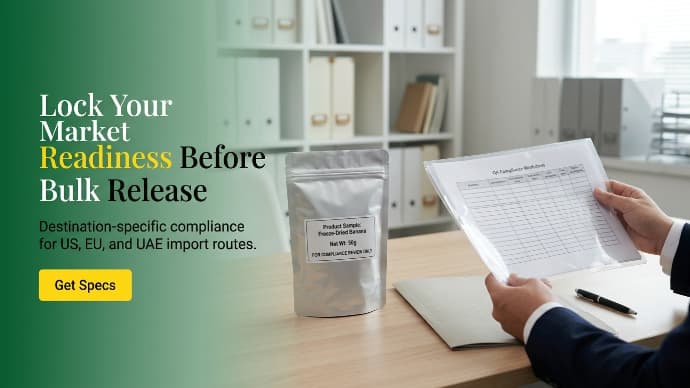
One clean supplier document does not make freeze-dried banana market-ready everywhere. FruitBuys treats market readiness as a controlled documentation process tied to product format, lot evidence, label inputs, packaging file and destination requirements. The buyer should define the destination first, then lock the testing, label and document scope before approving bulk release.
Does One Compliance File Cover Every Market?
No. Each destination applies its own rules for labeling, importer responsibility, contaminants and supporting documentation.
A certificate used for one market does not automatically establish readiness for another.
Buyers should define the destination before finalizing testing and label review.
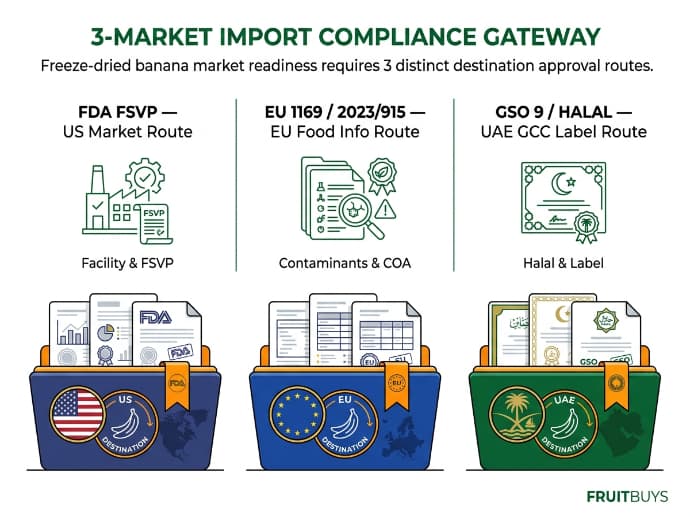
Freeze-dried banana may move through the same production route, but the approval file changes by destination. The US route may focus heavily on facility registration, importer verification and Nutrition Facts. The EU route may focus on food information, contaminants, residue scope and operator responsibility. The UAE route may require label review, storage instructions, origin information and careful treatment of Halal or conformity language.
This article sits under the freeze-dried banana wholesale guide. The hub explains the full product qualification route. This spoke focuses on destination-market readiness for US, EU and UAE buyers.
A buyer should not ask, “Is this product compliant?” That question is too broad. The better question is: “Which destination, which product format, which pack, which label, which lot and which document scope?”
United States Readiness
The US route should start with importer responsibility and facility status. FDA states that domestic and foreign facilities that manufacture, process, pack or hold food for human or animal consumption in the United States must register unless an exemption applies. FDA also states that a foreign food facility registration must include a US agent. (U.S. Food and Drug Administration)
US-focused freeze-dried banana buyers should review:
- Food facility registration applicability
- US agent information for a foreign facility where applicable
- Importer FSVP responsibility
- Product identity and ingredient statement
- Nutrition Facts route
- Lot-specific COA
- Microbiology and sanitation evidence
- Moisture and Aw results
- Packaging and storage statements
- Traceability records
- Shipment-document consistency
FDA’s FSVP rule requires importers to perform risk-based foreign supplier verification activities to verify that imported food is produced in a way that provides the same level of public-health protection required under applicable US standards. (U.S. Food and Drug Administration)
This does not make “FDA” a product certificate. Buyers should not write “FDA certified freeze-dried banana.” The correct review concerns facility registration applicability, importer verification, supplier evidence and label requirements. For lot evidence, connect this stage with lot-specific COA and laboratory testing.
US Label and Nutrition Review
US retail packs need a Nutrition Facts route that matches the final product. FDA states that it updated Nutrition Facts requirements on packaged foods and drinks and identifies added sugars, vitamin D, potassium, calcium and iron as part of the current label framework. (U.S. Food and Drug Administration)
For freeze-dried banana, US label review should cover:
| Label item | Buyer control |
|---|---|
| Product name | Must match the product identity |
| Ingredient statement | Must match banana and any treatment route |
| Serving size | Must match the final pack and US review |
| Nutrition Facts | Must use verified analysis or compliant calculation |
| Added sugars | Must reflect the ingredient route |
| Allergen statement | Must reflect product and facility assessment |
| Storage statement | Must match packaging and shelf-life evidence |
| Claims | Must receive separate review before use |
The supplied reference Nutrition Facts panel can support preliminary review, but it cannot become the final FruitBuys label without product-specific verification. Buyers should continue with freeze-dried banana Nutrition Facts.

EU Market Readiness
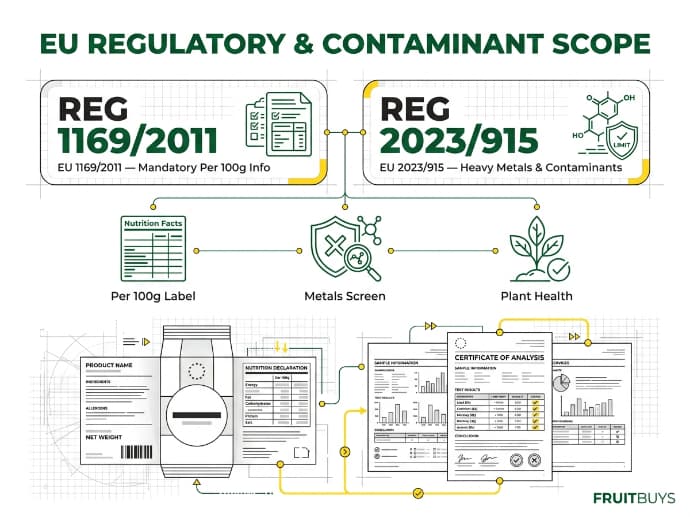
EU readiness starts with food information, contaminant scope, residue review and document consistency. Regulation (EU) No 1169/2011 covers the provision of food information to consumers, and EUR-Lex lists the consolidated version current to 01/04/2025. (Eur-Lex)
EU-focused buyers should review:
- Product name
- Ingredient list
- Nutrition declaration
- Allergen information where applicable
- Net quantity
- Date marking
- Storage conditions
- Food business operator details
- Language requirements by Member State
- Country-of-origin route where applicable
- Claims, if any
- Lot and traceability records
The EU route should not copy a US Nutrition Facts panel. EU food information and nutrition-declaration presentation differ. The buyer must prepare the label route for the destination, not recycle another market’s design file.
Commission Regulation (EU) 2023/915 sets maximum levels for certain contaminants in food and repealed Regulation (EC) No 1881/2006. EUR-Lex lists the regulation and its consolidated versions, including a current consolidated version dated 08/10/2025 in the search record. (Eur-Lex)
For freeze-dried banana, the buyer should confirm contaminant and residue testing scope before approval. Do not copy a contaminant panel from another fruit or another origin without checking product category, current legal text and buyer requirement.

EU Plant-Health and Document Review
A phytosanitary certificate should not be placed on every freeze-dried banana checklist without destination confirmation.
EU plant-health rules list banana among five fruits exempt from the phytosanitary certificate requirement, but the buyer must still verify the exact product and route.
Documentation should follow current destination rules, not an old template.
The European Commission states that no phytosanitary certificate is required for the fruits of pineapple, coconut, durian, banana or date under its listed plant-health rule information. (Food Safety)
This does not mean buyers can ignore documentation. It means buyers should stop treating phytosanitary paperwork as automatic. Product treatment, processing status, destination, importer instruction and current rule interpretation still matter.
EU documentation review should connect to HS code and documentation readiness. Product name, format, ingredient statement, lot code, packing list and supporting documents must carry the same identity.
UAE Market Readiness
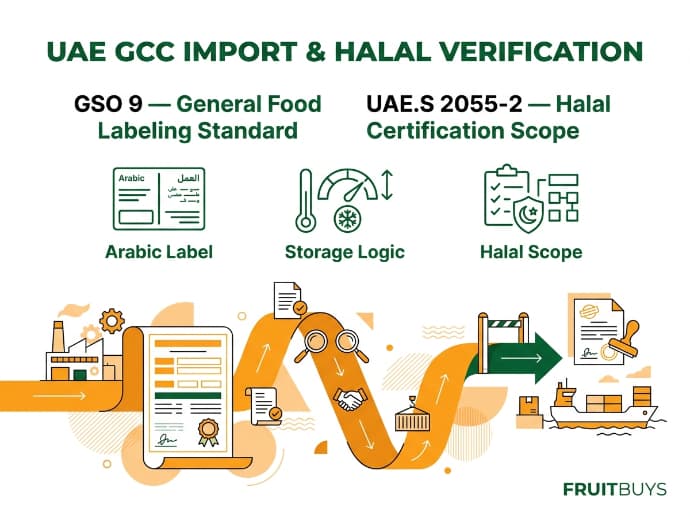
UAE readiness should begin with label presentation, product identity, origin, storage instructions and importer route. The Abu Dhabi Agriculture and Food Safety Authority’s general food labeling requirements state that pre-packaged food must not be described or presented in a false, misleading or deceptive way, and that mandatory labeling information must be clear, prominent, indelible and readily legible under normal conditions of purchase and use.
For UAE-focused freeze-dried banana, buyers should review:
- Product name
- Ingredient statement
- Net weight
- Country of origin
- Date marking
- Storage instructions
- Nutrition information route
- Arabic label requirements where applicable
- Importer or responsible-party information
- Halal claim only when exact certificate scope supports it
- Product and packaging consistency
The UAE route should not receive a label translated at the last stage without technical review. Storage statement, shelf-life direction, ingredient route and pack type must match the product file.
UAE MoIAT’s Halal standards page lists UAE.S/GSO 9 for labelling of prepackaged foodstuffs and UAE.S 2055-2 for general requirements for Halal certification bodies. (Moiat). That means a Halal reference or logo should not appear unless the exact product, production site, certification body, scope and validity support the claim.
Certification Scope
A certificate logo does not prove that the exact product, process and production site fall within scope.
Buyers must check the certificate holder, site address, scope and validity.
Unsupported certification language should not appear on product pages or labels.
For freeze-dried banana, buyers may request HACCP, ISO 22000, BRCGS, Halal or other certificate files. The document must be reviewed, not just collected.
Check:
- Legal certificate holder
- Site address
- Issuing body
- Certificate number
- Standard or scheme
- Scope statement
- Product category
- Included processes
- Issue date
- Expiry date
- Suspension status where available
- Link to the product format and packaging route
A certificate may support supplier review. It does not replace a lot-specific COA. It does not prove Nutrition Facts. It does not prove contaminant results. It does not make the product ready for every destination. This is why lot-specific COA and laboratory testing must sit beside certificate review.
Testing Matrix by Destination
The testing scope should follow the destination, buyer policy and application. A retail snack pouch, beverage powder and industrial inclusion may need different files.
| Requirement Area | US Route | EU Route | UAE Route |
|---|---|---|---|
| Facility or supplier review | Facility registration applicability and importer verification | Operator and supplier qualification | Importer and authority route review |
| Label route | Nutrition Facts and ingredient statement | Food information and nutrition declaration | General food labeling and Arabic route where applicable |
| Moisture and Aw | Lot-specific COA | Lot-specific COA | Lot-specific COA |
| Microbiology | Buyer and importer risk review | Buyer and market review | Buyer and importer review |
| Contaminants | Product and importer scope | EU 2023/915 applicability review | Destination and importer scope |
| Residues | Importer and buyer requirement | EU residue scope where applicable | Importer and buyer requirement |
| Certificates | Site, scope and validity | Site, scope and validity | Site, scope, validity and Halal claim review |
| Packaging | Shelf-life and storage support | Shelf-life and storage support | Shelf-life and storage support |
Do not treat this table as a fixed legal checklist. It is a market-readiness map. The final file must follow the product format, destination and buyer instruction. For packaging evidence, continue with packaging and shelf-life validation.
Packaging and Shelf-Life Evidence
Shelf life is not a market claim that can float without evidence. For this dataset, 12–24 months remains a conditional shelf-life direction. It should only move into publication when the product format, moisture, Aw, package structure, seal integrity, storage condition and validation route support it.
Freeze-dried banana needs packaging review because its porous structure can absorb moisture. Slices can soften or break. Powder can cake. Bites and cubes can clump or lose texture.
Market reviewers may ask for:
- Product specification
- Packaging specification
- Storage condition
- Shelf-life statement
- COA
- Retained sample record where available
- Lot code
- Packing record
- Label storage instruction
This belongs in freeze-dried banana packaging and shelf-life control.
OEM and Private Label Market Readiness
Private label products carry higher documentation pressure because product, pouch, label and consumer-facing claims meet in one SKU.
A private label freeze-dried banana project should lock:
- Destination
- Product format
- Pack size
- Ingredient statement
- Nutrition Facts or nutrition declaration route
- Storage statement
- Shelf-life support
- Language requirements
- Claims review
- Certificate-scope review
- Lot-release COA
- Packaging file
- Artwork approval record
The buyer should not finalize artwork before market-readiness review. Artwork moves fast; regulations and QA files move by proof. This route belongs in OEM and private label delivery.
Highest-Risk Market Shortcut
The highest-risk shortcut is approving product quality before approving the destination file.
A strong sample cannot repair a weak label, missing lot evidence, unsupported certificate claim or wrong document route.
Buyers should approve market-readiness evidence before bulk release.
This failure path is common. The buyer approves the sample. R&D likes the product. Procurement moves forward. Then the regulatory team asks for label basis, certificate scope, facility status, contaminant panel or lot-specific COA. The file is thin. Approval pauses. The product is not the problem. The documentation route is the problem.
That delay is avoidable. The buyer should define destination and document scope before final sample approval. FruitBuys can then align product specification, testing, packaging, label inputs and release files under one route.
Application Mapping
| Buyer Type | Application | Required Format | Proof Needed | FruitBuys Delivery |
|---|---|---|---|---|
| US importer | Retail or ingredient import | Slices, bites, cubes or powder | Facility-registration applicability, FSVP support file, COA, label route | Documentation and QA alignment |
| EU importer | Retail or ingredient distribution | Defined format | Food information review, contaminant scope, COA, traceability | Market-ready document set |
| UAE distributor | Retail or foodservice supply | Defined pack | General label review, storage statement, origin, certificate scope | Product and label-file alignment |
| Private label buyer | Branded pouch | Slices, bites or powder | Nutrition route, label language, packaging, COA | OEM / Private Label Delivery |
| QA manager | Supplier approval | Any approved format | Certificate scope, laboratory reports, methods and lot identity | Quality Control and Documentation |
| R&D developer | Product launch trial | Powder, bites, cubes or slices | Application test, COA, packaging evidence | Application-matched sample route |
| Procurement manager | Supplier qualification | Defined commercial format | Market-specific document checklist and release condition | Single accountable product file |
Why FruitBuys Delivers This
FruitBuys supplies freeze-dried banana through an Integrated Product Supply Model. The buyer does not collect isolated product samples, certificates, packaging notes and document drafts from disconnected sources. FruitBuys aligns the market-readiness file with one supplied product under one accountable supplier relationship. For US, EU and UAE readiness, FruitBuys applies five controls.
Documentation aligns product specification, ingredient statement, COA, laboratory reports, certificate scope, label inputs, packing records and shipment file identity.
Quality Control connects moisture, Aw, microbiology, contaminants, residues and physical inspection to the product format and release plan.
OEM/Private Label Delivery aligns pack size, label route, artwork inputs, coding, storage statement and destination review.
Export Logistics Coordination keeps product description, carton data, lot code and documentation aligned before handover.
Raw Material Sourcing Governance supports traceability and origin review by connecting raw material direction to the finished lot.
Buyers preparing a complete request should use the freeze-dried banana buyer RFQ checklist.
Buyer Checklist
Before approving freeze-dried banana for a target market, request:
- Destination country or region
- Product format
- Final pack type
- Ingredient statement
- Pretreatment declaration
- Nutrition Facts or nutrition declaration route
- Product specification
- Moisture and Aw limits
- Lot-specific COA template
- Microbiology panel
- Contaminant and residue panel
- Certificate copies
- Certificate scope and validity
- Packaging specification
- Storage statement
- Shelf-life evidence
- Lot-coding rule
- Packing record
- Traceability route
- Shipment document list
- Label-language requirements
- Importer-specific requirements
- National classification confirmation where required
Do not approve the destination route from a generic product sheet. Market readiness lives inside the final file, not the product name.
Summary
Freeze-dried banana market readiness differs for the US, EU and UAE. US review should address food facility registration applicability, importer FSVP responsibility, Nutrition Facts and lot evidence. EU review should address Regulation (EU) 1169/2011 food information, contaminant scope under Regulation (EU) 2023/915 and document consistency.
UAE review should address general food labeling, origin, storage instructions and certificate-scope review. FruitBuys connects market readiness through Documentation, Quality Control, OEM/private label delivery, export logistics coordination and traceability.
FAQ
Does one freeze-dried banana document file cover the US, EU and UAE?
No. Each destination requires its own label, testing, certificate and documentation review.
Is FDA a product certificate?
No. FDA registration and importer verification relate to regulatory processes. They do not make freeze-dried banana “FDA certified.”
What should US importers review first?
Review facility-registration applicability, FSVP responsibility, Nutrition Facts, ingredient statement, COA, testing scope and traceability.
What should EU buyers review first?
Review food information, nutrition declaration, contaminant and residue scope, lot traceability, product description and document consistency.
What should UAE buyers review first?
Review product name, ingredient statement, origin, date marking, storage instructions, nutrition route, Arabic label needs and certificate scope.
Can a Halal logo be used automatically?
No. The exact product, site, certification body, scope and validity must support the Halal claim.
What should buyers define before samples?
Define destination, format, pack type, label route, testing scope, documentation requirements and release criteria.
Conclusion
Freeze-dried banana market readiness is not a generic compliance badge. The US, EU and UAE routes each require destination-specific review. A strong sample and a clean product sheet cannot replace label proof, importer responsibility, COA, testing scope, certificate review, packaging evidence and document consistency. Buyers who delay this review push risk into the final approval stage. That creates avoidable hold points and relabeling work.
Submit the destination-market brief before finalizing the testing, label and documentation scope.
References
- U.S. Food and Drug Administration. Questions Regarding Whether Food Facilities Are Required to Pay Registration Fees and Private Businesses Claiming or Suggesting an Affiliation with FDA. (U.S. Food and Drug Administration)
- U.S. Food and Drug Administration. Food Facility Registration and Registration Cancellation by Paper. (U.S. Food and Drug Administration)
- U.S. Food and Drug Administration. FSMA Final Rule on Foreign Supplier Verification Programs for Importers of Food for Humans and Animals. (U.S. Food and Drug Administration)
- U.S. Food and Drug Administration. What’s on the Nutrition Facts Label and Changes to the Nutrition Facts Label. (U.S. Food and Drug Administration)
- European Union. Regulation (EU) No 1169/2011 on the provision of food information to consumers. (Eur-Lex)
- European Union. Commission Regulation (EU) 2023/915 on maximum levels for certain contaminants in food. (Eur-Lex)
- European Commission. Plant health rules and Trade in plants and plant products from non-EU countries. (Food Safety)
- Abu Dhabi Agriculture and Food Safety Authority. Code of Practice No. 05 of 2019: General Food Labelling Requirements. (Cục Đường bộ Ả Rập Emirate)
- UAE Ministry of Industry and Advanced Technology. Halal standards and UAE.S/GSO 9 labelling reference. (Moiat)