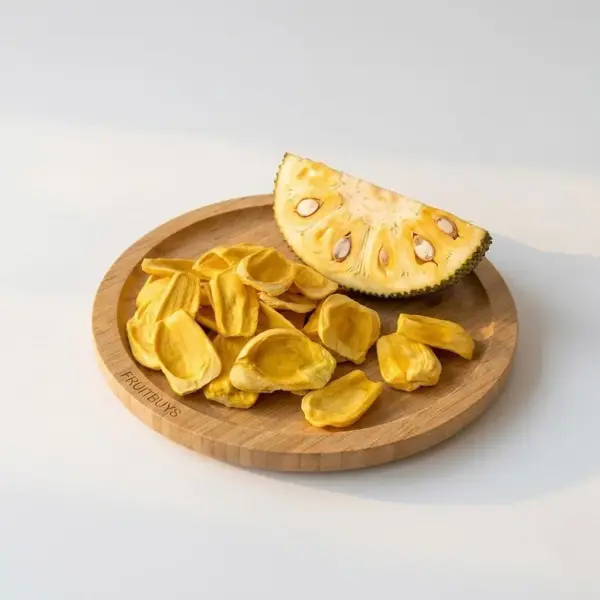
Freeze-Dried Jackfruit
Freeze-dried jackfruit is ripe jackfruit bulb flesh, deseeded and dried under vacuum from the frozen state. The result is a crisp, light piece with low water activity that keeps the colour, sweetness and aroma of fresh jackfruit. FruitBuys supplies it from Vietnam in bulk cartons and private-label retail packs for cereal, snack and confectionery manufacturers, importers and distributors. It is one of the tropical fruits in our freeze-dried fruit range.
This is ripe jackfruit, not the young green jackfruit sold as a meat substitute. If you need a savoury, fibrous ingredient that shreds like pulled meat, you need young jackfruit; FruitBuys supplies young jackfruit for savoury and plant-based lines as a custom project order. Before you shortlist suppliers, our guide to buying freeze-dried jackfruit in bulk explains how to compare forms, check a supplier and write an RFQ.
Product specification
| Item | Specification |
|---|---|
| Product | Freeze-dried jackfruit, ripe bulbs |
| Ingredient | 100% jackfruit (Artocarpus heterophyllus Lam.), deseeded; no sugar added |
| Origin | Vietnam: Tien Giang and Hau Giang (Mekong Delta), Dong Nai and the Central Highlands; Thai jackfruit at 18–24 °Brix, harvested year-round |
| Forms | Whole bulbs, pieces, dice |
| Texture / colour | Crisp, porous; natural golden yellow |
| Moisture | ≤5.0% contract limit (factory release target ≤4.0%) |
| Water activity | ≤0.30 contract limit (factory release target ≤0.25) |
| Total plate count | ≤10⁴ CFU/g |
| Yeasts and moulds | ≤10² CFU/g |
| E. coli / Salmonella | <10 CFU/g / not detected in 25 g |
| Conversion | 5–6 kg of deseeded bulbs per 1 kg of finished product |
| HS code | 0813.40 (dried fruit, other); confirm the national subheading with your broker or a BTI |
| Shelf life | 12 months at ≤25 °C, RH ≤60%; 18–24 months in cool storage at ≤18 °C, RH ≤50%, in the original unopened bag |
Contract limits, release testing and how to read the COA that travels with your lot are set out in freeze-dried jackfruit moisture, water activity and COA.
Nutrition (per 100 g, typical)
| Nutrient | Amount | % Daily Value* |
|---|---|---|
| Calories | 388 kcal | |
| Total fat | 0 g | 0% |
| Saturated fat | 0 g | 0% |
| Sodium | 0 mg | 0% |
| Potassium | 1,446 mg | 31% |
| Total carbohydrate | 88 g | 32% |
| Dietary fiber | 7.1 g | 25% |
| Total sugars | 67 g (naturally occurring, 0 g added) | |
| Protein | 7.1 g | 14% |
*Based on a 2,000 calorie diet.
Typical values for 100% freeze-dried jackfruit; values typically move within ±5–10% with season, origin and ripeness. A lot nutrition panel on your commercial lot is available for label artwork.
Formats and applications
| Format | Typical use |
|---|---|
| Whole bulbs | Retail snack packs and gift lines |
| Pieces | Trail mix, snack blends, yogurt and dessert toppings |
| Dice | Breakfast cereal, granola, bakery and chocolate inclusions |
| Powder | Beverages, dairy and bakery mixes: see freeze-dried jackfruit powder and the powder buying guide |
About 70% of the dry matter is natural sugar, so the pieces pick up moisture quickly. In milk, yogurt or a moist filling they soften within minutes. Use a fat or chocolate coating, or add the fruit at the point of consumption. Which cut suits which line is set out in freeze-dried jackfruit formats for food manufacturing.
Packaging
| Option | Detail |
|---|---|
| Bulk | 1–5 kg PET/AL/LLDPE barrier bags (100–120 µm), light-vacuum sealed with a 50–100 g desiccant, in a 5-ply export carton |
| Export carton | 58 × 28 × 34 cm, 7–10 kg net |
| Retail / private label | 30 g, 50 g, 100 g, 500 g aluminium zip pouches, gently vacuumed with a desiccant sachet (no nitrogen flush), or as requested |
| Storage | Below 25 °C and 60% RH, away from light and strong odours; re-seal after opening |
Carton weight changes your freight cost. In the same carton, a 10 kg fill puts 43% more product in a container than a 7 kg fill. The trade-off is breakage: whole bulbs pack lighter than dice. See how bulk freeze-dried jackfruit is packed and loaded.
Commercial terms
| Item | Detail |
|---|---|
| Production capacity | 100 tons/year |
| Private label / OEM / ODM | From 3,000–5,000 pouches per SKU on digital print (7–10 working days); from 500 kg per SKU on rotogravure (15–20 working days) |
| Samples | Dispatched in 3–5 working days; delivery time depends on the courier |
| Production lead time | 20–30 days for a 20 ft container, after deposit |
| 20 ft container, floor-loaded | About 550 cartons, 3,850–5,500 kg net |
| 40 ft HC container, floor-loaded | Up to 1,120 cartons, 7,840–11,200 kg net |
| Palletized (1.2 × 1.0 m pallets) | 20 ft: 300–320 cartons on 10 pallets · 40 ft HC: 720–756 cartons on 20–21 pallets |
| Pre-shipment sample | 100–200 g drawn from the packed lot in two sealed foil pouches, couriered within 24–48 hours of packing |
| Facility | One qualified facility locked to your contract, with on-site audit access and written change-control |
| Payment terms | T/T 40% deposit, 60% before shipment or against copy of B/L; L/C at sight |
| Port of loading | Cat Lai Port or Tan Son Nhat Airport |
| Shipping terms | FOB, CIF, DDP (sea and air) |
| Pricing | Quoted per form, cut size, packaging and Incoterm |
Container figures are planning values for floor-loaded cartons; the stuffing plan fixes the final count for your cut. Freeze-dried jackfruit costs more per kilogram than air-dried jackfruit because each kilogram uses 5–6 kg of deseeded bulbs; how much fresh jackfruit makes 1 kg of freeze-dried shows how to compare quotes on the same basis.
Quality and documents
- Standard COA with every full-container order: moisture, water activity, total plate count, yeasts and moulds, Salmonella and E. coli, per lot. Lead, arsenic and aflatoxin are tested on periodic batches.
- Extended tests on request, arranged at an accredited laboratory of your choice, such as Eurofins or SGS in Vietnam, before the container is sealed, and quoted at net laboratory cost: cadmium, pesticide multi-residue, nutrition panel, extended microbiology (Listeria, Enterobacteriaceae), ethylene oxide, sulfite.
- Trial and LCL orders: free in-house release QC log per batch (moisture, water activity, sensory), backed by our periodic third-party baseline reports. Independent batch testing can be arranged before dispatch; it runs at net laboratory cost and is credited back in full against your first full container.
- Baseline surveillance: periodic third-party testing for lead, arsenic, aflatoxin and core pathogens tracks long-term process capability, separately from lot release. Current reports are available on request.
- Retained samples: kept from every container lot at 20–22 °C and ≤50% RH for 24 months.
- Certifications: HACCP, ISO 22000, BRC and US FDA food facility registration, with Halal certification available on request; certificate copies and registration numbers are part of the pre-contract technical dossier.
- Standard export dossier with every shipment: phytosanitary certificate, certificate of origin (Form EUR.1 where a preference applies), lot COA and commercial documents, so your broker clears the container without chasing paperwork.
Import and labeling
- United States: dried jackfruit enters under HTS subheading 0813.40.90.00. FruitBuys supplies the facility’s US FDA registration number; the importer files an FDA Prior Notice for each shipment and keeps its FSVP file.
- European Union and UK: dried jackfruit is named in EU tariff line CN 0813 40 65, which carries 0% duty for every origin. Where a UK rate applies, the UKVFTA preference runs with a Form EUR.1. Jackfruit is not one of the 14 regulated allergens.
- UAE / GCC: product registration by the importer and Arabic labeling; see UAE product registration for freeze-dried jackfruit.
- HS code, residue testing and documents by market are covered in freeze-dried jackfruit HS code and import documents.
Verify the sample
- Look and smell. Golden yellow bulbs with ripe jackfruit aroma; reject chalky, pale or burnt-smelling pieces against the reference sample.
- Snap test. Pieces should break clean and crisp. A bendy or gummy piece points to moisture above the ≤5.0% limit.
- Water activity on arrival. Read aw from a freshly opened bag: ≤0.30 passes. A single bag above 0.35 usually means a punctured bag, not a failed lot.
- Fines. Sieve one bag: dice ≤3–5%, whole bulbs ≤5–8% broken pieces.
- Lab pouch. Send the second, sealed pre-shipment pouch to your laboratory and compare the results with the lot COA.
FAQ
Is freeze-dried jackfruit the same as the jackfruit used as a meat substitute?
No. Meat-substitute jackfruit is young, green and unsweet. Freeze-dried jackfruit is made from ripe, sweet bulbs and is used as a fruit snack or ingredient.
Does it contain added sugar?
No. The ingredient is 100% jackfruit. The sweetness, about 67 g of sugars per 100 g, comes from the fruit and is concentrated by drying.
How much fresh jackfruit goes into 1 kg?
Between 5 and 6 kg of deseeded bulbs, before counting peel, core and seeds removed from the whole fruit.
Do I get a COA for every lot?
Every full-container order comes with a lot COA for moisture, water activity, total plate count, yeasts and moulds, Salmonella and E. coli. Trial and LCL orders receive a free in-house release QC log, backed by our third-party baseline reports.
Why does the product go soft?
It absorbs moisture from the air once opened. Keep bags sealed, store below 60% humidity, and re-seal after each use.
What is the minimum order?
Bulk orders have no fixed minimum. Private-label packs start at 3,000–5,000 pouches per SKU on digital print, or 500 kg per SKU on rotogravure.
For the eight checks to run on any supplier before you commit, start with the freeze-dried jackfruit buyer guide.
Request a quote
Include these details so we can quote on the right basis:
- Form (whole bulbs, pieces, dice) and target cut size
- Annual volume and first-order quantity
- Bulk or retail packaging; pouch sizes for private label
- Destination country and Incoterm (FOB, CIF, DDP)
- COA parameters required beyond the standard set
- Labeling or certification requirements for your market
- Sample quantity and delivery address