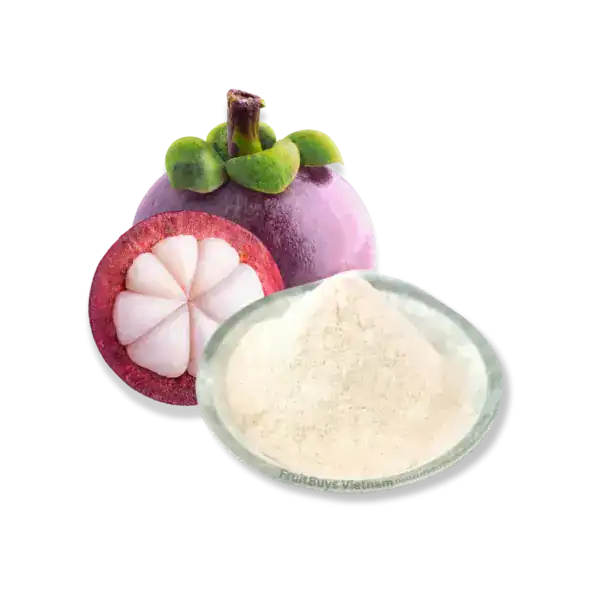
Freeze-Dried Mangosteen Powder for Food and Beverage Manufacturers
Freeze-dried mangosteen powder is the whole aril of Vietnamese Garcinia mangostana, with its natural seed, freeze-dried and milled cold to 60–80 mesh at ≤5.0% moisture and water activity ≤0.30. The standard version is 100% fruit: no maltodextrin, no anti-caking agent, no added sugar. A free-flowing version with up to 1% silicon dioxide runs on automatic stick-pack lines. It brings a sweet-tart tropical flavour and a natural ivory colour to drinks, dairy and confectionery, with a one-line label: “100% mangosteen”. The freeze-dried arils are cold-milled in a climate-controlled, dehumidified room (22–25 °C, below 40% RH) to 60–80 mesh and packed straight into foil, and every container lot ships with a third-party COA.
This is fruit powder from the white aril, not mangosteen peel (pericarp) powder sold for supplements. The fruit comes from Lai Thieu and the Mekong Delta at 16–19 °Brix, which is why it tastes sweet first, then bright and tart, with a floral finish. What to write into your contract is set out in what to specify before buying freeze-dried mangosteen powder in bulk.
Product specification
| Parameter | Specification |
|---|---|
| Composition | Pure: 100% mangosteen (standard) · Free-flowing: + up to 1% silicon dioxide (E551), on request; no carrier, added sugar or preservative |
| Raw material | Whole freeze-dried arils, seed-in; rind-free |
| Raw fruit | Lai Thieu (Binh Duong), Cho Lach (Ben Tre) and other Mekong Delta and Southeast orchards; aril 16–19 °Brix; main and late-season fruit, IQF-frozen in season for year-round milling |
| Fruit per kilo | about 17–24 kg whole fruit → 5–6 kg hand-peeled aril → 1 kg powder, by fruit size and season |
| Particle size | 60–80 mesh, ≥95% passing |
| Moisture | ≤5.0% (target ≤3%) |
| Water activity | ≤0.30 |
| Colour / taste | Ivory to light cream, no grey or purple specks; sweet-tart, no bitterness, no cooked note |
| Caking | Soft lumps that break under light pressure allowed; no hard caking |
| Total plate count | ≤10⁴ CFU/g standard · <1,000 CFU/g inclusion grade for chocolate, yogurt, ice cream and bars, confirmed on each lot COA |
| Yeasts & moulds | ≤10² CFU/g |
| E. coli | <10 CFU/g |
| Salmonella | Not detected / 25 g |
| Shelf life | 12 months at ≤25 °C, RH ≤60%; 18–24 months in cool storage at ≤18 °C, RH ≤50% |
| HS code | 1106.30, powder of Chapter 8 fruit; your broker confirms the national line |
Seed in, rind out. The whole aril goes to the chilled mill with its natural seed, so the powder carries the whole fruit, with its 13.3 g of fibre per 100 g, its fruit acids and its own sweetness. There is no deseeding step, so the arils are not cut open or handled again before milling. Bitterness in mangosteen comes from the rind, and that is where the control sits. A fragment of purple rind is easy to see on a whole aril and impossible to remove from powder, where it becomes grey specks and a bitter note. The arils going to the mill pass the same visual rind inspection as the arils packed whole, so the powder tastes of clean fruit.
Nutrition (per 100 g, typical values)
| Nutrient | Amount |
|---|---|
| Energy | 400 kcal (US label) / 360 kcal (EU label) |
| Total fat | 1.7 g |
| Saturated fat | 0 g |
| Sodium | 0 mg |
| Total carbohydrate | 90 g |
| Dietary fibre | 13.3 g |
| Total sugars | 70 g, naturally occurring (0 g added) |
| Protein | 3.3 g |
| Potassium | 260 mg |
Typical values for 100% freeze-dried mangosteen; natural variation by origin, season and ripeness applies. Lot nutrition panel available for label artwork.
The two energy figures come from two label rules: US labels count fibre with the carbohydrate, EU labels count fibre at 2 kcal/g. For your printed label, FruitBuys samples your commercial export lot and arranges the nutrition panel at an independent ISO/IEC 17025 accredited laboratory, formatted for your market.
The profile gives your marketing team clear label lines. The powder itself is 100% fruit with no added sugar, and at 13.3 g of fibre per 100 g it is well above the 6 g per 100 g that the EU sets for a “high fibre” claim. Most of the fruit’s xanthones sit in the purple rind and the white flesh carries only small amounts, so the strongest pack story is taste, clean label and fibre. Claims on your finished product follow your final recipe, so the lab panel on your commercial lot is the basis for the pack.
Applications and dosing
| Application | Typical dose | What it brings |
|---|---|---|
| Beverage and smoothie premixes, milk tea | 3–8% | Fruit flavour and natural body |
| Yogurt, ice cream, fillings | 3–6% | Flavour and ivory colour without colouring |
| White chocolate, coatings, icings | 3–5% | Fruit through every bite, pale colour kept |
| Bakery creams and dusting | 3–8% | Real-fruit label claim |
| Stick packs and sachets on auger lines | As formulated | Free-flowing version keeps the line running |
Freeze-dried powder is the whole aril, so it keeps the fruit’s sugars, acids and fibre. Spray-dried juice powders typically carry 30–50% maltodextrin and lose much of their aroma in the hot tower, so compare cost per kilo of fruit and per finished batch, not price per kilo of powder. A 100 kg batch of ice cream at 3–5% takes 3–5 kg of powder: one 5 kg bag, and a “100% fruit” line on the ingredient list. Pair powder with freeze-dried mangosteen arils and diced where the consumer should also see and bite the fruit.
How it is milled and packed
Powder can only gain moisture after the dryer, never lose it, so the milling room decides its quality. The arils are milled cold, so mangosteen sugar does not smear on the screen or brown, in a climate-controlled, dehumidified room at 22–25 °C and below 35–40% RH. The powder goes from the mill straight into foil, with no open hold in between, which keeps it free of hard caking.
| Item | Detail |
|---|---|
| Bulk bag | 5 kg aluminium-foil PE bags, gently de-aerated, food-grade silica gel sachet; no nitrogen, no iron-based absorbers |
| Carton | Standard export carton 58 × 28 × 34 cm, 20 kg as 4 × 5 kg bags; custom cartons and palletisation on request |
| Retail (OEM) | Stick packs, sachets, jars or foil pouches |
A 5 kg bag matches one batch on most lines: open it in a room below 40% RH, use the whole bag, and the other three in the carton stay sealed until their own batch.
Commercial terms
| Term | Detail |
|---|---|
| 20ft, floor-loaded | about 550 cartons, about 11 t, loaded to order size |
| 40ft HC | Not used for powder: a full load exceeds road weight limits; ship 20ft |
| Freight per kg | about 35% of the freight per kg of whole arils |
| Trial order | 50–100 kg, air or LCL |
| Bulk order | 200–500 kg and up |
| OEM / private label | MOQ 500 kg |
| Capacity | Up to 100 t/year of finished freeze-dried product across multi-fruit lines; mangosteen allocated by pre-season confirmation |
| Production lead time | 20–30 days per 20ft after deposit |
| Samples | Prepared in 3–5 working days |
| Payment | T/T 40% deposit, 60% before shipment or against copy B/L; L/C at sight |
| Incoterms | FOB, CIF, DDP |
| Port of loading | Cat Lai Port or Tan Son Nhat Airport |
Powder gives you the widest buying window in the mangosteen range. Arils are IQF-frozen at −25 °C in season and milled to order through the year, and powder also uses late-season fruit from August and September, with the same flavour. A 100 kg trial at 5% flavours 2 tonnes of finished product, enough for a full factory run before you commit to bulk.
Quality and documents
- Every full-container lot: third-party COA for moisture, water activity, total plate count, yeasts & moulds, E. coli and Salmonella.
- Periodic surveillance: lead, arsenic and aflatoxin (total and B1) at an ISO/IEC 17025 accredited laboratory. Reports available on request.
- Trial and LCL orders: trial orders ship with a free release QC log and our baseline reports; third-party testing on trial lots is arranged on request.
- Claims: 14 days from devanning for packaging, appearance, caking and water activity; 30 days for laboratory results.
- Facility control: one qualified processing facility locked per contract, with written notice and a new pre-shipment sample before any change, and audit access.
- Facility certifications: HACCP, ISO 22000, BRC (qualified processing facility) and US FDA Facility Registration. Halal certification available on request.
- Shipment documents: commercial invoice, packing list, bill of lading, COA, Certificate of Origin Form EUR.1, and a phytosanitary certificate with every shipment as part of the standard export dossier, so your broker clears the container on one complete file.
Import and labelling
- HS 1106.30, EU and UK: Form EUR.1 claims the preferential duty agreed under the EU–Vietnam FTA for fruit powders; check the line for your entry in the EU customs tariff database. The same EUR.1 works for the UK under UKVFTA.
- United States: the powder enters under heading 1106.30 of the US Harmonized Tariff Schedule as a processed food, with FDA Prior Notice filed before arrival. Your broker adds any US trade tariffs in force on the entry date.
- EU border checks: mangosteen is not on the EU list of foods under increased official controls, so containers move through routine controls.
- Ingredient line: “100% mangosteen (Garcinia mangostana)”. The seed is milled into the powder, so no seed statement is needed.
- Claims: sell on taste, clean label and fibre; no xanthone or health claims on a flesh-based powder.
Market-by-market detail is in what freeze-dried mangosteen needs to clear customs.
Verify the sample in three steps
- Look and feel. Even ivory colour with no grey or purple specks; powder free-flowing or in soft lumps that break under a finger. Moisture, water activity and microbiology are on the lot COA.
- Run it in your base. Disperse at 3–8% in your real product, milk, chocolate or ice cream: it should disperse smoothly with no gritty feel, and taste clean and sweet-tart with no bitterness.
- Check it after a week. Taste and look at the trial again after 7 days for colour and aroma stability.
FAQ
Is freeze-dried mangosteen powder 100% fruit?
The pure version is: whole arils, seed-in, with no carrier or added sugar. The free-flowing version adds up to 1% silicon dioxide.
Does it contain the seed?
Yes, milled with the aril. The rind is kept out.
Is it the same as mangosteen peel (rind) powder?
No. Peel powder is a bitter supplement ingredient made from the purple pericarp. This is the white flesh, used for flavour and colour.
How much should I use?
Usually 3–8% of the recipe.
What is the minimum order?
Trials from 50–100 kg, bulk from 200–500 kg, private label from 500 kg.
How much fits in a 20ft container?
About 550 cartons of 20 kg, or about 11 tonnes.
When is it available?
Through the year. Arils are IQF-frozen at −25 °C in season and milled to order, using main-season and late-season fruit.
Request a sample and quote
Send these details and we return a specification, sample and terms in one reply. The full specification guide is what to specify before buying freeze-dried mangosteen powder in bulk.
- Destination country and port
- Application and target dose
- Version: pure or free-flowing, and filling equipment (mixer, auger, stick-pack)
- First-order volume: trial, bulk or container
- Annual volume and delivery months
- Packaging: 5 kg bulk bags or retail format
- Labelling market
- Extra tests required by your market or customer