Dried Mango No Added Sugar: 10 Industrial Applications

A granola manufacturer in the Netherlands reformulated their tropical fruit inclusion three times in eight months. The issue was not flavor. It was moisture migration. Their previous dried mango supplier delivered batches with moisture content ranging from 14% to 21% across a six-month supply window. At 21% moisture, the mango pieces released free water into the granola matrix during shelf life, softening the oat clusters and generating consumer complaints about texture.
At 14%, the pieces were too hard and brittle, breaking under the tumbler and producing fines that failed the visual quality standard. The manufacturer was not buying a bad product. They were buying an inconsistent one. That inconsistency cost them three reformulation cycles and a delayed retail listing.
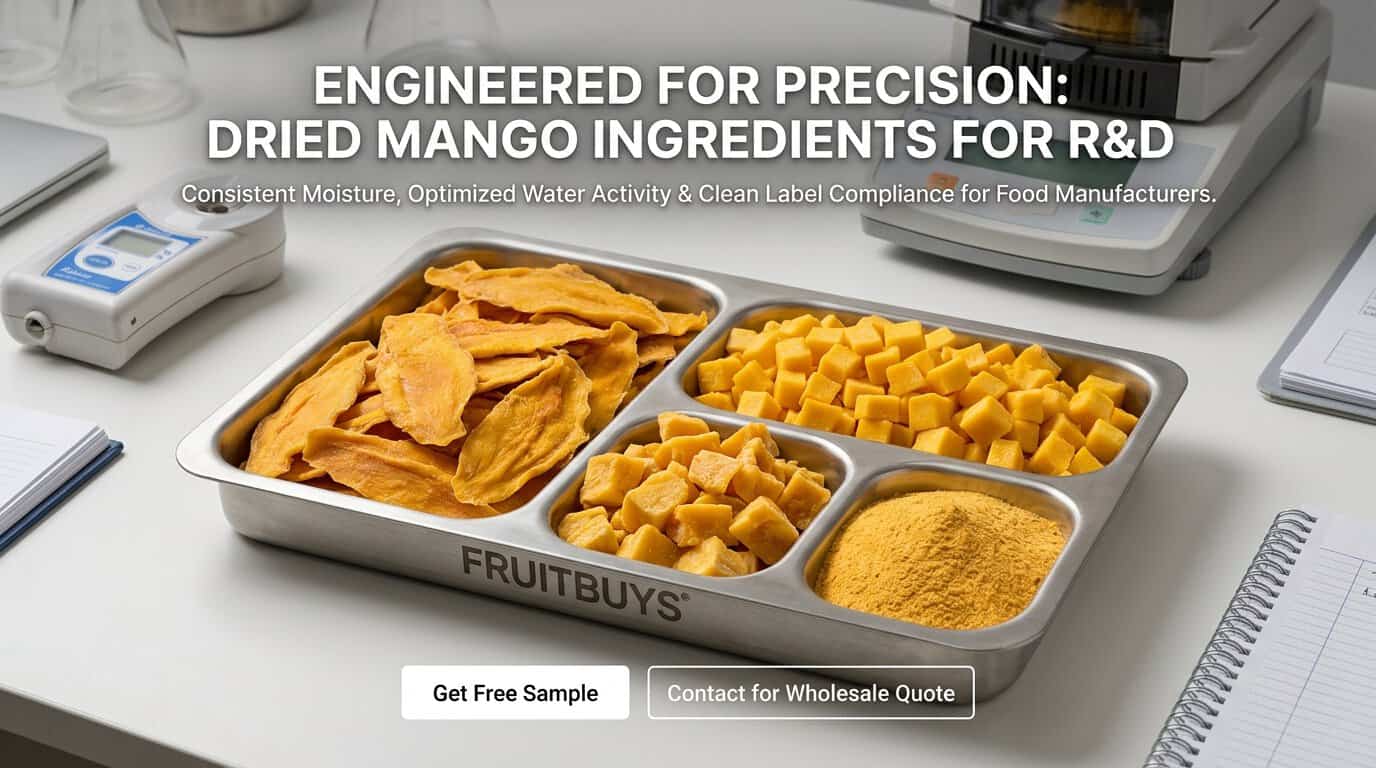
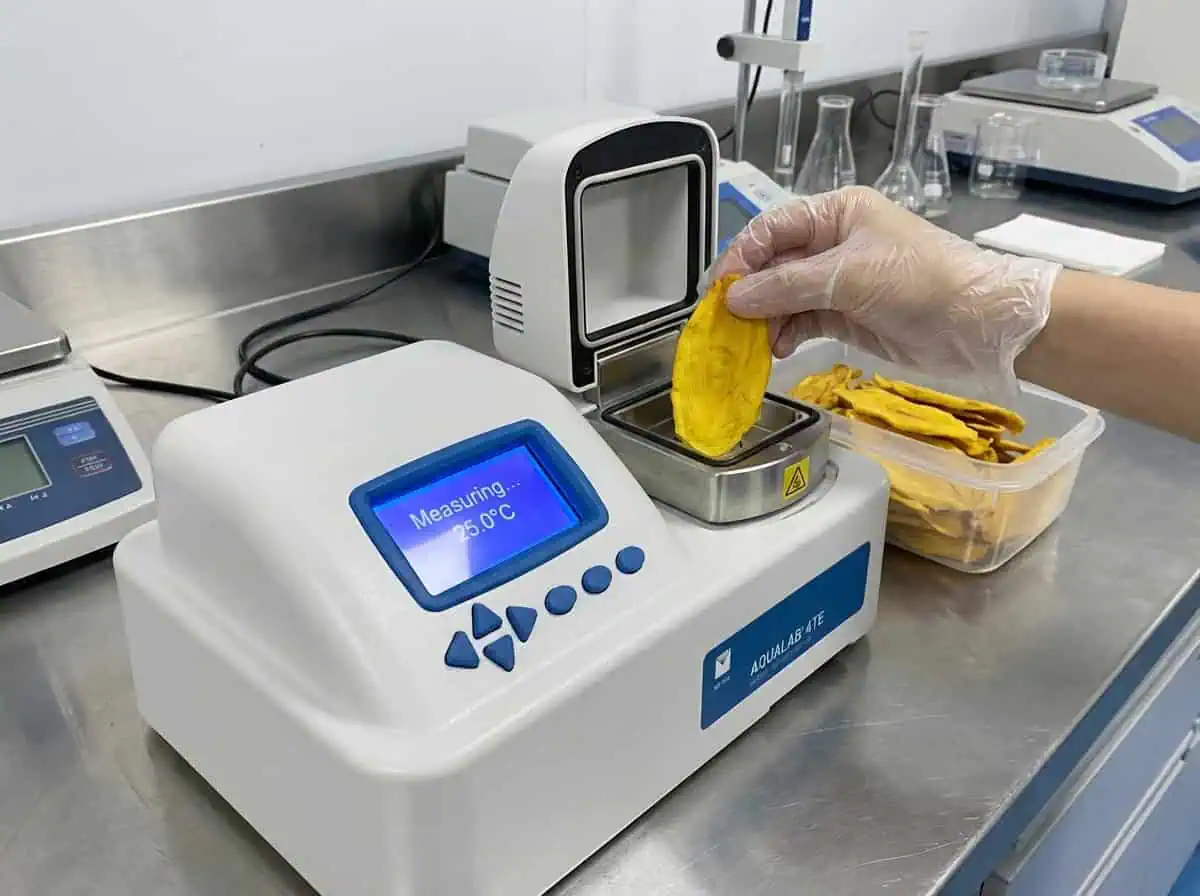
Dried mango no added sugar from FRUITBUYS VIETNAM is produced to moisture 15–18% (target 16%) with tolerance ±1.5%, water activity ≤0.60, and pH 3.5–4.5 per COA from an ISO 17025-accredited laboratory on every production batch. Those are not marketing specifications. They are production parameters with documented testing methodology and tolerance ranges that your R&D team can write into a purchase specification.
This guide covers 10 confirmed industrial applications for dried mango no added sugar, with the format specification, critical technical parameters, target buyer type, and revenue model for each. For food manufacturers evaluating this ingredient across multiple product lines, the application summary table at the end of this article is the reference your formulation team needs before the first technical inquiry.
Why Moisture Consistency Is the Only Specification That Matters First
Before addressing individual applications, the foundational specification must be stated once and clearly: every application in this guide depends on moisture and water activity (aw) consistency across batches.
Moisture content governs texture in finished product. Water activity governs microbial safety and moisture migration behavior within a multi-ingredient system. A supplier who cannot control both parameters within declared tolerances will destabilize your formulation regardless of how well the first sample performs.
At moisture 15–18% and aw 0.55–0.60, dried mango no added sugar behaves predictably in multi-ingredient matrices. It does not release free water into a granola or bar system. It does not harden to brittleness in low-humidity processing environments. It rehydrates at a consistent rate in smoothie or dairy applications. It binds within tolerance in energy bar extrusion. These outcomes are only reproducible when the incoming ingredient specification is tight and consistently met.
The hot air drying process at 60–80°C without osmotic pre-treatment produces a product that holds its moisture specification more consistently than osmotically pre-treated mango, precisely because there is no sugar-water equilibrium to manage after the initial treatment. The fruit dries from its natural moisture content to the target range in a single controlled step. What comes out of the dryer is what the COA says. This is the specification foundation for every application below.
Application Summary: Format, Specification, and Market
| # | Application | Required Format | Critical Spec | Buyer Type | Revenue Model |
|---|---|---|---|---|---|
| 1 | Ready-to-eat snacking | Slices 3–5mm | Moisture 15–18%, aw ≤0.60, no sugar | Retailer, distributor | Retail markup 100–200% |
| 2 | Granola / muesli | Dice 5–8mm | Moisture 14–16%, uniform size, non-sticky | Cereal manufacturer | Ingredient cost, volume |
| 3 | Trail mix | Chunks 1–2cm | Moisture 15–17%, non-sticky, piece integrity | Snack brand | Value-added mix margin |
| 4 | Bakery / confectionery | Dice 3–5mm or paste | aw ≤0.55, heat-stable, low free sugar | Bakery chain, CPG | Specialty ingredient |
| 5 | Smoothie bowl / beverage | Powder or freeze-dried upsell | Rehydration rate, Brix after rehydration | Juice bar, F&B chain | Ingredient, franchise supply |
| 6 | Ice cream / dairy | Dice or swirl | Freeze-thaw stability, moisture ≤15% | Dairy manufacturer | Premium frozen dessert ingredient |
| 7 | Food service / HORECA | Slices or chunks, bulk 5kg | Shelf life ≥6 months, easy portioning | Hotel/resort procurement | Bulk supply contract |
| 8 | Baby food / toddler snack | Powder or very small dice | Stringent micro limits, no allergens, SO₂ not detected | Baby food brand | Premium ingredient, high compliance |
| 9 | Energy / protein bar | Dice 3–5mm, chewy texture | Binding quality, moisture interaction, aw ≤0.60 | Sports nutrition brand | Fitness, gym channel ingredient |
| 10 | Confectionery coating / chocolate | Thin slices or dice, moisture ≤14% | Moisture ≤14% for coating adhesion, no bloom | Chocolate manufacturer | Premium seasonal confectionery |
All formats listed above are available from FRUITBUYS VIETNAM. Custom cut specifications beyond standard formats require written confirmation contact fruitbuys.com/contact with your technical specification before requesting a sample.
Application 1 – Ready-to-Eat Snacking
Format required: Slices, 3–5mm thickness, whole pieces.
Critical specs: Moisture 15–18%, aw ≤0.60, Added Sugars 0g, SO₂ <10ppm (not detected).
The ready-to-eat snacking format is the entry point for most retail distributors and private label brands. At 3–5mm slice thickness, the product delivers soft, chewy texture with visible piece integrity the consumer visual that communicates premium quality at the point of sale. No added sugar and no sulfites together qualify the product for natural food, clean label, and free-from retail channels in the US, EU, and UAE.
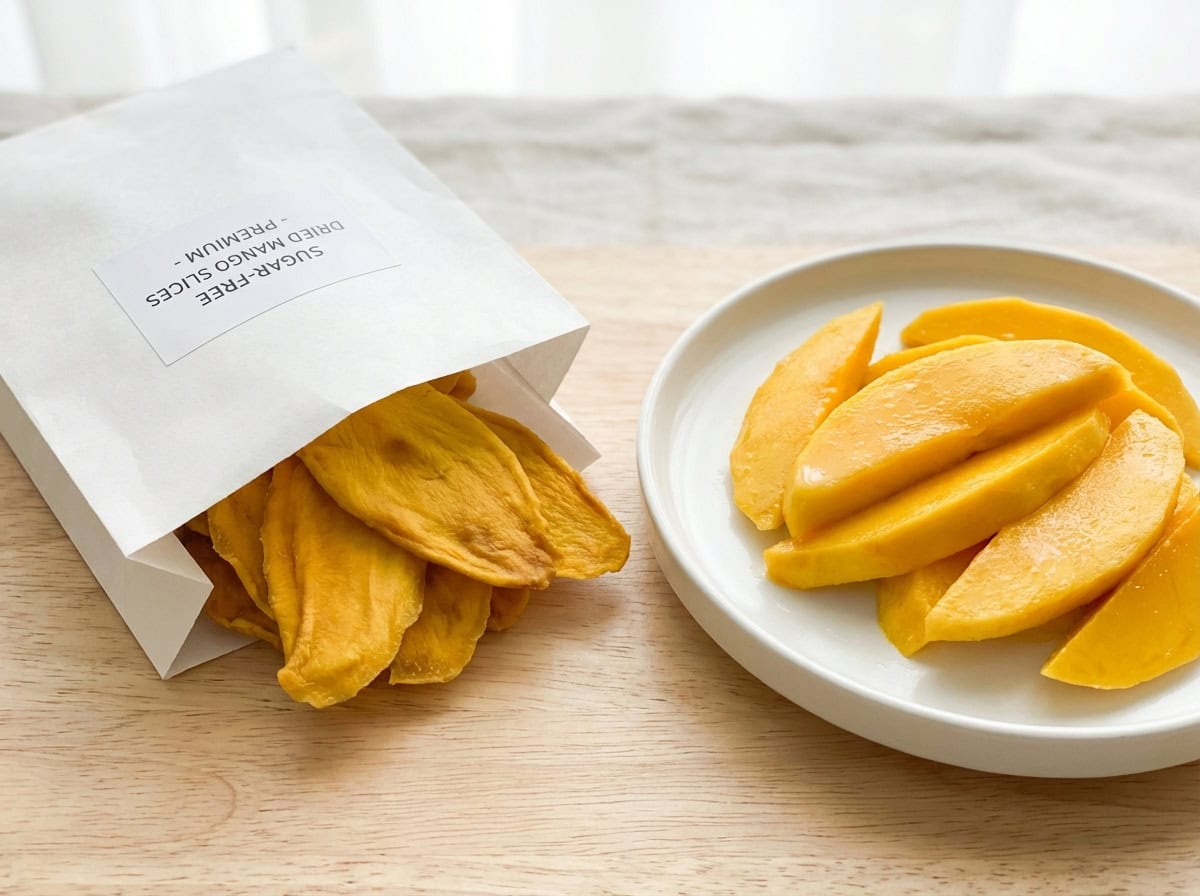
The commercial opportunity here is not in standard snacking but in the no-added-sugar premium tier, where retail markup of 100–200% over ingredient cost is achievable for brands with verified clean label documentation. A supplier who provides COA confirming Added Sugars 0g and SO₂ not detected per batch gives you the documentation infrastructure to maintain that premium positioning across retail audits and reformulation cycles. For the full health claims breakdown relevant to retail positioning in this channel, see: Is Dried Mango Healthy? Science-Based Benefits for Clean Label Buyers.
Application 2 – Granola and Muesli
Format required: Dice 5–8mm, uniform size, non-sticky.
Critical specs: Moisture 14–16% (lower end of range), uniform dice dimensions within ±1mm tolerance, non-sticky surface to prevent clumping in tumbler.
Granola and muesli are the highest-volume single application for dried mango in food manufacturing. The inclusion rate typically runs 8–12% of finished product by weight. At that inclusion rate, moisture consistency from the mango dice directly impacts the final product’s cluster formation, shelf life, and texture profile.
The 5–8mm dice specification at moisture 14–16% delivers the sweet spot for granola matrix behavior: the piece is small enough to distribute evenly in the tumbler, large enough to maintain visual presence in the finished product, and dry enough at the lower moisture end to minimize water migration into the oat-fat-sugar matrix during baking and cooling. Any batch with moisture above 17% in this application introduces free water activity risk that destabilizes the granola cluster during the baking step.
Non-sticky surface is the secondary specification that FRUITBUYS Vietnam controls through final aw management: at aw 0.55–0.58, the product surface does not develop the tacky characteristic that causes dice to aggregate into multi-piece clusters in the packaging and tumbling stages.
Application 3 – Trail Mix
Format required: Chunks 1–2cm, non-sticky, with piece integrity maintained through handling.
Critical specs: Moisture 15–17%, aw ≤0.60, piece integrity under compressive force (no crumbling under 500g load).
Trail mix is a volume category in outdoor, sports nutrition, and airline food service. Dried mango at 1–2cm chunk size provides the visual size anchor in a mixed-ingredient blend the large, identifiable piece that consumers see first in the clear window packaging that dominates the category.
The technical specification that matters most for trail mix is not moisture alone it is piece integrity under handling. Trail mix is typically produced in high-speed tumbling and weighing equipment. A dried mango chunk that breaks under the impact of metal-to-metal contact in the tumbler generates fines, alters the piece size distribution, and creates a visual quality problem in the finished pack. Chunks at moisture 15–17% and aw ≤0.60 maintain sufficient structural integrity under standard tumbling conditions.
The clean label positioning of no-added-sugar dried mango opens the premium outdoor and sports nutrition segment a channel where the “no junk” ingredient story commands a 30–50% retail premium over conventional sweetened trail mix formulations.
Application 4 – Bakery and Confectionery
Format required: Dice 3–5mm or paste form.
Critical specs: aw ≤0.55 (lower end of specification), heat-stable through bake cycle (160–200°C), low free reducing sugar to minimize excessive Maillard reaction during baking.
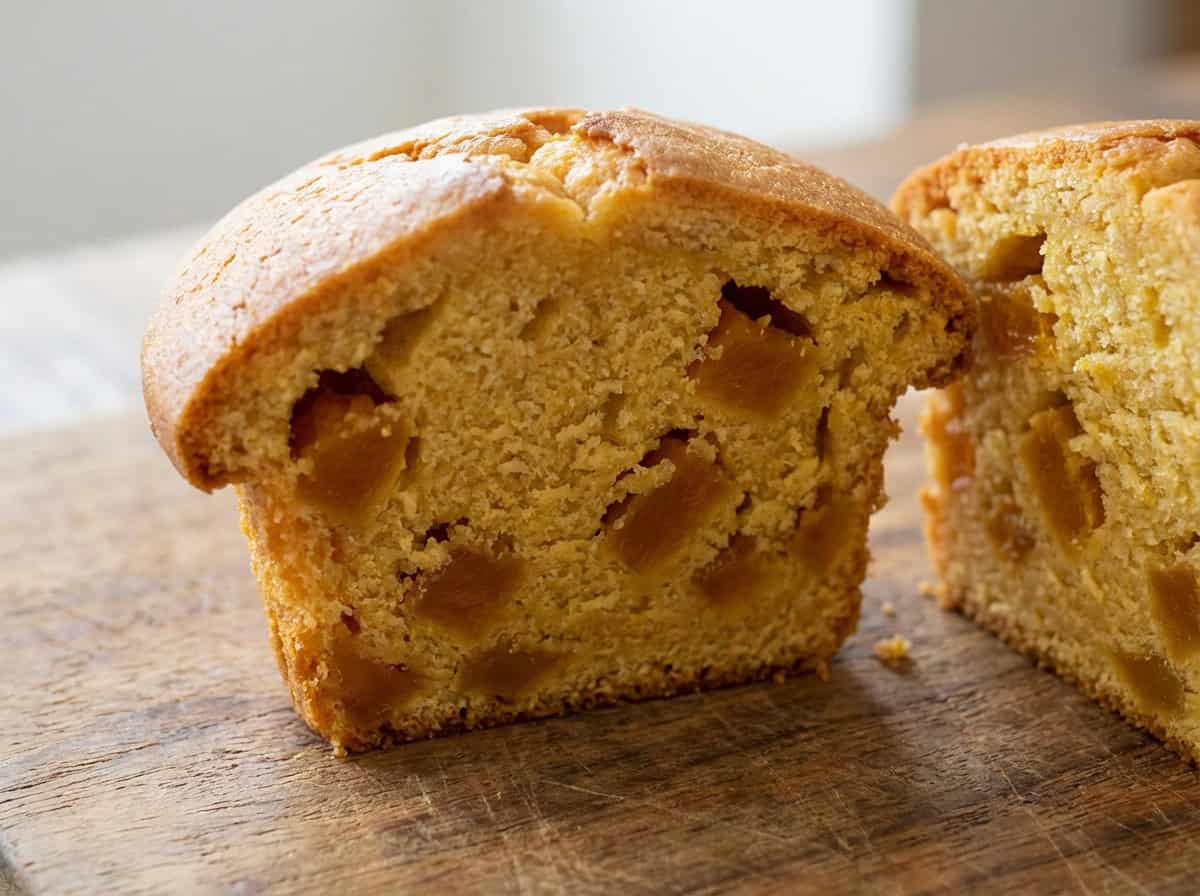
Dried mango in bakery applications faces the most demanding thermal processing of any application in this list. Muffins, cookies, and scones typically bake at 160–200°C for 12–25 minutes. At standard dried fruit moisture levels, the mango piece releases moisture during baking that creates a steam pocket around the inclusion, which can result in a hollow or wet texture ring in the finished product.
The solution is sourcing to the lower end of the moisture specification dice at aw ≤0.55 rather than the standard target of 0.55–0.58 which minimizes the moisture release during the bake cycle. FRUITBUYS VIETNAM can produce to this tighter specification on request with written confirmation; state aw target ≤0.55 explicitly in your purchase specification.
The no-added-sugar specification matters for bakery beyond clean label positioning: high levels of added exogenous sugar in the mango inclusion interact with batter sugars to accelerate surface browning and can cause localized over-caramelization around the inclusion site. Natural fruit sugars at the concentrations present in no-added-sugar dried mango interact more predictably within a standard bakery formula.
Application 5 – Smoothie Bowl and Beverage
Format required: Powder (freeze-dried mango powder, a natural upsell from soft-dried) or small rehydrating pieces.
Critical specs: Rehydration rate (rehydration to 80% original weight within 60 seconds in cold liquid at 4°C), Brix after rehydration ≥8°Bx to maintain flavor impact.
For smoothie bowl and beverage applications, the preferred format is freeze-dried mango powder rather than soft-dried pieces a format upgrade (same Vietnamese mango ingredient, different processing method) that delivers complete solubility, concentrated flavor, and a shelf-stable powder with 12–18 months ambient shelf life that requires no cold chain.
For applications where visible pieces are required acai bowl toppings, pour-over beverage garnishes, premium smoothie kit inclusions soft-dried slice format at 3–5mm provides rehydration in cold liquid within approximately 60–90 seconds, retaining piece identity while softening to a gel-adjacent texture that matches the bowl format. Juice bars and health beverage franchise chains operating at scale require year-round supply consistency and predictable rehydration behavior: both are governed by the same moisture and aw specification control that applies across all applications.
Application 6 – Ice Cream and Dairy
Format required: Dice or swirl format, moisture ≤15%.
Critical specs: Freeze-thaw stability (no significant texture degradation through two freeze-thaw cycles at -18°C to +4°C), moisture ≤15% to minimize ice crystal formation around the inclusion, pH 3.5–4.5 compatible with dairy matrix.
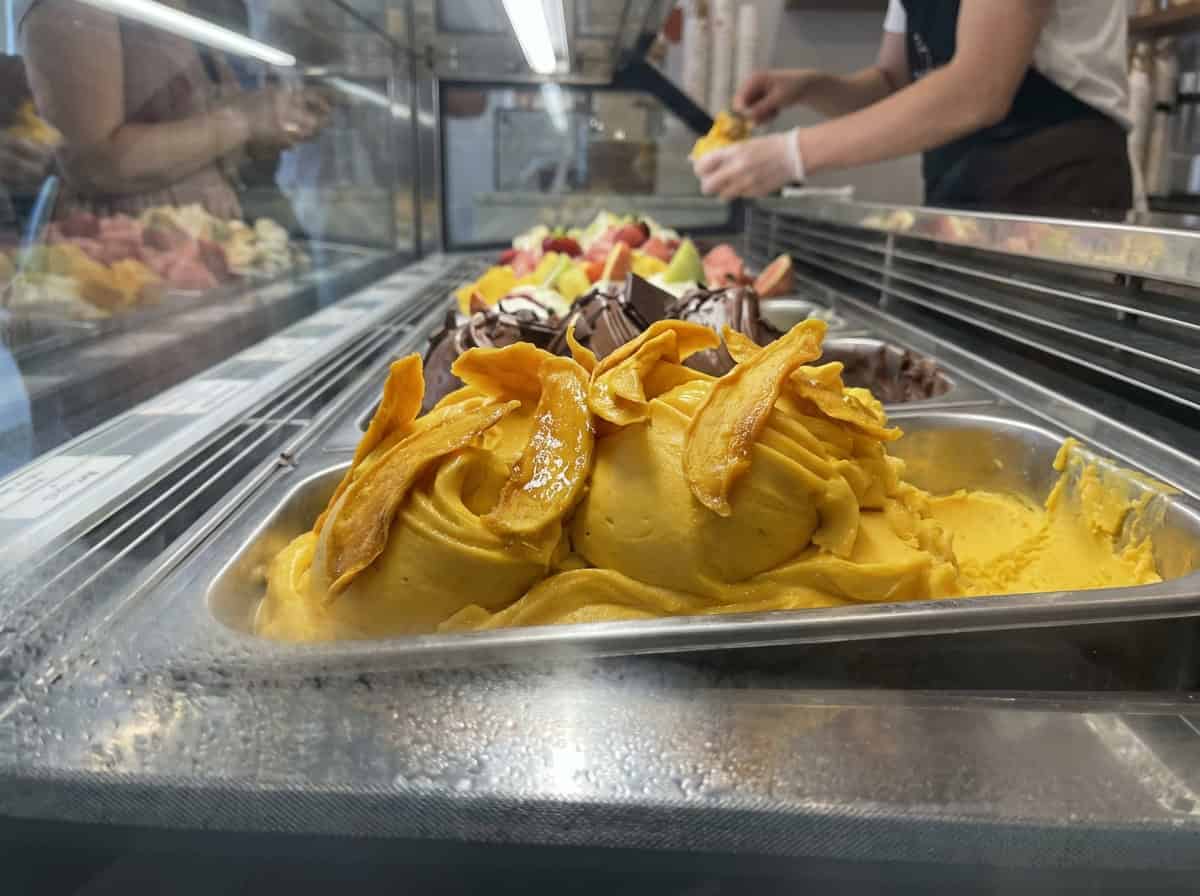
Ice cream inclusion is a technically demanding application because the processing environment subjects the dried mango piece to temperatures ranging from the mixing temperature (~5°C) through hardening (-18°C to -25°C) and repeated consumer freeze-thaw cycles. The mango piece must maintain textural integrity through this cycle without becoming a hard, icy inclusion at freezing temperatures or a mushy, wet piece at thawing temperatures.
Moisture ≤15% (target 14–15%) is the specification that most directly controls freeze-thaw behavior. At this moisture level, the piece contains less free water to form ice crystals during hardening, which preserves a soft-to-chewy texture even after freezing. The natural acid content of dried mango (pH 3.5–4.5) is compatible with dairy matrix pH ranges and does not cause protein destabilization in standard ice cream formulations. Request moisture ≤15% explicitly in your technical specification for this application.
Application 7 – Food Service and HORECA
Format required: Slices or chunks in bulk 5kg bags; portioning-ready format for kitchen use.
Critical specs: Shelf life ≥6 months from production date at 10–20°C cold storage, consistent piece size for portion control, metal detection certified (Fe ≤1.5mm).
Hotel kitchens, resort food and beverage operations, airline catering, and premium restaurant chains source dried mango as a buffet component, dessert element, cheese board garnish, and cocktail garnish. The HORECA channel buys in bulk 5kg and 10kg aluminum foil bags and prioritizes consistent piece size (for portioning efficiency), shelf life (to minimize waste in high-volume kitchen environments), and clean label status (for premium property marketing copy).
Metal detection certification (Fe ≤1.5mm, Non-Fe ≤2.0mm, SUS ≤2.5mm) is a specific requirement for airline catering procurement all food service ingredients entering airline catering production must pass metal detection at these thresholds under IATA food safety standards. FRUITBUYS VIETNAM product passes inline metal detection on the production line with these parameters. Request metal detection certificate as part of your HORECA procurement documentation.
Application 8 – Baby Food and Toddler Snacks
Format required: Powder or very small dice (<3mm).
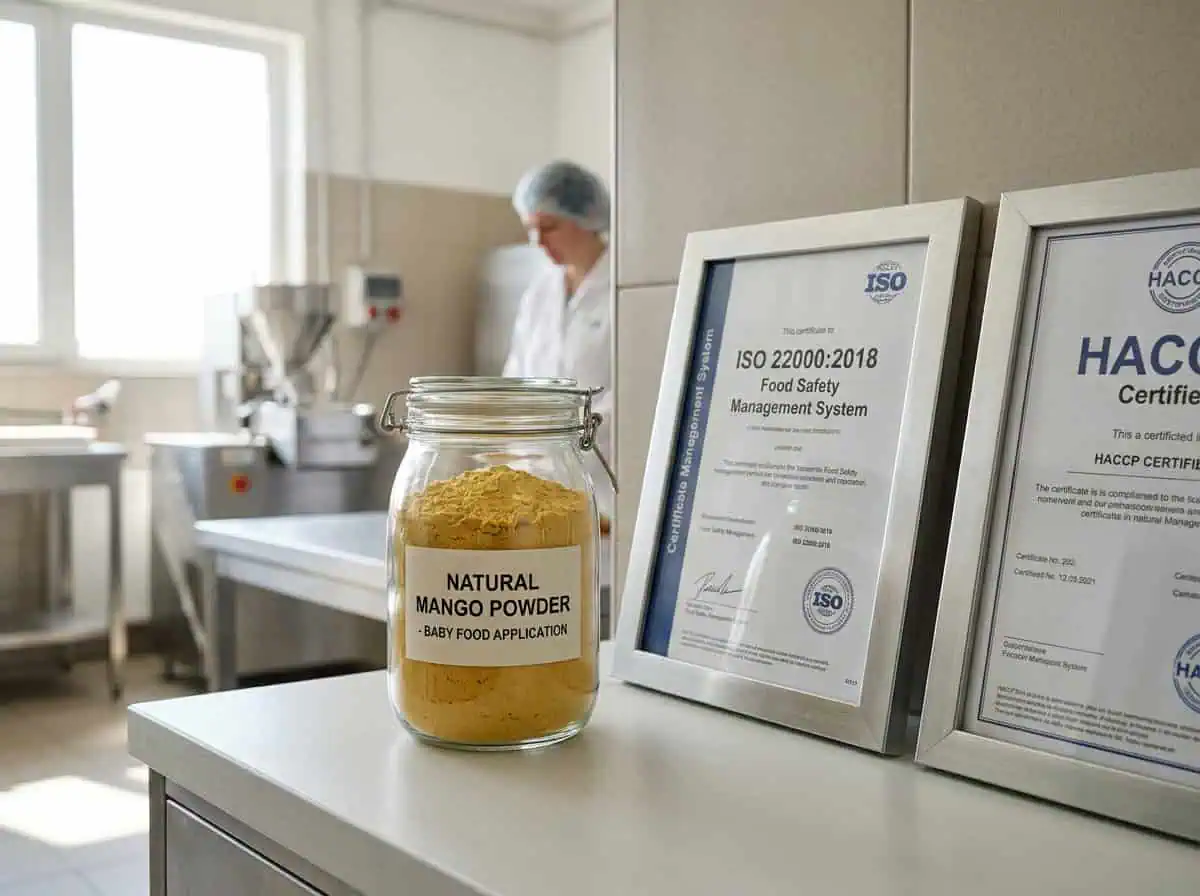
Critical specs: Microbiological parameters more stringent than standard food manufacturing (Salmonella not detected/25g, E. coli not detected/g EU standard, Listeria not detected/25g), SO₂ not detected (not ≤10ppm specifically not detected), no allergen cross-contamination documentation.
Baby food and toddler snack applications carry the most stringent compliance requirements of any application in this guide. Both the microbiological limits and the allergen documentation must meet a higher standard than adult food manufacturing, and the “no sulfites” requirement for infant products is an absolute not the regulatory threshold of <10ppm, but an actual “not detected” result under a named accredited method.
FRUITBUYS VIETNAM dried mango no added sugar tests SO₂ not detected under the Optimized Monier-Williams method meeting the baby food standard, not just the FDA adult food threshold. Microbiological parameters per production batch include Salmonella not detected/25g and Listeria not detected/25g per ISO methods.
The cross-contamination statement is: produced in a facility that also processes tree nuts (cashews). This must appear on the finished product label as an allergen advisory. Baby food brand buyers must evaluate whether this cross-contamination risk is acceptable for their specific formulation and target consumer.
Application 9 – Energy and Protein Bars
Format required: Dice 3–5mm, chewy texture under compression.
Critical specs: Binding quality (resistance to extrusion pressure without crumbling), moisture interaction with bar matrix (no excessive moisture migration into protein or oat components during shelf life), aw ≤0.60.
Energy and protein bar production subjects dried fruit inclusions to significant mechanical stress: mixing, compression, extrusion, and slicing at speeds of 100–300 units per minute on automated production lines. A dried mango dice at moisture 15–18% and aw 0.55–0.60 withstands this process without generating excessive fines, while providing the chewy texture that binds the bar matrix rather than acting as a friable discontinuity that causes fracture at the inclusion point.
The moisture interaction risk in bar applications arises during shelf life: if the dried mango piece has aw materially above the aw of the surrounding protein or grain matrix, moisture migrates from the mango to the drier surrounding components over weeks to months of shelf life, increasing mango piece hardness while softening the bar matrix. Specifying aw ≤0.60 at the inclusion stage, and matching this to your bar matrix aw during formulation development, minimizes this migration.
Sports nutrition is one of the fastest-growing market segments for clean label snack inclusions, driven by consumer demand for recognizable whole-food ingredients on protein bar labels. “Dried mango (Mangifera indica)” as a single-ingredient entry on a protein bar label outperforms “mango pieces (mango, sugar, preservatives)” in clean label shelf appeal, which is measurable in consumer research and increasingly demanded by major sports nutrition retailers.
Application 10 – Confectionery Coating and Chocolate
Format required: Thin slices or dice, moisture ≤14%.
Critical specs: Moisture ≤14% for coating adhesion (chocolate does not adhere to surfaces with free moisture above the critical threshold), no bloom development through temperature cycling, pH compatibility with cocoa and chocolate matrix.
Chocolate-enrobed dried mango is a high-margin confectionery application that performs strongly in premium gift packaging, seasonal holiday lines, and artisan chocolate retail. The technical requirement that differentiates it from other applications is moisture: chocolate enrobing requires a dry fruit surface. At moisture ≤14%, the mango surface provides sufficient adhesion for chocolate coating without the free moisture that causes bloom (the whitish surface crystallization that occurs when moisture migrates between the fruit and the chocolate layer during temperature cycling).
FRUITBUYS VIETNAM produces to moisture ≤14% for confectionery applications on request this is below the standard production target of 15–18%, so state this specification explicitly in your technical inquiry. Minimum order for a custom moisture specification run is confirmed at 1,000kg OEM.
For seasonal confectionery buyers, the natural amber-to-orange color of SO₂-free dried mango from Vietnamese Cát Chu or Hoà Lộc varieties provides a visually distinctive base for chocolate enrobing that contrasts with the artificially bright yellow of sulfite-treated alternatives a visual differentiation point that premium chocolate brands can communicate in product photography and copy.
Technical Specification Reference for R&D Teams
Before submitting a technical inquiry to FRUITBUYS VIETNAM, your R&D team should confirm three things from the data below:
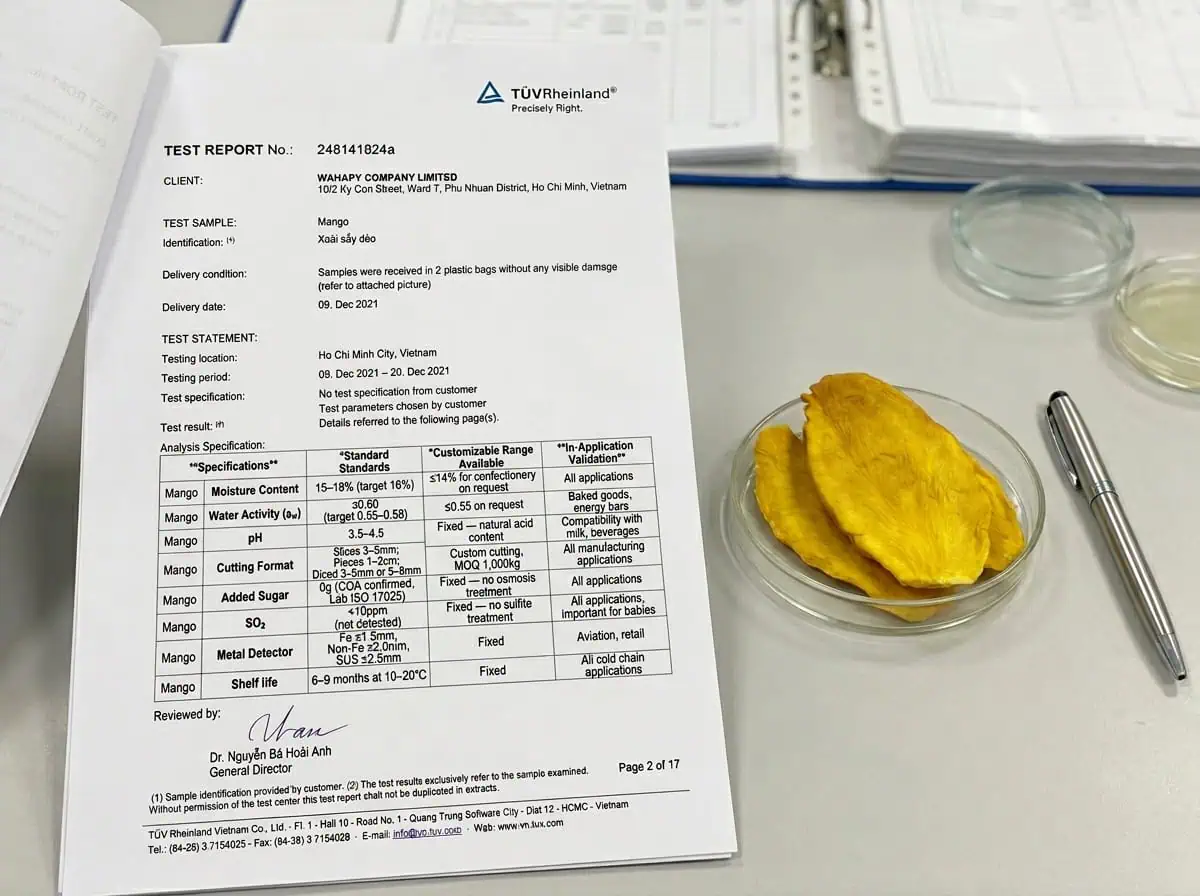
| Parameter | Standard Specification | Custom Range Available | Verify in Application |
|---|---|---|---|
| Moisture content | 15–18% (target 16%) | ≤14% for confectionery/bakery on request | All applications |
| Water activity (aw) | ≤0.60 (target 0.55–0.58) | ≤0.55 on request | Bakery, bar, confectionery |
| pH | 3.5–4.5 | Fixed natural acid content | Dairy, beverage compatibility |
| Cut format | Slices 3–5mm; Chunks 1–2cm; Dice 3–5mm or 5–8mm | Custom cut on request, MOQ 1,000kg | All manufacturing applications |
| Added Sugars | 0g (COA confirmed, ISO 17025 lab) | Fixed no osmotic treatment | All applications |
| SO₂ | <10ppm (not detected) | Fixed no sulfite treatment | All applications, critical for baby food |
| Metal detection | Fe ≤1.5mm, Non-Fe ≤2.0mm, SUS ≤2.5mm | Fixed | Airline catering, retail |
| Microbiological | Per EU Reg. 2073/2005 standards | Per shipment COA | Baby food: verify ESMA-specific limits |
| Shelf life | 6–9 months at 10–20°C | Fixed | All cold-chain applications |
| MOQ (custom spec) | 1,000kg for custom format/moisture | Standard format: no MOQ trial | R&D pilot runs, scale-up planning |
For specifications marked “Custom on request” submit your technical spec sheet to FRUITBUYS VIETNAM before requesting a sample. We confirm production capability in writing within 48 hours. If we cannot meet a parameter, we say so at the inquiry stage, not after the sample ships.
Objection: “We Need Batch-to-Batch Consistency Before We Can Qualify a Supplier”
This is the only objection that actually matters for food manufacturers, and it deserves a direct answer.
Moisture content variance of ±3% between batches a common failure in dried fruit supply from aggregator-based suppliers breaks formulas that were developed to work at 15–16% moisture. A batch that arrives at 19% rewrites your shelf life calculation. A batch at 13% changes your texture profile. Both generate rework costs, customer complaints, or production holds.
FRUITBUYS VIETNAM provides moisture and aw per COA on every production batch, from the same ISO 17025-accredited lab partners SGS Vietnam, Bureau Veritas Vietnam, or Eurofins Vietnam. The tolerance is ±1.5% moisture. If a batch falls outside specification, the COA shows it, and the batch does not ship. That is not a policy statement it is the practical consequence of having lab documentation that your production team can reference against every incoming delivery.
Request three consecutive batch COAs before qualifying FRUITBUYS VIETNAM as a supplier. That documentation is available on request and demonstrates the consistency profile across production runs not just a single sample designed to impress.
Frequently Asked Questions
What format is best for dried mango in granola production?
Dice 5–8mm at moisture 14–16% and aw ≤0.60. This size distributes evenly in the tumbler, maintains visual presence in the finished product, and sits at the lower end of the moisture range to minimize free water migration into the granola matrix during baking. Non-sticky surface is essential confirm aw ≤0.58 in your specification to prevent aggregation during packaging. FRUITBUYS VIETNAM provides this format with COA per batch.
Can dried mango no added sugar be used in protein bar production?
Yes. Dice 3–5mm at moisture 15–18% and aw ≤0.60 performs well in most bar matrix applications mixing, compression, and extrusion. Specify aw matched to your bar matrix to control moisture migration during shelf life. The no-added-sugar, single-ingredient declaration supports clean label bar positioning in the sports nutrition channel. Request a technical spec sheet and COA before R&D trials at
What moisture specification is required for chocolate enrobing?
Moisture ≤14% is the threshold for reliable chocolate coating adhesion without bloom risk. Standard FRUITBUYS production target is 15–18%, so this requires a custom specification order. State moisture ≤14% explicitly in your technical inquiry. MOQ for a custom moisture specification run is 1,000kg. Turnaround: 20–30 days from order confirmation.
Does dried mango no added sugar work in baby food formulations?
From a microbiological and allergen standpoint: Salmonella not detected/25g, Listeria not detected/25g, SO₂ not detected (Optimized Monier-Williams). The facility processes cashew nuts, so a cross-contamination advisory for tree nuts applies. Baby food brand buyers must confirm whether this allergen cross-contact statement is acceptable for their formulation and target consumer before proceeding.
What is the minimum order for a custom-cut dried mango specification?
1,000kg for any cut format outside the standard range (slices 3–5mm, chunks 1–2cm, dice 5–8mm). Trial orders below 1,000kg at standard specification have no minimum. Custom moisture specifications (e.g., ≤14% for confectionery) also require 1,000kg minimum. Lead time for custom specification production: 20–30 days after deposit confirmation.
Your Formula Starts With the Right Ingredient Specification
Food manufacturers running 2–5 container orders per month on annual contracts do not change ingredient suppliers because of price. They change when a supplier stops hitting specification. And they stay when a supplier hits specification on every batch, without requiring them to police the COA for variance that should not exist.
Your competitors are sourcing dried mango right now. Some of them are building formulations on inconsistent ingredient batches without knowing it yet. They will find out when their retail buyers raise a texture complaint six months into the distribution agreement, and they will spend 90 days reformulating with a replacement ingredient while their shelf space erodes.
Contact FRUITBUYS VIETNAM today. Send your R&D team’s technical specification. We confirm production capability in writing within 48 hours. Samples with full COA ship in 3–5 business days. We do not ask you to trust us before you test us. We ask you to test us with your own lab and your own formulation team and then contact us with the result.
Contact FRUITBUYS VIETNAM:
- WhatsApp: +84-909.499.619
- Email: hotro@fruitbuys.vn
- Website: https://fruitbuys.com
- Office: 10/2 Ky Con, Cau Kieu Ward, Ho Chi Minh City
- Warehouse: 182 An Phu Dong 09, An Phu Dong Ward, District 12, Ho Chi Minh City